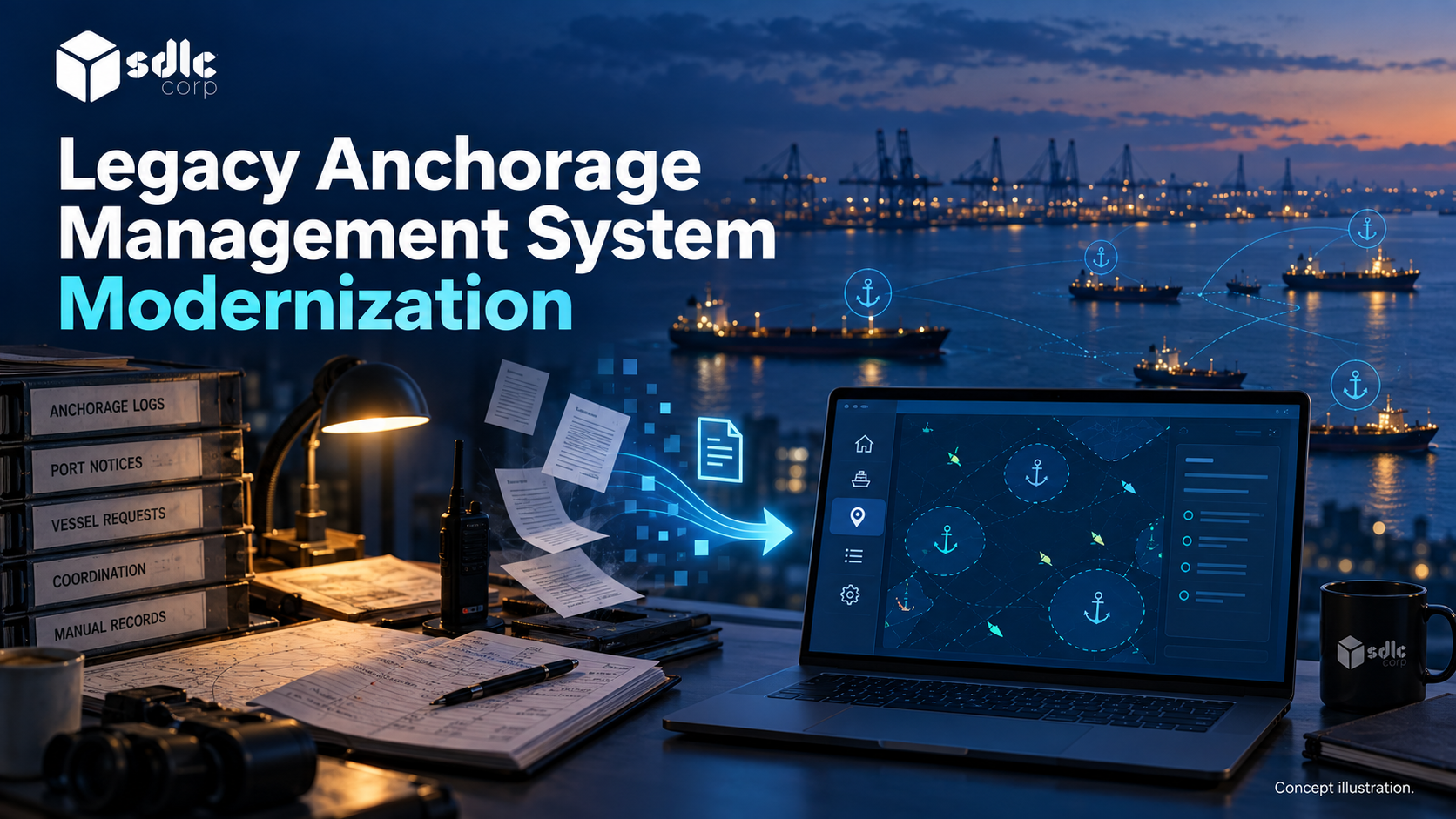
Legacy anchorage management system modernization means transferring operational responsibilities, not just redesigning screens. Each function may depend on data ownership, scheduled jobs, interfaces and support procedures that keep the old system necessary.
The safe approach is to move one capability at a time: map hidden dependencies first, keep exactly one authoritative writer for each decision during the transition, and retire old functions only after their reports, jobs and users have moved.
Where a single cutover is proposed instead, its recovery position and acceptance evidence need the same explicit treatment.
When Legacy Port Software Needs Modernization
Modernization proposals are more persuasive when tied to an operational trigger than to age. The usual triggers are concrete.
| Trigger | What It Actually Means | Why It Forces a Decision |
|---|---|---|
| Unsupported platform | No security patches available | Risk becomes non-negotiable |
| Single point of knowledge | One person can change the system | Continuity risk, not a technical one |
| Integration impossible | No interface, no documentation | Blocks every other initiative |
| Audit cannot be produced | Decisions not reconstructable | Governance exposure |
| Manual reconciliation load | Effort spent keeping records aligned | Measurable and rising |
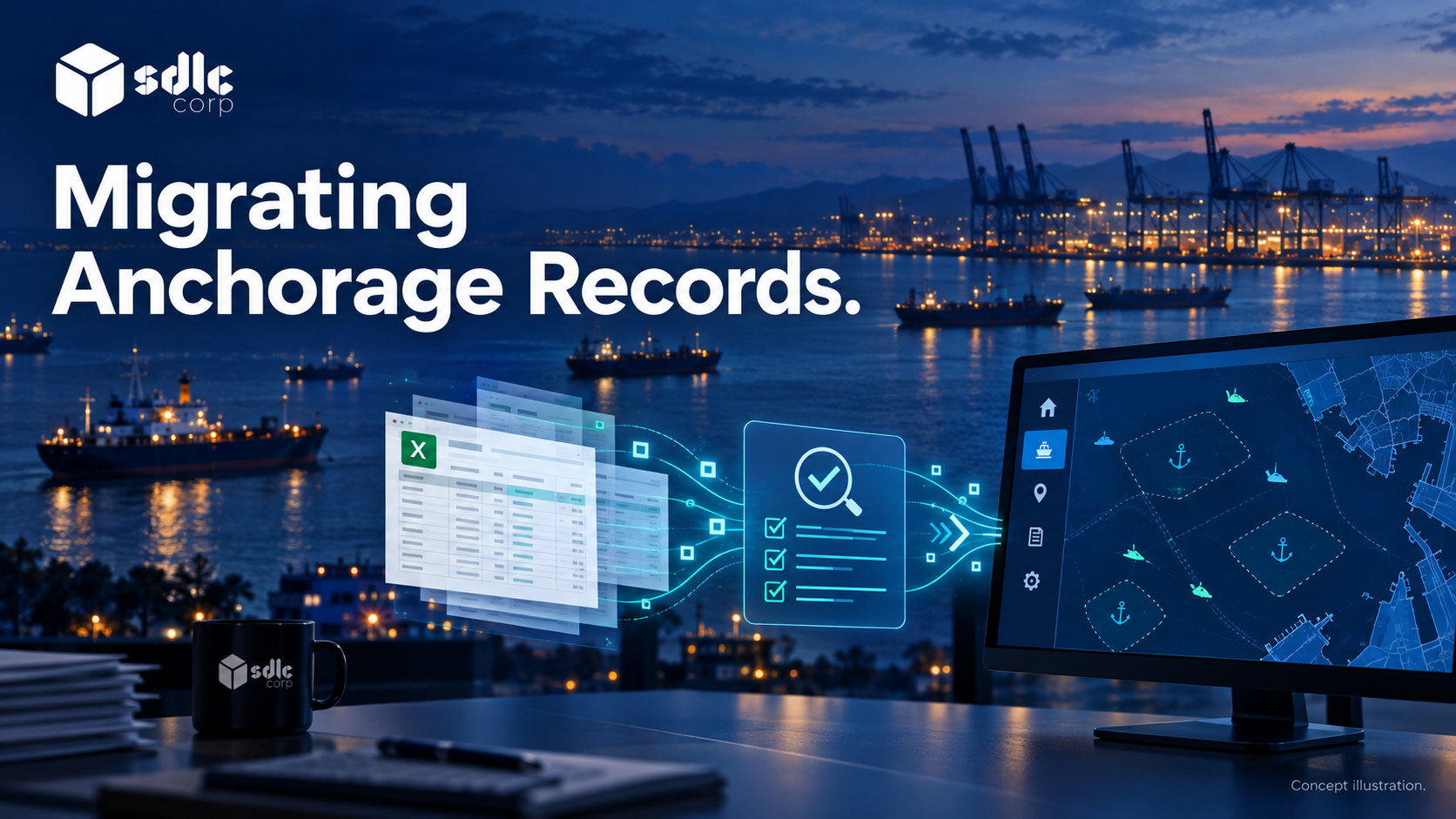
Migrating from Spreadsheets and Legacy Tools to an Anchorage Management System covers the case where the legacy system is a set of files rather than an application.
Inventory Hidden Rules, Scheduled Jobs and Unowned Interfaces
Discovery should produce an accurate picture of what the current system does, including the parts nobody documented.
- Every workflow, including the exception paths people use daily.
- Every integration, with its trigger, frequency and failure behavior.
- Every report and who depends on it.
- Business rules embedded in spreadsheets, macros or local configuration.
- Data quality in the existing store, measured rather than assumed.
Expect to find rules that are operationally necessary and were never written down. Losing one during replacement is what produces the "the new system can't do what the old one did" reaction.
Check hosting constraints before choosing where the replacement function will run, as Cloud or On-Premises? Plan for the Port's Network Outages explains. Moving the hosting does not fix a missing source interface.
Replace a Small Legacy Estate in Controlled Phases
Illustrative example
This estate contains a desktop request application, a spreadsheet rule list, a nightly reporting job and one traffic adapter. The phases are dependency-based, not a promised delivery schedule.
| Component | Current Responsibility | Hidden Dependency |
|---|---|---|
| Desktop application | Requests and approvals | Reporting job reads its database |
| Spreadsheet | Zone restrictions | Operator copies values manually |
| Traffic adapter | Position observations | Uses legacy vessel references |
| Nightly job | Management totals | Assumes legacy status names |
What Moves in Each Phase?
| Phase | New Owner | Legacy Function Retained | Exit Evidence |
|---|---|---|---|
| 1: inventory and mapping | Shared identity map | All live writes remain legacy | Sample calls match across systems |
| 2: request entry | New request service | Legacy approves through agreed handoff | Amendments and cancellations reconcile |
| 3: approvals and rules | New approval workflow and versioned rules | Legacy read-only history | Operator tests pass; one active writer |
| 4: reports and retirement | New reporting pipeline | Controlled archive only | Nightly totals reconcile; consumers migrated |
If phase 2 fails, route new requests back through the agreed recovery process and reconcile those already accepted. Do not simply discard the new database.
Phase 3 cannot begin until the traffic adapter can resolve the new call identifiers. The old reporting job must move or be formally retired before the legacy database can leave service.
Prove Ownership and Rollback at Each Handoff
| Phase | Authoritative Writer and Synchronization | Rollback Trigger | Retirement Condition |
|---|---|---|---|
| Identity mapping | Legacy writes; new model receives read-only mapped copies | Calls cannot be matched or reconciled | No retirement; mapping accepted first |
| Request entry | New service writes requests; legacy alone approves through the agreed handoff | An amendment or cancellation is lost | Old request entry disabled only after all writers and consumers switch |
| Approvals | New workflow becomes the sole approval writer; legacy retains history | Decision history or capacity cannot be reconciled | Restore the agreed writer only after accounting for new decisions; prevent concurrent approvals during rollback |
| Reporting | New pipeline reads approved records; legacy is an archive | Totals or downstream consumers disagree | Consumers, retention and archive access accepted |
A rollback must account for decisions made after the switch. Restoring an old screen without reconciling those decisions can create a second writer or lose accepted work. Test the transition and the reverse transition before widening the pilot.
Choose a Path for Legacy Anchorage Management System Modernization
List what consumes the legacy system's data and what it consumes. Dependencies decide whether a phased replacement is possible or whether a component must be replaced whole.
During a phased replacement, two systems temporarily hold the same facts. Reconciling VTMIS and Anchorage Records: Which Value Wins? shows how to decide ownership for that period explicitly, rather than synchronizing in both directions and hoping.
Compare Modernization Options Against the Dependency Map
The options below map to the AWS migration strategies, often called the "7 Rs," which include rehosting, replatforming, refactoring and retiring.
| Option | When to Investigate It | Limitation to Test |
|---|---|---|
| Rehost an existing application | Infrastructure is the immediate constraint | Workflow, support and code risks may remain |
| Replace one capability at a time | Stable boundaries and transitional data exchange are feasible | Duplicate writes and reconciliation need control |
| Introduce an adapter | A supported or approved extraction path exists | The adapter may preserve an unsupported dependency |
| Replace in one cutover | Transitional options are impractical after assessment | Recovery and operational readiness carry concentrated risk |
Choose the approach for each function. Reports may move before approvals, but keep one owner for allocation changes throughout. Running two applications should never give both permission to approve the same request.
Prefer Phased Replacement Where Dependencies Allow
Define a Boundary That Can Move Without Losing Ownership
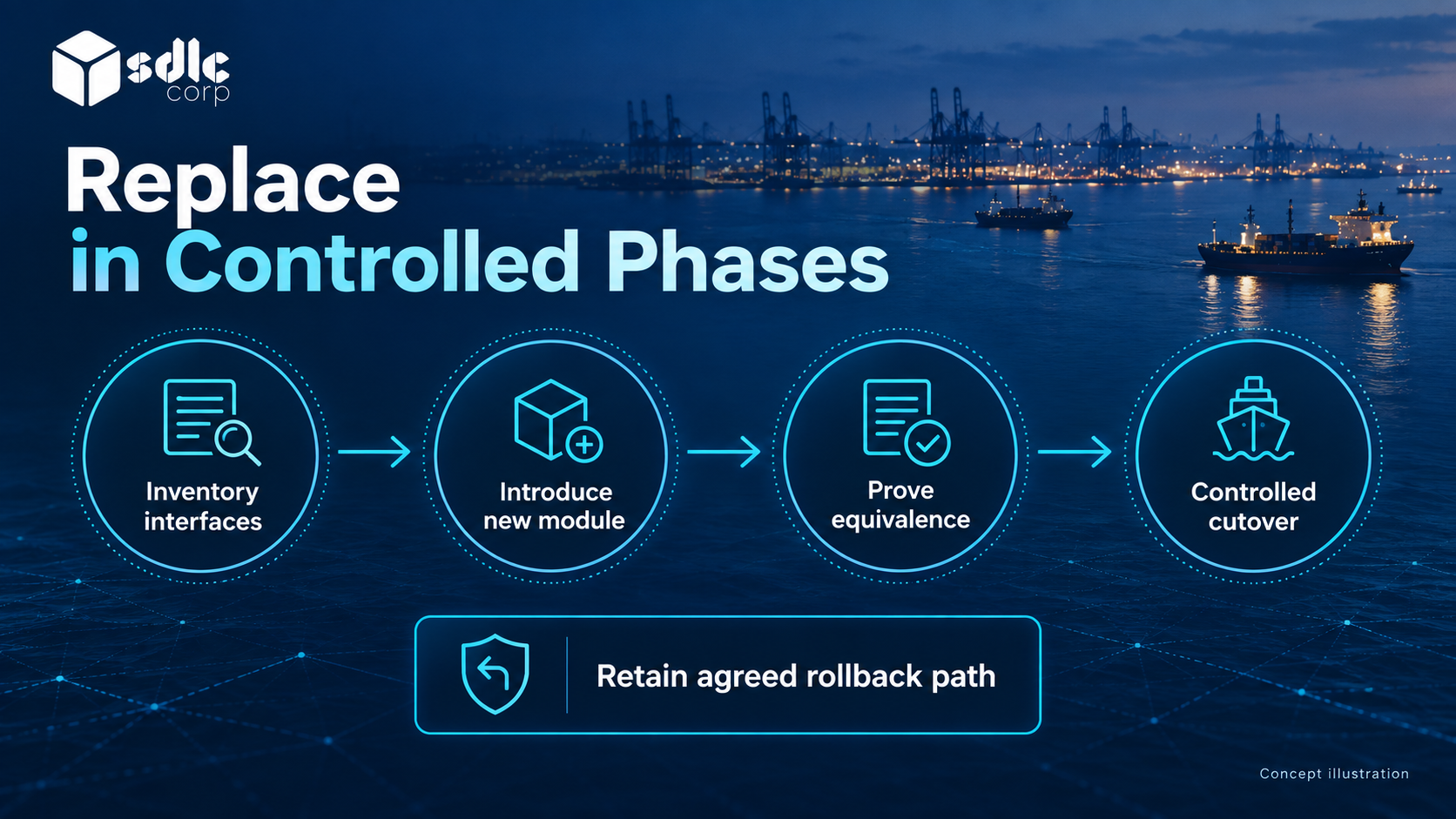
A phased replacement moves one function while the rest stays in use. A common pattern puts an interface in front of the old system, so other applications keep using it while the function behind it changes.
Martin Fowler named this the strangler fig application. AWS guidance on the strangler fig pattern adds that it depends on being able to intercept and redirect calls.
Verify that the installed system supports the required reads and writes before choosing an adapter-based transition.
- Put an interface in front of the legacy system before replacing anything behind it.
- Move one capability, with a parallel run and a rollback position.
- Migrate the consumers of that capability, not all consumers at once.
- Retire the legacy function only after dependent reads, writes, scheduled jobs and support processes have migrated or been formally retired.
If no supported interface exists, check approved extracts or a temporary adapter, and compare them with a full replacement. Integrating VTMIS With An Anchorage Application helps identify which source connections are feasible.
Phase 2 in the example above is the typical first move: request entry changes hands while approvals stay put, and the pilot proves that amendments and cancellations cross that boundary.
For a delivered reference, Anchorage Management System Digital Transformation describes an SDLC Corp anchorage project. Ask for its transition evidence when you plan your own phases.
Plan Data Migration as Its Own Workstream
Decide early how much history moves. Migrating every record adds cost and can preserve old quality problems. Keep required history through migration or a controlled, accessible archive, following the agreed retention policy.
- Define the cut: which entities, which period, at what quality.
- Clean at source where possible, because cleaning during migration hides the cause.
- Reconcile record counts, samples and checksums on key fields, with a signed-off tolerance.
- Keep the legacy store readable for a defined period rather than deleting it.
- Record what was not migrated and where it can still be found.
Run in Parallel and Cut Over Deliberately
During a parallel run, define which records are compared and who checks them, and agree the differences that must be fixed before cutover. Without an exit rule, the trial becomes permanent double entry.
Keep one live writer for each business decision. Give each connection a fallback plan and name who decides to use it.
Anchorage Management System Implementation Roadmap sets the overall sequence. Do not retire the old function until its reports, jobs and users have moved.
Retrain Operators Phase by Phase
Each capability move changes how some people work. Train the affected operators just before their phase, not months ahead, and put floor support in place for the first shifts after the switch.
Collect their questions during the parallel run, because they often reveal undocumented rules the discovery missed.
Decommission the Old System Deliberately
Retirement is a task, not an assumption. Confirm archive access and retention periods, remove old credentials and integrations, and end licences and support contracts only after the final consumer has moved.
Conclusion
Successful legacy anchorage management system modernization moves a function, its data and its dependent jobs together. Run representative work through the old and new arrangements, and investigate discrepancies before retiring anything.
Set exit criteria and review dates for parallel operation. If they are not met, make an explicit remediation, extension or rollback decision instead of letting the transition drift.
Plan a Modernization Assessment with SDLC Corp
Discuss a phased move to our Anchorage Management Software, supported by SDLC Corp's Legacy Software Modernization Services. Bring your dependency inventory and authoritative-record map.
We will scope a bounded first phase with one writer per operational fact, reconciliation evidence, rollback conditions and a retirement plan, so the transition can be assessed before its scope grows.
Frequently Asked Questions
Must the Whole System Be Replaced at Once?
No. Compare feasible phases and transitional interfaces with a single cutover. Missing direct interfaces may require supported extracts or adapters, but they do not by themselves make phased replacement impossible.
What Is the Strangler Fig Pattern?
It places an interface in front of the old system and moves functions behind it one at a time. Other applications keep calling the same interface while the old system is gradually replaced and then retired.
What Should Move in One Phase?
Group a usable function with its necessary records, jobs, interfaces and support duties. Replacing the screen while leaving essential processing undocumented in the old system does not complete that transfer.
How Do You Roll Back a Phase Safely?
Account for every decision made after the switch before restoring the old writer. Prevent both systems from approving during rollback, and test the reverse transition before widening the pilot.
What Happens to History That Is Not Migrated?
Keep it in a controlled, readable archive for the agreed retention period, and record what was left behind and where it can be found.
When Should Parallel Operation End?
Set a planned duration, review dates and measurable exit conditions, including representative workflow coverage and resolved critical discrepancies. Decide explicitly whether to extend, remediate or roll back if those conditions remain unmet.