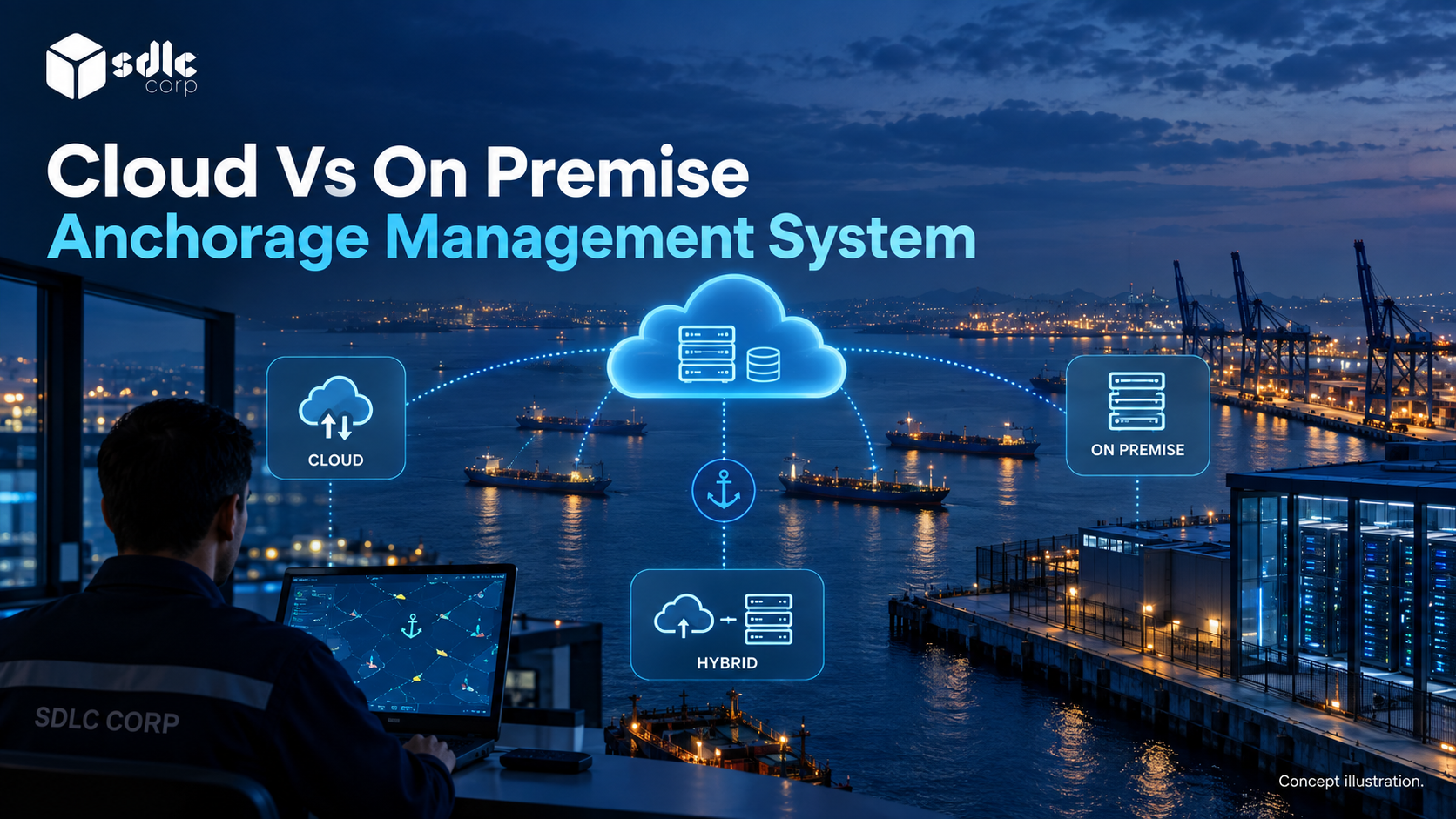
A cloud vs on-premises anchorage management system decision should rest on what operators can still do when a network or component fails. Hosting location changes interface access and support duties, but a hosting label alone does not guarantee continuity.
The rule is simple: if authorized allocations must continue through an internet outage, you need a local authoritative workflow. If a read-only view and a manual fallback are acceptable, hosted or hybrid designs can work.
Set the recovery time objective (RTO), how quickly service must return, and the recovery point objective (RPO), how much recent data you can afford to lose. Those two targets turn a hosting debate into a test.
Compare a Cloud vs On-Premises Anchorage Management System
NIST's definition of cloud computing sets out the standard deployment and service models. Assess each option against the port's continuity needs by testing network paths, recovery procedures and support responsibilities.
Score each factor for your own situation, not in the abstract. The answer differs between a port whose traffic system sits on an isolated operational network and one whose systems are already hosted.
| Factor | May Favor On-Premises | May Favor Cloud |
|---|---|---|
| Integration proximity | Sensors and traffic systems on a closed network | Counterparties reached over the internet |
| Connectivity resilience | Operations must continue when the link drops | Reliable, redundant connectivity available |
| Data residency | Explicit obligation to hold data locally | No residency constraint, or a compliant region |
| Operations capability | Mature internal infrastructure team | Limited platform staffing |
| Scaling and change | Stable, predictable load | Variable load or rapid iteration expected |
Treat these as prompts to investigate, not selection rules, and score them alongside functional fit rather than leaving deployment to the IT team alone.
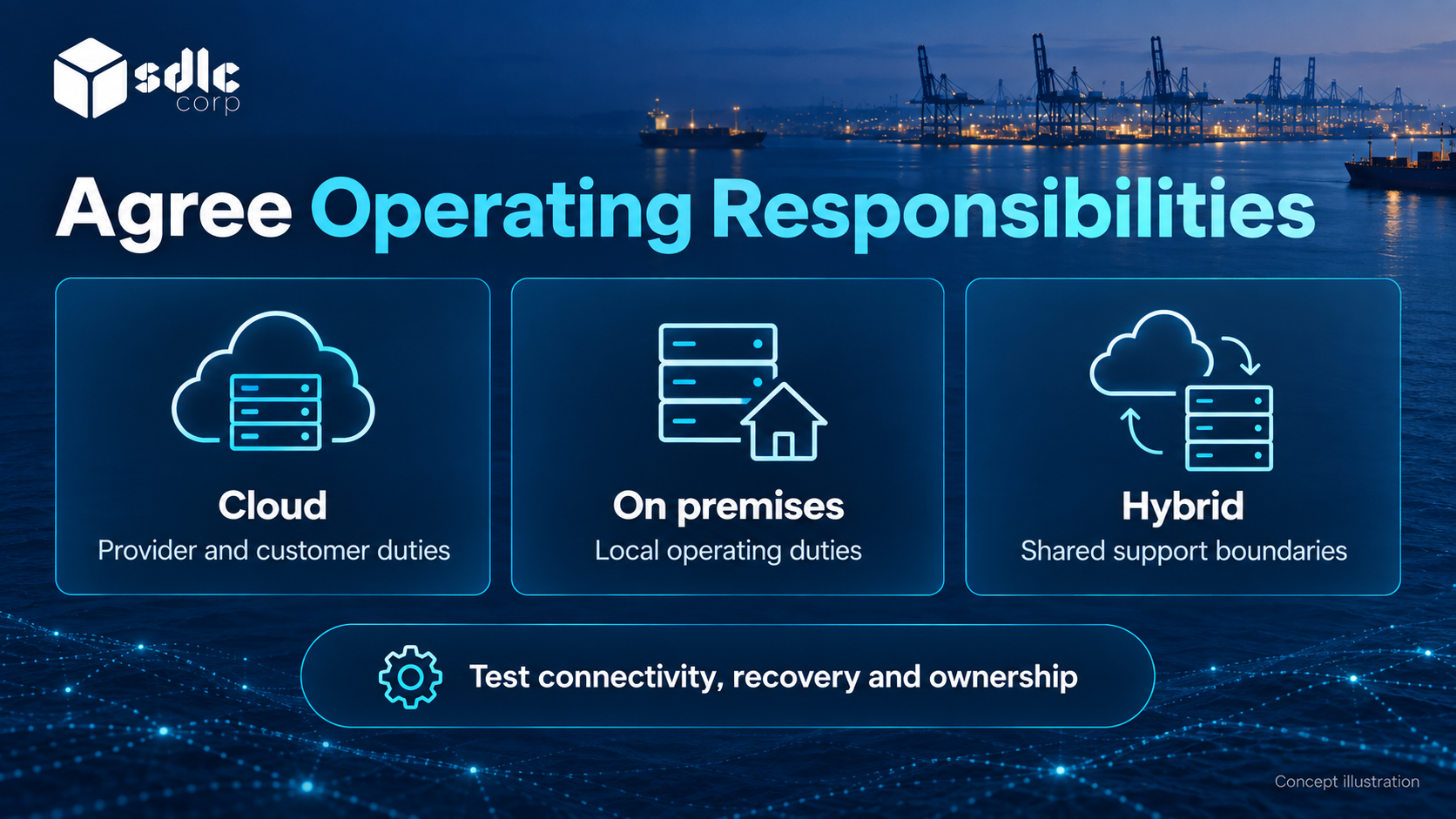
Start with Integration Proximity
Check whether sensor and traffic interfaces sit on an isolated operational network. A hosted application will then need an approved route to them, such as a controlled network connection or a local component.
Agree that design with the source owner and security team. Then map every interface and mark where it can be reached from, because that map decides whether a hybrid design is needed.
Compare Three Designs During the Same Outage
Illustrative example
The designs below describe stated capabilities. A hybrid read-only cache keeps observation history visible, but it cannot approve allocations while disconnected.
| Scenario | Hosted Application Only | Local Application | Hybrid with Read-Only Local Cache |
|---|---|---|---|
| 15-minute external network loss | Local operators cannot reach application | Local tasks continue if local dependencies work | Cached view available; approvals held |
| 2-hour external network loss | Approved manual fallback needed | External exchanges queue for reconciliation | Cache becomes increasingly old; manual fallback needed |
| Identity provider unavailable | New sessions fail unless a separately tested fallback exists | Same dependency applies if local login relies on that provider | Cached records do not imply permission to bypass login |
| External observation interface unavailable | Affected data ages; application may remain usable | Affected data ages; local hosting does not restore the source | Cache retains only its permitted history with age shown |
| Local server failure | Hosted service may remain reachable | Recovery depends on local restore or failover | Cached component unavailable; hosted service still depends on access |
| Local network segment unavailable | Affected operators or adapters may lose access | Local application may also become unreachable | Test whether the cache and source adapter share the failed segment |
Test the Two-Hour Loss
At 10:00, the external link fails and the hybrid screen marks its 09:59 snapshot as disconnected. At 10:20, an operator records manual decision D-8 under the fallback procedure. At 12:00, connectivity returns.
The cached screen does not create a second online approval for that decision.
| Recovery Step | Passing Evidence |
|---|---|
| Fetch hosted changes since 09:59 | Complete version sequence or reconciled snapshot |
| Compare manual D-8 with hosted state | Named reviewer resolves any conflict |
| Reconcile queued sensor records | Original observation times retained |
| Restore normal workflow | Supervisor records the return-to-service decision |
If the requirement is to continue authorized allocations locally for two hours, neither the hosted-only design nor this read-only hybrid meets it. A local authoritative workflow or another approved fallback must be designed and tested.
Choose Against a Measurable RTO and RPO
The targets below belong to this test scenario; deployment location does not supply them. Wide area network (WAN) loss is tested separately from failure of the application host.
NIST SP 800-34 contingency planning guidance explains how to set recovery objectives and test them.
| Requirement | Test | Result for the Three Sample Designs |
|---|---|---|
| Operators must view the last confirmed record during a 15-minute WAN loss | Disconnect the external link and open C-182 | Hosted-only fails without another route; local and specified hybrid cache can pass |
| Authorized allocations must continue through a two-hour WAN loss | Complete a permitted approval while disconnected | Local design may pass after testing; hosted-only and read-only cache fail |
| RTO: recover the application within two hours of host failure | Time an isolated failover or restore | No design passes by label; measured result required |
| RPO: lose no more than 15 minutes of decision records | Reconcile restored decision records against the source log | Backup cadence alone is insufficient; verify the achieved gap |
Suppose the local restore takes 95 minutes and the newest recoverable record is ten minutes before failure. That meets both the sample RTO and RPO.
It still fails if approval roles or required local feeds are unavailable after the restore. A cached screen cannot count as approval capability just because it stays visible.
Which Anchorage Tasks Must Continue During an Internet Outage?
Assess What Operators Can Do During a Disconnection
Ask what happens to anchorage operations when the site's internet connection fails. If operations must continue, define which tasks continue and through what approved arrangement.
The options are a local operational core, a bounded offline mode or a controlled manual procedure. Each needs stated limits and reconciliation on recovery.
Any continuity arrangement also needs funded procedures, data handling, conflict rules and recovery testing. Reconciling VTMIS and Anchorage Records: Which Value Wins? covers the conflict rules to agree before anyone promises offline capability.
AIS Failure and Radar Fallback for Vessel Tracking shows which tasks need live evidence and which can continue under an approved fallback.
Treat Residency and Security as Requirements, Not Preferences
Residency obligations come from regulation, an authority's own policy or a contract. Establish which applies and in what form.
Rules on where data is stored and rules on where it can be accessed from lead to different designs, so confirm both before choosing a region or site.
Security posture differs in kind rather than quality. A hosted platform brings a shared responsibility model and supplier evidence, while an on-premises deployment brings direct control and direct responsibility for patching, backup and monitoring.
The requirements in Who Can Approve, Change and Audit an Anchorage Record? apply to both. Only the party that satisfies each one changes.
Compare Maintenance and Update Models
Set the update model in the contract. Hosted and on-premises services can both use managed or customer-controlled releases, so confirm notice, deferral rights, compatibility testing and patch responsibility.
- Who applies updates, and with what notice.
- Whether a version can be deferred, and for how long.
- How integration compatibility is tested before an update reaches production.
- Who is responsible when an update breaks an interface.
Check the supplier's support dates before deferring an update, because a delayed upgrade can leave the port outside the supported version range.
Put tested restoration and data-recovery duties into the support agreement, with owners for both application and infrastructure. Anchorage Management SLA and Support Checklist lists the clauses to include.
Model Cost over the Full Term
Compare total cost over a realistic term, including the items usually left out of the first comparison.
| Cost Element | On-Premises | Cloud |
|---|---|---|
| Infrastructure | Capital, refresh cycle | Recurring, consumption-linked |
| Platform operations | Internal or contracted operations effort | Confirm included service and retained customer duties |
| Disaster recovery | Second site or arrangement | Regional capability, configured |
| Updates | Confirm deployment and testing responsibility | Confirm inclusions, notice and deferral rights |
| Exit | Migration effort | Migration effort plus data egress |
Ask suppliers for the cost drivers rather than a headline price, and build the comparison from those drivers instead of invented figures.
Apply the same comparison whether you build, buy or combine the two. Every option needs a funded owner for ongoing operation.
When Local Sensor Adapters and Hosted Workflows Can Coexist
Hybrid works only when it is deliberate. Name which components sit where, why, and how each behaves at the boundary. An undesigned hybrid becomes two systems with a synchronization problem.
Test the Actual Failure Boundary in a Hybrid Design
Suppose a local adapter receives sensor tracks while the workflow runs in a hosted environment. Losing the site-to-host link can leave the sensor healthy but the hosted picture stale.
Document what the local component retains, whether it supports any operator workflow and what must wait for reconnection. A local adapter is not automatically a local operating mode.
When the link returns, compare missing or changed records before marking the view current. Name the support owners for the adapter, network and hosted service, and who coordinates faults across them.
Carry network, identity and source-access prerequisites into the Anchorage Management System Implementation Roadmap before setting the cutover date.
Conclusion
A cloud vs on-premises anchorage management system choice should be settled by testing, not labels. Run each design through the same outage and restoration scenarios, and record which tasks continue, which stop and how work is reconciled.
Choose the option that meets your RTO and RPO with support duties the port can sustain, and compare infrastructure, service and change costs over the same planning period.
Evaluate Hosting Options with SDLC Corp
Evaluate deployment options for our Anchorage Management Software with SDLC Corp's Cloud Consultant Services. Bring your network, identity, sensor and recovery dependencies, not just a preferred hosting label.
We will compare tested failure behavior, retained port duties and recurring costs, with clear conditions for offline work, restoration and reconciliation before you select an architecture.
Frequently Asked Questions
Is Cloud Inherently Less Secure than Local Hosting?
No hosting category establishes security on its own. Compare the actual controls and responsibility model for identity, configuration, infrastructure, data and recovery, and require evidence for the proposed deployment.
What Are RTO and RPO for an Anchorage System?
RTO is how quickly the application must be working again after a failure. RPO is how much recent data the port can afford to lose, such as 15 minutes of decisions. Test both rather than trusting the hosting label.
Does a Hybrid Cache Let Operators Keep Approving Offline?
Not on its own. A read-only cache keeps the last known picture visible, but approvals need an authoritative local workflow or an approved manual fallback that is reconciled when the link returns.
What If Traffic Interfaces Use an Isolated Network?
Respect the approved network boundary. Assess a permitted local integration component or another supported exchange, including failure behavior. Do not assume the network will be opened to accommodate the application.
Who Is Responsible for Security in a Hosted Deployment?
Responsibility is shared. The provider secures the underlying infrastructure, while the port and its supplier stay responsible for identity, configuration, data and access rules. Confirm the split in the contract.
How Long Should the Cost Comparison Cover?
Use the same planning term for each option and include relevant renewals, upgrades, infrastructure replacement and exit work. Show material costs that fall outside the chosen period rather than letting timing alone decide the apparent winner.