
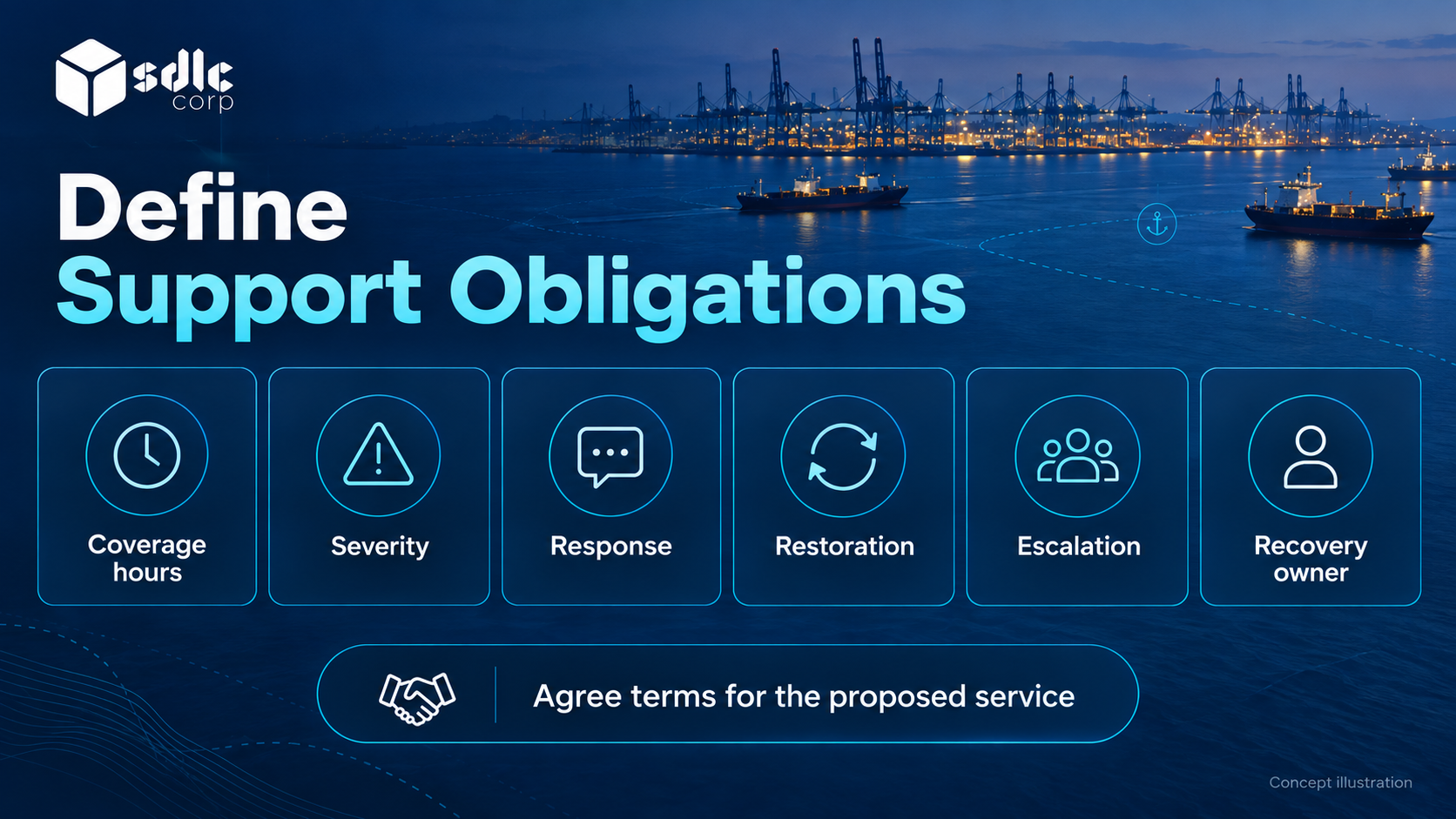
An anchorage management system SLA (service level agreement) should define what support will do when a fault affects port operations. Coverage hours, incident severity, response, communication and restoration commitments need clear measurement rules and responsible parties.
Ticket acknowledgement is different from service recovery. The agreement should also distinguish restoration time and data loss objectives, including how the application team works with infrastructure and external feed owners during an incident.
Define Severity in Operational Terms
Describe the Impact Before Assigning a Response Target
Severity definitions written in technical language produce disputes at exactly the wrong moment. Write them by operational impact.
- Severity one: a required workflow cannot be completed and there is no workaround
- Severity two: a workflow needs an approved workaround; classify feed loss by its actual operational impact
- Severity three: degraded function with limited operational impact
- Severity four: cosmetic or documentation
Attach both a response commitment and a restoration or workaround commitment to each. Response alone means someone acknowledges the ticket.
Make the Response and Restoration Clocks Measurable
For each type of incident, define when the clock starts and stops. State the service hours, target and any allowed pauses. An acknowledged ticket ends the response clock, not the restoration clock. Agree who can accept a workaround and what evidence shows that normal work has resumed.
When a third-party feed fails, the application supplier may detect the fault and help diagnose it while the feed owner fixes the source. Give each task its own owner and target. Track handoffs. Avoid a blanket pause whenever another supplier is involved.
Set Support Coverage for the Port’s Operating Hours
A continuously operating port needs an agreed route for critical incidents outside office hours, whether provided by internal teams, a supplier or both.
| Term | What to define | Common gap |
|---|---|---|
| Service hours | Coverage against your operational pattern | Office hours behind a continuous operation |
| Availability | Measurement window and exclusions | Planned maintenance excluded without limit |
| Contact route | How to raise a severity one incident out of hours | A web form with no escalation |
| Escalation | Named path with timescales | Escalation at the supplier's discretion |
Define planned maintenance limits explicitly: frequency, notice period, duration and the windows in which it may not occur.
List the maintained components and interfaces in the scope of work. The support agreement should use the same boundary.
Set the Service Targets from Operational Impact
Define severity by the affected task, available fallback and consequence of delay. The buyer and supplier must agree the targets, measurement clocks, coverage and exclusions against that operating need. A priority label does not prescribe a maritime response or restoration standard.
| Severity | Impact Definition To Agree | Response Target | Restoration Or Workaround | Communication |
|---|---|---|---|---|
| P1 | Critical accepted workflow unavailable with no permitted fallback | Buyer to set and supplier to agree | Buyer to set and supplier to agree | Buyer to set and supplier to agree |
| P2 | Material degradation with an approved usable fallback | Buyer to set and supplier to agree | Buyer to set and supplier to agree | Buyer to set and supplier to agree |
| P3 | Lower-impact issue that can follow planned remediation | Buyer to set and supplier to agree | Agreed fix and review process | Agreed update process |
Specify recovery time objective (RTO) and recovery point objective (RPO) separately. RTO defines the restoration target for the stated scope; RPO defines the targeted recoverable data gap. Both need an agreed boundary and tested recovery capability, not just a fast ticket acknowledgement.
Illustrative example
Check the Contract Against an Incident Sequence
This contract profile illustrates responsibility and measurement structure, not a maritime standard. Numeric targets remain for the buyer and supplier to agree.
Illustrative example
An allocation service fails while an external observation feed is also unavailable. Support acknowledges the incident, assesses the operational impact and assigns an incident owner. An approved workaround restores some tasks, but source recovery and record reconciliation remain open.
| Event | Contract Question | Evidence |
|---|---|---|
| Failure detected | Which event starts each clock? | Monitoring and incident record |
| Support responds | What action counts as response? | Attributed acknowledgement and triage |
| Workaround validated | Which required tasks are restored? | Operator validation against agreed scope |
| Records recovered | Does the recovered state meet the data objective? | Checkpoint and reconciliation evidence |
| Full service returns | What remains open after restoration? | Root cause, corrective action and closure decision |
Measure each interval against the negotiated target. Restoration of a screen does not establish recovery of decisions lost during the interruption, and a third-party exclusion does not remove the agreed detection or escalation duties.
Turn the agreed commitments into testable requirements with measurement boundaries, responsible owners and evidence that can be reviewed during service reporting.
Cover Monitoring and Feed Health Explicitly
Include feed health monitoring explicitly. Some failures produce no visible application error unless freshness and delivery are monitored.
- Who monitors each integration, and with what alerting
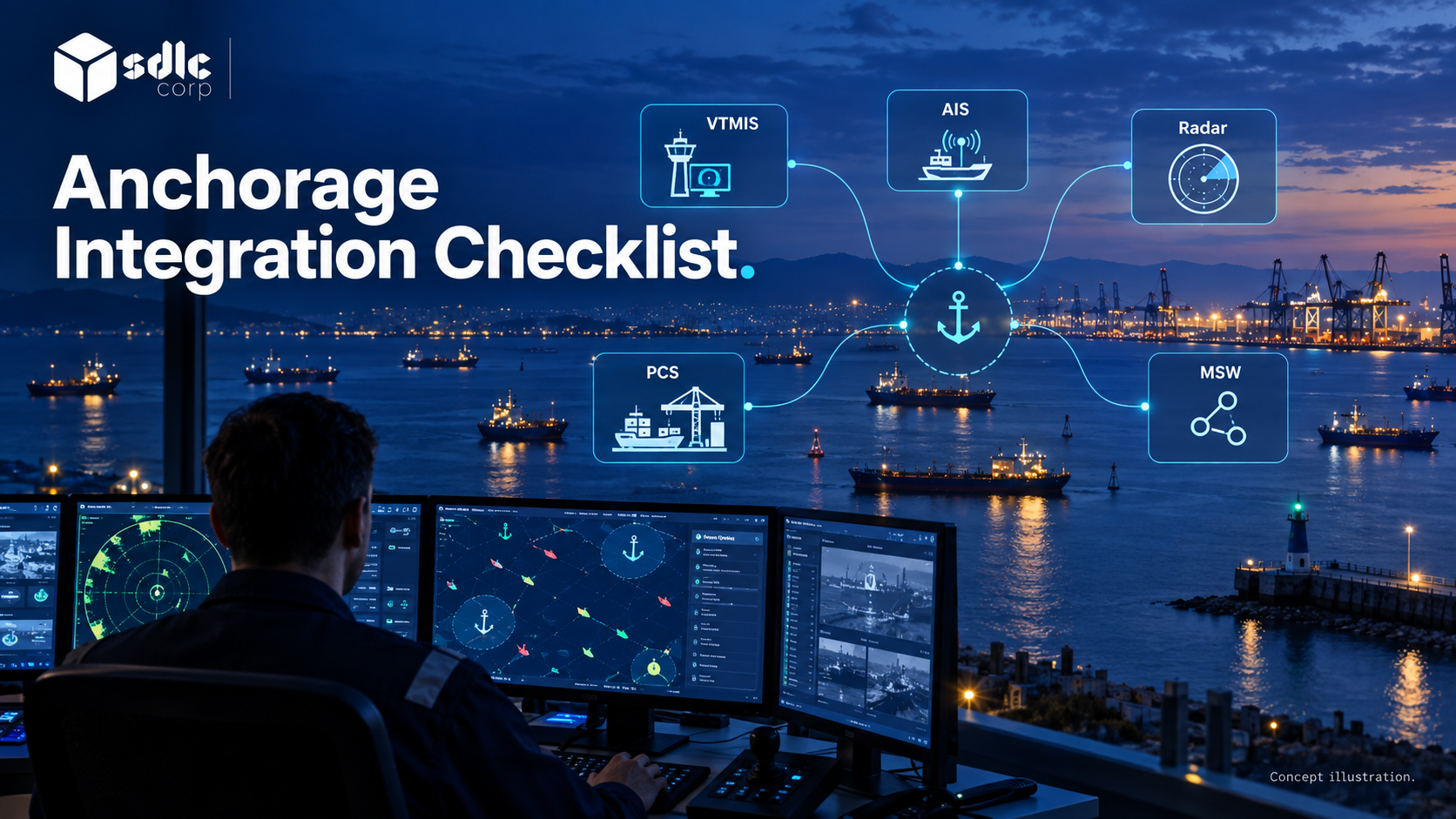
- Whether an automatic identification system (AIS), radar or other feed loss raises a supplier side alert
- The response obligation when a feed fails, separate from application incidents
- Whether a feed failure counts against availability
- Who investigates when the failure is on a third-party's side
Where sensor resilience is in scope, multi sensor acceptance requirements defines the alarm and provenance requirements that this clause must support operationally. AIS loss operating states describes the degraded states the service agreement should recognize.
State Degraded Mode Expectations
An availability percentage does not describe what the port can still do during a partial failure. Name the degraded states and what the supplier owes in each.
Test three cases: the application works but a feed is down; users can read but cannot change records; a dashboard is behind the source data. For each, say what operators may do, what support must do and what the port handles itself.
For each state, define what ends the incident. Restoring the feed connection may leave missing observations or conflicting manual updates. Specify the review that confirms records are usable again and the person who accepts that result. Track partial restoration separately from complete recovery so an acknowledgement cannot close an unresolved operating problem.
Agree Maintenance, Releases and Change
- Notice period for a release, and whether it can be deferred
- Who tests integration compatibility before a release reaches production
- Emergency change process and who authorises it
- Whether the port has a non production environment to test against
- How a defect introduced by a release is handled and prioritized
delivery phases and acceptance gates should have established the environment position; the service agreement is where it becomes an ongoing obligation rather than a project arrangement.
Agree Recovery Targets, Restore Tests and Exit Exports
- Backup frequency, retention and where copies are held
- Recovery point objective (RPO): acceptable data loss window; recovery time objective (RTO): target restoration time, with scope and measurement agreed
- Evidence of the last successful restore test, and the test frequency
- Disaster recovery arrangement and the last exercise date
- Data export format, frequency and whether the port can self serve
- Exit assistance: duration, scope, cost and what ends on termination
anchorage management system security checklist covers the evidence to request for these; the agreement is where they become obligations rather than statements.
Define Reporting and Service Review
- Monthly service report with incidents, severities and commitment performance
- Feed availability reported separately from application availability
- Trend reporting on recurring incidents and their root causes
- A scheduled service review with named attendees on both sides
- A route for the port's operational requirements to reach the roadmap
Complete the support agreement by walking through an application outage, a source failure and recovery, including every handoff between the responsible organizations.
Review a sample report before agreeing the format. It should connect a missed target to the incident timeline, affected function and responsible handoff. Keep unresolved recurring faults visible with an owner and due date. At each service review, decide which corrective actions are accepted, overdue or require a scope change; a monthly availability total alone cannot support those decisions.
Resolve the vendor due diligence questions before finalizing support terms so the agreement reflects verified responsibilities.
Final Thoughts
Walk through an incident that crosses an application, network and source provider boundary. Confirm who detects it, who communicates with the port and who coordinates restoration and reconciliation.
Use the result to close gaps in the agreement before support begins. Review performance against the defined measures, including exceptions and escalation, rather than judging service solely by how quickly tickets receive a reply.
Discuss Support Scope with SDLC Corp
Discuss support for the digital anchorage management platform with SDLC Corp through its software consulting services. Define critical workflows, operating hours, external dependency owners and measurable response, restoration and communication commitments. Ensure the proposal clearly states coverage, exclusions, maintenance and reconciliation responsibilities for the port’s operating needs.
Frequently Asked Questions
How Do Response and Restoration Targets Differ?
Response defines the agreed initial support action or acknowledgement. Restoration concerns returning the service to its required state. Data recovery objectives are separate again, so specify and measure each obligation explicitly.
Should an External Feed Outage Count Against Availability?
Define the measurement boundary and exclusions in the agreement. Separately state the duties to detect, display, escalate and assist with the outage, even where the application supplier does not control the feed.
What Should Hypercare Include?
Agree the extra coverage, access to implementation specialists, escalation and any temporary targets. Set a planned review and evidence for transition to standard support; the term alone does not establish faster restoration.