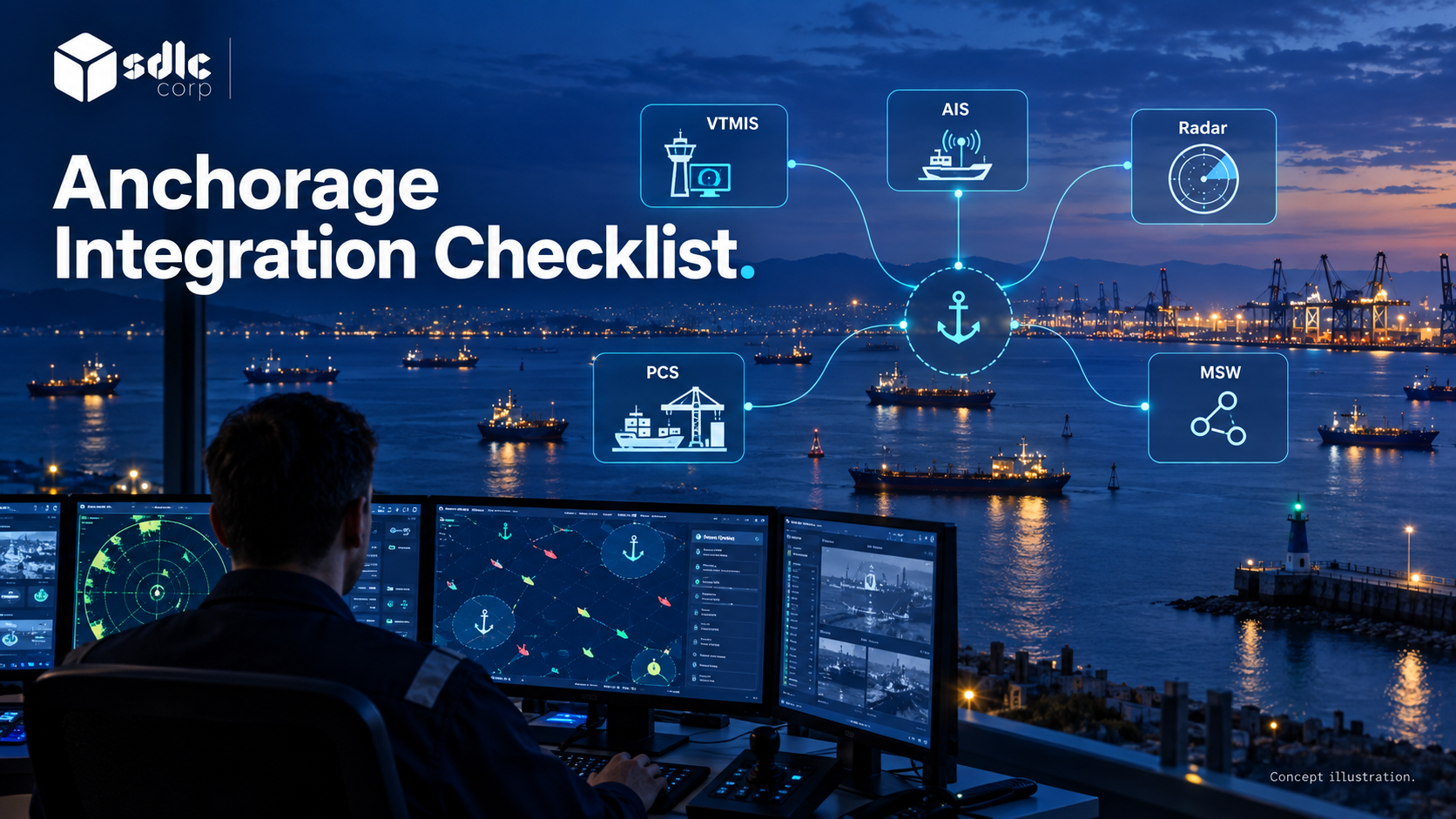
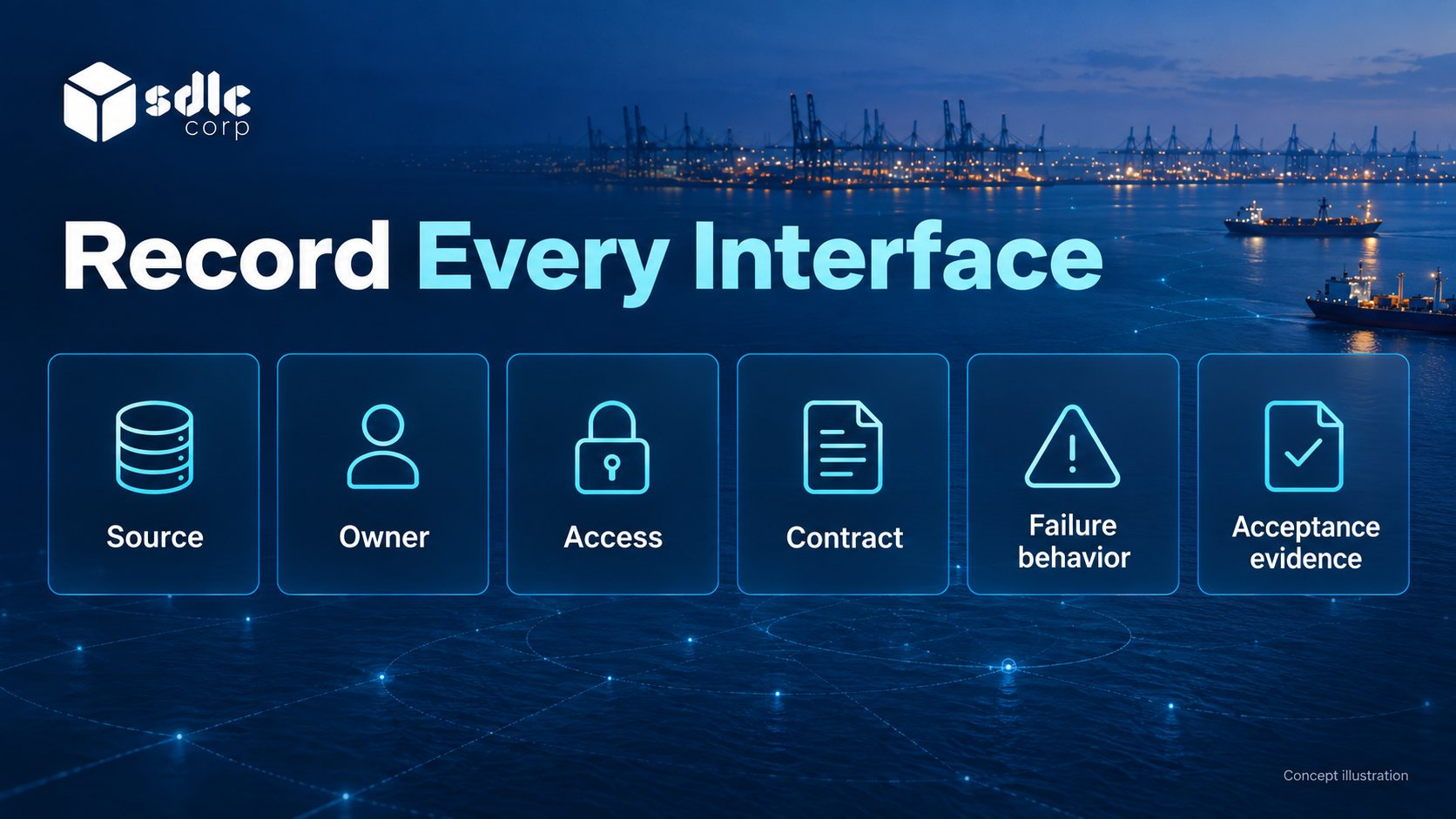
An anchorage management system integration checklist confirms, for each required transaction, the supported contract, permission to use it, test access, data ownership and failure behavior, and records who resolves every gap.
Documentation helps, but it cannot substitute for permission to use an interface or a working test environment.
Classify each dependency by its effect on the release. A missing optional detail can remain conditional with an owner; an unavailable mandatory connection blocks the work that depends on it.
Decide Readiness per Required Transaction
Readiness is a set of gates, not a percentage. A transaction is ready for a stage only when that stage's evidence exists, and read access and an authorized write can have different outcomes on the same interface.
| Gate | Evidence | If Missing |
|---|---|---|
| Supported operation and version | Current contract confirmed by its owner | Block the affected operation |
| Permission for the intended use | Approved access and usage rights | Block use; do not infer permission |
| Test access and representative records | Authorized environment and usable cases | Keep integration acceptance open |
| Meaning and ownership | Field mapping, identifiers and decision owner | Resolve before trusting exchanged state |
| Failure and recovery path | Agreed scenarios and evidence required | Do not approve production readiness |
Name who signs off each gate. Typically the port integration lead approves development readiness, while production readiness needs the source owner and operations owner as well.
Keep Development Readiness Separate from Production Readiness
Illustrative example
A traffic feed has a supported read contract and permitted test access. Adapter development can begin, while production credentials and outage tests remain open.
A weather archive is unavailable, so a historical evaluation stays outside the accepted scope. An allocation write has no authorization, so that operation is blocked even though its documentation is complete.
| Interface and Transaction | Status | Missing Evidence or Blocker | Owner | Next Action |
|---|---|---|---|---|
| Traffic platform observation read | Ready for development; production acceptance open | Production access and recovery results | Port integration lead | Obtain production approval and schedule recovery tests |
| Automatic Identification System (AIS) feed ingestion | Conditional | Sample replay behavior has not been confirmed | Feed owner | Supply interrupted-feed records and document resynchronization |
| Weather archive for analysis | Blocked for proposed archive use | Storage and reuse rights not granted | Data procurement owner | Obtain written rights or narrow the scope |
Record an owner and decision date for every open condition. If write permission is denied, a read-only release is a scope change, not proof that the original write requirement passed.
Anchorage Management System Integration Checklist: List Every Interface
Start with what exists, not with what the new system will do. For each system record the owner, vendor, version, support arrangement and whether a test environment exists.
Include a Port Community System (PCS) where it exchanges call information with external participants.
| System | What It Holds | Questions to Settle |
|---|---|---|
| Traffic or Vessel Traffic Management and Information System (VTMIS) | Observed position, traffic picture | Interface type, access approval, support boundary |
| Radar and sensors | Detection and track data | Track or video, tracker ownership, documentation |
| Call or community system | Voyage and stakeholder data | Master data ownership, message formats |
| Reporting window | Authority submissions | Regulatory boundary, reuse of data |
| Anchorage application | Requests, allocations, audit | What it owns versus consumes |
For the reporting window, the IMO Maritime Single Window requirement under the FAL Convention shapes which submissions flow through it and who owns them.
Identify the anchorage workflows each interface supports. That tells the source owner why the project needs access and which failure scenarios matter.
Integrating VTMIS With An Anchorage Application separates permitted reads from supported writes. Writing API Contracts for Port Systems sets the identity and error rules for each interface.
Collect Interface Specifications, Samples and Approved Test Access
Verify the Connection the Project Can Actually Use
Get the interface guide, permitted sample records and a named technical contact. Arrange test credentials through the approved secure process.
Keep "documented," "accessible" and "tested" as separate statuses; one does not prove the next.
- Interface specification obtained and readable.
- Sample messages or records, including awkward cases.
- Test environment available, with a refresh policy.
- Commercial or licensing approval needed, and from whom.
- Network path and firewall changes identified and scheduled.
- Third-party effort required, scoped and funded.
Access approvals, firewall changes and third-party work often set the critical path, so request them first. Assign a required date and escalation owner to every unresolved access dependency.
Example: Documentation Exists but Access Is Unapproved
Suppose an interface manual is available but the source owner has not approved test access. The team can review the contract, yet connectivity and real exchange behavior remain unverified.
Record the approval, network work and test data dependency separately, so a document in the project folder is never mistaken for an integration-ready connection.
Compare Anchorage Management System Digital Transformation with the access register only where its interfaces and delivery stage are relevant. A prior project does not establish permission for a new connection.
Record each required operation and its passing evidence in the Anchorage Management System Requirements Checklist, including the party that supplies access.
Settle Data Entities, Ownership and Identity
Name the system allowed to change each fact. Then map its record identifiers to the receiving system. A wrong match can put a valid update on the wrong vessel call.
- List of records and fields, with one named owner for each fact.
- Authoritative identifiers for vessel, voyage and call.
- Mapping between external and internal references, stored and inspectable.
- Rules for uncertain record matches, including who reviews and resolves them.
- Reference data maintained in one place.
Reconciling VTMIS and Anchorage Records: Which Value Wins? covers precedence, staleness and what happens when two systems disagree beyond tolerance.
Specify Sensor Feeds and Degraded Operation
Where AIS, radar or other sensors are in scope, the checklist must cover failure cases as explicitly as the normal path.
- AIS feed provider, update rate and health monitoring.
- Radar interface: structured track data or video, and which is contracted.
- Single time base and coordinate reference applied to every source.
- Rules for matching observations and combining tracks, including ambiguous cases.
- Source of each observation and its confidence visible to the operator.
- Alarms for feed loss, track staleness and source disagreement, each with an owner.
- Defined permitted request and queue actions; qualified or held geofence results when source evidence is insufficient.
- Tested recovery when a source returns, including when operators may rely on it again.
Connecting Radar Track Feeds to Anchorage Software and Radar and AIS Sensor Fusion for Port Operations set out the design.
AIS Failure and Radar Fallback for Vessel Tracking covers the degraded states. Carry procurement wording from the Radar and AIS Sensor Fusion Requirements Checklist.
Use How to Integrate an AIS Feed into Anchorage Software to confirm timestamp meaning, usage rights and recovery behavior before accepting a tracking dependency.
Agree Non-Functional Requirements and Environments
Agree these service conditions with each interface owner, and state how the team will test each one. This list is a planning aid; source owners and the port agree the actual limits.
- Latency budget from observation to display, under representative load.
- Throughput expectations and behavior at the limit.
- Authentication, authorization and credential rotation per interface.
- Network segmentation for sensor and operational traffic.
- Environment separation, with integration available in non-production.
- Monitoring: connection health, references that trace an update across systems, and named alert recipients.
For record-level access tests, use the OWASP API Security guidance on broken object level authorization.
Plan Testing, Cutover and Support Ownership
Plan tests across the actual connections. Name the team needed on each side and book access before setting the test date.
- Test data covering normal, boundary and failure cases.
- System integration testing with each counterpart, scheduled with its owner.
- User acceptance scenarios that cross system boundaries.
- Degraded mode and recovery drills, run before acceptance.
- Cutover sequence, including what runs in parallel and for how long.
- Rollback position for each interface.
- Post-go-live support boundary for every feed, named in the contract.
Support boundaries belong in the service agreement rather than a project document. Leave discovery with an interface register that separates documented, accessible and tested connections, with an owner for every open dependency.
Carry blocked dependencies into the Anchorage Management System Implementation Roadmap so the cutover plan reflects access and evidence that actually exist.
Conclusion
Work through the anchorage management system integration checklist interface by interface, and attach evidence to each readiness status. For every conditional item, state who resolves it and which milestone depends on it.
Keep blocked functionality out of an unconditional release commitment. Proceed when the agreed scope has a usable access and acceptance path, or approve a revised scope that can operate independently.
Explore Integration Discovery with SDLC Corp
Bring your interface readiness register when evaluating our Anchorage Management Software and the required Software Integration Services.
We will classify each operation by supported contract, permission and available evidence, name an owner for missing dependencies, and keep development readiness separate from production acceptance before scope, price or timing is agreed.
Frequently Asked Questions
What Evidence Establishes Integration Readiness?
Confirm the supported contract, permitted access, representative test environment, responsible owners and acceptance scenarios. Distinguish readiness to begin development from readiness for production use.
Can Testing Begin Before Production Credentials Exist?
Yes, in an authorized representative environment. Production access and operating constraints remain separate conditions that must be verified before accepting the live connection.
What Should Happen to a Blocked Interface?
Record the blocker and affected functionality, then assign a resolution owner. Postpone that functionality or revise the release through the agreed process, rather than presenting test data as proof the connection is ready.
Who Approves an Interface as Ready?
Name an approver for each gate. The port integration lead usually approves development readiness; production readiness also needs the source owner and the operations owner.
Which Access Requests Should Start First?
Start with source-owner approvals, firewall changes and third-party work, because they often set the critical path. Documentation review can run in parallel.
Does a Prior Integration Prove Readiness for a New Port?
No. A previous project shows a supplier's experience, but permission, versions and test access must be confirmed again for each new connection.