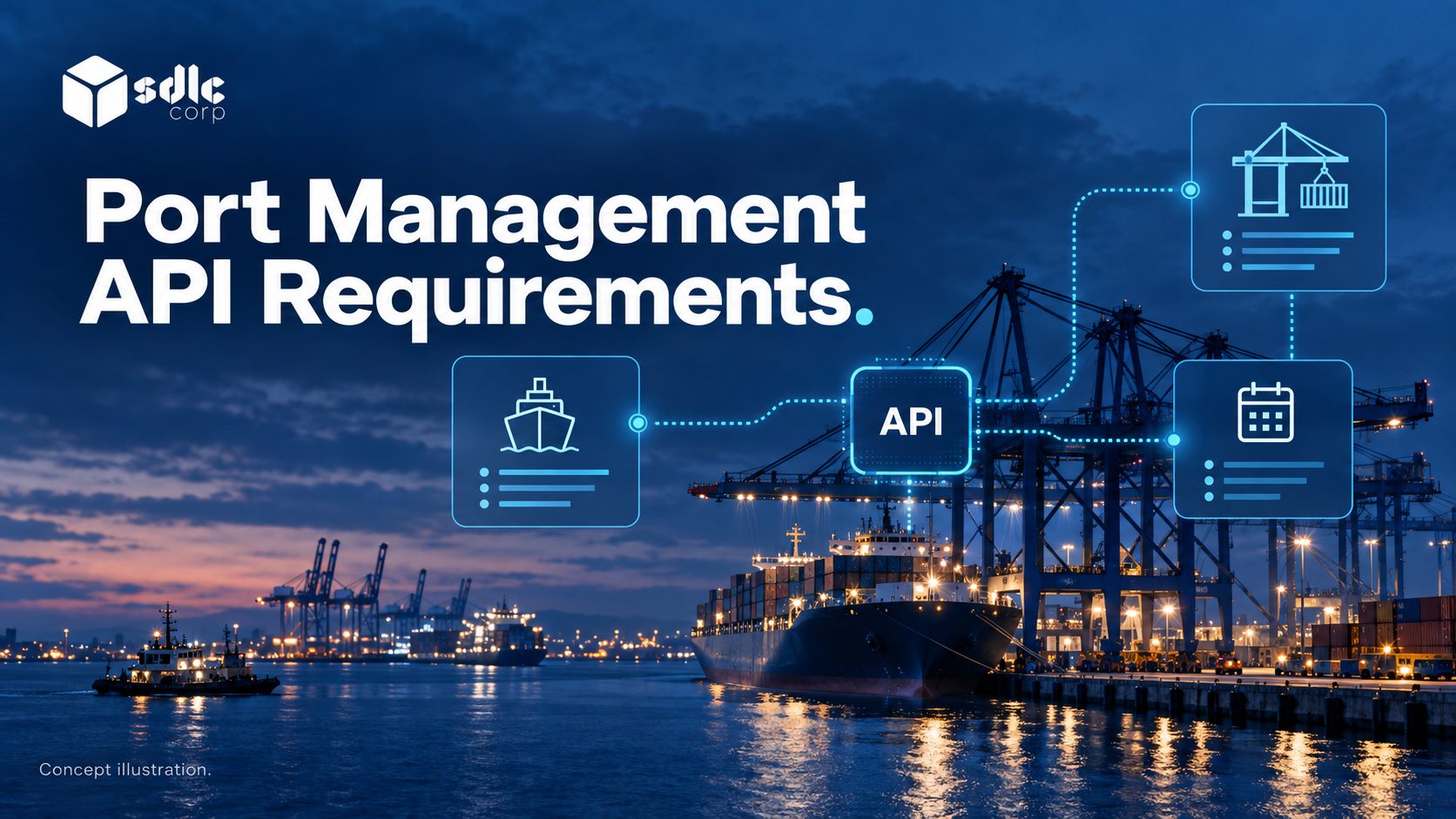
A port system application programming interface (API) contract tells another application what it can request, change and rely on in the response. The contract needs more than an endpoint list: it must define record ownership, authorization, versions and unsuccessful outcomes.
Consider a caller that submits a change and loses the connection. It needs a reliable way to discover the result or repeat the request without creating a second change.
Which Port Records Need An API, And Who Owns Them?
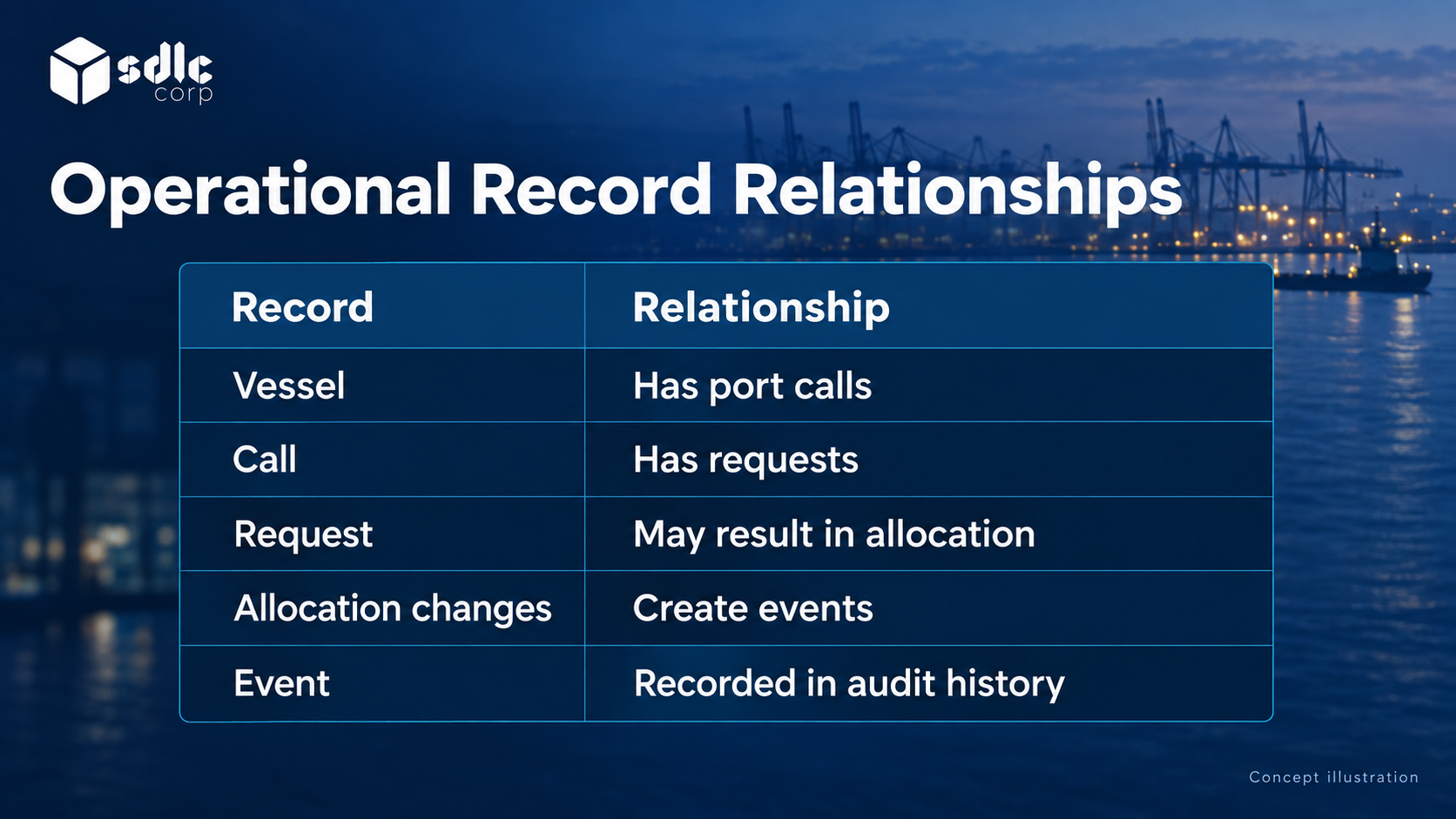
List the entities before the endpoints, and name the system that owns each one. Assign authority at the entity or field-level. Other systems may submit authorized change requests without independently overwriting the authoritative value.
| Entity | Typical owner | Consumed by |
|---|---|---|
| Vessel master data | Reference or traffic system | All applications |
| Voyage or port call | Call management or community system | Anchorage, berth, reporting |
| Anchorage request and allocation | Anchorage application | Traffic picture, reporting |
| Position and track | Traffic or sensor systems | Anchorage, dashboards |
| Operator actions and audit | The system performing them | Reporting, investigation |
field ownership and reconciliation covers what happens when two systems disagree about an entity they both hold. Settle ownership there before writing the interface.
Extend the inventory to approved zones and geofence events, alerts and acknowledgements, user/role access, and audit exports where required. For each, distinguish reading information from a command that changes state. A public endpoint is not required for every internal entity.
Put the contracts, sample messages and acceptance tests into the interface delivery scope, with a named owner for each output.
Map Vessel, Voyage And Call IDs Across Port Systems
Identity mismatches are an important integration failure mode. Agree which identifier is authoritative for a vessel, which for a voyage, and how an external reference maps to an internal one. Record the mapping rather than recomputing it, and make the mapping inspectable when a match goes wrong.
Require a documented rule for partial matches, and an operator path to resolve them. A silently guessed match is worse than a flagged one. Vessel Traffic Management and Information System (VTMIS) integration architecture describes the same problem where the traffic system is the counterpart.
Read A Version And Submit A Change
Illustrative example
This is one illustrative representational state transfer (REST) design, not a mandatory maritime interface. An installed system may instead expose messages, files or another supported contract. Preserve equivalent authorization, conflict and recovery behavior using that contract. The example uses expected_version for application-level conflict detection. The /example/ paths describe the test contract and are not live endpoints.
GET /example/calls/C-182
200 OK
{
"call_id": "C-182",
"allocation_status": "approved",
"zone": "A",
"version": 7
}POST /example/calls/C-182/change-requests
Idempotency-Key: op-41
Content-Type: application/json{
"expected_version": 7,
"requested_zone": "B",
"reason": "zone review"
}For an authorized proposer, the sample success response is 201 Created with {"request_id":"CR-9","status":"pending_approval"}. Creating CR-9 does not change the approved zone. A separate permitted approval action owns that transition.
Errors, Retries And Events
| Condition | Sample Response | Caller Behavior |
|---|---|---|
| Current call version is 8 | 409 with current_version: 8 | Read version 8; reconcile before submitting a revised operation |
| User cannot propose for C-182 | 403 forbidden | Do not retry with the same permissions |
| Required requested_zone missing | 422 invalid_request | Correct the body |
| Response lost after CR-9 is stored | Retry same key and identical body | Contract returns the original CR-9 result within the agreed retention window |
| Same key reused with a different body | 409 idempotency_conflict | Use a new key for a genuinely new operation |
{
  "event_id": "E-91",
  "type": "change_request.created",
  "request_id": "CR-9",
  "call_id": "C-182",
  "version": 8
}
Consumers deduplicate E-91 and fetch current state if their version is behind. The HTTP conflict definition supports 409 for a conflict with current resource state. The idempotency key retention, payload matching and event schema remain explicit choices in this sample contract.
Complete Success And Conflict Responses
The sample successful change request submission returns:
HTTP/1.1 201 Created
Location: /example/change-requests/CR-9
Content-Type: application/json
{
"request_id": "CR-9",
"call_id": "C-182",
"status": "pending_approval",
"call_version": 8,
"operation_id": "op-41"
}If a different operation still expects version 7 after the call reaches version 8, the sample response is:
HTTP/1.1 409 Conflict
Content-Type: application/json
{
"error": "version_conflict",
"call_id": "C-182",
"expected_version": 7,
"current_version": 8,
"retry_without_review": false
}For the same authenticated caller, the same idempotency key and identical request body return the original CR-9 response within the configured 24-hour retention period, even though the call version is now 8. The server checks for that stored operation result before treating a duplicate as a new version conflict. Reusing op-41 with a different body produces idempotency_conflict, not another CR-9.
Specify API Payloads, Retry Semantics And Version Conflicts
Distinguish Request Receipt From An Approved Workflow Transition
The endpoint list is the least interesting part. What determines whether an integration survives its first year is the contract around it.
- Versioning: how a breaking change is introduced and how long the previous version is supported
- Idempotency: a repeated request must not create a second allocation or duplicate an event
- Pagination or another bounded retrieval mechanism for growing collections, with stable ordering and filters appropriate to the task
- Error semantics: distinguishable client errors, server errors and business rule rejections
- Time: a documented representation, with observation time and provenance separate from receipt time; mark unavailable source time explicitly
State expected payloads with real examples rather than field lists. A sample message that a supplier can actually parse removes more ambiguity than a page of prose.
Sample Acceptance Contract For Submitting A Request
For a request submission contract, specify a mapped call reference, requested allocation details, an authenticated principal and a client operation identifier. The receiver returns a durable request reference and the resulting workflow status. Receipt creates no approval unless the explicitly authorized operation and policy permit it.
| Test | Contracted behavior to define |
|---|---|
| Same operation repeated with the same payload | Return or locate the original result without a second request |
| Same operation identifier with different content | Reject or flag the conflict under the documented rule |
| Amendment based on an old record version | Return the current version and require reconciliation |
| User submits against an inaccessible call | Deny the action on the server and retain appropriate audit evidence |
State how long duplicate protection records are retained and how the caller checks an uncertain result after a timeout. Without that boundary, an idempotency promise cannot be tested meaningfully.
Cover Events As Well As Requests
Port operations are event-driven in practice: a request is submitted, an allocation approved, an arrival confirmed, an exception raised. A pull only API forces consumers to poll and makes timeliness a function of polling interval.
Specify which events are published, their payload, their ordering guarantees and their delivery semantics. Define retry behavior and what happens to an event a consumer cannot process. Event-driven architecture for port operations covers the wider design; the API specification should state which parts of it are contractual.
Webhooks need their own requirements: registration, authentication, retry schedule, dead letter handling and a way for the consumer to replay a missed window.
Security, Limits And Observability
Authentication and authorisation belong in the API specification, not only in a security annex. State the mechanism, the token lifetime, how credentials are rotated, and which scopes exist. Map scopes to the operational roles that will use them.
- Rate limits, with documented behavior at the limit
- Transport security and any network restrictions
- Audit logging of API actions, attributable to a principal
- Health and status endpoints the port can monitor
- Correlation identifiers carried end-to-end for tracing
The Open Worldwide Application Security Project (OWASP) API Security Top 10 is a reasonable baseline to reference in requirement text, including object-level authorization risks that should be tested explicitly.
The role and object-level permission model should determine which records each principal can read or change, including direct calls and exports.
Require A Sandbox, Failure Responses And Contract Tests
Require a sandbox with representative data and a published test plan. Acceptance criteria should be written as scenarios a person can run: submit a request, approve it, confirm arrival, raise an exception, replay an event, recover from a rejected call.
- Sandbox availability and refresh policy
- Sample datasets that include awkward cases, not only clean ones
- Contract tests both parties run, not just the supplier
- A documented path for interface defects after go-live, with owners
The integration checklist turns these requirements into dated actions with named owners, which is where interface commitments usually slip.
Treat sample payloads, failure responses and repeatable contract tests as part of interface readiness, alongside credentials and a named support owner.
Conclusion
Review complete request and response examples for a successful change, a version conflict and a repeated request. Verify that the reported state agrees with the stored record and that unauthorized callers cannot perform the action.
Accept the contract when both sides can explain timeout recovery and version changes. Keep those scenarios in the sandbox tests as the interface evolves.
Review API Scope With SDLC Corp
Evaluate the interface scope for the digital anchorage management platform with SDLC Corp and discuss software integration services against the installed systems' actual contracts. Bring sample reads, change requests and failure cases. Request documented authorization, version conflicts, retry behavior and reconciliation, with proposed design choices distinguished from existing interface obligations and acceptance evidence attached to each required exchange.
Frequently Asked Questions
What Must An API Contract Specify?
Define the entities, permitted actions, ownership, identifiers, authorization, request and response fields, errors and versioning. Include recovery examples so callers know what to do after a timeout or conflict.
Should We Use APIs, Events Or Both?
Queries and commands can use an API, while events can announce state changes. Choose the combination from supported interfaces and timing needs, and define how a consumer retrieves or reconstructs the state after missed delivery.
What Belongs In The Procurement Specification?
State the required exchanges, security and identity rules, dependencies and acceptance scenarios so bids are comparable. Detailed endpoints may be finalized during design, but the required behavior should not remain an unspecified future decision.