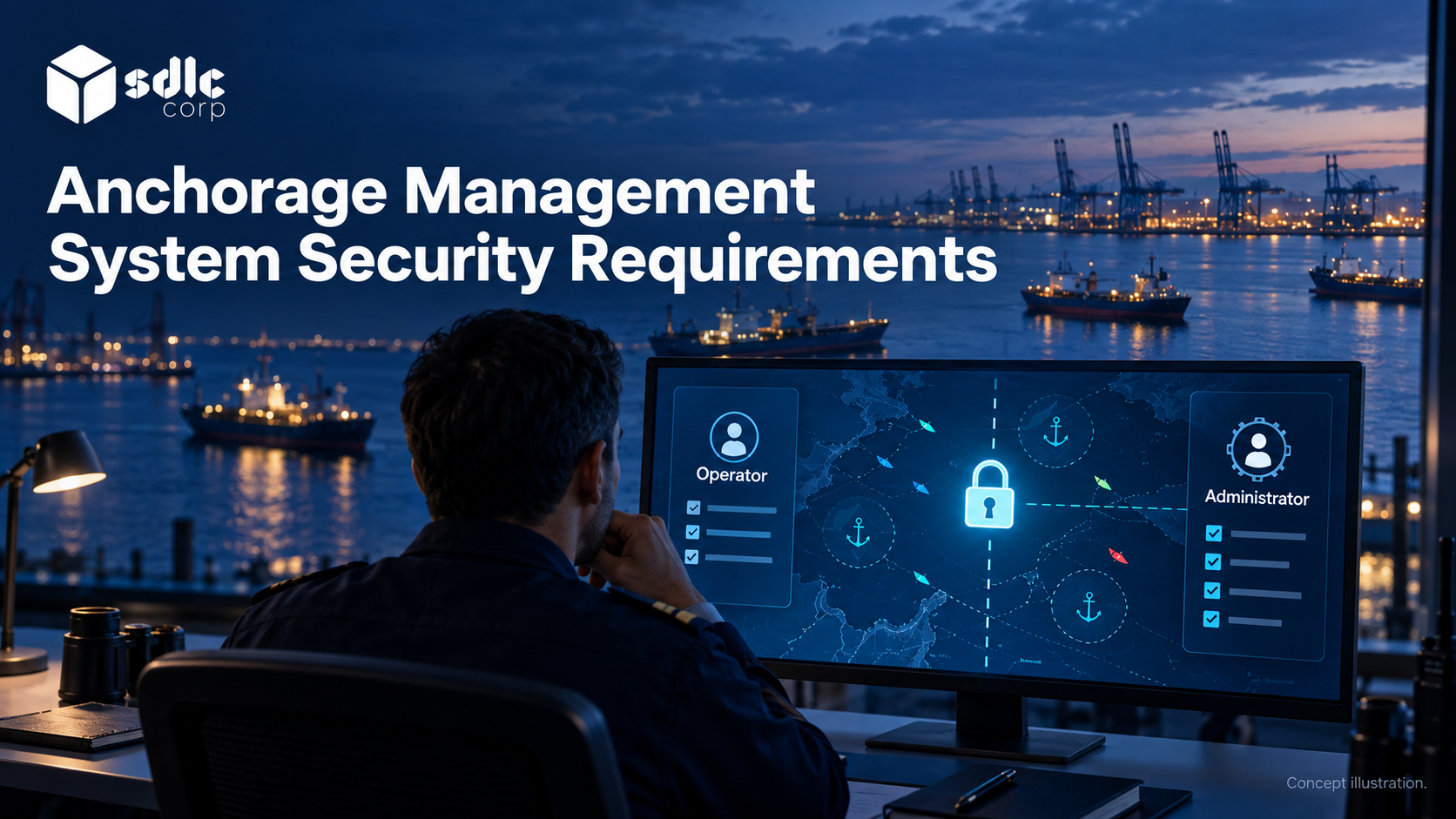
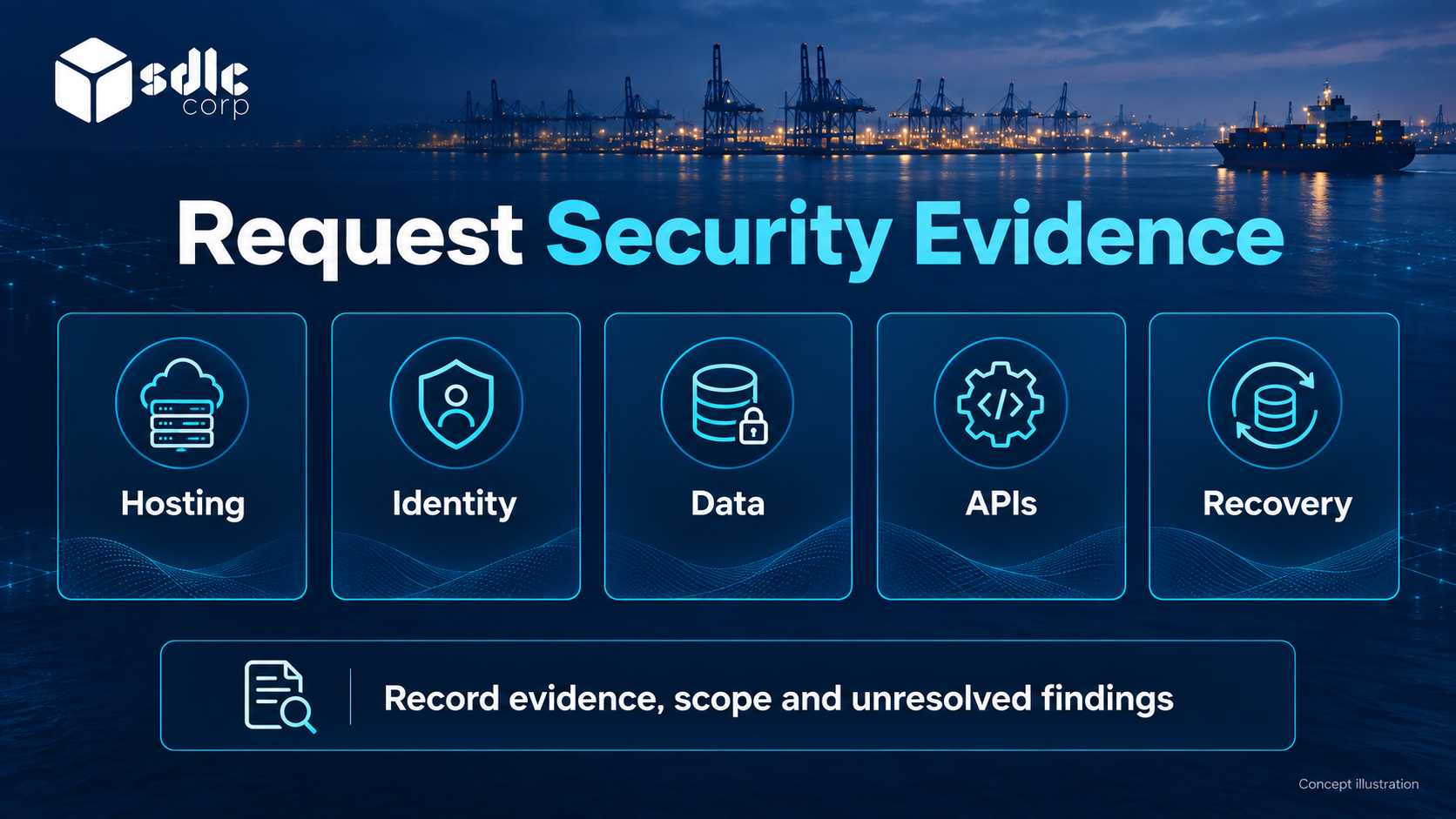
An anchorage management system security checklist should establish how the proposed deployment protects access, credentials, records and recovery. Ask for evidence connected to the actual application and operating responsibilities, rather than treating a general assurance as proof of every control.
The review should also show what remains unresolved. A control that depends on configuration, a hosting service or another supplier needs an owner and a way to verify it before acceptance.
Request Hosting, Tenancy and Third-Party Data Flow Evidence
Start with where the components run and who operates them. Use that map to assign responsibility for each security control.
| Question | Evidence to request |
|---|---|
| Where is the system hosted, and in which regions? | Architecture diagram, region list |
| Which components sit on the port's network? | Component and network diagram |
| Is the tenancy shared or dedicated? | Written statement, with isolation model |
| Which third parties process our data? | Subprocessor list with purpose |
| How are environments separated? | Environment diagram and access model |
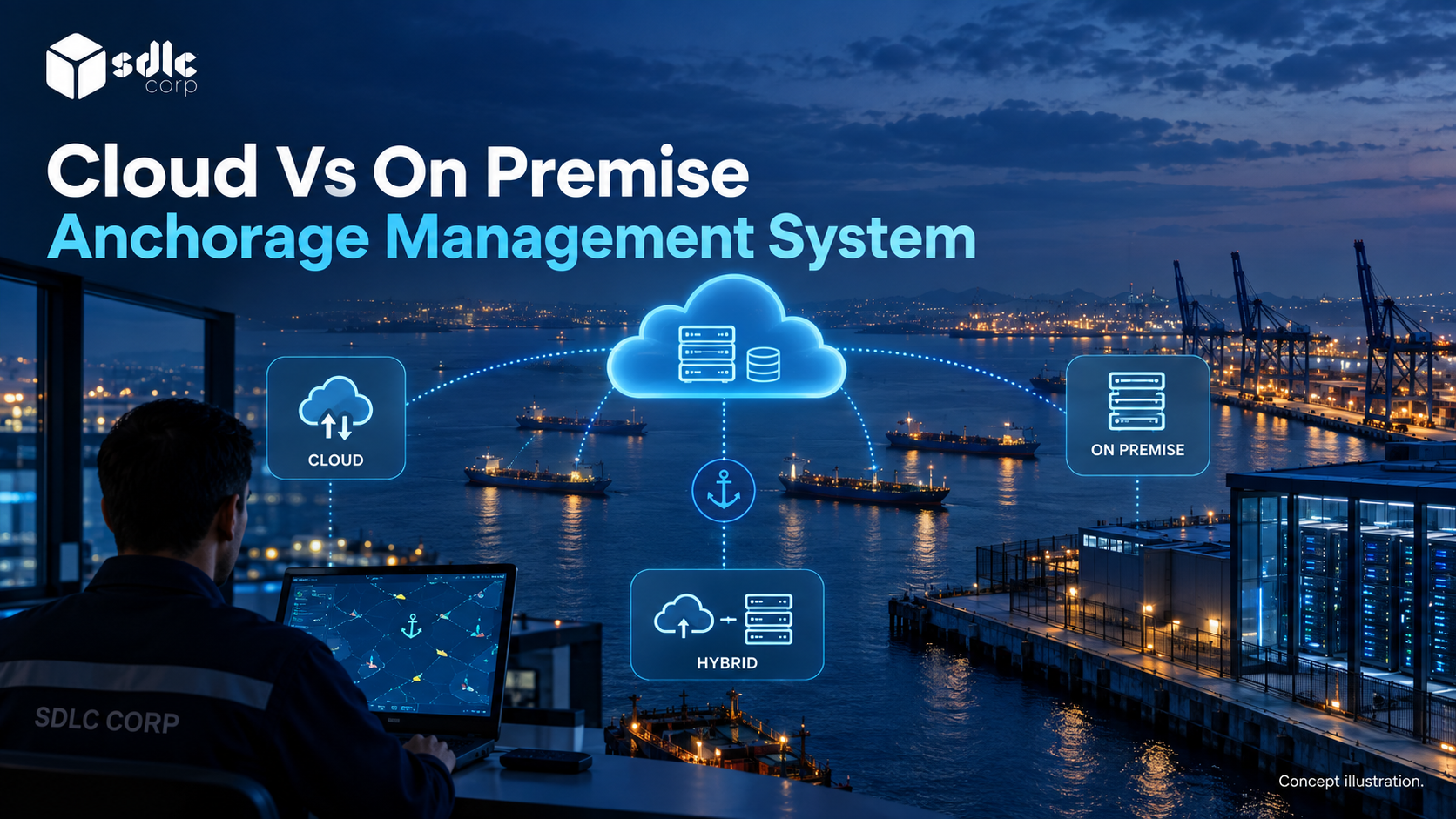
If the architecture diagram is outdated or missing, request a current version before judging the proposed controls. The cloud-versus-on-premises decision guide covers how the hosting choice shifts these responsibilities.
Use the anchorage operating model to identify the decisions, records and interfaces being protected. Request evidence against that scope rather than an unrestricted security questionnaire.
Verify Login, Privileged Access and Record-Level Authorization
Single sign-on (SSO) connects application access to an identity service; test account removal and session handling as well as login.
Test the Boundary Between Permitted and Restricted Records
- Single sign on against the port's identity provider, including removal of access when an account is disabled
- Multi-factor authentication for privileged capabilities
- Role model mapping to approve, configure and investigate capabilities
- Separation between proposing and approving where required by the approved control model
- Service accounts for integrations, scoped and separate from named users
- Emergency access: available, time-bounded, recorded and reviewed
Ask which administrator actions are logged and which are not. Request a sample log and investigate any gaps against the port’s audit requirements.
Control, Evidence, Good Answer and Red Flag
Illustrative example
Assess the response against the required control and the evidence supplied.
| Control | Evidence To Inspect | Good Answer | Red Flag |
|---|---|---|---|
| Record-level permissions | Direct request test across Organization A and Organization B | Organization A cannot read Organization B’s call | Only menu restrictions shown |
| Authentication | Identity-provider login, disabled-account and active-session tests | Disabled account loses access under the agreed policy | Login demonstration only |
| Incident notification | Simulated alert and notification record | Named recipient, trigger, agreed clock and documented update | No owner outside office hours |
| Privileged access | Role grant/revoke history and session test | Revoked approver denied on next required check | Open session retains indefinite access |
| Secrets | Storage design and rotation demonstration | Credentials rotated without exposing values in logs | Shared key embedded in a configuration export |
| Audit integrity | Retention/access policy and tamper attempt | Restricted writer; alteration attempt detectable | Administrator can silently erase history |
| Recovery | Isolated restore report and reconciled records | Scope and achieved recovery stated | “Backups enabled” with no restore evidence |
| Vulnerability handling | Sample triage, remediation and release record | Owner and tracked resolution | No process after a scanner alert |
Test Cross-Organization Access
Create call C-A for Organization A and C-B for Organization B. As A, read C-A, then send the same direct request for C-B. The first should succeed; the second should be denied without exposing B’s fields. Repeat against update and export routes, not only the main screen.
| Result | Assessment |
|---|---|
| Screen hides C-B but direct request returns it | Control failed |
| Read denied but export includes C-B | Control failed |
| All routes enforce the boundary and log permitted security evidence | Passing evidence for the tested scope |
The record includes account roles, tested routes, release version and results, without retaining live credentials in the report.
Data Protection and Encryption
- Encryption in transit and at rest, with the mechanism stated
- Key and secret management, including rotation and who holds them
- Whether production data is used in non-production, and how it is treated
- Data classification and any personal data held, with its basis
- Retention periods, and how deletion is evidenced
- Export format and assistance on exit
Test operator permissions and audit design with permitted actions, denied requests and retained decision histories for each role.
Application and Interface Security
Review integration credentials and permissions explicitly, including any shared or long-lived secrets.
- Authorisation enforced server-side on every object, not only in the interface
- Per integration credentials with a documented rotation process
- Rate limiting, with defined behavior at the limit
- Input validation and error handling that does not leak internals
- Network segmentation between sensor, operational and administrative traffic
Reference the Open Worldwide Application Security Project (OWASP) application programming interface (API) Security Top 10 in the request and ask how each item is addressed. Test object-level authorization using permitted and prohibited actions instead of relying on a general assurance statement.
Logging, Monitoring and Incident Response
- Audit records that application users, including administrators, cannot alter or delete
- Retention long enough to investigate an incident discovered late
- Read access to sensitive history recorded, not only writes
- Monitoring and alerting, with who receives alerts out of hours
- Incident notification obligations and timescales, including supplier-side breaches
- Evidence of a tested incident response process
Request a sample covering a failed access attempt, an administrator changing permissions and an operational override. Check that the records identify the actor, affected object, time and result without exposing credentials. Ask how clocks are aligned and how investigators connect events across the application and its interfaces.
Walk through one suspected incident with the proposed support owners. Who receives the alert outside office hours, preserves relevant evidence and informs the port?
Agree access to logs, the notification route and continuing investigation support. Test whether privileged users can alter the retained evidence and how attempts are detected. A retention figure alone does not prove the records will be usable.
Walk the incident from detection through closure: preserve the alert and affected records, restrict compromised access, record who makes containment decisions, notify the agreed contacts and validate recovery.
Capture administrative role changes and sensitive exports alongside operational changes. Protect credentials and unnecessary personal data from logging. Test whether the incident owner can obtain the evidence without giving unrestricted access to all call records.
The support agreement should name incident ownership, notification and escalation duties across the application and its external dependencies.
Assurance, Resilience and Supply Chain
| Area | What to request | Weak answer |
|---|---|---|
| Penetration testing | Most recent summary and remediation status | "We test regularly" |
| Vulnerability management | Patch commitments by severity | No stated timescales |
| Secure development | Code review, dependency scanning, release process | Description without evidence |
| Backup and recovery | Recovery point objective (RPO), recovery time objective (RTO) and last restore test date | Backups taken, never restored |
| Disaster recovery | Plan and last exercise | Plan with no exercise record |
| Certifications | Scope statement, not just the badge | Certificate covering a different entity |
A certification is only as relevant as its scope. Read the scope statement to confirm it covers the service you are buying.
If artificial intelligence (AI) is proposed, ask who provides the model and which data it receives. Confirm how long that data is kept and whether it may be used for training. Request evidence of access controls, monitoring and a way to withdraw the feature.
For an assistant, test whether it reveals another agent’s call or follows malicious instructions embedded in a retrieved document. A forecasting model needs a separate evaluation of prediction errors. A general AI assurance statement cannot demonstrate both.
Resolve the controls required for the proposed scope through evidence and named owners. Keep unanswered security questions distinct from controls that were actually demonstrated.
Carry unresolved evidence into the vendor evaluation scorecard, with an owner and a decision on whether the gap blocks acceptance.
A certificate or penetration-test summary does not prove that this application prevents one organization from reading another organization’s records. Check the certification scope, then require direct tests of the proposed application, interfaces and exports.
Exercise unresolved controls in a bounded demo or proof of concept with the security reviewer, using the actual proposed access model.
Final Thoughts
Map the required controls to deployment evidence and explicit tests. Review the scope of any assurance documents, then close the gaps for permissions, secrets, logging, patching and recovery in the proposed arrangement.
Assign unresolved risks to the appropriate decision owner. Proceed under the port's approval process only when the required evidence and conditions are clear, including duties shared with other suppliers.
Explore Security Review Support with SDLC Corp
Discuss security requirements for your anchorage management system with SDLC Corp's software consulting services. Bring the hosting boundaries, record permissions and incident obligations. Request deployment-specific evidence for denied access, privileged activity and recovery, with limitations and third-party responsibilities clearly documented.
Frequently Asked Questions
Do Certifications Replace Deployment Review?
No. Examine the certified scope and its relevance, then verify the controls needed for the proposed application and configuration. An assurance document does not automatically cover every interface or operating responsibility.
How Should a Smaller Supplier Be Assessed?
Use evidence appropriate to the required scope and risk, applying mandatory procurement conditions consistently. Review actual access controls, recovery evidence and maintenance commitments rather than using company size as a substitute for the assessment.
What if a Control Depends on Another Provider?
Name the responsible provider, required evidence and coordination process. Confirm how the port will verify the combined arrangement; one supplier's statement should not leave an essential shared responsibility unassigned.