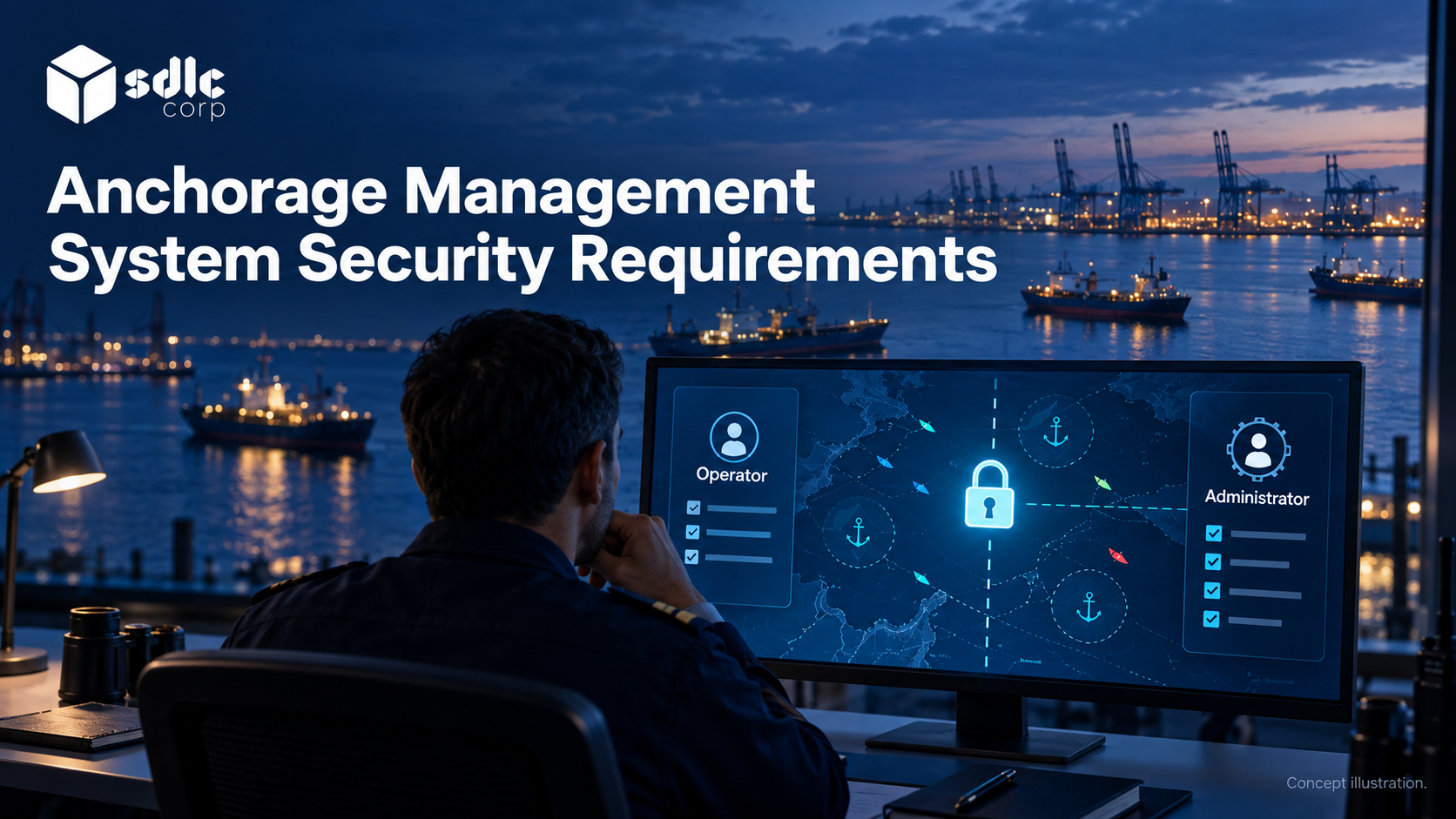
Anchorage management system security starts with a clear split between who can view a record, propose a change, approve it and administer the rules. Role-based access control (RBAC) covers the general action permissions.
It comes down to three rules: check every action against the specific record on the server, separate who proposes from who approves, and keep an audit trail that nobody, including administrators, can alter.
Record ownership, organization and other attributes may need object or attribute policies on top of roles. The audit history then connects the user, changed values, time and reason, including temporary privileges.
Anchorage Permissions: View, Propose, Approve and Investigate
Describe the Permission in Terms of an Action and Record
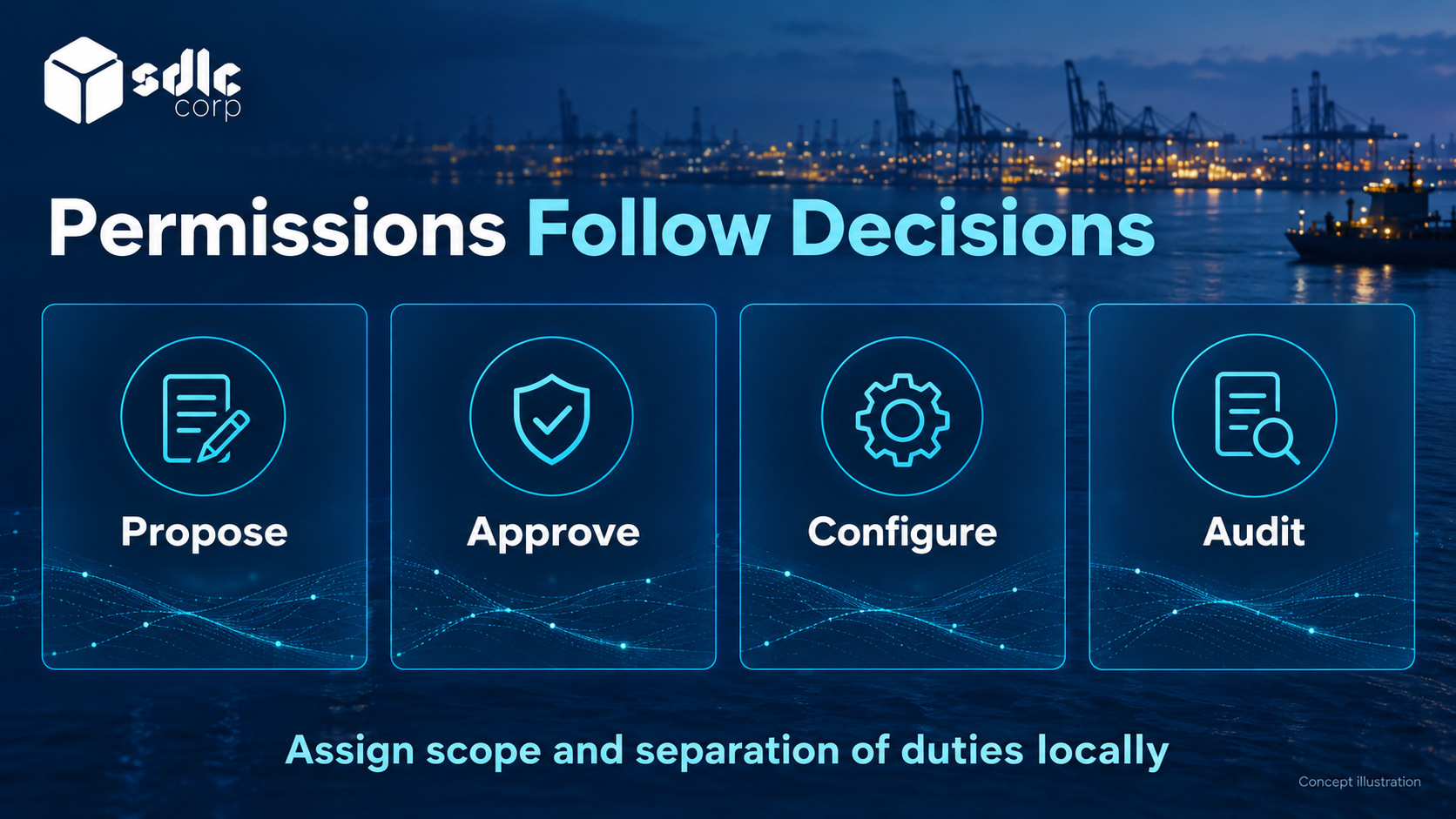
Job titles change and vary between ports. Permissions should attach to the decisions people are accountable for.
| Capability | Who Typically Holds It | Why It Is Separate |
|---|---|---|
| View operational state | Staff authorized for the relevant records and duties | Read scope is separate from decision authority |
| Propose or submit a request | Operators, or external agents | Initiation is not approval |
| Approve, amend or release | Supervisors | Carries operational accountability |
| Configure zones, rules, thresholds | Administrators | Changes how every decision is evaluated |
| Investigate history and audit | Supervisors, assurance | Read of sensitive history |
Separate proposing and approving where the authority's control model requires it, and enforce that restriction even when one person holds both roles. Put the role model in the procurement requirements so every bidder answers against the same structure.
Apply Record-Level Policy Beyond Roles
Give each account only the access it needs, which is the principle of least privilege. Test a permitted and a denied action for each role, and send the denied request straight to the server.
Hiding a button in the interface does not stop someone calling the server directly. That is why every check must run on the server, for every request.
OWASP's object-level authorization guidance calls for checks on access to the specific record requested. For the port test, keep the same role but change the call identifier to another organization's record.
The server must evaluate that record's policy rather than assuming a general role permission authorizes every call.
- Roles composed from capabilities rather than fixed bundles.
- No implicit administrator rights for operational accounts.
- Configuration changes requiring a distinct capability.
- Emergency access available but recorded, time-bounded and reviewed.
- Service accounts for integrations, scoped and separate from named user accounts.
These controls map to recognized frameworks. NIST SP 800-53 covers least privilege (AC-6), separation of duties (AC-5) and audit records (the AU family), which makes it a useful requirements checklist.
Ask which administrative actions are logged and who can alter log storage. Distinguish application administrators from infrastructure administrators, and request evidence of monitored privileged access.
Ask vendors for evidence of these controls inside the proposed service boundary. A general capability statement does not demonstrate record-level access.
A Permission Matrix for One Anchorage Workflow
Illustrative example
This matrix separates proposal, approval and administration. "Own calls" means records assigned to the agent's organization, and it is enforced on every request.
| Role | Read Calls | Propose Allocation | Approve Allocation | Change Roles |
|---|---|---|---|---|
| Agent | Own calls | Submit request only | No | No |
| Operator | Assigned operating area | Yes | No | No |
| Duty approver | Assigned operating area | Yes | Yes, under separation policy | No |
| Access administrator | Account metadata; no automatic call access | No | No | Yes, with approved request |
| Auditor | Authorized read-only history | No | No | No |
An Approval Record and a Denial Test
{
  "audit_id": "AU-91",
  "actor": "approver-3",
  "action": "allocation.override",
  "role": "duty-approver",
  "object_authorization": {"operating_area": "Zone-A", "policy_result": "permit"},
  "separation_of_duties": "requester-is-not-approver",
  "record_id": "AL-7",
  "before": {
    "status": "proposed",
    "version": 1
  },
  "after": {
    "status": "approved",
    "version": 2
  },
  "reason": "approved exception reviewed against current restriction",
  "occurred_at": "2026-09-18T09:15:00Z",
  "request_id": "OP-41"
}
Log in as an operator and send the same approval request directly to the server. The expected result is access denied, AL-7 unchanged and a security event recorded for the attempt.
Role revocation during an open session is tested separately, as part of the lifecycle tests below.
Integrate Identity Rather than Duplicating It
Check whether the port already uses an identity provider. A system that keeps its own parallel user directory creates leaver risk that nobody notices until an audit.
Connect through single sign-on standards such as SAML 2.0 or OpenID Connect where feasible. Session lifetime then matters, because long sessions delay the moment a disabled account actually loses access.
Assess multi-factor authentication (MFA) for privileged actions with the security team. For outside agents, name who creates, reviews and closes each account, and end access when the agent no longer has a role in the call.
Record Who Changed an Allocation, What Changed and Why
The audit history should explain a decision after the shift ends. It needs to show the earlier record, the change, who made it and why. Keep this history separate from logs used to diagnose a software fault.
- Every operational decision attributed to a person, with time and prior state.
- Configuration changes captured with before and after values.
- Override actions distinguished from routine ones.
- Read access to sensitive history recorded.
- Audit immutable to application users, including administrators.
- Retention set by policy, with a defined export path.
Make the Audit Trail Tamper-Evident
Immutability needs a mechanism, not a promise. Write audit entries to append-only storage, protect them with hashing or signing, and give log administration to different people from application administration.
An administrator who changes a record then cannot also quietly change its history.
Reconciling VTMIS and Anchorage Records: Which Value Wins? shows why this matters: a difference between systems is only resolvable if each side can show how it reached its value.
Apply the same control model to approvals and overrides in Anchorage Allocation Software, preserving the reason and policy behind each decision.
Extend Anchorage Management System Security to Interfaces and Secrets
Integration credentials and permissions need explicit controls, especially where secrets are long-lived or reused.
- Per-integration credentials with documented rotation.
- Secret values held in an approved store, never in source code or ordinary configuration.
- Authorization enforced server-side on every application programming interface (API) object, not only in the interface.
- Rate limiting, with documented behavior at the limit.
- Network segmentation between sensor, operational and administrative traffic.
- Production data not reused in test environments without treatment.
Agree how data is protected in transit, at rest and in backups, and name who controls the keys. Then test denied requests, revoked accounts, expired sessions, rotated credentials and attempts to change the audit history.
Check a restore too. A list of roles does not prove these controls work.
Writing API Contracts For Port Systems explains how those permissions carry into the interface, including direct requests and exports that bypass the visible screen.
Test Role Changes, Emergency Access and Privilege Removal
Test access over a person's lifecycle, not only at first login. Change an operator's role while a session is open, then attempt an action that is no longer permitted.
Agree when the change must take effect, and confirm the server enforces it at that point.
For a departing user, disable access and test existing sessions, saved links and delegated credentials. For temporary privileges, record the approver, purpose and expiry, and check that expiry removes the capability automatically.
Emergency access needs an agreed activation path, limited scope and a later review. Capture who invoked it, which records were affected and when normal permissions resumed.
Test a shift change too. An acting supervisor must not gain approval rights over a request they submitted earlier.
Review Access on a Schedule
Permissions drift over time. Recertify who holds approver and administrator roles at an agreed interval, and remove what is no longer needed. The OWASP Authorization Cheat Sheet recommends reviewing permissions as needs change.
Agree responsibility for urgent revocation and incident escalation in the service level agreement (SLA). Complete acceptance with an access matrix, lifecycle test results and audit evidence for each decision.
For port-level context, the IAPH Cybersecurity Guidelines for Ports and Port Facilities, submitted to the IMO in 2021, treat cyber risk as a responsibility that starts with port leadership.
Assess supplier evidence with Anchorage Management Security Due Diligence, using the same service boundary and access tests.
Conclusion
Anchorage management system security is proven by tests, not role lists. Run the permission matrix through the normal interface and through direct requests, including a changed role, a revoked account and an emergency session.
Inspect the resulting audit records during acceptance. The port should be able to show what changed, who was authorized at the time and when temporary access ended.
Review Access Control Requirements with SDLC Corp
SDLC Corp can review permissions for our Anchorage Management Software, with Custom Software Development Services where local policy needs a supported extension. Share your action-and-record matrix, organization boundaries and separation rules.
We will provide evidence of denied requests, privilege changes and auditable overrides, and state responsibility for identity integration and emergency access before you accept the control model.
Frequently Asked Questions
Is Hiding an Approval Button Sufficient?
No. The server must check the user's permission for that action and record. A direct request from an unauthorized user should fail even if the normal screen would never offer the button.
What Is Object-Level Authorization?
It means the server checks whether this user may act on this specific record, not just whether their role allows the action in general. It stops a user reaching another organization's call by changing an identifier.
What Should an Audit Record Contain?
Keep the acting identity, affected record, time, action and relevant previous and resulting values, plus the reason where required. Agree access and retention separately from diagnostic logging.
Can an Administrator Edit the Audit Trail?
It should not be possible. Store audit entries in append-only or tamper-evident storage, and separate log administration from application administration so no single person can change a record and its history.
Should Anchorage Systems Use Single Sign-On?
Where the port has an identity provider, yes. Single sign-on through SAML 2.0 or OpenID Connect avoids a parallel user directory and makes disabling a leaver's account take effect across systems.
How Should Emergency Access Be Controlled?
Define who can authorize it, its scope and duration, and the required review. Record the reason and actions, then verify that expiry or revocation removes the temporary permissions.