

Anchorage allocation software turns the port's rules into a sequence of checks: determine eligibility, identify feasible zones, rank permitted choices and record an authorized decision. Preferences can help choose among valid options, but they cannot make a closed or unavailable zone eligible.
The workflow also needs to handle two operators competing for the same capacity. Whether ranking uses fixed scores or artificial intelligence (AI), a proposal is useful only if the final approval checks the current state and records a clear conflict when it cannot proceed.
Begin With The Allocation Lifecycle
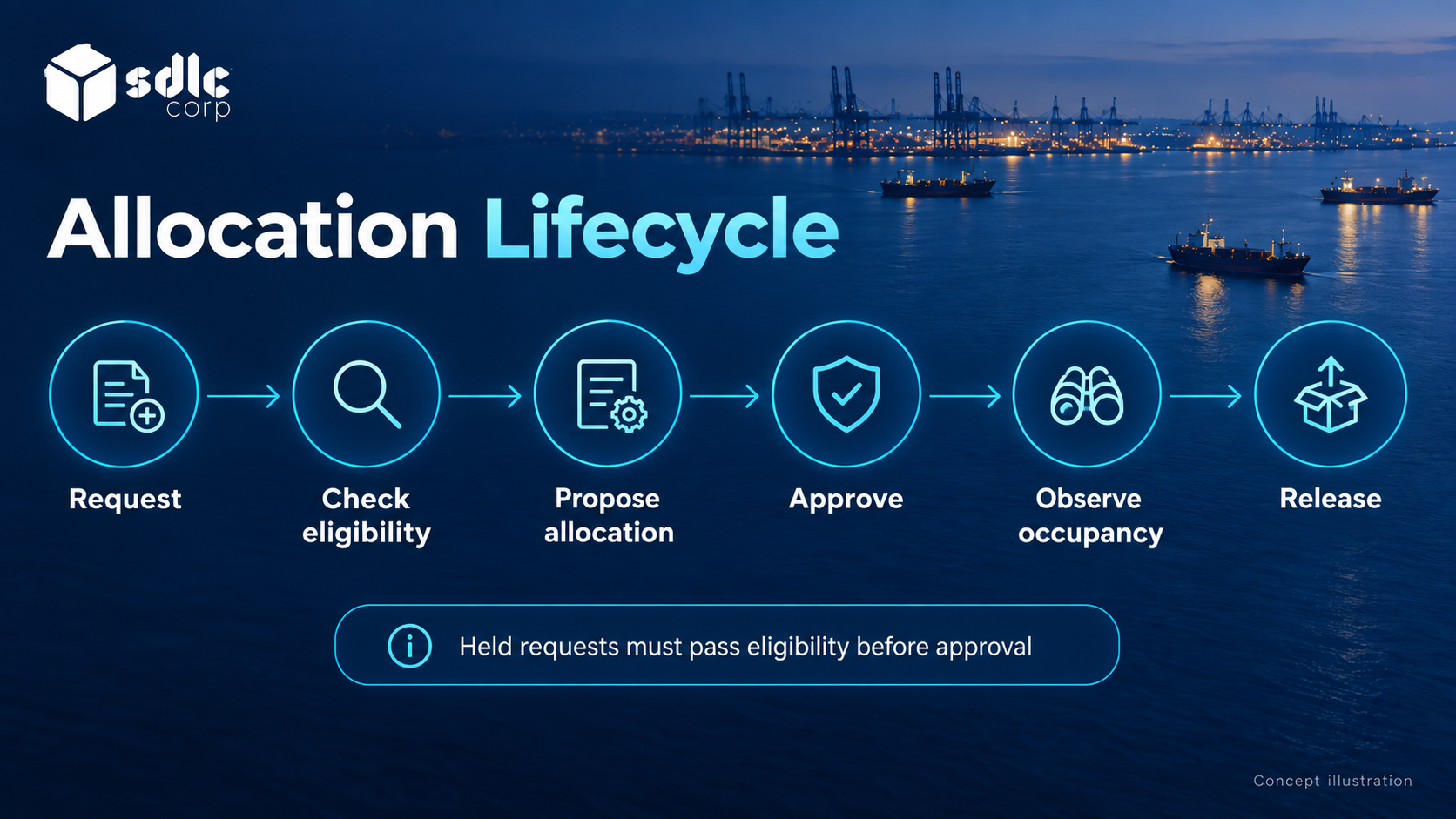
A request asks for space. A proposal suggests an option. An approved reservation commits it under the port's rules. Occupancy records presence, and release ends the allocation. Give each step an owner and an allowed next action. Show these states clearly on both maps and lists.
Use versioned zones and geofence events to define the geographic inputs to allocation. A crossing observation and an approval remain separate records.
Document cancellation and reallocation as carefully as the first assignment. The system should preserve the earlier decision, the reason for change, the approving role, and the affected notifications. This is particularly useful when different shifts need to understand how the current arrangement was reached.
Use the queue eligibility and priority rules to determine which requests reach allocation review; queue rank alone does not reserve a zone.
Hard Eligibility Constraints Vs Allocation Preferences
Explain Why An Option Is Allowed Before Ranking It
| Rule Type | Example to Validate Locally | Expected System Behavior |
|---|---|---|
| Hard constraint | Port-approved zone eligibility or closure | Exclude the option and explain why |
| Missing evidence | Required vessel or environmental information absent | Flag the missing input and follow the approved hold process |
| Preference | Minimize avoidable reallocation | Rank eligible options without overriding constraints |
| Authorized exception | Time-bounded operational override | Require authority, reason and audit evidence |
The authority and its qualified operational specialists must supply the actual limits and decision procedures. A software supplier should not infer navigational clearances or safe separation values from generic examples. Keep configurable rules versioned so a later review can identify the policy applied at the time.
Preferences should be understandable. If the system ranks one eligible area above another, the operator should see the relevant factors and their order. Avoid an unexplained score that prevents the team from judging whether the recommendation fits current conditions.
Work Through An Allocation With No Feasible Option
Suppose two zones are under consideration. The first fails an approved vessel eligibility rule; the second has a conflicting reservation for the requested period. A preference score must not make either option eligible. Show the failed rule and conflicting record, keep the request unresolved and route it to the authorized review process.
If a reservation is released, check the remaining options again using current rules and data. Check once more when the operator approves. Another user may have reserved the space since the recommendation was shown. Explain whether the next action creates an allocation, changes one or waits for more evidence.
Allocate Three Vessels Across Two Zones
Illustrative example
This simplified exercise uses abstract vessel classes and one available slot per zone. It is a software rule example, not a navigational capacity or separation model. Zone A accepts class S; Zone B accepts S or L. Vessel-specific operating constraints have already been approved for the exercise.
| Vessel | Class / Eligibility | Zone A | Zone B |
|---|---|---|---|
| A | S; all required approvals present | Eligible; preference 8 | Eligible; preference 5 |
| B | L; all required approvals present | Ineligible by class rule | Eligible; preference 7 |
| C | S; required approval missing | Blocked | Blocked |
The Proposed And Authorized Result
| Step | Result | Why |
|---|---|---|
| Remove invalid choices | B to A and all C choices excluded | Hard constraints apply before scores |
| Reserve the constrained choice | Propose B to B | B has only one eligible zone |
| Allocate the remaining slot | Propose A to A | A’s preferred zone remains available |
| Human approval | Approver accepts both proposals as revision 1 | Proposal becomes an authorized record |
| Keep C waiting | Missing approval task stays open | No score can make C eligible |
If another operator fills Zone B before approval, the system rejects the stale proposal and reruns the availability check. It must not allocate B into A or exceed the one slot limit to preserve the original plan. When C’s approval arrives, eligibility is reassessed against current capacity; its earlier blocked proposal is not automatically accepted.
Collect Inputs With Provenance And Freshness
List the facts needed for a decision: the call, vessel details, requested service, zones, reservations, restrictions and any relevant weather or tide data. Name the source of each fact. Mark which values an operator must verify.
The Vessel Traffic Management and Information System (VTMIS) data contract and reconciliation approach is relevant when source information changes during an allocation decision. Display the observation time and any missing fields. An apparently precise recommendation can still rely on old data, so freshness must be part of the review experience.
Model capacity in a way that reflects the authority's approved rules. A simple count of vessel icons may not capture spatial restrictions, temporary closures, or reservations. Require the supplier to demonstrate the specific representation being proposed and how operators can inspect it.
Design Approval And Concurrent Updates
Two operators may review the same space before either confirms an allocation. The system should detect the conflict at approval time and provide a clear response. Merely refreshing the map more often does not establish a safe reservation workflow.
Show the proposed place, the rule version, the source data and any open warnings together. If a relevant input changes, check the proposal again before approval. Record who approved it and which version they saw.
An override should be a specific action with a reason and permitted scope. It should not become a universal bypass button. Where a constraint cannot be overridden under the port's procedures, the interface should reflect that distinction.
The permission and audit model should identify who can approve, override and investigate each allocation in its operating area.
Handle Reallocation, Overrides And Unavailable Zones
Test an arriving vessel with incomplete information, a newly restricted area, a delayed departure, a canceled request, and an integration outage. For each scenario, identify the record that remains authoritative and the person responsible for resolution. A system should make an unresolved exception visible rather than quietly invent a replacement status.
Queue priority requires its own policy. Request time, operational urgency, service readiness, and approved priorities can conflict. Keep the ordering rule transparent, record changes, and explain the reason for any manual adjustment. Do not market a particular ordering rule as inherently fair without agreement on the port's objectives.
Evaluate Recommendations And Optional AI
Separate deterministic eligibility checks from optional ranking or prediction. The buyer should be able to test the core workflow even when predictive features are disabled. Ask what data the model needs, what its output means, and when the system abstains or falls back to manual review.
Use representative scenarios with known operational expectations. Compare recommendations against the agreed rules, including borderline and missing data cases. A simulated demonstration can establish an interface behavior; it does not establish measured improvement in utilization or safety at the port.
Build An Acceptance Checklist
- A prohibited option is rejected with a traceable reason.
- A missing mandatory input follows the approved hold procedure.
- Concurrent approvals cannot silently create conflicting reservations.
- Reallocation preserves the original approval and the reason for change.
- A stale feed is visible, with the permitted operating mode clearly shown.
- Historical review identifies the rule version and evidence used.
Add these scenarios to a requirements checklist with acceptance evidence. During the supplier selection process, ask bidders to demonstrate the same cases and disclose which behaviors require configuration or custom work. That creates a more useful comparison than counting feature names.
Use a small acceptance set containing an ordinary allocation, a blocked option, a concurrent approval and a cancellation with an auditable outcome.
Keep a complete approval workflow in the first-release feature scope before adding optional ranking or forecasting capabilities.
Conclusion
Test allocation with competing requests, a changed restriction and missing information. Inspect the reason for every excluded option and verify that approval cannot consume capacity already committed elsewhere.
Once those controls work, assess whether ranking improves the operator's choice. Accept a recommendation method only when its preferences remain separate from mandatory constraints and approval authority.
Review Allocation Requirements With SDLC Corp
SDLC Corp can be consulted about whether the anchorage operations platform supports your approved allocation workflow through configuration or requires custom software development services. Provide the eligibility rules, approval roles and conflict scenarios. Request a clear boundary between recommendation and authorization, with demonstrable handling of concurrent approvals, overrides and rule changes before agreeing the implementation scope or its acceptance criteria.
Frequently Asked Questions
Can A High Preference Score Override A Constraint?
No. Exclude options that fail mandatory rules before ranking the feasible ones. If there is no eligible option, preserve the request and explain the blocking condition rather than offering an invalid allocation.
How Do Capacity And Occupancy Differ?
Capacity expresses what the approved rules permit. Occupancy records the observed or confirmed current state. Reservations and restrictions can reduce availability even when the corresponding space is not currently occupied.
What If Two Requests Compete For One Slot?
Check capacity when the approval is committed, using the agreed concurrency rules. Retain one valid allocation and an explicit conflict or pending result for the other request, with enough history to explain what happened.