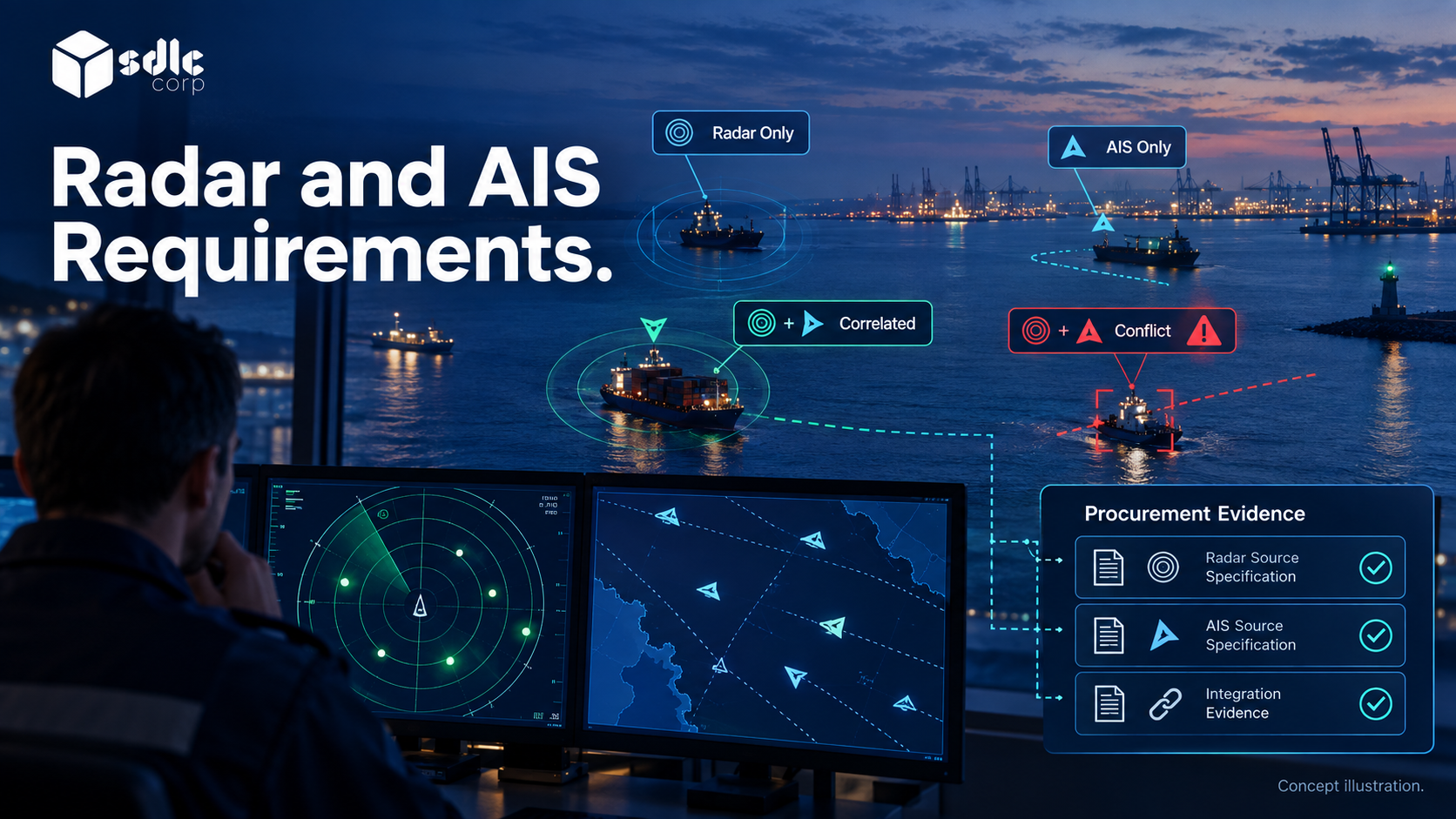
The must-have anchorage management system features are the ones a single vessel call needs to finish: request intake, approval, allocation, queue and occupancy, exception handling, source freshness and audit history. Forecasting and optimization can wait.
In practice, the first release should support one complete piece of operational work, from request through approval, change and release. Permissions, freshness, exceptions and history belong with that workflow, not in a later finishing phase.
Think of it as a minimum viable operating scope, not a minimum demo: small enough to deliver, complete enough to run a real shift.
Which Anchorage Management System Features Are Mandatory?
Connect the Feature to an Operator Task
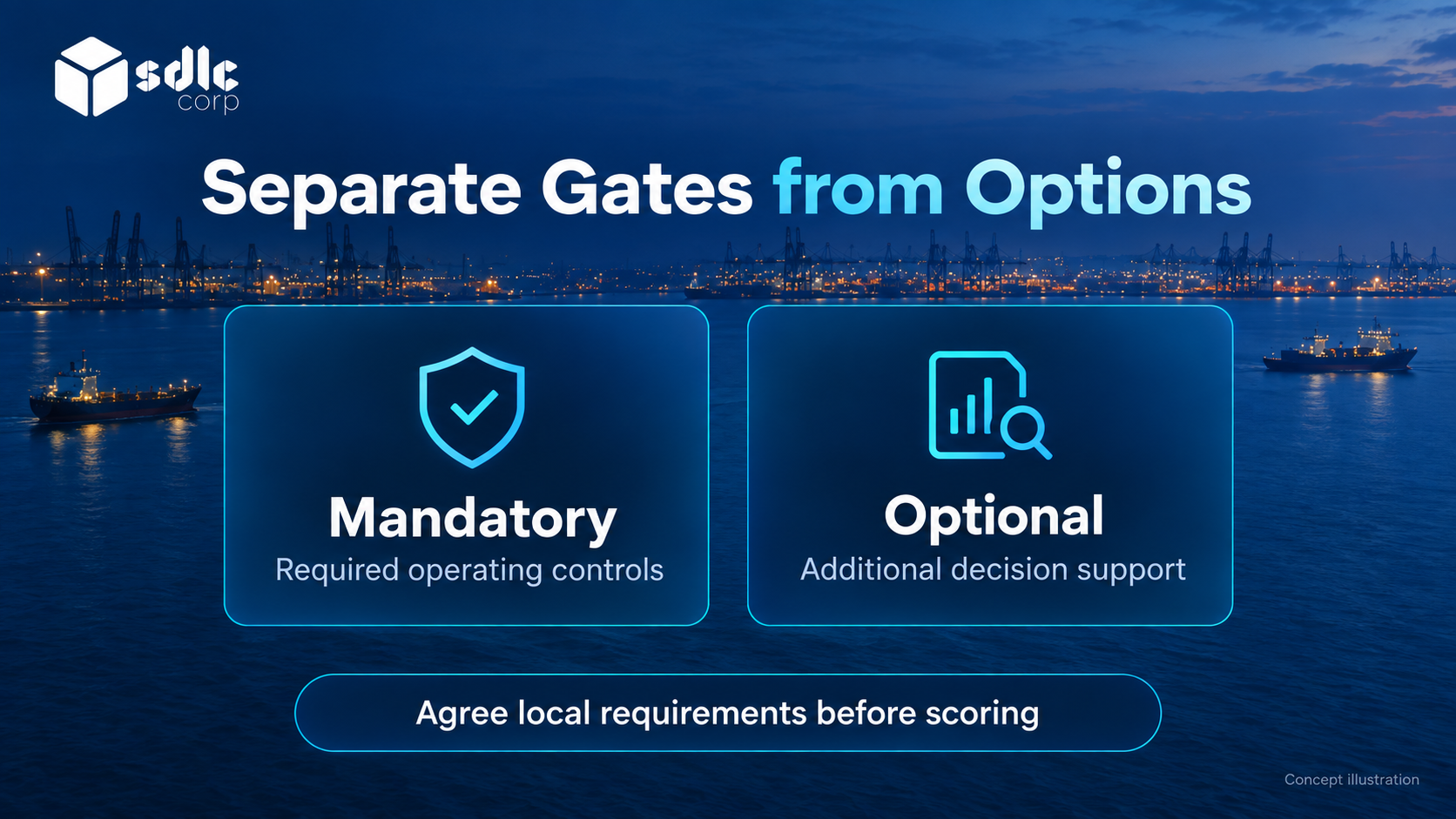
Agree what makes a feature mandatory before scoring it. It must support a task the port has to complete, or meet a security, legal or contractual obligation. Record that reason, and rank optional improvements separately.
| Capability | Must-Have Because | Failure Without It |
|---|---|---|
| Shared vessel call record | Every other function references it | Parallel spreadsheets return |
| Request and approval workflow | Allocation is a decision, not a note | No accountability for who approved |
| Queue and occupancy view | Operators need current state | Status answered by phone |
| Exception list | Work that is stuck must be visible | Problems found after the fact |
| Searchable history | Decisions must be reconstructable | No defensible audit |
Ask how each claimed feature is delivered. A native function, a configured extension and a roadmap promise are three different answers, and only the first two count toward a first release.
The Anchorage Management System Requirements Checklist turns each mandatory feature into observable behavior with an acceptance condition.
Core Operational Features
These are the functions operators touch during a shift. Judge the complete task, including handoffs to people or external systems, and whether the application records the resulting state and evidence.
- Vessel call record with identifiers, status and history.
- Anchorage request capture, including who submitted it and when.
- Approval, amendment, rejection and release, each attributed.
- Allocation against defined zones with capacity and restrictions.
- Queue management with position, priority and the reason for both.
- Arrival and departure confirmation, with the source recorded.
- Exception and hold handling with owner and next action.
Anchorage Allocation Software covers what good looks like in the allocation layer, including how constraints and preferences are kept separate.
A Complete First Release for One Operating Area
Illustrative example
This release serves one approved area and a limited operator group. It assumes interface access is available and keeps movement authority with the existing procedure.
| Include in Release 1 | Minimum Working Behavior | Deliberately Deferred |
|---|---|---|
| Request intake | Required fields, amendment and cancellation | Bulk agent onboarding |
| Allocation | Eligibility, conflict check and authorized approval | Automated preference optimization |
| Occupancy and release | Observed state separate from approval; attributed closure | Wider multi-terminal rollout |
| Queue and exceptions | Owner, reason, age and next action | Predictive queue scoring |
| Source display | Current, stale or unavailable, with provenance | Additional nonessential feeds |
| Access and history | Role enforcement and before-and-after decision records | Optional management analytics |
| Operations | Restore test, support route and degraded workflow | Advanced reporting customization |
Release Gate: One Call Must Finish
| Step | Passing Result |
|---|---|
| Agent submits C-182 with missing data | Correction requested without creating an allocation |
| Operator completes review | Eligible proposal enters the approval queue |
| Approver accepts a zone | Attributed allocation and history created |
| Feed stops | Source state changes; affected action follows the fallback policy |
| Authorized release is recorded | Allocation closes and capacity reconciles |
If an essential allocation check depends on an unbuilt forecasting module, the first release is incomplete.
Either implement that check as an approved deterministic rule, or narrow the operating scope until the dependency is resolved.
Connect Scope to Dependencies and Evidence
| Capability | Dependency | Acceptance Evidence |
|---|---|---|
| Request and approval | Approved fields, roles and operating rules | Complete, amend and cancel a call with its history intact |
| Source display | Permitted feed and timestamp contract | Current, stale and recovered states shown without losing provenance |
| Allocation | Approved capacity representation and permissions | Conflicting proposals produce one authorized result |
| Support and recovery | Assigned support owners and recovery environment | Restored records reconcile and the operator can resume the workflow |
This release boundary is a planning example, not a universal minimum product. Defer a capability only when its absence leaves the accepted workflow complete and usable.
Map, Monitoring and Alerts
A map demonstration should include stale data and operational exceptions. Ask what the map does when data is old.
- Approved zones and restrictions rendered from configuration, not hard-coded.
- Vessel positions with a visible freshness indicator.
- Source provenance where more than one source contributes.
- Geofence events tied to an operational rule, not just a visual boundary.
- Alerts with owner, evidence and a closure path.
What Port Operators Need From A Dashboard separates a dashboard that supports a decision from one that only displays totals.
Where sensor resilience is in scope, the Radar and AIS Sensor Fusion Requirements Checklist defines what operators need when a source fails.
Integration, Administration and Security
Include these functions in evaluation because they decide maintenance, security and integration effort after launch.
- Documented interfaces to the traffic, call and community systems you use.
- Reference data maintained in one place and consumed elsewhere.
- Configurable zones, rules, statuses and thresholds without a code change.
- Role-based permissions distinguishing view, propose, approve and configure.
- Full audit of operational and administrative actions.
- Environment separation and a tested restore.
The Anchorage Management System RFP Checklist puts these integration and security requirements in a form every bidder must answer, so responses are comparable.
Optional and Advanced Capabilities
Treat these as differentiators once the core is proven, never as reasons to accept a weak foundation.
- Predictive congestion or arrival analytics, with uncertainty shown.
- Scenario planning, kept distinct from forecasting.
- Automated allocation proposals, with operator approval retained.
- Mobile or field access for confirmations.
- Advanced reporting and self-service analytics.
Predictive arrival analytics support practices such as the IMO Just-in-Time Arrival Guide, but they depend on reliable call and position data. That core has to work first.
Mobile confirmation becomes mandatory when arrivals and departures are confirmed in the field and no other source records them. Otherwise it can follow later.
Ask for the decision boundary in each case: what the system proposes, what it decides, and what a person must confirm. A capability that removes an accountable operator from a decision is a risk, not a feature.
Use the Anchorage Management System Cost breakdown to compare the operating core with separately scoped enhancements.
Select a Release That Works Without Future Modules
A must-have is an acceptance condition, while Phase 1 and Phase 2 describe delivery timing. Keep them separate: a mandatory control cannot become optional because its interface is difficult.
Instead, narrow the first release so the workflow runs within approved limits, or hold the release until the dependency is resolved.
These tiers mirror MoSCoW prioritization (must, should, could, won't this time), a method widely used for release scoping.
| Group | Selection Test | Example Decision |
|---|---|---|
| Must-have gate | Would its absence prevent approved use? | Enforce approval permissions before operational release |
| Phase 1 | Does it complete a frequent task within the agreed boundary? | Deliver request review, amendment and cancellation together |
| Phase 2 | Can the first release work without it? | Add a further supported source after access is available |
| Optional | Is there evidence of value beyond the working core? | Evaluate an advanced forecast as a separate pilot |
For each candidate, record frequency of use, failure impact, external dependencies, configuration maturity and the available acceptance test.
A screen that depends on an unavailable approval or data service is not an independently usable release. Sequence interface-dependent capabilities through the Anchorage Management System Implementation Roadmap.
Demonstrate Must-Have Features Before Scoring Optional Ones
Test mandatory requirements as pass-or-fail gates, and resolve any failure through the port's agreed approval process before comparing optional features. Use your own scenarios and one scoring sheet for every supplier.
The weights below are an illustrative starting point. Adjust them to your port's priorities, but agree them before the first demonstration.
| Block | Example Weight | Validation Method |
|---|---|---|
| Core operational workflow | 35% | Scripted scenario walkthrough |
| Integration and data | 25% | Interface evidence and sample data |
| Map, alerts and degraded modes | 20% | Live scenario including a source loss |
| Security and administration | 15% | Configuration walkthrough and evidence |
| Optional and advanced | 5% | Discussion, not score inflation |
The Anchorage Management Demo and Proof-of-Concept Checklist gives the scenario set to run. A shared scoring sheet keeps the comparison defensible afterwards.
Conclusion
Choose the anchorage management system features that let the smallest operating scope be accepted on its own, then test its full workflow and exceptions. Remove a feature only when the remaining process stays complete and controlled.
Keep optional modules in a separate plan with their dependencies. A successful first release is a usable operational capability, not a set of disconnected screens awaiting later development.
How SDLC Corp Can Help
Evaluate a first release of our Anchorage Management Software with SDLC Corp, using Custom Software Development Services only where a documented requirement needs it.
Bring your mandatory workflow and deferred capabilities. We will scope a release that completes the operating task without future modules, with dependencies, acceptance evidence and later enhancements kept separate.
Frequently Asked Questions
Which Features Are Essential in the First Release?
The functions needed to complete the selected workflow with its permissions, exceptions and recovery. Requests, approvals, allocation changes and history should work together rather than being assessed as isolated features.
What Is the Difference Between Must-Have and Phase 1?
Must-have is an acceptance condition: without it, the release cannot be used. Phase 1 is delivery timing. A mandatory control cannot move to a later phase just because it is hard to build.
Can Predictive Features Be Deferred?
Yes, when the accepted operating process does not depend on them. Keep the source-quality indicators and controls that current decisions need, even if forecasting and optimization stay outside the release.
How Should Anchorage Software Features Be Weighted?
Weight the core workflow highest, then integration and data, degraded modes, security, and optional features last. Agree the weights before any demonstration and use the same sheet for every supplier.
Is Mobile Access a Must-Have Feature?
Only when arrivals, departures or other events are confirmed in the field and no other source records them. Otherwise mobile access can follow once the core workflow is proven.
How Should Features Be Accepted?
Run a representative call through normal work, amendments, conflicting actions and a source outage. Record the outcome against each mandatory behavior and identify any dependency that prevents completion.