
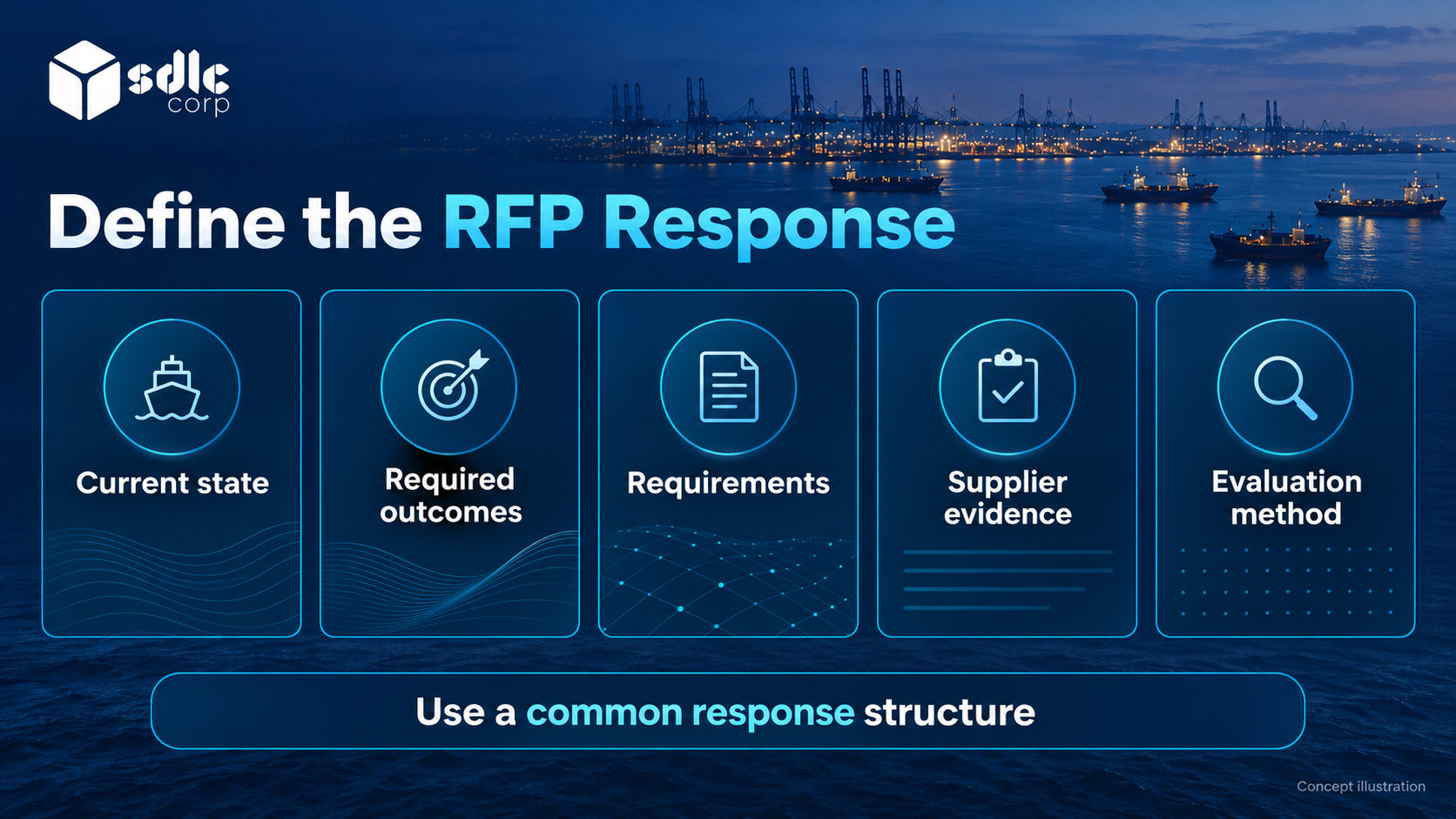
A good anchorage management system RFP gives every bidder the same scope, requirement IDs, interface owners, demonstration scenarios and pricing template, and makes each bidder label every answer as standard, configured, custom, third-party or excluded.
That labelling is what makes prices and delivery promises comparable. A shared feature list alone leaves suppliers free to assume different interfaces, acceptance conditions or support obligations.
Describe the Current State and Intended Outcome
Describe how requests, approvals, queues and occupancy are handled today. Name the teams and systems involved, show where records disagree or staff repeat work, and state which tasks the new system will own.
Use the Anchorage Management System Scope of Work structure to fix the work boundary, outputs and exclusions before bidders price them.
Describe intended improvements as objectives to measure, and keep unsupported savings or safety claims out of the baseline. If bidders propose quantified benefits, require their assumptions, data needs and measurement plan separately from delivery commitments.
Require Bidders to Separate Existing, Configured and Proposed Work
Make Bidders Answer the Same Question in the Same Form
| RFP Section | Required Bidder Response | Buyer Check |
|---|---|---|
| Workflow scope | Standard, configured, custom, third-party or excluded | Coverage matches the operational model |
| Interfaces | Contract, owner, prerequisites and source-side work | Dependencies have an accountable owner |
| Delivery | Stages, deliverables, staffing and acceptance evidence | Plan addresses actual constraints |
| Security and operations | Controls, evidence, support boundaries and recovery | Claims are reviewable |
| Commercials | One-time, recurring, usage, change and exit costs | Quotes use comparable assumptions |
Give each requirement a stable reference and have bidders answer against it, with supporting notes for their approach. Keep proposed future features separate from what they can show today: a planned release is not evidence of current capability.
Questions to Ask an Anchorage Management Vendor turns unclear responses into named evidence requests rather than a bare "yes."
An Anchorage Management System RFP Bid Pack You Can Compare
Illustrative example
This sample structure is a procurement drafting aid for local review, not a ready-made legal agreement.
| RFP Part | Buyer Provides | Bidder Returns |
|---|---|---|
| 1. Operating scope | One-area, request-to-release journey and exclusions | Proposed coverage and deviations |
| 2. Requirements | Stable IDs and acceptance conditions | Response by requirement ID |
| 3. Interfaces | Owners, access status and permitted sample formats | Adapter scope and source-side dependencies |
| 4. Demonstration | Common normal, conflict and outage scenarios | Demonstration evidence and unresolved gaps |
| 5. Delivery | Buyer responsibilities and decision gates | Named team, dependency schedule and outputs |
| 6. Commercials | Pricing period and cost categories | One-time, recurring, optional and exit costs |
| 7. Acceptance and support | Test ownership and incident scope | Commitments, exclusions and proposed terms |
Sample Clauses and Response Schedule
Adapt these drafting examples with the port's procurement and legal reviewers, and replace role, scope and acceptance placeholders with approved local requirements before issue.
Workflow clause: "For each in-scope request, preserve its proposed, approved, amended and released states with the authorized actor, reason and prior values. Demonstrate the normal path and a rejected unauthorized change."
Acceptance clause: "Provide the agreed workflow and failure evidence for each deliverable. Acceptance requires the named owner's decision against the stated criteria; incomplete mandatory evidence remains an open condition."
Requirement clause: "For REQ-03, the proposed release shall prevent two approvals from consuming the same single available slot. A concurrent submission test must produce one accepted allocation and one traceable conflict response."
Evidence clause: "For each interface, state whether it exists, needs configuration or needs development, plus the version tested, access prerequisites and the party responsible for source-side changes."
| Requirement | Sample Bidder Answer | Evaluation Consequence |
|---|---|---|
| REQ-03 concurrency | Available in proposed version; test log D-3 attached | Demonstrate against buyer scenario |
| INT-02 source adapter | New development; source sandbox due from port | Conditional dependency and separate price |
| OPS-04 restore | Proposed test during acceptance | Contracted future evidence, not a current pass |
An "available" answer without version or evidence remains unverified. A priced dependency can be compared; an undisclosed assumption cannot.
Attach the Requirements and Interface Baselines
Attach the Anchorage Management System Requirements Checklist as the baseline: workflows, permissions, audit, reporting, usability, service conditions and acceptance-critical exceptions.
Specify outcomes without unnecessary implementation detail, and state mandatory constraints explicitly rather than burying them in description.
For Vessel Traffic Management and Information System (VTMIS) interfaces, list the owners, sample formats where permitted, environment availability and outstanding access dependencies. Integrating VTMIS With An Anchorage Application shows what to cover.
Request source-side costs and incumbent supplier work as separate line items, and require bidders to state what their price assumes about data quality and interface support.
Define which records and history will move, who cleans the data, how the port checks the result and how unusable records are handled. "Migration included" does not tell the buyer which data it will receive.
Specify Demonstration and Proof-of-Concept Evidence
Give shortlisted bidders the same scenarios: a normal request, incomplete vessel data, a conflicting allocation, an unavailable integration, an authorized correction and an audit review. Evaluators should record observed behavior, not general impressions.
If a proof of concept is required, define its time limit, data rights, environments, outputs and success criteria. Sample data supports workflow evaluation, but it does not prove production access, data quality or performance.
Ask each reference to state its scope (proposal, demonstration, pilot or production) and what was actually implemented. A proposed target is not a measured customer result.
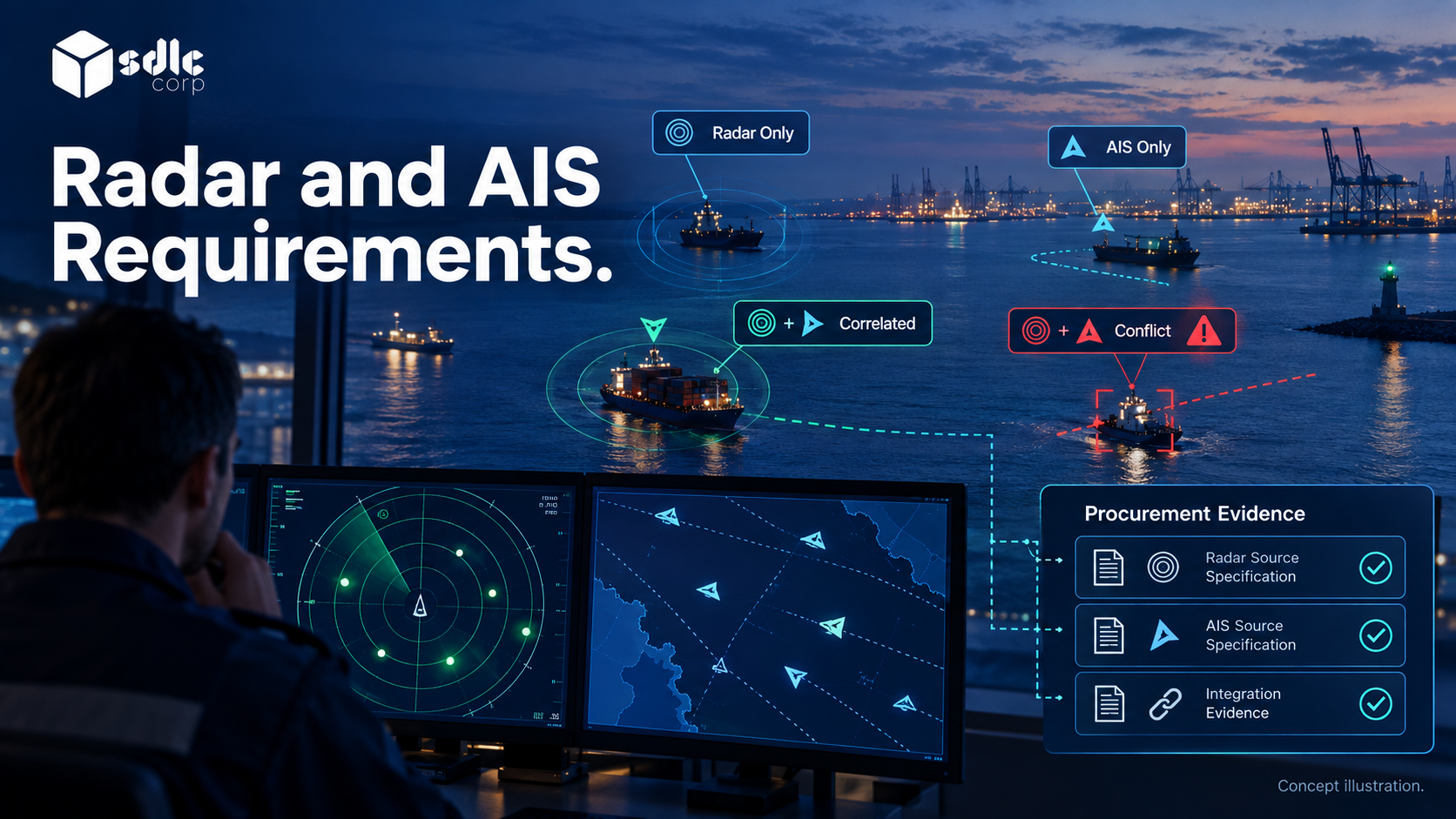
Where radar or fusion is proposed, add source loss, radar-only identity, conflicting observations and controlled recovery to the scenarios. The Radar and AIS Sensor Fusion Requirements Checklist lists what bidders must evidence.
Evaluate Security and Delivery Practices
Ask how the supplier develops, tests, releases and supports the software. Request evidence of vulnerability handling, access-control testing, dependency management, secure configuration and incident responsibilities.
The NIST Secure Software Development Framework (SP 800-218) gives a recognized structure for those questions. Confirm which obligations apply to the port's procurement before making them mandatory.
Require an architecture and hosting explanation, a recovery plan, and a description of secrets and privileged access. State which evidence is due during evaluation and which is a contractual delivery obligation.
A certification logo or broad assurance statement is no substitute for reviewing the actual proposed service boundary.
Define Acceptance, Support and Commercial Boundaries
Name who accepts each output and how open defects affect that decision, covering interface tests, operator tasks, training, documents, restore tests and support readiness. If another system blocks a test, record the delay; an unrun test is not a pass.
Support scope should split application, infrastructure, integration and third-party responsibilities. Define severity by operational impact, separate response from restoration, and specify change, escalation, reporting and exit assistance.
Normalize prices using the categories in Anchorage Management System Cost. Ask bidders to name excluded licenses, feed charges, environments, travel, migration effort and support tiers.
A fair comparison shows uncertainty instead of forcing every estimate into an apparently exact total.
Run the RFP Process Fairly
- Issue a request for information (RFI) first if you are unsure what the market offers, then fix the RFP scope.
- Set a fixed clarification window, and share every answer with all bidders as a written addendum.
- Use two envelopes: score the technical and evidence response before opening prices, so cost cannot bias capability scores.
- State the award basis upfront: lowest compliant price, or best value (often called most economically advantageous tender).
- Set page or word limits per section so responses stay comparable.
Apply a Consistent Evaluation Process
First check that each bid meets the conditions required to proceed, then score the rest with the same published method. Keep the evidence behind each score and any conditions still to resolve.
Before issuing, confirm that requirements, evidence requests, scoring and commercial schedules share one scope, and name who evaluates each response.
The Anchorage Management System Vendor Evaluation Scorecard supports comparison only after mandatory gates and the agreed procurement method have been applied.
Conclusion
Issue your anchorage management system RFP with one requirements baseline, response schedule and set of evaluation scenarios, and require bidders to state each assumption beside the deliverable and price it affects.
Before selection, resolve material differences in what each bid includes. An unanswered dependency or untested capability should stay visible, not disappear inside a total score or headline price.
Explore RFP Consulting with SDLC Corp
Use SDLC Corp's Software Consulting Services to prepare a procurement brief, with our Anchorage Management Software as one option to evaluate. Bring your workflow, requirements and interface baseline.
We will separate available functionality, proposed development, third-party dependencies and exclusions, using the same response and acceptance structure as other suppliers so our proposal stays comparable.
Frequently Asked Questions
What Should the RFP Contain?
Operating scope, requirements, interface assumptions, deliverables, acceptance scenarios and a bidder response schedule. Ask suppliers to identify exclusions, dependencies and the evidence behind each claimed capability.
Should We Issue an RFI Before the RFP?
Yes, if you are unsure what the market offers or how suppliers price integration. An RFI informs the scope; the RFP then asks every bidder the same fixed questions.
How Do We Keep Price from Biasing the Technical Score?
Use a two-envelope process. Evaluators score the technical and evidence response first, and prices are opened only after those scores are locked.
Should We Prescribe the Technology Stack?
Only where a real integration, security, operating or support constraint requires it. Otherwise ask bidders how their design meets the outcomes and how the port will maintain it.
How Should Proposed Development Be Evaluated?
Require its scope, milestone, dependencies, acceptance test and cost assumption. Keep it separate from demonstrated capability, and treat equivalent responses from every bidder the same way.
How Long Should Bidders Have to Respond?
Long enough to answer every requirement ID with evidence, typically several weeks for a scope of this kind, plus a clarification window. Too short a period favors bidders who answer "yes" without proof.