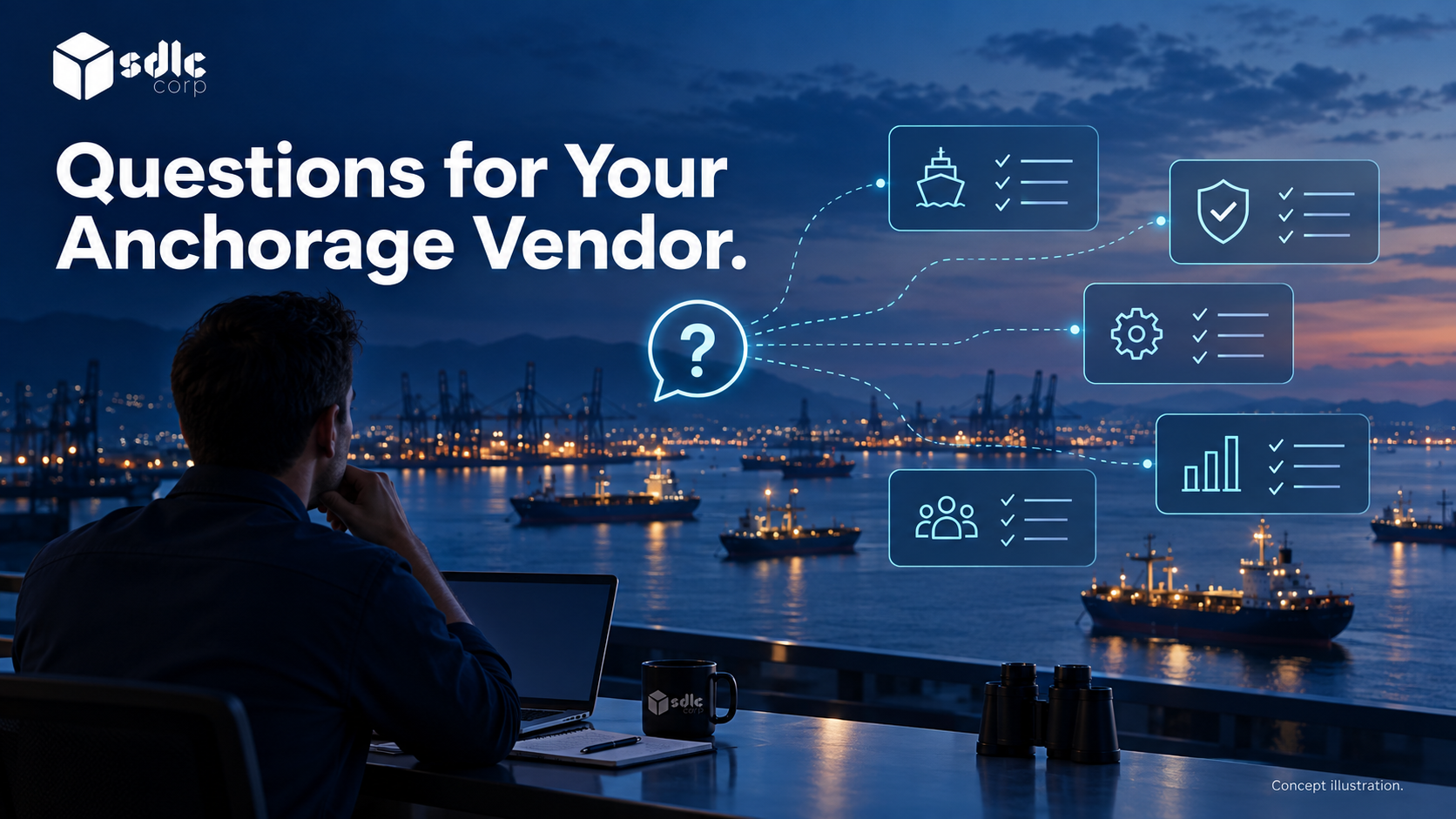
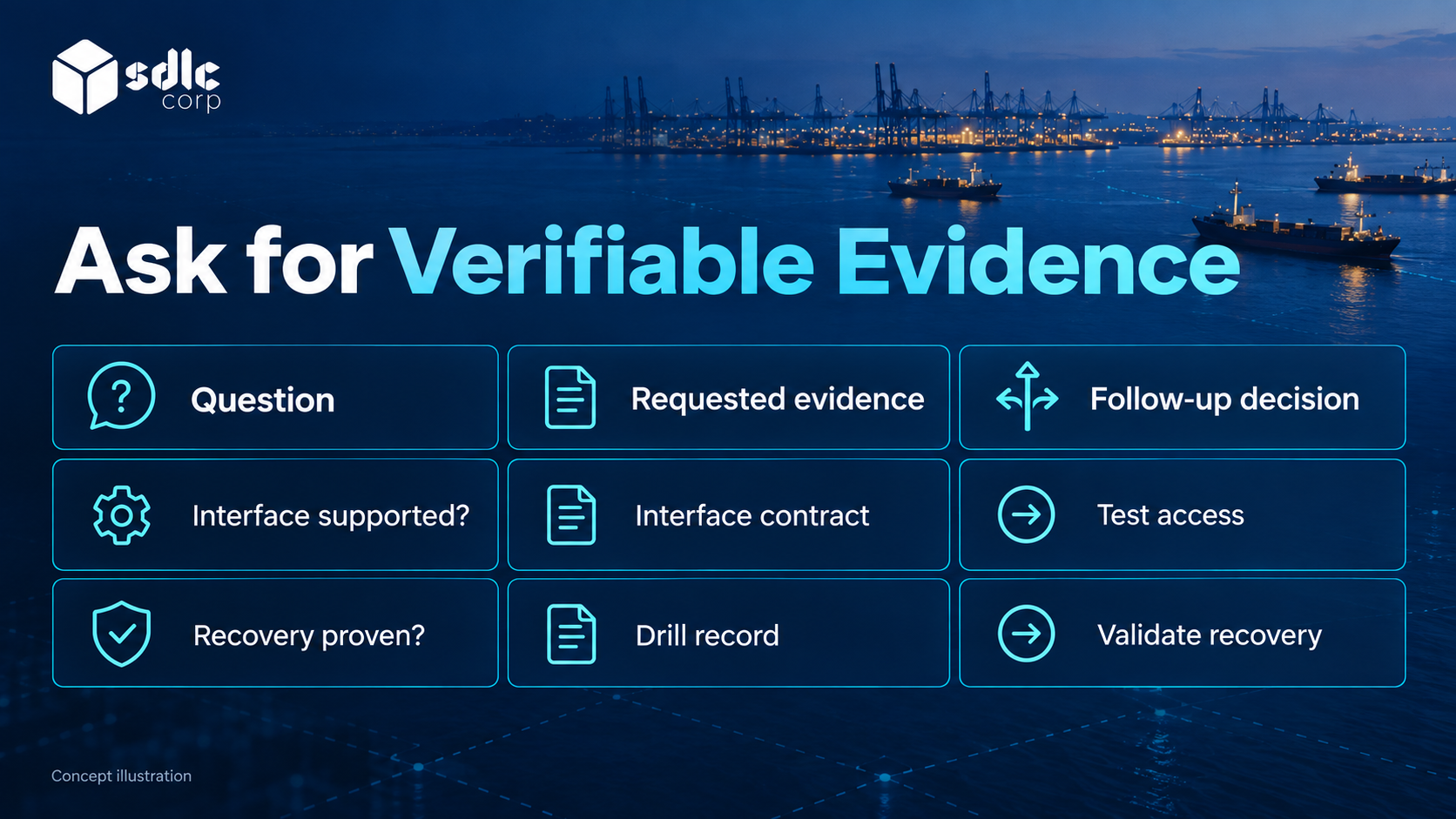
The best anchorage management vendor questions ask for evidence, not assurances: a live run of your workflow, access to your installed interfaces, access-control and restore tests, a named delivery team and defined exit terms.
Treat any unproved mandatory requirement as a selection blocker. A longer feature list or a lower price never compensates for it. Use the tables below, each with the evidence to request and the red flag to watch for.
Start with the Conditions That Can Stop Selection
Agree mandatory conditions before interviewing suppliers: permitted deployment, essential approval controls, accessible interfaces and an accountable support route. Name who decides whether each one passes.
A promise to investigate later is an open dependency, not current evidence. Take the conditions from your How to Write an Anchorage Management System RFP requirement structure so every supplier answers the same questions.
Keep a Clarification Log
Illustrative example
| Question | Response | Evidence Reference | Open Condition | Owner | Due |
|---|---|---|---|---|---|
| INT-02: Can you write approved allocations to our VTMIS? | Yes, via adapter | None yet; design note only | No authorized test access | Port IT and incumbent supplier | Before shortlist decision |
Record each answer as demonstrated, proposed development, third-party work or roadmap. These tables organize the interview; they do not replace specialist testing.
Check Workflow Fit and Configuration Limits
| Question | Evidence to Request | Red Flag |
|---|---|---|
| Can a request be amended and cancelled without losing its history? | Complete workflow with linked records, actors and previous states | Only the initial request screen is demonstrated |
| Can our approval rule change through a supported mechanism? | Configuration or extension demonstration and upgrade test | A roadmap slide or an unexplained core modification |
| What happens when competing proposals claim the same capacity? | Conflicting approval scenario and resulting records | Both screens appear successful without reconciled state |
Run the same scenario for every supplier, and ask to see the state left after an exception, not just the success screen. Proposed work needs a deliverable and an acceptance condition.
The Anchorage Management Demo and Proof-of-Concept Checklist structures that evidence.
Establish Interface Access and Data Ownership
| Question | Evidence to Request | Red Flag |
|---|---|---|
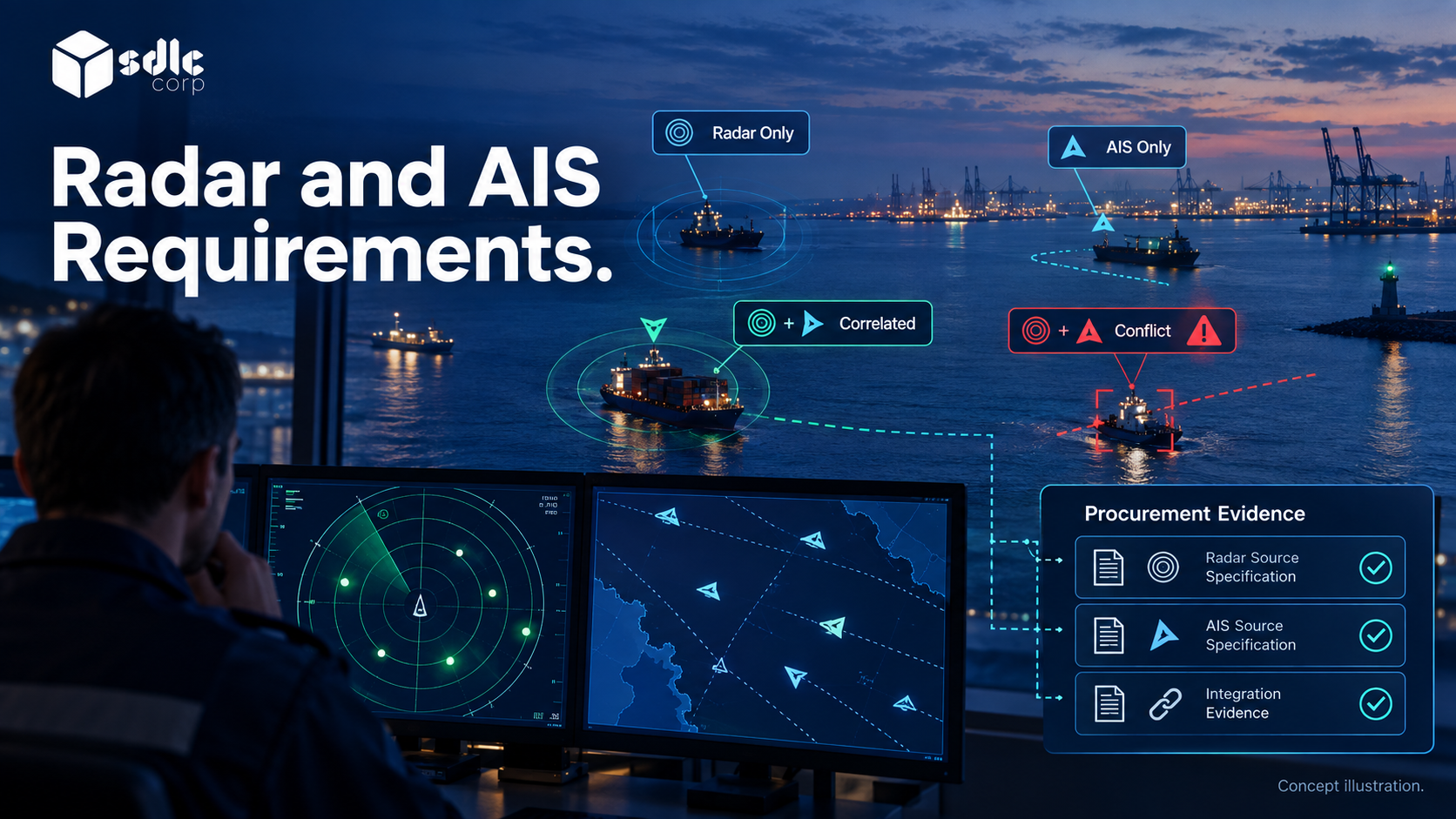
| Can you use our installed source interface? | Version, supported operation, permission, sample message and named source owner | "We support all systems" without the installed contract |
| Which system may change each field or workflow state? | Field-level ownership and conflict example | The newest timestamp always wins |
| What happens when a change receives no acknowledgment? | Operation lookup, retry contract and reconciliation result | Blind resend can create another operational change |
Access often depends partly on the port or the incumbent supplier. Name that owner, and keep read access separate from permission to write.
If a required operation is unavailable, record the accepted alternative or leave the condition blocked. The Anchorage Management Integration Checklist lists the evidence still needed.
Test Access Controls and Audit Evidence
| Question | Evidence to Request | Red Flag |
|---|---|---|
| Can one organization read another organization's restricted call? | Direct request, export and notification tests | Only hidden menus are demonstrated |
| What happens when an approver's privileges are revoked? | Active-session test and role-change history | Permission remains indefinitely in an open session |
| Can an administrator change or erase operational history silently? | Audit access policy and alteration-detection test | An assurance statement without application evidence |
The first row tests what OWASP calls Broken Object Level Authorization, the top API security risk. A certification does not prove the proposed application prevents it.
Apply the Anchorage Management Security Due Diligence questions to the actual release and hosting scope, and record what remains untested.
Establish Recovery, Delivery and Commercial Responsibilities
| Question | Evidence to Request | Red Flag |
|---|---|---|
| What can operators do during a source outage? | Controlled loss, permitted manual work and reconciled recovery | A combined symbol stays current throughout the outage |
| Who owns an incident involving the application and an external feed? | Named incident owner, coverage and escalation handoffs | Each supplier redirects the port to the other |
| Who will deliver and accept the proposed work? | Assigned team, dependencies, deliverables and acceptance owners | Profiles of people who are not committed to the project |
| What does the price exclude, and what leaves with us at exit? | Implementation and recurring breakdown, source fees, export schema, history and assistance terms | "All included" or "your data is yours" without defined obligations |
Ask for a restore result, not proof that backups run. NIST SP 800-34 sets out contingency plan testing as a distinct step for exactly this reason.
Technical testing and operator acceptance need distinct owners. Price future capabilities as future work; never score them as demonstrated.
Anchorage Management Vendor Questions on Viability and References
Anchorage software is a niche market, and some suppliers are small specialist firms. Check that the vendor and its team will still be there after go-live.
| Question | Evidence to Request | Red Flag |
|---|---|---|
| How much of the work is subcontracted, and to whom? | Named subcontractors and their scope | Subcontracting disclosed only after award |
| What happens if a key person leaves? | Backup roles and documented knowledge transfer | One named expert holds all product knowledge |
| What protects us if the vendor fails? | Financial statements, source code escrow or code ownership terms | No escrow and no export of configuration |
| Can we speak to a port at comparable scope? | Reference contact with the same version and interfaces | Only logos, or references for a different product line |
| What failed at the reference port's go-live? | A candid account of defects, dropped interfaces and recovery | A reference that reports no problems at all |
Close Each Clarification with a Decision
Take the log example above: a plausible adapter design with no authorized test access. The follow-up records who obtains access, what source-side work is needed and when the contract can be tested.
Selection may stay conditional, but the integration cannot be called proven.
Close a question when its evidence meets the agreed condition, or record why the port accepts the limitation. Never close it because the supplier repeated the claim more confidently.
Closed evidence becomes a rating in the Anchorage Management System Vendor Evaluation Scorecard, and open conditions carry into How to Select an Anchorage Management System.
Conclusion
Ask the same anchorage management vendor questions of every shortlisted supplier, and end each session with an evidence list and named follow-ups.
Tie every open answer to the workflow, cost or delivery assumption it affects. Where evidence cannot be provided, keep the uncertainty in the selection record rather than treating an assurance as confirmation.
Discuss Open Questions with SDLC Corp
Bring your clarification log when discussing our Anchorage Management Software or Software Consulting Services with SDLC Corp.
Ask us the same questions you ask other suppliers, including implementation ownership, supported interfaces, recovery and exit terms. We will separate demonstrated capability from proposed work.
Frequently Asked Questions
Which Vendor Questions Matter Most?
Prioritize the mandatory workflow, permitted interfaces, proposed team, failure recovery and ongoing support. Ask how each will be demonstrated and what depends on the port or another supplier.
What Should We Ask a Reference Customer?
Ask about comparable scope, the version and interfaces in use, what failed at go-live and whether the proposed team delivered their project. A logo alone does not establish relevance.
How Do We Check a Small Vendor's Viability?
Request financial statements, subcontracting details and key-person backup plans. Ask for source code escrow or code ownership terms, and confirm you can export your configuration and history.
What Belongs in a Clarification Log?
The question, the supplier's response, the evidence reference, any open condition, its owner and a due date. Mark each answer as demonstrated, proposed, third-party or roadmap.
Is a Security Certification Enough Evidence?
No. A certification supports the assessment, but it does not prove the proposed application blocks one organization from reading another's records. Test that directly.
When Is Vendor Due Diligence Complete?
When the required evidence has been obtained or every remaining condition has an explicit decision. If confidentiality blocks one route, agree an alternative rather than silently dropping the requirement.