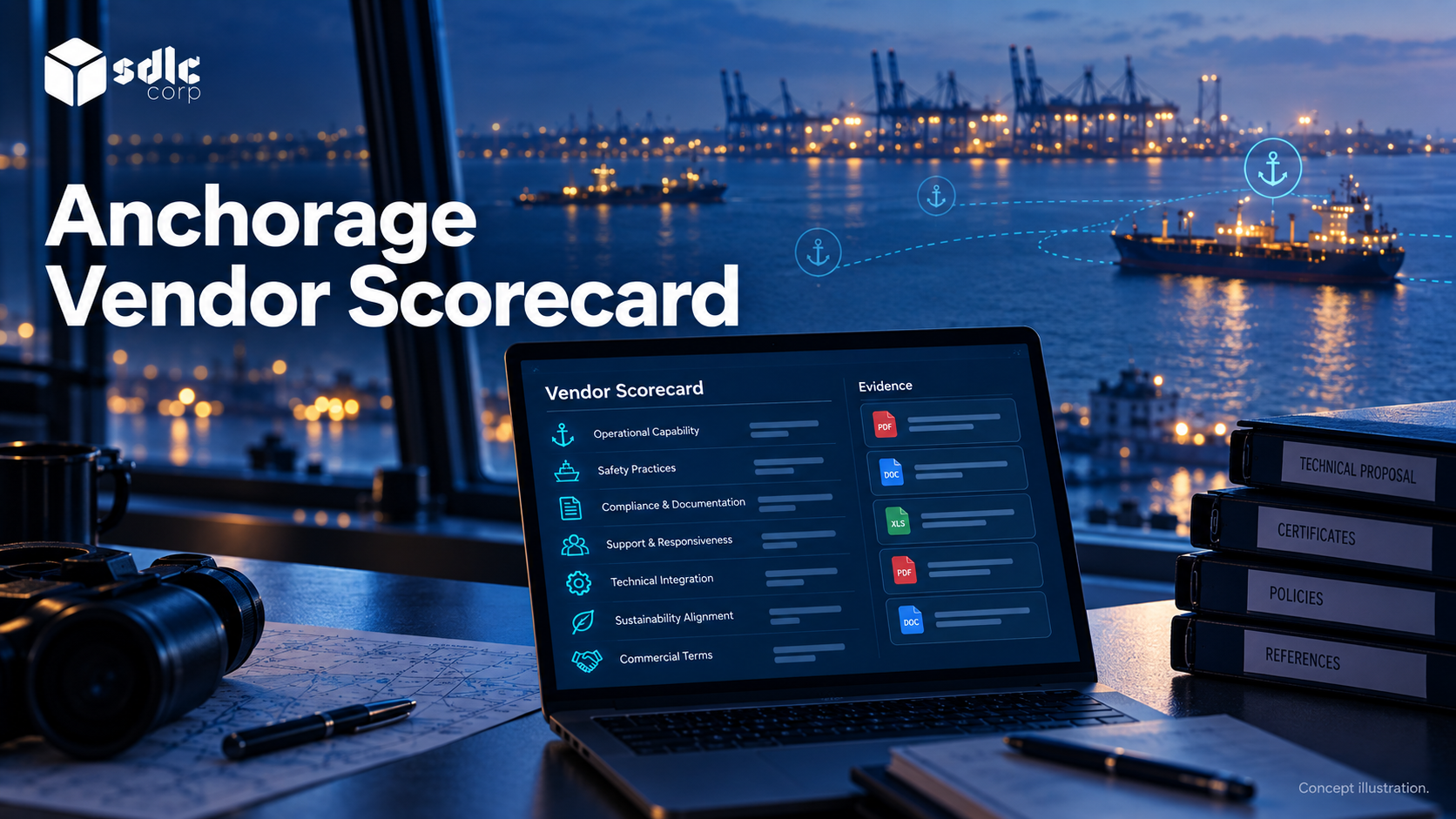
Anchorage management system vendor evaluation works in two steps: pass or fail every bid on mandatory gates, then score only the eligible bids against weights agreed in advance, with evidence behind every rating and a sensitivity check before award.
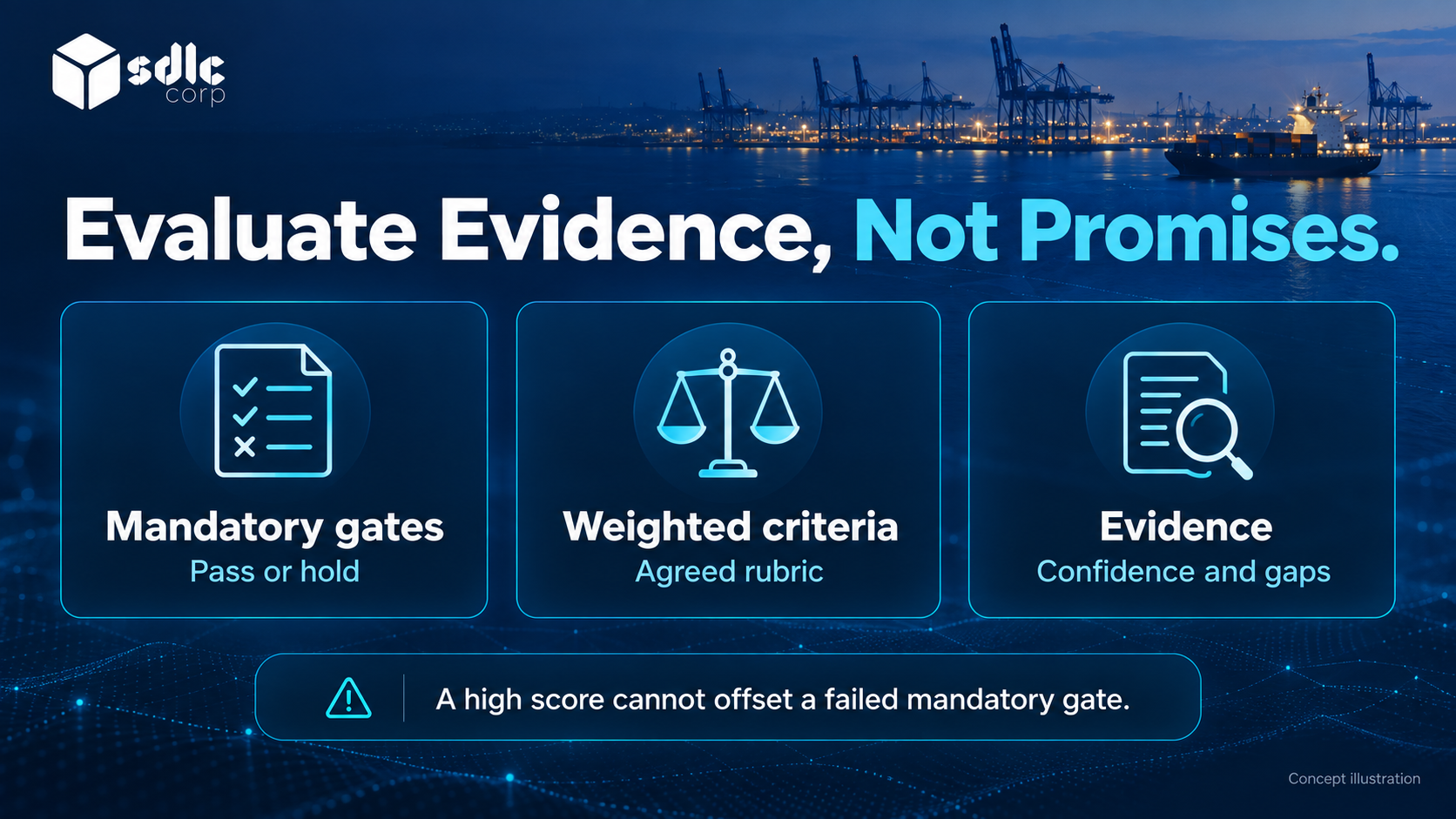
A high total must never hide a failed access, security or operating requirement. Where two vendors score closely, the demonstrations, open conditions and ownership costs matter more than the larger number.
Example Anchorage Vendor Scorecard: Weights Totaling 100
Illustrative example
Freeze Weights Before Anyone Scores
Agree weights before scoring anything, and record the rationale. A weighting chosen after the demonstrations is a rationalization.
These sample weights total 100; they are not vendor scores. Mandatory operational, security and interface gates are assessed separately, and a failed gate cannot be offset by a high total.
| Dimension | Example Weight out of 100 | Score from 0 to 5 | Primary Evidence |
|---|---|---|---|
| Functional fit | 25 | To assess | Buyer-supplied scenarios |
| Integration | 20 | To assess | Interface contracts, sample data and tests |
| Architecture and security | 15 | To assess | Proposed deployment and control evidence |
| Implementation team | 15 | To assess | Assigned roles, dependencies and plan |
| Support | 10 | To assess | Coverage, escalation and recovery terms |
| Lifecycle cost | 10 | To assess | Comparable scope and cost assumptions |
| Comparable references | 5 | To assess | Verified scope and project stage |
Each contribution is weight × score ÷ 5, and the contributions sum to a total out of 100. This is standard weighted scoring, a form of multi-criteria decision analysis described in the UK Government's multi-criteria analysis manual.
Keep unresolved evidence marked as pending; never assign it an average. At the evidence deadline, apply the published rule for unsupported claims, including zero where specified.
Use a Defined Scoring Scale
- 0: No supporting evidence.
- 1: A major demonstrated gap.
- 2: Partial fit with substantial unresolved work.
- 3: The agreed requirement is demonstrated.
- 4: Demonstrated fit plus relevant, evidenced advantages.
- 5: Clearly justified exceptional fit against the published criteria.
Record the evidence reference, assessor and confidence beside each score. A feature promised for a later release is a delivery dependency, not demonstrated capability.
Build the criteria from the Anchorage Management System Requirements Checklist, and use How to Select an Anchorage Management System to keep weights tied to the port's real constraints.
Anchorage Management System Vendor Evaluation: A Worked Example
Illustrative example
Apply Mandatory Gates First
| Supplier | Mandatory Gate | Evidence and Open Condition | Result |
|---|---|---|---|
| A | Pass | Operator scenarios and source access demonstrated; confirm named team dates | Eligible for scoring subject to staffing commitment |
| B | Fail | Required source write path unavailable and no accepted alternative | Excluded from weighted scoring for this scope |
| C | Pass | Working access and restore evidence; weaker workflow fit | Eligible alternative |
Compare Only the Eligible Proposals
Ratings use the agreed 0 to 5 scale, and each contribution is weight × rating ÷ 5. B has no weighted total because its mandatory gate failed.
| Criterion | Weight | Supplier A | Supplier C |
|---|---|---|---|
| Workflow fit | 25 | 4 | 3 |
| Integration | 20 | 4 | 4 |
| Architecture and security | 15 | 4 | 4 |
| Delivery team | 15 | 3 | 4 |
| Support | 10 | 4 | 3 |
| Lifecycle cost | 10 | 3 | 4 |
| References | 5 | 4 | 3 |
| Weighted total | 100 | 75 | 72 |
For A, the contributions are 20 + 16 + 12 + 9 + 8 + 6 + 4 = 75. A is provisionally preferred, subject to its staffing commitment; if that fails, reassess C under the published process.
Keep the evidence with each rating. A three-point difference is not persuasive when the underlying evidence is uncertain.
Test Whether a Plausible Weight Change Alters the Result
A sensitivity check asks whether a reasonable change in priorities would change the winner. Here, moving 10 points from workflow fit to delivery team takes A from 75 to 73 and C from 72 to 74.
| Passing Supplier | Original Weighting | Workflow 15, Delivery 25 | Interpretation |
|---|---|---|---|
| A | 75 | 73 | Stronger workflow evidence has less influence |
| C | 72 | 74 | Stronger delivery evidence has more influence |
The reversal shows the result depends on those priorities; it does not repair B's failed gate. Settle why the port prefers one weighting before award.
Never change weights after seeing results just to select a preferred bidder. Close scores call for scrutiny of evidence and open conditions.
Score Functional Fit from Your Own Scenarios
Functional fit only means something when measured against workflows you supplied. Score per scenario, not per feature, and note any step that left the system.
Configuration can legitimately meet a requirement when shown in the proposed version. Record whether each answer is native, configured, committed development or uncommitted roadmap, because their evidence, cost and delivery risk differ.
Take the scoring blocks from Which Anchorage Management System Features Belong in the First Release? and the scenarios from the Anchorage Management Demo and Proof-of-Concept Checklist.
Score Integration on Evidence, Not Assertion
Score integration against the interfaces and dependencies that matter in this procurement.
- Named interfaces to the systems you actually run, with documentation.
- Sample messages or records a third party can inspect.
- A sandbox the port's own team can call.
- Prior integrations at comparable scope, discussable with a reference.
- A clear statement of which interfaces they do not currently support.
For Vessel Traffic Management and Information System (VTMIS) connections, assess the integration contract, recovery requirements and source access. Integrating VTMIS With An Anchorage Application lists what to check.
Where sensor resilience is in scope, score degraded-mode capability separately. The Radar and AIS Sensor Fusion Requirements Checklist lists the items to evidence, including provenance, alarm ownership and recovery.
Score Implementation Capability and the Actual Team
Buy the team as much as the product. Ask who will be assigned, their availability, and what share of the work is subcontracted.
- Named roles with committed availability, not a capability statement.
- An implementation plan with dependencies the port must satisfy.
- Domain understanding evident in the questions they ask.
- Willingness to identify risks in your scope rather than agreeing with everything.
- A handover and knowledge transfer approach.
Candid answers about dependencies are useful evidence, but they do not replace checks on the assigned team and delivery plan.
Score Support, Commercial Terms and Roadmap
- Service hours against your operational hours, including out-of-hours cover.
- Severity definitions and response commitments that match operational impact.
- Who monitors integrations and sensor feeds after go-live.
- Cost drivers over a realistic term, including growth and change requests.
- Roadmap influence: how a port's requirement enters it, and with what commitment.
- Exit terms: data export format, assistance and what ends on termination.
The Anchorage Management SLA and Support Checklist provides the items to score. Weight roadmap promises low unless they are contractual.
Score Price and Moderate Fairly
Convert Price into a Score
A common method gives the lowest compliant price full marks: price score = lowest compliant price ÷ bid price × weight. Apply it only to eligible bids priced on the same scope and ownership period.
For example, with a 10-point cost weight, a bid of 1.0 million against a lowest compliant bid of 0.8 million scores 0.8 ÷ 1.0 × 10 = 8 points.
Score Individually, Then Agree a Consensus
Evaluators should declare any conflict of interest, then score independently before meeting. In the moderation meeting, discuss large gaps between evaluators; they usually signal unclear criteria or evidence.
Agree in advance who scores, who moderates and who decides. Project staff alone miss operational reality; operators alone miss architecture and commercial risk.
Record Red Flags Separately from Scores
Some findings should never be averaged away by a strong score elsewhere. Keep a separate list and require an explicit decision on each.
- Refusal to run your scenarios or provide sample data.
- Metrics quoted without conditions, particularly on accuracy or coverage.
- Named customers used as evidence without permission to discuss the work.
- Integration described as available without documentation.
- Capability claims that cannot be demonstrated in any environment.
Questions to Ask an Anchorage Management Vendor surfaces these during due diligence rather than after contract.
Resolve Pending Evidence, Close Scores and Mandatory Failures
Record the final recommendation with evidence references, open conditions and the decision owner. A total without that explanation is not a complete selection record.
Turn uncertain ratings into named follow-up requests, and update the decision record whenever the evidence changes.
Conclusion
Good anchorage management system vendor evaluation completes the mandatory gates before any ranking, and keeps the evidence behind every rating. Revisit a score whenever a demonstration contradicts a written response.
For a close result, run the sensitivity check and examine open conditions. Record why the chosen proposal is preferable and which commitments must be settled before award.
Discuss Evaluation Support with SDLC Corp
Discuss your evaluation criteria through SDLC Corp's Software Consulting Services, including evidence of fit for our Anchorage Management Software under the same gates, scenarios and scoring rules as other proposals.
We will show demonstrated capabilities, named dependencies and open conditions, while the port keeps independent ownership of ratings, sensitivity review and the final decision.
Frequently Asked Questions
Can a High Score Compensate for a Failed Mandatory Gate?
No. Treat the proposal under the published gate rules until the required evidence is supplied. Strengths in other areas never erase a mandatory condition.
How Is Price Converted into a Score?
A common formula is lowest compliant price divided by the bid price, multiplied by the cost weight. The cheapest compliant bid gets full marks, and only eligible bids on the same scope are compared.
Should Evaluators Score Individually or Together?
Both. Evaluators score independently first, then meet to moderate. Large gaps between their scores usually point to unclear criteria or evidence that needs resolving.
What Is a Sensitivity Check?
It tests whether a reasonable change in weights would change the winner. If it does, the port must decide which priorities it truly holds before award, not after.
How Should a Close Score Be Resolved?
Review the supporting evidence and open conditions using the agreed tie-breaking process. A small numerical difference is not decisive when the ratings rest on uncertain or different evidence.
How Should Recurring Costs Be Included?
Compare every bid over the same ownership period, including licenses, support, hosting and expected change requests, not just the initial price. Apply any affordability gate consistently.