
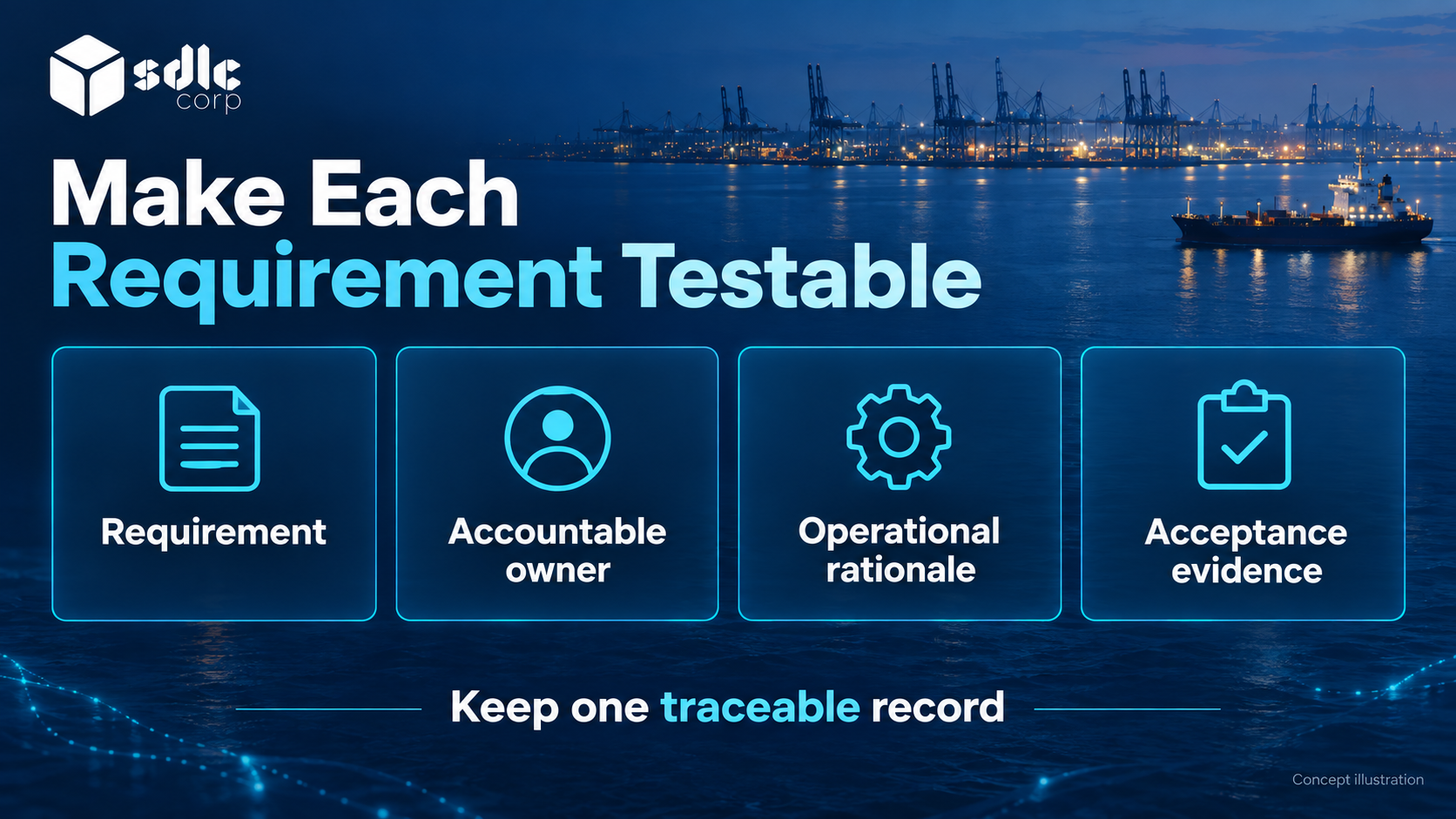
Good anchorage management system requirements describe an observable behavior under a stated condition, with a stable ID, a priority, an accountable owner and the evidence that will prove it at acceptance.
"Conflict prevention" is a feature label. A testable requirement says what happens when two operators approve competing requests, and what record shows one accepted and one rejected.
That baseline lets the port compare proposals on equal terms, then check whether the delivered release meets the same expectation.
Write Anchorage Management System Requirements with an Owner and Pass Condition
| Field | What to Record | Example |
|---|---|---|
| Identifier | A stable reference | ALLOC-04 |
| Behavior | What the system must do | Reject a conflicting approval |
| Condition | When the behavior applies | Two operators request the same reserved resource |
| Priority and owner | Business criticality and accountable reviewer | Mandatory; anchorage operations |
| Evidence | How acceptance will be demonstrated | Concurrent action test and retained audit record |
What Makes a Requirement Testable
A well-formed requirement is atomic (one behavior), unambiguous, verifiable, feasible and traceable. These criteria follow ISO/IEC/IEEE 29148, the international standard for requirements engineering.
A Given-When-Then statement makes the pass condition explicit. For REQ-03 below: given one free slot, when two users approve competing proposals at once, then exactly one approval succeeds and the other is rejected as a conflict.
Name the Roles Before the Screens
Identify which teams use each workflow: duty operators, supervisors, administrators and support teams. Add external participants only where their access is in scope, and never assume every role gets the same view or editing rights.
"User-friendly" is too vague to test. Instead, ask an operator to find a blocked request, see why it is blocked and identify who can act, on an agreed device with agreed sample records.
Eight Requirements That Can Be Tested
Illustrative example
Adapt the clauses to the approved scope, roles and acceptance process.
| ID | Required Behavior and Condition | Source and Owner | Acceptance Test | Evidence |
|---|---|---|---|---|
| REQ-01 | An incomplete request cannot enter approval | Operations owner | Omit the required call reference | Field error; no approval task |
| REQ-02 | Only the assigned approver can approve | Access-policy owner | Operator sends approval directly | Denied response; record unchanged |
| REQ-03 | One remaining slot cannot be allocated twice | Allocation-policy owner | Two users approve competing proposals | One success; one conflict |
| REQ-04 | Old observations retain their source time | Feed contract owner | Replay yesterday's observation | Old age visible; not marked fresh |
| REQ-05 | Every allocation correction retains history | Operational audit owner | Change Zone A to B with a reason | Before and after values, actor and reason stored |
| REQ-06 | Duplicate submissions create one request | Request contract owner | Resend same operation identifier | Same request returned |
| REQ-07 | Source loss produces an owned exception | Service owner | Stop the test feed | Alert includes source, age and owner |
| REQ-08 | Required records can be restored | Recovery owner | Restore the agreed backup in isolation | Counts and sample workflow history reconcile |
Trace One Requirement into a Release Decision
For REQ-03, start with one free test slot and proposals P-1 and P-2, then submit both approvals concurrently. A pass is one approved allocation and one rejected conflict, with the losing proposal still reviewable.
Two successful approvals fail the requirement, even if the screen later hides one of them.
The table below is a small requirements traceability matrix: it links one requirement to its bid response, test, evidence and release decision.
| Trace Item | Sample Record |
|---|---|
| Bid response | Supplier commits to REQ-03 in release 1 |
| Test | AT-03 against build 1.4 with two named test accounts |
| Evidence | Response log, allocation count and decision history |
| Release decision | Pass only if the one-slot invariant holds |
This chain turns "concurrency supported" into a verifiable delivery obligation rather than a feature label.
Define the Core Operational Behaviors
Write Requirements as Observable Behavior
List the steps from request to release: create, check, approve, assign a space, confirm occupancy and close. Include amendments and cancellations, and name the required fields and permitted actor at each step. A correction should keep the earlier decision.
For allocation, ask which rule version produced each result, test two users reserving the same space, and show why an option was rejected and who may override. Anchorage Allocation Software covers these rules in depth.
Keep planned reservations distinct from vessels recorded as present.
Map requirements should name approved zone data, layers, freshness indicators, selection behavior and the actions available from a vessel or request. Getting Anchorage Geofences And Zone Events Right explains the zone logic behind them.
Make Integration Dependencies Explicit
List each source and receiving system, its owner, supported interface, required entities and access dependency. Mark read-only and write operations separately. Where an incumbent supplier must build an adapter or change configuration, name who buys and accepts that work.
The integration contract should define identity matching, source timestamps, duplicate handling, correction rules and reconciliation. Writing API Contracts For Port Systems shows how to specify these.
Include test scenarios for an unavailable source, malformed data, an unmatched vessel, and an update that arrives after a newer decision.
Require a visible degraded state and a recovery workflow. If an operator takes a permitted manual action during an outage, acceptance should show how that action is reconciled later. A successful connection test alone does not prove business continuity.
Where sensors are in scope, add requirement IDs for source provenance, identity confidence, disagreement, loss of correlation and recovery. Radar and AIS Sensor Fusion for Port Operations lists the cases to cover.
Specify Permissions, Audit and Security Evidence
Define who can view, propose, approve, override, configure, export and administer records. Require checks against both the action and the specific object.
The OWASP API Security Top 10 is a useful reference for object-level authorization and related application programming interface (API) risks.
For each decision, keep who acted, what changed, when and why. Agree who may read or export that history and how long it is kept. Diagnostic logs serve a different purpose and are not a complete decision record.
Request evidence for secure development, vulnerability handling, credential management, environment separation and recovery testing. Agree the evidence with your security team, and obtain separate assessments for any certification obligations.
Specify Workload, Availability and Recovery Acceptance Conditions
These are non-functional requirements. ISO/IEC 25010 groups them into quality characteristics such as performance efficiency, reliability and security, which is a useful checklist for completeness.
Give each one a number and a condition. Say what is timed, under what load and on which network: a screen opening differs from another system accepting an allocation.
Set targets from the port's needs and keep test conditions with the result.
Availability and recovery requirements need scope too: the components covered, the permitted outage mode, the recovery priority and the evidence from a restore test. Agree support coverage and escalation for application, infrastructure and third-party interfaces.
Reporting requirements need definitions for states, date boundaries, time zones and exports, and a test that each report reconciles to the underlying records. What Port Operators Need From A Dashboard shows why.
Separate Mandatory Scope from Later Enhancements
Classify each requirement as mandatory for acceptance, important for the first release, or optional for later. This mirrors MoSCoW prioritization (must, should, could, won't this time) and should carry a short rationale.
A predictive model may be optional while the stale-data indicator every operator uses is mandatory.
Ask suppliers to mark each requirement as standard product, configuration, custom work, third-party dependency or excluded. Compare those answers with demonstrations and implementation assumptions, because a "yes" in a compliance table is not a delivery method.
Use the Anchorage Management Demo and Proof-of-Concept Checklist to resolve high-impact uncertainties before treating a supplier answer as proven.
Use the Checklist Through Delivery
Agree a checklist version before seeking detailed estimates, and record later changes with their effect on cost, dates and tests. Attach it to the Anchorage Management System RFP Checklist response structure.
During delivery, link each item to its design, test result, open defects and sign-off.
Before go-live, accept shift training, documentation, support access, monitoring and rollback decisions alongside software behavior. A working application is still unready if the people handling an exception cannot identify their next action.
When reviewing Anchorage Management System Digital Transformation, compare its delivered scope with your requirements and request the acceptance records for anything still unproven.
The Anchorage Management UAT Checklist then turns requirements into complete operator tasks for sign-off.
Conclusion
Review your anchorage management system requirements with operations, system owners and security before requesting detailed proposals. For every mandatory item, confirm its behavior can be demonstrated and its dependencies are named.
Keep the identifiers through design, testing and change control, so acceptance traces back to the original requirement or an approved revision, not a supplier's broad statement that a feature is complete.
Develop a Requirements Brief with SDLC Corp
Bring your requirements register to SDLC Corp to discuss our Anchorage Management Software and Software Consulting Services.
We will mark each behavior as supported, configurable or new work, and provide evidence under the same conditions you apply to other options, with ownership, source access and acceptance decisions kept explicit.
Frequently Asked Questions
What Makes a Requirement Testable?
State the starting condition, required behavior and observable outcome. Add the evidence and acceptance owner so results are assessed consistently, including when an interface is unavailable or an action is rejected.
What Is a Requirements Traceability Matrix?
It is a table linking each requirement to its bid response, design, test, evidence and release decision, so acceptance can be traced back to the original requirement or an approved change.
Should Non-Functional Requirements Have Numbers?
Yes. Performance, availability and recovery requirements need a measurable target plus the load, network and scope under which it is tested, or they cannot be accepted objectively.
How Should Requirements Be Prioritized?
Classify each as mandatory, important or optional, similar to MoSCoW, with a short rationale. Mandatory items must be demonstrated before acceptance; optional ones can be evaluated later.
Who Approves Integration Requirements?
A port acceptance owner, with the connected system owners involved. The supplier demonstrates its adapter, while the port confirms data meaning, permitted access and operating responsibilities across the boundary.
Does the Requirements Checklist Replace Security Review?
No. It organizes the requested controls and evidence. Security specialists should determine the applicable assessment, deployment constraints and unresolved risks for the proposed scope.