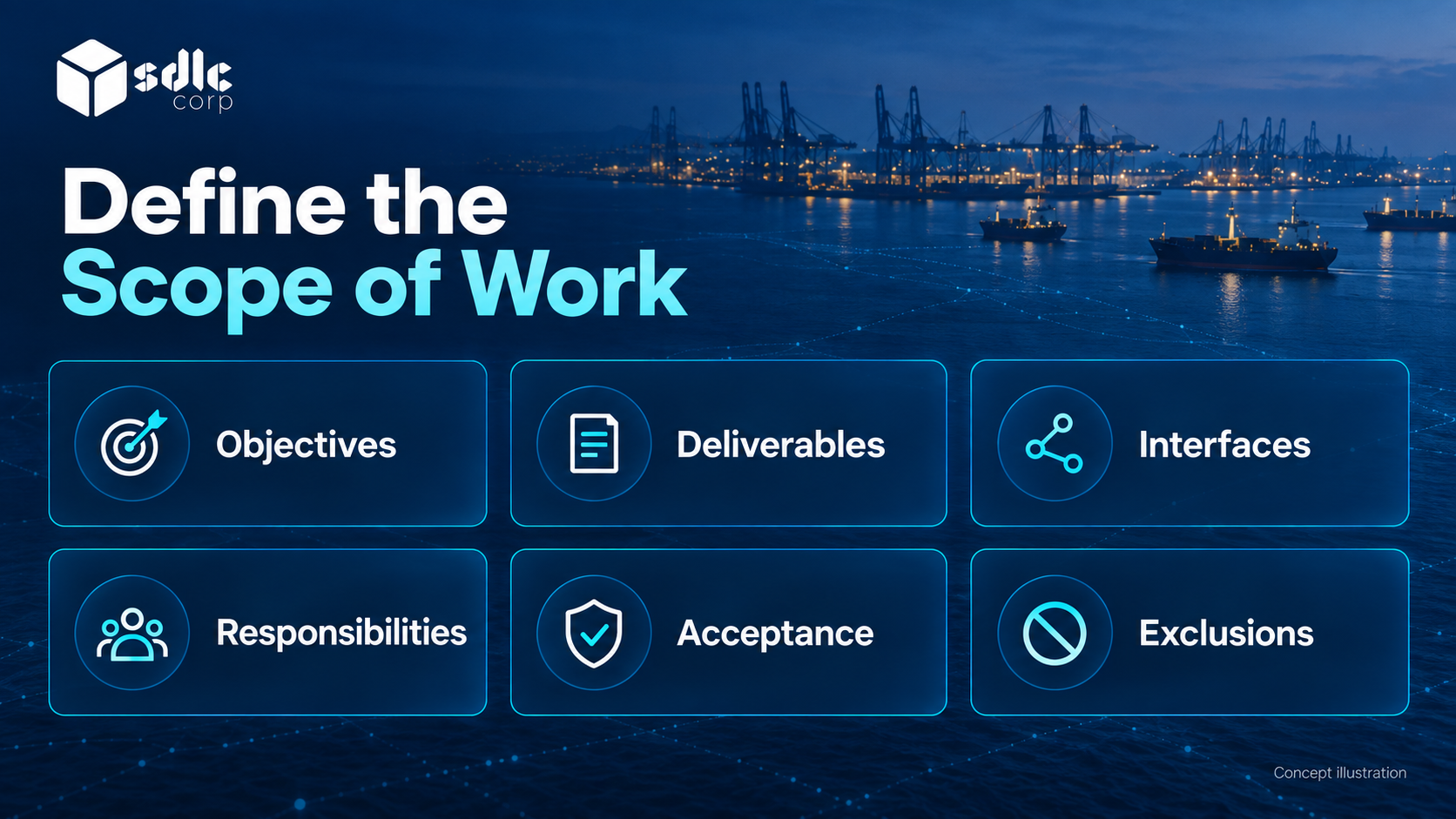
An anchorage management system scope of work (SOW) translates requirements into deliverables the buyer can accept. Each deliverable needs a clear result, owner, dependencies and evidence showing when it is complete.
A feature list leaves those obligations unresolved. The scope must also explain exclusions, handover, changes and what happens when access or work controlled by another party is unavailable.
Background and Objectives
Describe the current operation honestly, including what does not work. Bidders price risk, and an SOW that conceals the messy parts produces prices that change after award.
State objectives in operational terms that can be tested: a single record of each anchorage request and its approval, an auditable decision history, and continuity of operation when a data source is unavailable. Avoid objectives that cannot be verified, such as improving efficiency.
Scope, Users and Workflows
| Section | What to include | Frequent omission |
|---|---|---|
| In scope | Workflows, users, sites, integrations | Exception paths |
| Out of scope | Explicitly excluded systems and processes | Nothing stated, so everything is assumed |
| User groups | Roles, counts, locations, shift patterns | External parties such as agents |
| Workflows | Normal and exception sequences | Amendment, override, release |
| Volumes | Calls, requests, concurrent users | Peak versus average |
Describe workflows as sequences with decision points and owners rather than as feature lists. Include the workflow, performance, security and recovery requirements identified in the requirements checklist.
A Sample Deliverables Schedule
Illustrative example
Confirm the proposed port and supplier responsibilities through the procurement and contract review process.
| Deliverable | Accountable Delivery Owner | Dependency | Output / Acceptance Evidence |
|---|---|---|---|
| D-01 workflow baseline | Supplier analyst; port approves | Operator availability | Signed request to release model and exceptions |
| D-02 interface adapter | Supplier integration lead | Port obtains permitted source access | Mapping, working exchange and failure test results |
| D-03 configured approval flow | Supplier lead | Port-approved rules and roles | Role and concurrency tests passed |
| D-04 data migration | Named migration lead | Port validates source records | Mapping register, rejects and reconciliation totals |
| D-05 operational handover | Supplier support lead | Port assigns service owners | Restore demonstration, runbook and escalation drill |
Acceptance and a Delayed Dependency
Sample clause: “D-02 is accepted when the agreed read, duplicate, source loss and recovery cases pass against the permitted source environment, with message identifiers and reconciliation results supplied. An unavailable environment does not count as a passed test.”
| Event | Treatment In The Sample Scope |
|---|---|
| Port access delivery slips | Owner records impact; affected milestone reviewed |
| Supplier adapter fails an agreed case | Defect corrected and case rerun |
| Buyer requests an additional source | Change request identifies cost, schedule and acceptance additions |
| Original source is replaced | Revise mapping and tests; do not reuse old acceptance blindly |
Each handover includes the version, configuration, documentation and credentials transfer process through an approved secure channel. A completion invoice alone does not establish that the agreed technical evidence exists.
State When Each Deliverable Is Due and What It Excludes
| Deliverable | Due Condition | Explicit Boundary |
|---|---|---|
| Workflow baseline | Before dependent configuration is accepted | Future operating areas require separate scope |
| Interface adapter | After permitted test access and agreed source contract are available | Incumbent changes are excluded unless assigned in writing |
| Migration | After source correction rules and a trial reconciliation are approved | Unapproved historical reconstruction is excluded |
| Operational handover | Before the authorized production transition | Additional coverage or new interfaces require agreement |
Use named deliverables to connect payment, evidence and acceptance. Applicable security and regulatory obligations belong in the scope with their responsible reviewers; a broad promise of compliance does not define an acceptance test.
Functional Requirements
Group requirements by workflow and give each a unique reference so bids can be compared line by line. State the requirement, not the implementation.
- Vessel call record, search and history
- Request capture, approval, amendment, release, each attributed
- Allocation against configurable zones with capacity and restrictions
- Queue management with position and reason
- Map and geofence behavior, including data freshness display
- Alerts with owner, evidence and closure
- Exception handling and authorized override, recorded with a defined correction, reversal or compensating action
- Reporting, with state definitions matching the operational screens
Mark a requirement mandatory when the port cannot accept the system without it, or when an applicable obligation requires it. Record the reason. Score useful extras after these conditions are met. Do not set an arbitrary quota for mandatory items.
Integrations and Data
Integration access and data preparation affect price and delivery dates. State what the port will provide and which dependencies the supplier must resolve.
- Each system to be integrated, with owner, interface type and documentation status
- Whether test environments and sample data are available
- Which approvals or network changes the port will obtain, and by when
- Data entities and which system owns each
- Sensor feeds in scope, with degraded mode and recovery requirements
- Migration scope: entities, period, quality and reconciliation tolerance
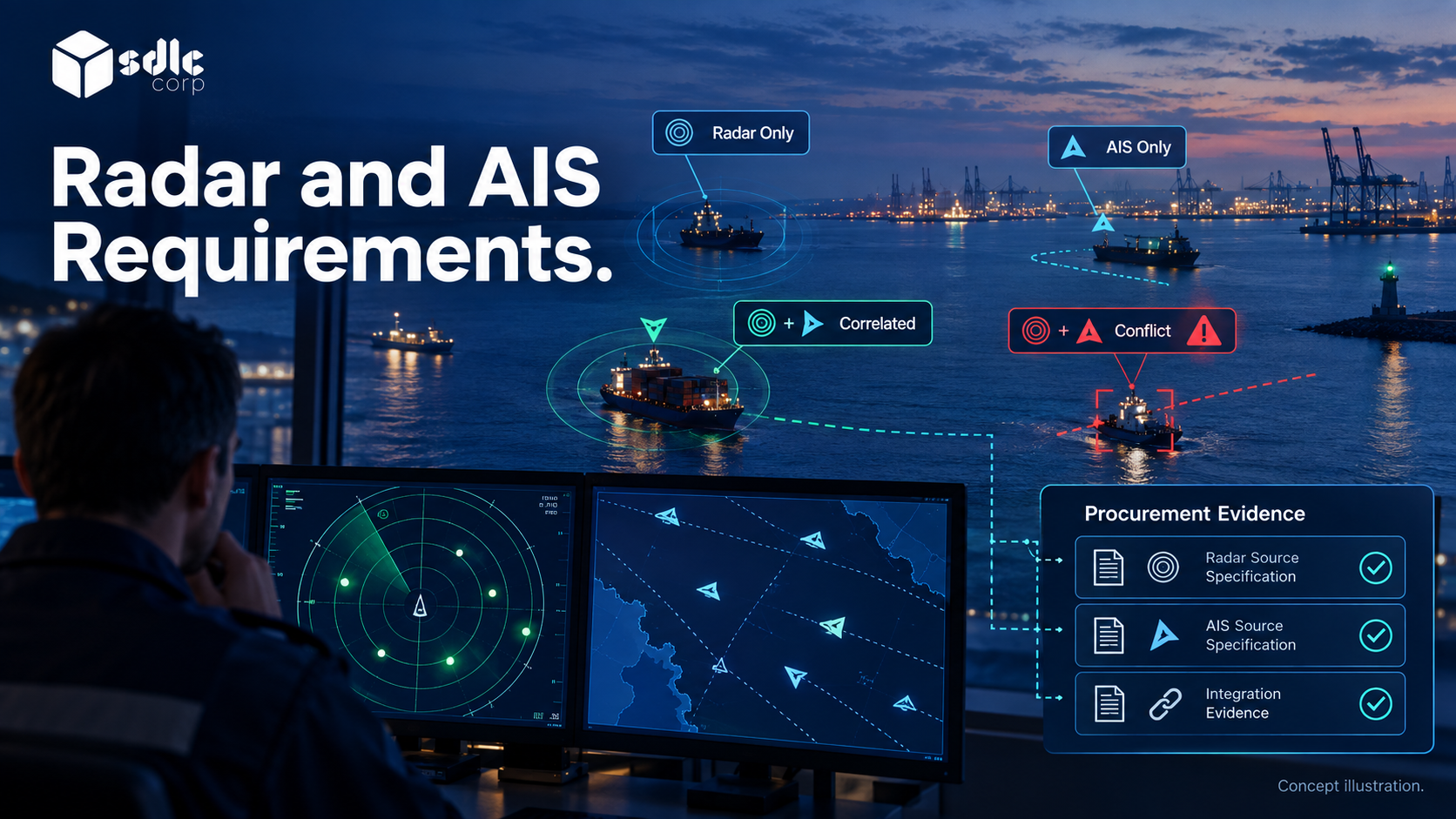
Where sensor resilience is in scope, define the multi-sensor acceptance requirements explicitly. Complete the integration access and testing checklist before the SOW is issued so that dependencies are stated rather than discovered.
For Vessel Traffic Management and Information System (VTMIS) connections, specify the interface and recovery deliverables along with source access and support responsibilities.
Architecture, Security and Environments
State constraints, not designs. Deployment model and any residency obligation, identity provider integration, role and audit requirements, environment separation, and monitoring expectations.
Ask bidders to explain how their design meets the constraints. For each security control, request the evidence needed to check it. Put required outputs and acceptance tests in the scope or a schedule that the agreement explicitly includes.
Test the user experience (UX) through tasks: find a blocked request, inspect the evidence, take an allowed action and recover from an error. Include small screens, keyboard use and readable contrast.
The World Wide Web Consortium guidance on visible focus explains why keyboard users need to see which control receives their input. Turn that into a testable interface requirement. Ask operators to review prototypes and check how stale data and outages appear.
Connect Deliverables to Acceptance Evidence and Support Terms
- Phases and the output that closes each one
- Port-side commitments: decision owners, operator availability, interface access
- Testing: system integration, user acceptance, degraded mode drills
- Acceptance criteria per phase, and the defect severity model
- Training scope and materials, including for later joiners
- Documentation to be delivered, and in what form
- Hypercare duration and transition to standard support
- Service levels, or a reference to the agreement they will be set in
Acceptance criteria connect deliverables to reviewable evidence; the port’s procurement and legal teams should review the contractual terms. The operational acceptance checklist is the source for those criteria; the service level agreement (SLA) and support checklist cover the service terms.
Example Deliverable Clause To Adapt
Describe a deliverable as a bounded outcome: an approved read-only interface that associates permitted source observations with the intended vessel call and displays freshness and unresolved identity states. Name the source interface, environments, port-side access dependencies and exclusions, including any write operations outside this phase.
Test a valid update, unknown call, duplicate, delayed record, denied request and reconnection. Name the reviewer and evidence for each result. Agree how failed tests will be handled. Have procurement and legal reviewers agree the acceptance obligations and remedies in the contract. “Integrate VTMIS” alone does not define when the work is complete.
The dependency-based rollout plan shows which acceptance and handover activities must finish before cutover can proceed.
Assumptions, Dependencies and Response Instructions
Require Owners, Assumptions and Pricing for Unconfirmed Interfaces
List each assumption and what evidence would confirm it. Give every third-party dependency an owner. Tell bidders to return a response against each requirement, a plan, named roles and a price by phase. Ask for references that cover comparable interface work.
Example: The Source Interface Is Not Yet Confirmed
Suppose the project brief names a sensor feed but access and message samples are still pending. State those facts and ask respondents to identify their assumptions, required evidence and estimating consequences. Presenting the feed as a settled input would invite incompatible proposals. A useful brief makes uncertainty easy to answer consistently instead of leaving each bidder to infer it.
The brief is ready to circulate when respondents can distinguish confirmed scope, open dependencies and the evidence they must provide for a comparable proposal.
Align response instructions with the vendor scoring method so bidders know which evidence evaluators will use.
Use the request for proposal (RFP) response structure to collect comparable answers about deliverables, exclusions and unresolved dependencies.
Final Thoughts
Trace each deliverable to its acceptance test and required handover evidence. Confirm that assumptions and external dependencies have owners and that their effect on timing and scope is explicit.
Resolve ambiguous completion terms before delivery begins. Installing an adapter or presenting a screen should count as acceptance only when it satisfies the agreed result and evidence, not merely because the component exists.
Discuss Scope Preparation with SDLC Corp
Discuss the deliverable schedule for your anchorage management system with SDLC Corp through its software consulting services. Define owners, client dependencies, acceptance conditions, exclusions and change handling. Keep unconfirmed interfaces conditional and compare proposals against the same requirements.
Frequently Asked Questions
How Does a Scope of Work Differ from a Feature List?
A scope assigns delivery obligations and defines completion. It connects features to outputs, responsibilities, dependencies, acceptance and handover, rather than listing capabilities without explaining what the buyer receives.
How Should External Dependencies Be Documented?
Name the required access, environment or third-party action, its owner and affected deliverables. State the agreed treatment of a missed dependency so changes to dates or scope are handled explicitly.
Does Delivering an Adapter Complete the Integration?
Only if the agreed acceptance conditions are met. The required tests and resulting records must be demonstrated in the permitted environment; an unavailable dependency remains an open condition rather than a passed test.