An anchorage management system ROI business case should connect a measured operating problem to a benefit the port can substantiate. Time saved by staff is useful capacity, but it becomes a cash saving only when the corresponding expenditure actually changes.
Calculate return on investment (ROI) using attributable benefits and the full costs of achieving them. Keep assumptions about adoption, work volumes and other organizations visible so reviewers can see what would make the case stronger or weaker.
Measure Operator Effort and Reconciliation Before Estimating ROI
Define the task and its start and end events, choose representative calls and shifts, and record observed effort before and after the change. Keep comparable workload and staffing conditions, record other process changes, and distinguish measured time from an estimate. Confirm actual overtime removed, contracts retired and new operating costs before assigning cash benefits.
| Baseline measure | How to capture it | Why it is credible |
|---|---|---|
| Operator effort per vessel call | Time study or sampled log review | Directly observable |
| Reconciliation effort | Hours spent aligning records across systems | Measurable; attribution needs a counterfactual |
| Exception handling effort | Count and average handling time | Falls within the system's influence |
| Requests resolved outside the system | Calls and messages sampled over a period | Shows the coordination gap |
| Audit and reporting preparation | Hours per reporting cycle | Repeatable and easy to verify |
Predictive congestion analytics and artificial intelligence (AI) capability in anchorage management are separate propositions and should not be used to inflate the core case; keep analytics benefits in their own scenario with their conditions stated.
Fill the Baseline Before Calculating a Benefit
| Input | Local Value To Record | Evidence And Owner |
|---|---|---|
| Defined task and observation period | To complete | Operations owner and time-study method |
| Eligible call volume | To complete | Call register with inclusion rules |
| Current effort and variation | To complete | Observed durations and difficult cases |
| Expected changed effort | To test in pilot | Same task definition and comparison population |
| Paid expenditure actually removed | To verify | Finance-approved overtime or contract change |
| Costs of delivery and operation | To obtain | Scope-matched supplier and internal estimates |
Keep measured entries separate from forecast assumptions and leave unavailable values blank. Assign an owner to verify each assumption before using the result for investment approval.
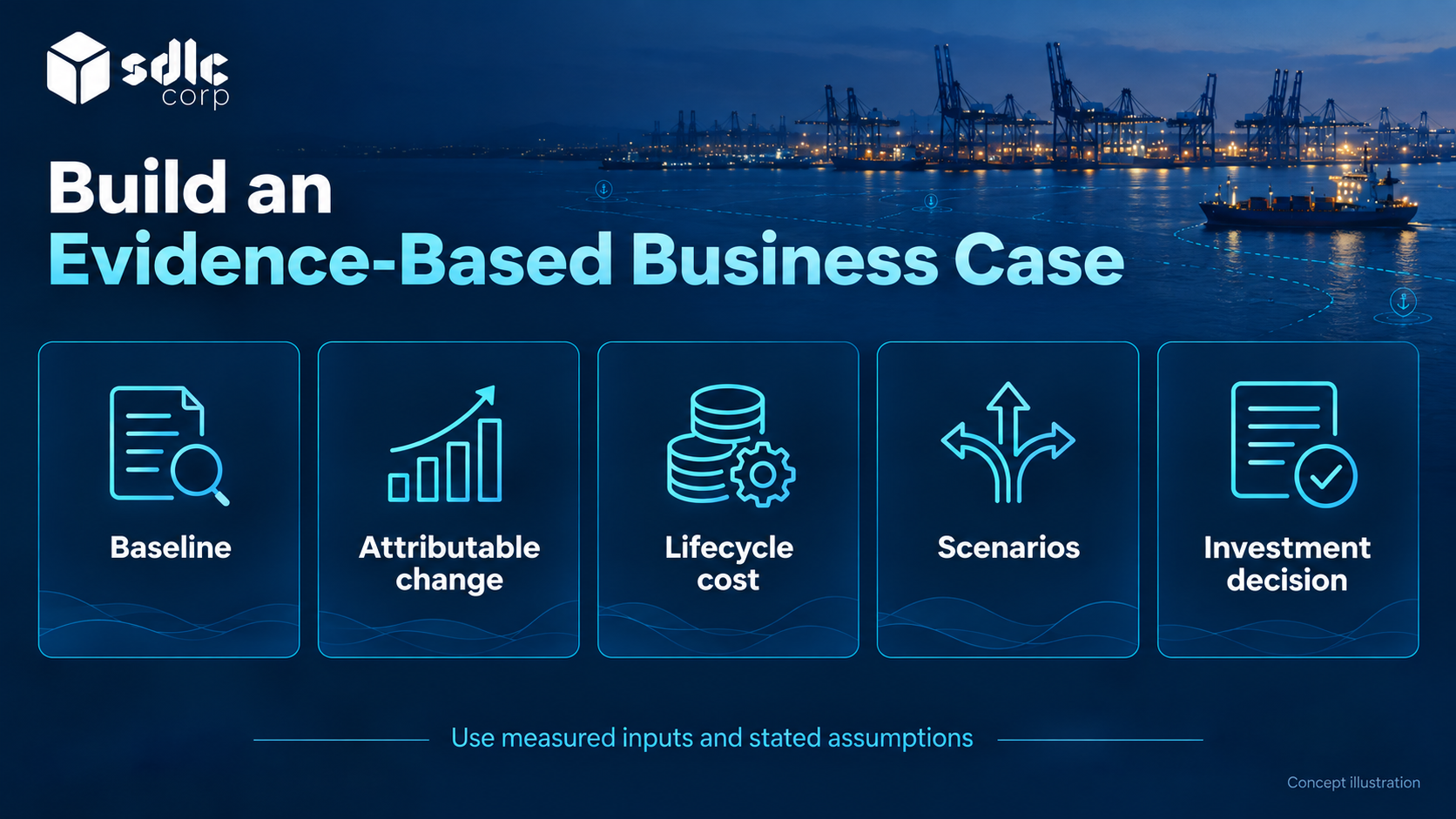
Claim Benefits the System Can Actually Influence
Separate Released Capacity from Cash Savings
Sort candidate benefits into three groups and treat them differently in the case.
- Potentially direct: reduced coordination or audit effort, subject to measured adoption and a credible counterfactual
- Conditionally attributable: coordination improvements that depend on other parties adopting the workflow
- Not attributable: vessel waiting driven by capacity, weather or external scheduling
Include the first group in the base case only with justified realization assumptions. Time released is capacity, not automatically a cash saving. Put the second in a scenario with its conditions stated. Leave the third out, and say why it is excluded. A case that excludes something explicitly is more persuasive than one that quietly includes it.
Verify That a Change Produces a Real Benefit
Check whether workload, staffing and task definitions were comparable, and whether another change explains part of the reduction. If the same staff use those hours elsewhere, report capacity released. Recognize a cash saving only where an actual cost changes, such as evidenced avoided overtime.
Do not count the same hours as both redeployed capacity and cash savings in an additive benefit total. Assign an owner to verify realization after the pilot before carrying the assumption into payback calculations.
Connect each benefit to a specific change in the anchorage workflow. Name the baseline and who will measure the result before assigning a financial value.
Build the Cost Model Over the Full Term
Include the costs that appear after year one, because that is where business cases lose credibility.
- Licence or subscription, with growth assumptions stated
- Implementation, including port-side effort as a real cost
- Integration delivery and ongoing interface maintenance
- Infrastructure or hosting
- Support and service charges
- Training, including replacement training as staff change
- Change requests, estimated rather than assumed to be zero
- Data cleanup and migration, including verification and controlled archives
- Exit, export and transition assistance at the end of the term
Cost and total cost of ownership (TCO) guidance provides the structure. Ask suppliers for cost drivers rather than a headline figure, and model a scope change to see how the profile responds.
Calculate Benefits from Explicit Assumptions
Illustrative example
The arithmetic below concerns a narrowly scoped process improvement. Its cost inputs are not an SDLC Corp implementation quotation or a budget for the full anchorage platform.
The calculation uses assumed times of 20 minutes before and 12 minutes after a workflow change, with 300 comparable calls per month. These are formula inputs, not observed customer performance. A year at that volume gives 3,600 × 8 ÷ 60 = 480 staff hours released.
| Benefit Component | Assumption To Verify | Annual Value In The Model |
|---|---|---|
| Paid overtime avoided | 120 hours no longer paid at USD 40 | USD 4,800 cash reduction |
| Remaining capacity | 360 hours available for other work | Report separately from cash savings |
| Legacy support retired | USD 12,000 contract expenditure actually ends | USD 12,000 cash reduction |
| Cash reduction | Overtime plus retired expenditure | USD 16,800 |
Assume USD 30,000 incremental implementation and USD 6,000 annual operation for this bounded change. Keep these inputs separate from a full-platform budget.
| Measure | Calculation | Result |
|---|---|---|
| Annual net cash benefit | 16,800 − 6,000 | USD 10,800 |
| Simple payback after steady benefits start | 30,000 ÷ 10,800 | 2.78 years |
| Three-year net cash position | 3 × 10,800 − 30,000 | USD 2,400 |
| Three-year return on investment (ROI) | 2,400 ÷ (30,000 + 3 × 6,000) | 5% |
If overtime expenditure does not fall, the annual net cash benefit becomes USD 6,000 and simple payback becomes five years. Benefit ramp-up, taxes and discounting require separate treatment in the investment appraisal. Released staff capacity must not be added again as cash in the numerator.
Use Scenarios Instead of a Single Number
A single point estimate invites challenge on the assumption it is most sensitive to. Present a conservative, an expected and an optimistic case, and show which assumption moves the result most.
Name the conditions under which each scenario holds: adoption by external parties, interface availability, data quality at migration. A scenario explores stated assumptions; it does not become an observed result or a reliable forecast merely because those assumptions are documented.
Calculate Net Cash Flow, Payback and Discounted Value
Finance reviewers are less interested in the total than in whether the method holds.
- State the term, the discount rate and who set it
- Show payback on the directly attributable benefits alone
- Keep capital and operating treatment consistent with the port's own policy
- Separate one off from recurring effects
- Exclude benefits that depend on decisions the port has not taken
Use port call coordination boundaries to separate delays the port can influence from constraints outside its control when presenting the business case.
For each period, calculate net cash flow as realized monetary benefits minus incremental costs. Net present value is the sum of those cash flows discounted at the finance approved rate, including initial investment at time zero.
Simple payback is the point cumulative undiscounted net cash flow becomes non negative; report if it never does within the appraisal term. Separate non cash capacity benefits and avoid counting the same released hours twice. The Green Book appraisal guidance explains discounting and uncertainty in its UK public sector context; use the port’s applicable appraisal policy and rates.
Commit to Measuring Afterwards
The strongest element in a business case is a measurement plan. It shows the sponsor that the claim will be tested rather than forgotten.
- Which baseline measures will be recaptured, and when
- Who owns the measurement and reports it
- What counts as the benefit being realised
- What happens if it is not, including the corrective options
Take the business case forward with a measured baseline, explicit assumptions and an owner for post launch measurement. Keep uncertain benefits visible as scenarios.
The dashboard metric definitions should use the same states, denominators and observation periods as the approved benefits baseline.
Final Thoughts
Build the base case from a documented workload and benefits whose mechanism is clear. Subtract recurring costs, avoid counting the same improvement twice and test less favorable adoption or volume assumptions.
Assign ownership for measuring the result after rollout. Keep benefits that depend on unconfirmed participant behavior in explicit scenarios until there is evidence to include them in the main case.
Review Business Case Assumptions with SDLC Corp
Discuss your business case for anchorage management software with SDLC Corp through its software consulting services. Bring measured task effort, verifiable cost reductions and scope-matched cost inputs. Keep assumptions and pilot measurements separate from observed results so released staff capacity is not counted as unsupported cash savings.
Frequently Asked Questions
Is Staff Time Saved a Cash Benefit?
It is released capacity unless there is an attributable reduction or avoided increase in expenditure. Show the two separately and explain how the port expects to use the time saved.
Can Reduced Vessel Waiting Be Included?
Include it only with a supported causal basis and the relevant conditions. Separate coordination delay from physical restrictions, and use a scenario where the benefit still depends on uncertain participation or operational changes.
What if Baseline Data Is Missing?
Measure representative work before relying on a firm benefit claim. Record sampling limits and workload assumptions, then use sensitivity scenarios to show how uncertainty affects the result.
How Should Benefits Requiring Other Parties Be Treated?
State the required participation or process change and show the result with and without it. Do not present an unconfirmed external dependency as a guaranteed benefit of installing the software.