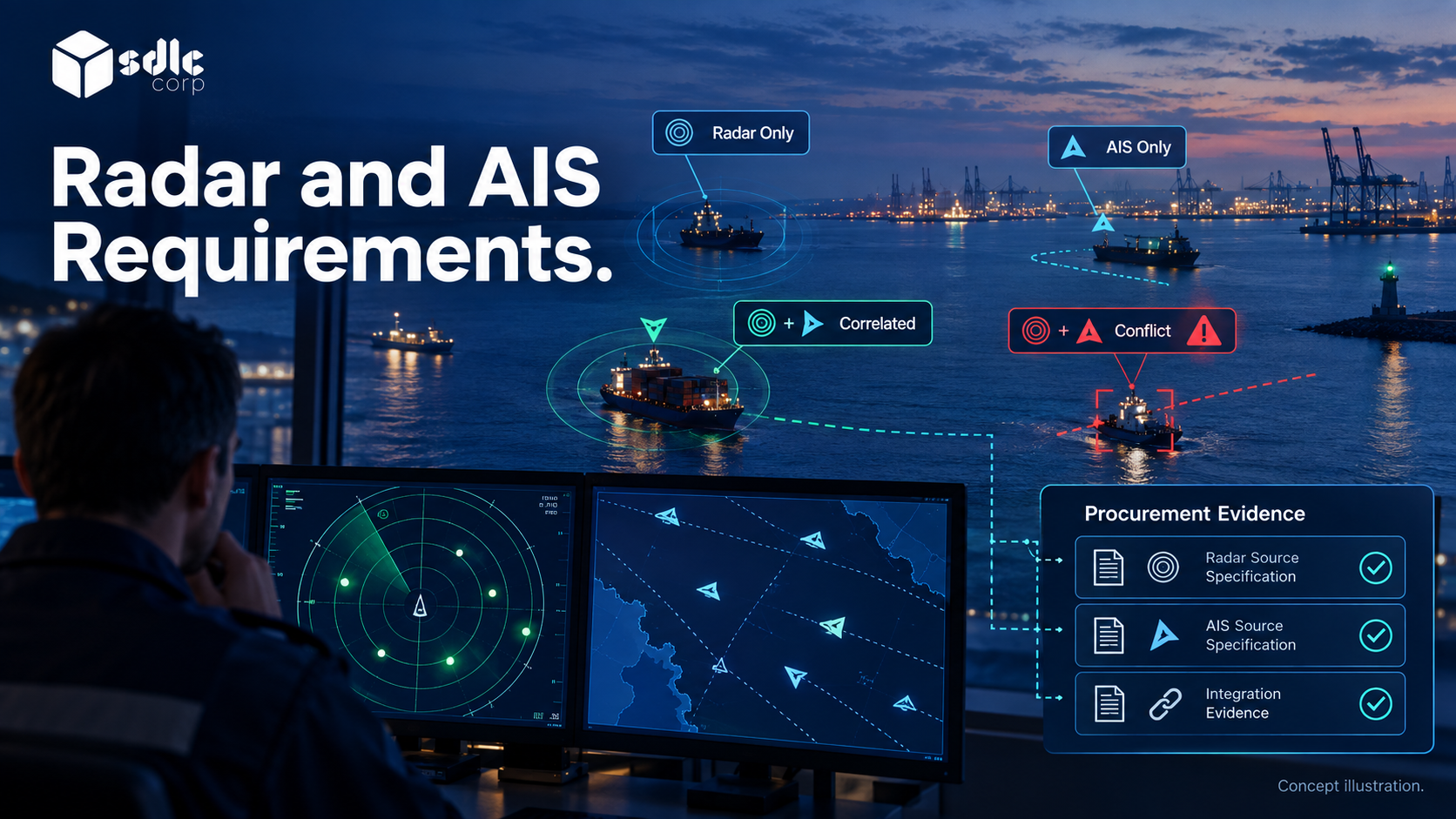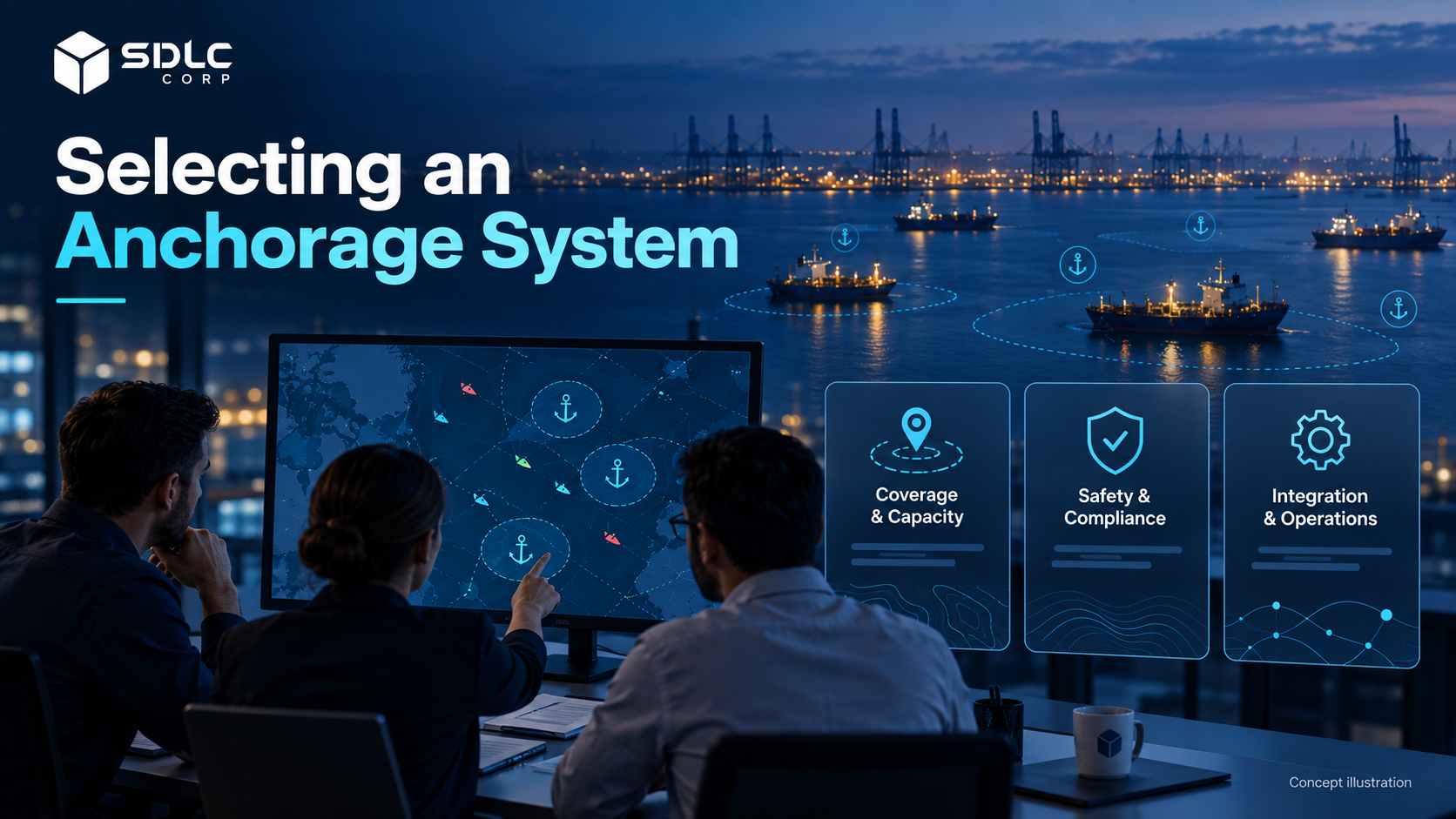
To select an anchorage management system, name the decision owners, pass or fail every option on mandatory gates, and test survivors with the same scenarios. Then normalize costs and record a conditional recommendation with an owner per open item.
A strong demonstration or low price never settles missing interface access, unclear ownership or an unproved mandatory requirement. Keep those conditions visible until they close.
Agree the Decision Owners and Scope
Bring operations, information technology (IT), security, procurement and finance into the review, plus the owners of connected systems. Name who makes the final decision and who checks each mandatory condition.
Resolve source access questions with the source owner, not just the new supplier.
Baseline only what the port can measure reliably, such as operator effort, unresolved exceptions and reconciliation work. Agree those definitions before discussing benefits. Software alone does not determine vessel waiting time.
Decide Whether to Buy, Build or Extend
The first fork is not which product, but which route. Decide it before shortlisting, because each route attracts different suppliers and different evidence.
| Route | Fits When | Main Risk | Evidence to Ask For |
|---|---|---|---|
| Buy a packaged product | Port workflows are close to common practice | Configuration limits and vendor roadmap control | Your scenarios run in the proposed version |
| Build custom software | Workflows or integrations are unusual and stable | Delivery risk and long-term ownership cost | Discovery plan, team continuity and code ownership terms |
| Extend a current system | An existing VTMIS or port system already holds most data | Stretching a platform beyond its design | Incumbent supplier commitment and upgrade path |
The UK Government Technology Code of Practice sets a useful discipline here: consider existing and reusable options before commissioning something new.
Build the Long List and Shortlist Against Interfaces, Deployment and Support
Form the long list from a request for information, peer ports and existing supplier relationships. Shortlist on fit to your interfaces, deployment constraints and support capacity, not brochure features.
Ask each vendor to separate standard functions, configuration, custom development, third-party work and exclusions. Check that the deployment model fits the port's connectivity, security and support staff.
Judge experience at the level of actual scope. A demonstration build is a demonstration; a production reference should name delivered functions and the evidence behind any claimed results.
Prefer suppliers who surface unknown interfaces, data issues and source-side work during discovery over those who promise a fixed date without inspecting them.
Use Mandatory Gates Before Weighted Preferences
Separate Eligibility from Comparative Advantage
| Decision Gate | Evidence | Proceed When |
|---|---|---|
| Operational fit | Demonstration of required states and approvals | Acceptance-critical workflows are covered |
| Integration feasibility | Supported contracts, owners and access plan | Dependencies have credible resolution paths |
| Security and deployment | Architecture review and requested evidence | Mandatory conditions are met or formally resolved |
| Delivery and support | Named stages, owners and operating model | The port can implement and run the proposal |
| Exit and data ownership | Export formats, escrow or code ownership, termination terms | The port can leave without losing its records |
| Commercial clarity | Comparable cost assumptions and exclusions | The committee understands what it is buying |
Take mandatory behaviors from the Anchorage Management System Requirements Checklist. Attractive optional features must never compensate for a failed mandatory condition.
Freeze weights before final bids are reviewed. The Anchorage Management System Vendor Evaluation Scorecard shows the scoring method, a worked calculation and a sensitivity check.
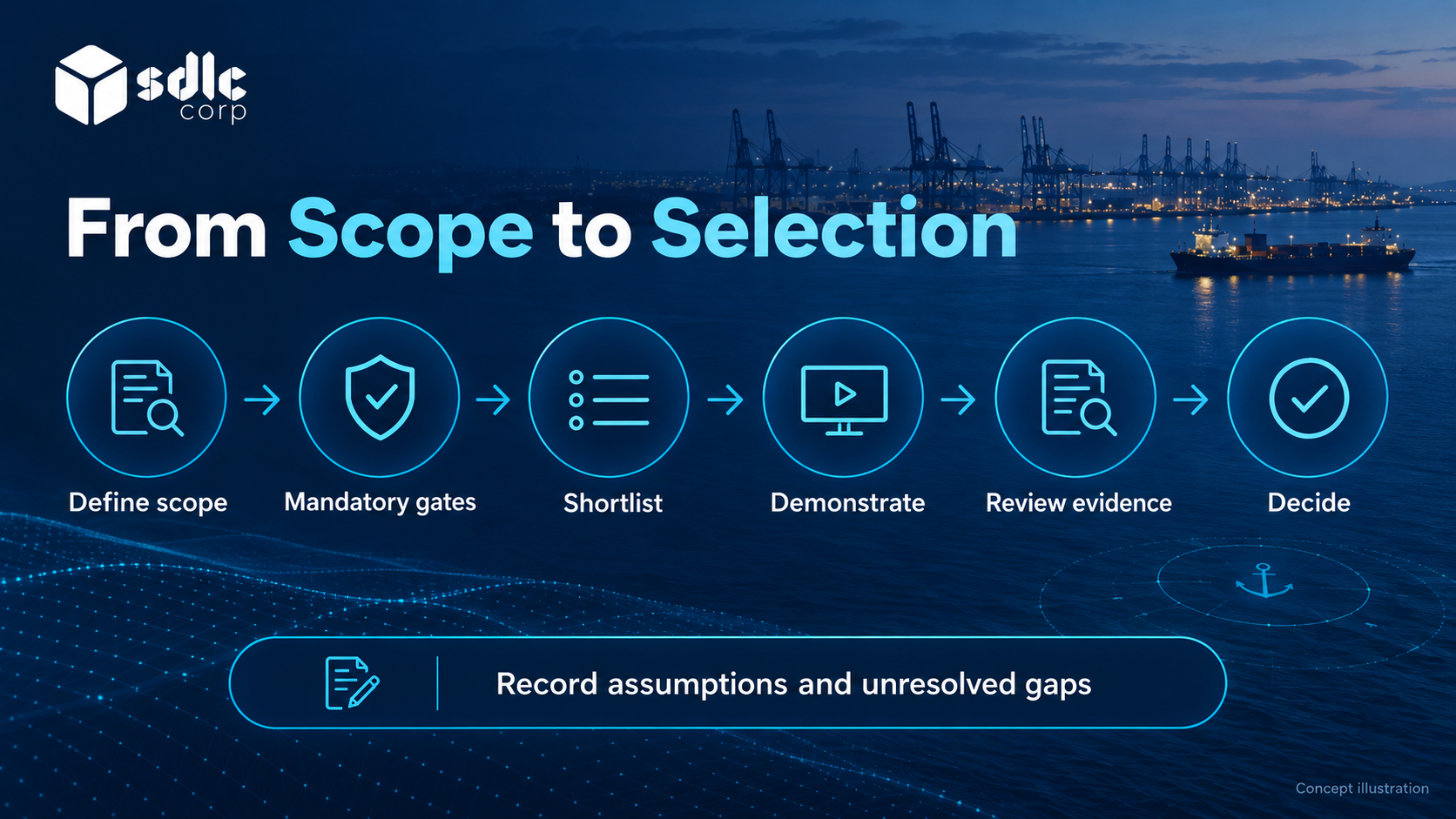
Run a Controlled Operational Demonstration
Give every shortlisted bidder the same scenarios: a normal request, missing vessel data, an allocation conflict, an unavailable feed, an amended decision and an audit search.
Evaluate what the operator sees and what the support team can trace.
For allocation rules, inspect the rule explanation, approving role and handling of concurrent actions. Anchorage Allocation Software covers what good allocation behavior looks like.
Ask the demonstrator to change an input and show how a pending recommendation is invalidated. Note any scenario that relies on a prototype, simulation or manual step, and record the work still needed.
Use a Proof of Concept to Resolve Specific Unknowns
A proof of concept should answer one bounded question: does this interface supply the needed data, can operators finish this workflow, or does this control hold under realistic conditions?
Define the data, environment, success criteria and the output that feeds the next decision. If source access is missing, record what sample data can and cannot prove.
Record failed cases and the supplier's proposed fix. A proof of concept that exposes a constraint before purchase has done its job.
Pick the question from the Anchorage Management Demo and Proof-of-Concept Checklist, and close the condition only with evidence.
Check References at Comparable Scope
- Speak to a port running the same product version at similar scope.
- Ask what failed during go-live and how long recovery took.
- Ask which interfaces were delivered and which were dropped or deferred.
- Ask whether the named delivery team was the team that actually worked on the project.
Questions to Ask an Anchorage Management Vendor turns reference answers into named evidence requests.
Normalize Commercials and Implementation Assumptions
Compare bids using the categories in Anchorage Management System Cost: initial delivery, licenses, feeds, infrastructure, support, changes and exit. The cheapest quote is rarely the cheapest like-for-like scope.
Review the implementation sequence with the people who provide data, access, testing and training. Agree phased adoption, recovery and rollback before fixing a cutover date.
Capture final obligations using the structure in How to Write an Anchorage Management System RFP, and involve the port's procurement and legal specialists.
Select an Anchorage Management System: A Worked Shortlist
Illustrative example
All three options use the same scope: one operating area, two required interfaces and an approved recovery procedure.
| Gate | Option A | Option B | Option C |
|---|---|---|---|
| Required workflow demonstrated | Pass | Pass | Pass |
| Both required source interfaces accessible | Pass | Fail: one unavailable | Pass |
| Access controls and restore test | Pass | Pass | Pass |
| Named support owner | Pass | Pass | Conditional: supplier confirmation due |
Record the Recommendation and Its Conditions
| Option | Evidence-Based Decision | Condition Before Commitment |
|---|---|---|
| A | Preferred for demonstrated workflow and interface fit | Confirm quoted scope and assigned delivery team |
| B | Fails required interface access for this scope | Demonstrate an approved route or accept a formally revised scope |
| C | Alternative with support condition unresolved | Obtain the named support commitment and compare remaining trade-offs |
If support coverage became more important, or A's team availability changed, would the recommendation still hold? Revisit the evidence rather than defending a ranking.
A discount does not repair a failed mandatory gate.
Make a Conditional Recommendation Explicit
State the recommended option, the alternatives considered, the evidence of fit and every open condition, each with an owner and a deadline. Keep the version demonstrated and the scenario results in the record.
Keep dissenting technical or operational concerns visible until resolved. A committee can decide under uncertainty, but must never blur verified behavior, contractual commitment and assumption.
Conclusion
To select an anchorage management system well, decide the route first, apply mandatory gates, test with common scenarios and write the result as a decision record with owned conditions.
If a mandatory requirement remains unproved, keep the selection provisional or revise the scope through the approved process.
How SDLC Corp Can Help
SDLC Corp's Software Consulting Services can support a structured selection, including evaluating our Anchorage Management Software as one option. Bring your operating scope, mandatory conditions and unresolved interfaces.
We will respond with demonstrations and clear commercial assumptions, under the same criteria and evidence review the port applies to every supplier.
Frequently Asked Questions
What Should We Decide Before Shortlisting Products?
Agree the workflows, mandatory constraints, required interfaces and ownership expectations, and choose between buying, building or extending. These decide which proposals are eligible before presentation quality has any influence.
Should We Buy, Build or Extend an Existing System?
Buy when your workflows match common practice, build when they are unusual and stable, and extend when an existing system already holds most of the data. Test each route with the same scenarios.
How Many Suppliers Need a Proof of Concept?
Only as many as have a specific open question. Use procurement rules, evaluation capacity and remaining uncertainty to decide, and apply the same criteria to every supplier tested.
What Should We Ask a Reference Port?
Ask what version and scope they run, what failed at go-live, which interfaces were dropped or deferred, and whether the proposed team actually delivered their project.
How Long Does Anchorage Software Selection Take?
It depends on scope and procurement rules. Plan time for each stage: scope and gates, demonstrations, any proof of concept, reference checks and commercial review. Missing interface access is the most common cause of delay.
What If the Highest-Scoring Vendor Fails a Mandatory Requirement?
Keep the proposal ineligible or conditional as the published rules require. A weighted score cannot establish that a mandatory requirement has been met.