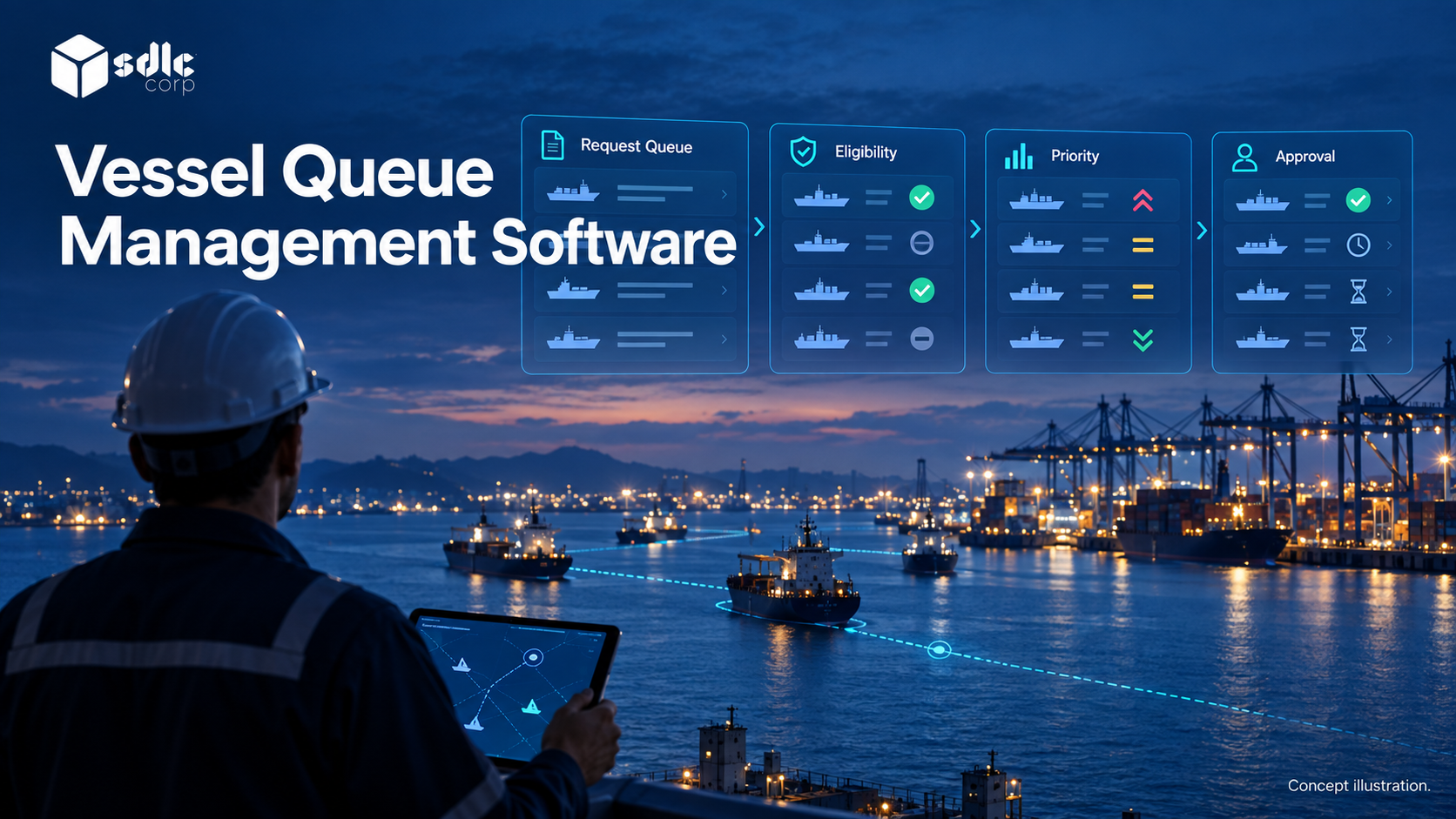
A vessel queue is a policy for ordering requests that are eligible for review or allocation. The port must define eligibility, priority, tie breaking and how an urgent but incomplete request is escalated; software should not infer those rules from arrival order alone.
Queue position is also different from approval. An operator needs to see why a request is waiting, what prevents it from progressing and who can resolve the condition.
Vessel Queue States: Incomplete, Eligible, Waiting And Approved
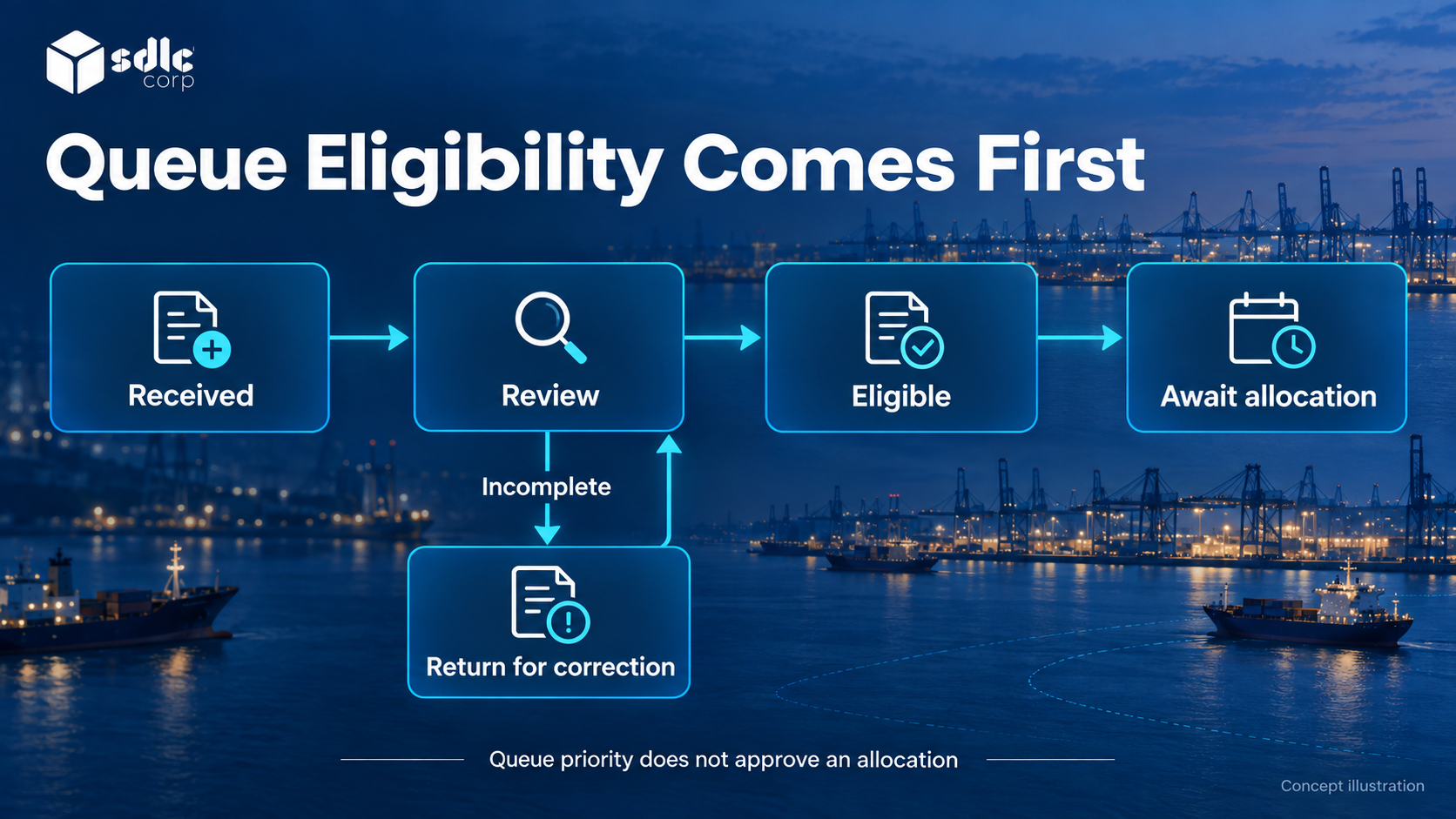
Agree the lifecycle with the teams that submit, review, and approve requests. Useful states may include received, incomplete, under review, eligible, awaiting allocation, approved, canceled, and closed. Adopt the states that match the actual process rather than importing a vendor's default vocabulary unchanged.
| State question | Information the operator needs |
|---|---|
| Is the request complete? | Missing fields and the responsible submitter |
| Is it eligible? | Applicable rule and unresolved constraints |
| Why is it prioritized? | Policy, reason and effective time |
| Can it progress? | Required approval and available allocation |
Keep priority distinct from permission. Moving a request upward in a queue should not itself approve an allocation. Allocation constraints and approval rules defines the next decision after queue review.
Include eligibility, visible reasons and auditable overrides in the queue-management feature scope before considering predictive ranking.
Define Priority Rules, Tie Breaks And Authorized Overrides
Separate The Priority Rule From A One Off Exception
Represent priority rules as approved, versioned policy. For each rule, record its owner, effective date, conditions, and exception process. The interface should show which rule affected a request and which facts were used. Avoid opaque scores that operators cannot challenge or explain during a later review.
If an authorized user overrides a priority, require a reason and retain the previous state. Distinguish a temporary exception from a permanent policy change. A busy shift should not accidentally redefine how future requests are ranked. Review the control model alongside roles, permissions and audit requirements.
Define Tie Breaks Without Letting Rank Become Permission
Use a documented ordering sequence. First determine which requests are eligible for the queue being viewed. Next apply the locally approved priority categories. If requests remain tied, use the agreed tie breaker, such as the relevant recorded submission time, and retain the reason for the resulting order. These are policy choices to confirm, not a universal first come rule.
Test two requests with the same priority, one corrected submission and a later cancellation. Decide whether correction preserves the original queue age or starts a new eligible period.
Show both timestamps if they answer different questions. A user should be able to reconstruct the ranking without interpreting an unexplained numeric score or assuming that the first item already has an approved allocation.
If berth readiness affects eligibility, agree the anchorage and berth scheduling responsibilities first. A shared dependency does not give both teams authority over the same decision.
Order Five Requests With A Clear Tie Break
Illustrative example
This policy puts eligible high-priority requests before eligible normal requests, then uses submission time. Equal times use the stable request identifier. These are sample rules, not a universal port policy.
| Vessel / Request | Submitted | Eligible? | Priority And Constraint |
|---|---|---|---|
| A / R-01 | 08:10 | Yes | Normal; either zone |
| B / R-02 | 08:30 | No | Urgent; missing approval |
| C / R-03 | 08:40 | Yes | High; Zone 2 only |
| D / R-04 | 09:00 | Yes | Normal; either zone |
| E / R-05 | 09:00 | Yes | Normal; either zone |
Result At 09:05
| Position | Request | Explanation |
|---|---|---|
| 1 | C / R-03 | High-priority and eligible |
| 2 | A / R-01 | Earliest eligible normal request |
| 3 | D / R-04 | Ties with E on time; lower request identifier |
| 4 | E / R-05 | Same priority and time as D |
| Separate blocked list | B / R-02 | Urgency does not supply the missing approval |
If Zone 2 is unavailable, C remains the highest ranked eligible request but cannot receive an allocation there. A may use another eligible zone only if the port’s bypass policy permits it, with the reason recorded.
At 09:10, B’s missing approval is supplied. Under this test policy, eligible urgent requests precede high and normal priority, so the new order is B, C, A, D, E. Preserve the earlier order, the eligibility change and the applied rule version. No request receives allocation approval merely by becoming first.
Design For Concurrent Work
Two operators may open the same request before either completes a decision. Use a visible ownership or version checking mechanism so a later save cannot silently overwrite an earlier approval. When a conflict occurs, show the current state and let the user reconcile their intended change.
The Amazon Web Services (AWS) documentation on optimistic locking illustrates version checks that reject an update based on stale data. It is one implementation example, with documented limitations; confirm conflict behavior in the chosen datastore and deployment.
New observations should update supporting information without replacing the user's place in the queue. Preserve filters, keyboard focus, and selected records during refresh. A clear age indicator and an explanation of changed eligibility are more useful than a constantly jumping list. The supervisor's exception dashboard should use the same queue states so totals and worklists agree.
Test Fairness Through Traceability
Fairness cannot be established by a software label. It depends on approved policy and consistent, reviewable application. Ask evaluators to reconstruct why two requests received different treatment. They should be able to inspect the relevant conditions, missing information, authorized exceptions, and policy version.
| Demonstration | Expected evidence |
|---|---|
| Incomplete urgent request | Priority visible, eligibility still blocked |
| Authorized exception | Reason, approver and previous position retained |
| Policy revision | Effective version attached to later decisions |
| Simultaneous edits | Conflict shown without silent overwrite |
Include a canceled request and a repeated submission. Neither should leave a hidden reservation or create two active queue items for one intended request.
Keep estimated arrival and confirmed berth readiness distinct. A revised estimate may flag a request for review; it must not silently change priority or approve allocation. Define which incoming changes trigger an alert, who acknowledges it, and how duplicate notifications are suppressed.
Measure Request Age Separately From Vessel Waiting
Track request age by state, unresolved ownership, correction cycles, and exception reasons. Separate time awaiting the submitter from time awaiting an internal decision. Otherwise the same headline metric can unfairly attribute delay to the wrong team.
Compare queue records with allocation records during a pilot. A request marked approved should have the required downstream relationship, while cancellation should release only the intended reservation. Acceptance tests for operational workflows can turn these relationships into explicit pass conditions. Keep physical vessel waiting separate from administrative request time unless their relationship has been verified.
Review a pilot queue by reconstructing several decisions from the history. Each should explain priority, eligibility, the responsible person and the next permitted action.
Conclusion
Run a small set of requests through the queue, including equal priorities, missing data and an approved priority change. The resulting order and every blocked request should have an explainable reason.
Use separate timestamps for administrative processing and vessel waiting. That distinction lets the port improve queue handling without attributing unrelated physical delays to the same measure.
Discuss Queue Workflows With SDLC Corp
Evaluate queue handling in the anchorage management system with SDLC Corp using your eligibility, priority and override policies. Discuss custom software development services only where the supported configuration cannot meet a documented need. Ask for a demonstration that explains each rank, recalculates changed conditions and preserves history, while keeping queue order separate from allocation approval and movement authority.
Frequently Asked Questions
Must A Vessel Queue Follow Arrival Order?
Only where the approved policy requires it. Eligibility conditions, priority classes and tie breaking rules may produce another order. Record the rule and reason so an operator can explain why one request precedes another.
How Should An Urgent Incomplete Request Be Handled?
Keep it visible and route it through the approved escalation procedure. Urgency should not silently bypass a mandatory condition; record any authorized exception, its approver and its effect on eligibility.
Does Queue Age Measure Vessel Waiting?
Not necessarily. Queue age measures time between defined request states. Vessel waiting uses separately defined physical or operational events, so report both with their own start and end conditions.