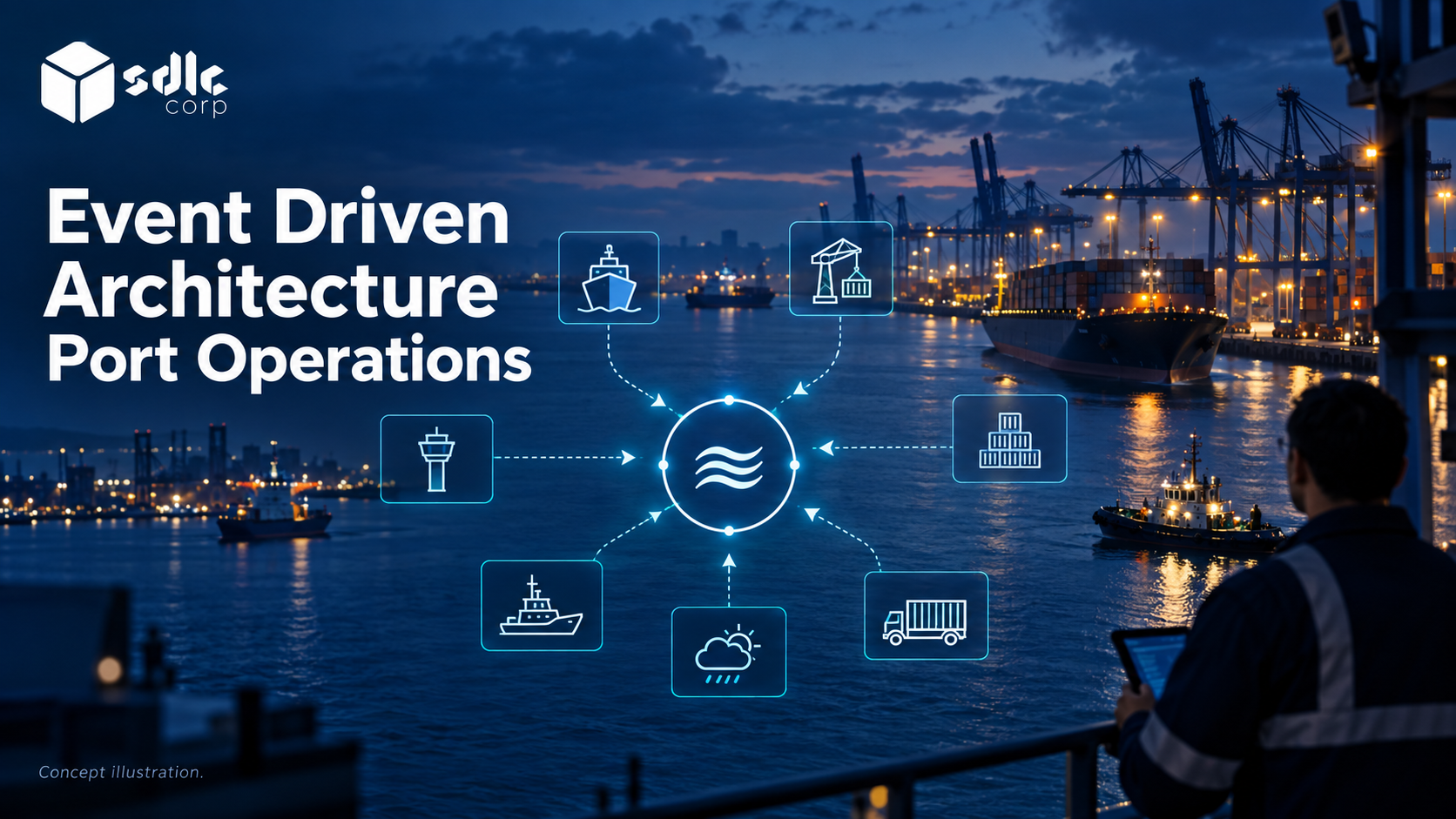
Event-driven architecture for ports lets one system publish a change, such as an approved allocation, for other applications to process independently. It fits when several workflows need the same update without joining a single synchronous request.
A port system needs event-driven architecture when several consumers must react to the same change and recover after downtime. A single consumer with no replay need is usually better served by a direct call.
The design must also handle repeated messages, missing revisions and replay. Delivery alone is not the outcome: records and external actions must stay correct when a consumer reconnects or rebuilds its state.
When Should a Port Workflow Use Events Instead of Direct Calls?
Assess each flow for fan-out, response timing, coupling and recovery needs. Then choose the exchange pattern that meets those requirements under the port's operating conditions.
| Flow | Multiple Consumers | Time-Sensitive | Pattern to Evaluate |
|---|---|---|---|
| Allocation approved | Traffic view, agent, reporting | Yes | Event distribution |
| Arrival confirmed | Queue, berth planning, audit | Yes | Event distribution |
| Historical report request | One | No | Direct call |
| Reference data refresh | Several | No | Scheduled job |
| Exception raised | Owner, supervisor, dashboards | Yes | Event distribution |
As Writing API Contracts For Port Systems explains, the contract should state which parts of the event model are binding. An event that other organizations consume is an interface, whether or not it is documented as one.
Define Allocation, Arrival and Exception Events
Events describe things that happened, so past-tense names such as allocation.cancelled help separate facts from requested actions. Agree a vocabulary with consumers and keep each event focused on one business fact.
The S-211 Port Call Message Format offers a standard vocabulary for port call events, separating estimated, requested, confirmed and actual times. Reuse its terms where your consumers already know them.
Include the identifiers a consumer needs to act, the time the fact occurred, the source and a version. The CloudEvents specification defines a common envelope whose attributes include id, source, type and time.
Then choose between a thin notification carrying identifiers and an event carrying the state consumers need. Thin events keep payloads small but force a later query; state-carrying events add versioning work.
Close the Gap Between Saving an Approval and Publishing Its Event
Consider an approval saved successfully just before the publisher fails. If the database write and the event publication are separate operations, downstream systems may never learn about the approval.
A transactional outbox closes that gap. Save the state change and its publication record in one local transaction, then let a relay publish pending records. AWS transactional outbox guidance explains this dual-write problem.
The relay may publish more than once, so consumers still need duplicate handling. Monitor pending publication age and failed relay work alongside consumer lag.
The outbox does not make an external action happen exactly once. It does ensure a committed change never silently loses its notification, and that is the evidence to ask for.
A Data Contract For Port-Call Milestone Updates shows why each event's owner, revision and business meaning must be agreed with its consumers.
Get Ordering, Idempotency and Replay Right
Protect the Current State When Events Repeat or Arrive Late
These five practices determine whether the architecture stays dependable under load and after failure.
- Ordering guarantees stated per stream, with a key such as the call identifier that preserves per-call order.
- Idempotent consumers, so a redelivered event never creates a second allocation.
- Deduplication using an event identifier rather than payload comparison.
- Retry with backoff, and a dead-letter destination that a named person owns.
- Replay from a point in time, for recovery and for investigation.
Keep occurrence time and publication time as separate fields. Field ownership and reconciliation rules depend on that distinction to reject a late, older observation without overwriting a newer one.
Broker guarantees matter here. Apache Kafka's documentation describes ordering as guaranteed within a partition, which is why the call or allocation identifier makes a good partition key.
A Cancellation Event That Arrives Twice
Illustrative example
This event envelope has a unique event identifier and a version for one allocation. Versions are ordered per allocation, not globally across all port activity.
{
  "event_id": "E-88",
  "type": "allocation.cancelled",
  "allocation_id": "AL-7",
  "call_id": "C-182",
  "aggregate_version": 8,
  "occurred_at": "2026-09-18T10:00:00Z",
  "reason": "authorized replacement"
}
Duplicate, Late Event, Retry and Replay
| Delivery | Consumer Starting State | Expected Result |
|---|---|---|
| E-88 version 8 | Version 7 approved | Store cancellation and processed event identifier together |
| E-88 repeated | Version 8 cancelled | No second cancellation or notification |
| Amendment E-87 version 7 arrives late | Version 8 cancelled | Preserve history; do not restore approved state |
| Version 10 arrives before 9 | Version 8 | Hold or fetch missing state according to the contract |
| Consumer fails before committing | Version 8 unchanged | Retry can apply the event once |
| Historical replay rebuilds a dashboard | Empty projection | Rebuild state without repeating external notifications |
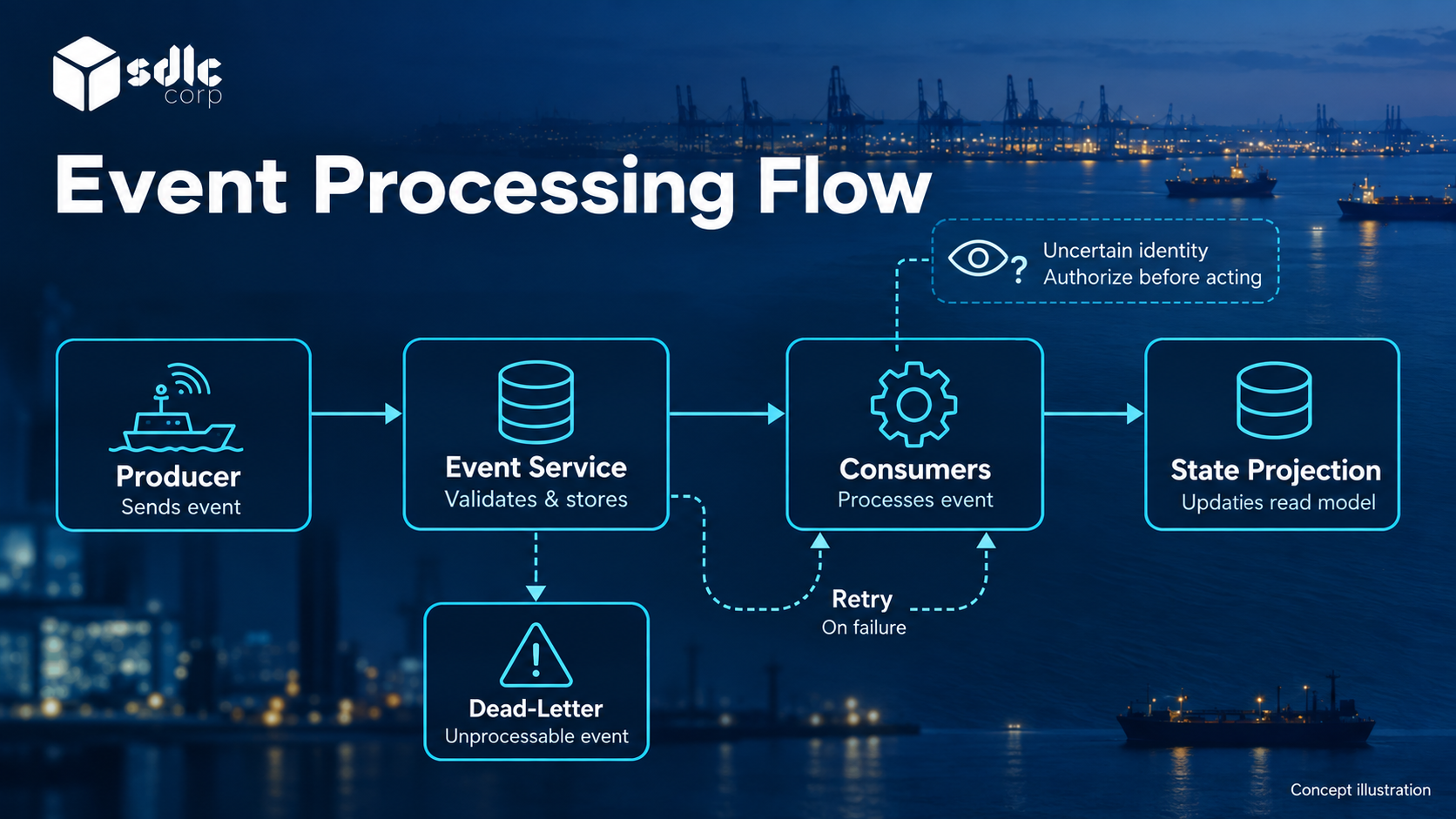
Under an outbox design, the producer stores the business change and the outgoing event in one transaction. Delivery may still repeat, so consumer idempotency remains necessary.
The two identifiers do different jobs. The event identifier prevents duplicate processing, while the allocation version stops an older but distinct event from overwriting newer state.
A replay mode must also tell rebuilding a view apart from repeating a real-world side effect, such as a notification sent to an agent.
Execute a Version Gap and a Safe Replay
For this projection, the policy holds later versions until missing ones arrive. Event application and the processed-event marker commit together, and external notifications use a separately deduplicated delivery record.
| Delivery Order | Projection Before | Committed Result |
|---|---|---|
| E-88, version 8, cancellation | Version 7 approved | Version 8 cancelled; one notification job N-88 |
| E-88 repeated after acknowledgement loss | Version 8 cancelled | No state change; no second N-88 |
| E-90, version 10, corrected cancellation reason | Version 8 | Held as pending; version 8 remains current |
| E-89, version 9, cancellation review note | Version 8 | Apply 9, then held 10; current version 10 |
| Rebuild projection from versions 1 to 10 | Empty replacement projection | Version 10 rebuilt; notification sending disabled during replay |
If version 9 cannot be retrieved, the projection stays marked incomplete and follows the agreed reconciliation route rather than applying version 10 blindly. The authoritative record stays with its owning service meanwhile.
Keep a Projection Operators Can Read
Consumers usually need current state as well as the stream. A projection maintains that view from events; event sourcing is optional. Agree how snapshots, reconciliation and retained events rebuild it after failure.
Show the lag rather than hiding it. A dashboard that silently displays stale data during a broker incident is worse than one that says it is behind.
What Port Operators Need From A Dashboard covers how freshness and staleness should be surfaced to the people making decisions.
Decide What a Delayed View Permits
Suppose an allocation approval has reached the owning system but not yet a downstream dashboard. For that interval, the two screens show different states.
The design must say where users check the authoritative decision before acting again. A lag indicator explains the discrepancy but does not prevent a conflicting action, so test permission and state checks alongside the delayed display.
Decide where producers, brokers and consumers run, and test what happens when the network between them fails. A network break can separate components that normally appear to share one service.
Plan for Degraded Modes Explicitly
Asynchronous systems fail differently from synchronous ones. A consumer that stops processing does not produce an error the user sees; it produces silence and a growing backlog.
- Alarm on consumer lag and dead-letter volume, with named owners for each alarm.
- Define what the operator interface shows when a projection is behind.
- Decide which actions are blocked and which continue during a backlog.
- Write the audit record on the owning side, not only through the stream.
The same principle applies to Automatic Identification System (AIS) feeds: when a sensor stops reporting, the degraded state must be visible rather than inferred.
Before wrapping a Vessel Traffic Management and Information System (VTMIS) in an event layer, confirm the exchanges it already supports. Integrating VTMIS With An Anchorage Application explains how to approach that integration.
Select Infrastructure for Event-Driven Architecture in Ports
Choose a broker against the required delivery guarantees, recovery behavior and measured workload. Weigh operational familiarity, support arrangements and whether someone can run it at three in the morning.
| Option | Ordering | Retention and Replay | Best Suited To |
|---|---|---|---|
| Apache Kafka | Per partition, using a key such as the call identifier | Retained log; consumers replay from any offset | High-volume streams with rebuilds and many consumers |
| RabbitMQ | Per queue, with a single consumer | Messages removed after acknowledgement; streams add replay | Task distribution and routing at moderate volume |
| Managed cloud services (Azure Event Hubs, Amazon EventBridge, Google Pub/Sub) | Partition or ordering-key based, depending on the service | Retention, archive and replay vary by service | Teams that prefer managed operations over running brokers |
| Webhooks | Per sender, if the sender enforces it | None unless the sender stores and retries | A few consumers with simple recovery needs |
Treat the table as a starting point. Confirm each guarantee against the product documentation and your own failure tests before committing to a platform.
Microsoft's event-driven architecture guidance distinguishes payload choices, delivery patterns and event sourcing. Specify the guarantees you selected rather than assuming every transport supports durable replay.
Migrate incrementally. Introduce events alongside existing calls for one flow, prove the operational handling, then extend. A cutover that converts every integration at once removes the ability to trace a problem to its cause.
Conclusion
Before adopting event-driven architecture for ports, demonstrate the chosen duplicate, gap and ordering policy against a real sequence of record versions. Then rebuild a consumer from retained events and inspect its final state and notifications.
Choose infrastructure that supports those requirements and your team's operating capacity. Replay should never repeat external actions unless the agreed recovery procedure explicitly requires it.
Assess Event Architecture with SDLC Corp
SDLC Corp can review event-based connections for your Anchorage Management Software through its Software Integration Services. Bring the business facts, consumers and recovery requirements you need to support.
We will check whether events solve a defined coordination problem, and show evidence for duplicate handling, missing revisions and replay. Proposed infrastructure follows those requirements, with clear support responsibilities for publishers and consumers.
Frequently Asked Questions
When Is an Event-Based Design Useful?
When multiple consumers need the same change independently or must catch up after being unavailable. Specify consistency and recovery needs first; a simple request interface may be enough for a smaller exchange.
Is a Broker Mandatory?
No. Webhooks can suit a limited set of flows if retry, retention and recovery meet the requirements. A broker supports broader delivery needs, but its operating responsibilities must be planned.
How Much Data Should an Event Contain?
Enough permitted context to interpret the change. Identifiers keep messages small but require a later query, while carrying state reduces that dependency. Version the chosen contract and leave out unnecessary fields.
What Is a Transactional Outbox?
It saves the business change and its outgoing event record in one database transaction, then publishes pending records from a relay. A committed change therefore cannot lose its notification.
How Do Consumers Handle Duplicate Events?
Store each processed event identifier with the state change in one commit, and skip any event already recorded. Use the aggregate version to reject older events that arrive late.
Can Replay Resend Notifications?
Not by default. Run replay in a mode that rebuilds views while external notifications stay disabled, unless the recovery procedure explicitly requires them.