
Port call milestone integration lets participants exchange changes without losing who owns a time or what that time means. A useful data contract identifies the call, milestone, owner and revision, and distinguishes estimated, committed and observed times.
Acknowledgement has its own meaning: a recipient may have processed the update without approving the revised plan. Withdrawal and older messages also need defined outcomes to keep the shared timeline consistent.
Assign Arrival Estimates, Berth And Nautical Service Milestone Owners
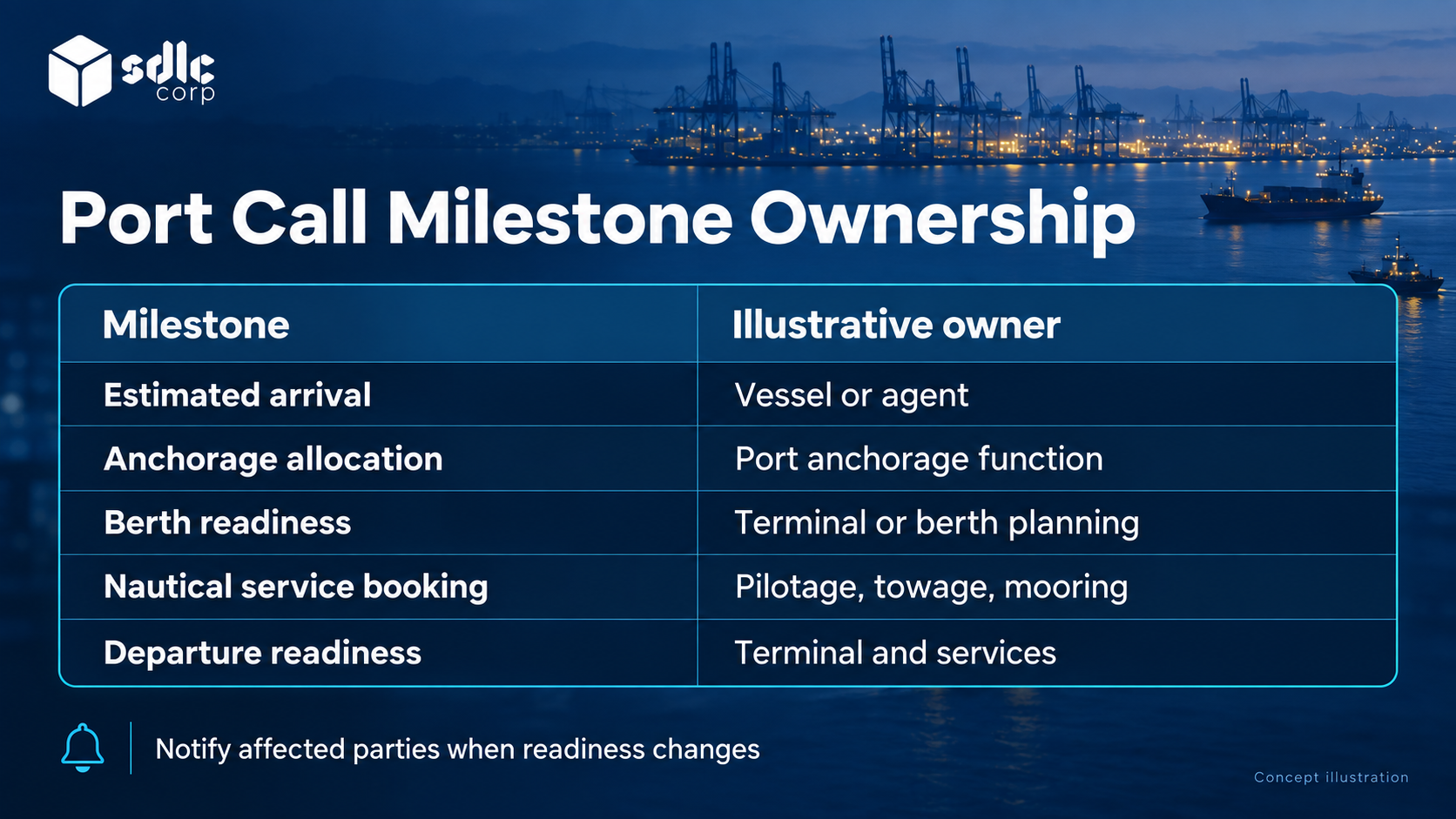
Agree the milestone owners, dependencies and revision rules before integration design. Milestones can change independently; the table maps responsibilities rather than prescribing a universal event sequence.
| Milestone | Typical owner | Who must react to a change |
|---|---|---|
| Estimated arrival | Vessel or agent | Anchorage, berth, services |
| Anchorage allocation | Port anchorage function | Vessel, agent, traffic |
| Berth readiness | Terminal or berth planning | Anchorage, pilotage, services |
| Nautical service booking | Pilotage, towage, mooring | Berth planning, vessel |
| Departure readiness | Terminal and services | Traffic, next call |
The commercial case for connecting port call and anchorage systems covers which delays this coordination can influence and which are outside the port's control.
For each update, mark whether it changes anchorage planning or a commitment owned by another team. Shared visibility does not transfer responsibility for that commitment.
Distinguish Estimate, Commitment And Observation
Keep Each Milestone Meaning Visible
A field used for several different time meanings can cause coordination disputes. An estimated time is a forecast. A commitment is an undertaking a party has made. An observation is what happened.
Store them separately and show all three. A berth readiness estimate that quietly becomes a commitment, and then is compared against an observation, produces an argument nobody can settle from the record. Source of truth and reconciliation design describes the ownership discipline that keeps these apart.
A Readiness Message And Its Acknowledgement
Illustrative example
These payloads form an illustrative internal contract. Field names, ownership and revision rules are design choices to agree with the participants; they are not a published maritime message schema.
Map the application message to the agreed interface contract. Times retain an explicit date and offset.
{
  "event_id": "E-204",
  "call_id": "C-182",
  "milestone": "berth_ready",
  "status": "committed",
  "effective_at": "2026-09-18T13:00:00Z",
  "issued_at": "2026-09-18T10:00:00Z",
  "revision": 2,
  "owner": "terminal-A",
  "supersedes_event_id": "E-203"
}
{
"event_id": "E-204",
"consumer": "anchorage-coordinator",
"processed_at": "2026-09-18T10:00:03Z",
"result": "applied",
"applied_revision": 2
}What Happens When The Plan Changes Again?
| Sequence | Contract Behavior | Planning Consequence |
|---|---|---|
| Revision 2 changes readiness from 12:00 to 13:00 | Retain both revisions; current value becomes 13:00 | Affected services need reconfirmation |
| E-204 revision 2 arrives again | Recognize the same event and return its recorded acknowledgement | No repeated plan update or notification |
| Revision 1 arrives late | Store arrival for audit; do not replace revision 2 | Plan stays at 13:00 |
| Revision 3 withdraws commitment | Current status becomes withdrawn | Coordinator sees missing readiness |
| Consumer cannot process revision 3 | Return a failure with the event reference | Owner can retry or resolve the error |
The message owner controls the berth readiness fact. The anchorage approver still owns the allocation. An “applied” acknowledgement cannot be reused as evidence of movement approval or a service provider’s commitment.
Exchange Milestone Revisions With Call IDs And Acknowledgements
An event is worth publishing when someone else has to act. Publishing every field change produces noise that consumers filter out and then stop trusting.
The International Maritime Organization's Just In Time arrival guide relates arrival planning to berth, fairway and nautical service availability. Agree the meaning and authority of each readiness message with the participants responsible for berth, fairway and service availability.
- Arrival estimate revised beyond a defined tolerance
- Anchorage request submitted, approved, amended or released
- Berth readiness confirmed, changed or withdrawn
- Nautical service booked, confirmed or cancelled
- Exception raised against any of the above, with an owner
Each event needs sufficient permitted context to support its consumer, or a documented way to retrieve that context, and a time that reflects when the fact changed rather than when the message was sent. application programming interface (API) and interface requirements gives the contract shape for these events, including ordering, idempotency and retry behavior.
Trace A Berth Readiness Revision Across The Call
A readiness message can identify the call, milestone, issuing organization, revision and effective time, plus whether the value is estimated, committed or observed. If a terminal withdraws a commitment, consumers should identify the superseded revision and acknowledge processing without implying that the whole call plan has been approved again.
The anchorage team reviews the affected allocation or release plan; a service coordinator reviews relevant bookings. Each acts within its own authority. Show unresolved acknowledgements and conflicts in a worklist with escalation owners. When a repeated message arrives, it should not create another booking or repeat a notification indefinitely.
This single revision scenario tests the coordination contract more effectively than merely showing that two systems can display the same estimated time of arrival (ETA).
The event delivery and replay design explains how consumers can recover revisions without repeating the resulting external actions.
Handle Withdrawn Readiness And Unacknowledged Revisions
The optimized sequence is not the interesting one. What determines whether the platform is used is how it handles the call that slips: readiness withdrawn, a service unavailable, weather closing a window, an allocation that has to move.
Define who is notified, what the system proposes, what a person must approve, and how the earlier plan is retained. An exception that quietly rewrites the plan removes the evidence needed to review the decision afterwards. Weather and tide data integration covers the environmental inputs that can affect these exceptions and how to keep them advisory rather than automatic.
Give Each Party A View They Will Actually Use
Shared visibility is the point, but one undifferentiated screen can obscure the tasks of different roles. A terminal planner, an anchorage operator, an agent and a service provider need different subsets and different alerting.
Define per role views against the decision each role makes, and keep the underlying state definitions identical across all of them. A milestone that counts differently on two screens will be raised as a defect for the life of the system.
Measure What The Coordination Changed
Choose a small number of measures tied to the coordination itself rather than to port performance in general. Waiting time has too many causes to attribute to a platform.
- Lead time between a readiness change and the affected parties acting
- Proportion of calls where the plan changed after a commitment
- Exceptions resolved without leaving the system
- Reconciliation effort spent on conflicting milestone data
Baseline these before go live. The return on investment (ROI) and business case framework covers how to separate effects the platform can claim from those it cannot.
Sequence The Rollout Around Willing Participants
Start with the participants who will engage and the milestones they already track. A phased rollout that delivers real coordination between two parties beats a full model nobody updates.
Agree a small set of milestones and participants for the pilot. Each milestone needs a meaning, an owner and a response when it changes.
Pilot one exchange through a revision and a missed acknowledgement, using the actual participant permissions. Compare the sender's record with the receiving view and inspect what remains queued during an outage. Do not mark delivery complete merely because the sender has transmitted a message.
Before expanding, agree how an unsupported response, withdrawn commitment and unmatched call are assigned for review. Keep one authoritative owner for each milestone. Retain the contract version, observed results and support contacts so the next participant can join a tested exchange rather than an undocumented convention.
Conclusion
Pilot one milestone exchange through creation, revision, acknowledgement and withdrawal. Check that every participant displays the same revision and understands what the acknowledgement confirms.
Before widening the exchange, test a delayed older update and a conflicting change. Preserve their history without allowing either to silently replace the accepted current milestone.
Plan A Milestone Integration With SDLC Corp
Bring the milestone owners and revision examples to an SDLC Corp review of the anchorage management software and the required software integration services. Request a contract that distinguishes estimates, commitments and observations, with acknowledgements, rejected updates and recovery demonstrated. The scope should identify which participants supply each fact and what remains unresolved before a shared workflow can be accepted.
Frequently Asked Questions
What Fields Belong In A Milestone Update?
Include the call identifier, milestone type, responsible source, revision and time meaning, along with the relevant timestamp. The recipient needs enough context to distinguish a new estimate from an observed event or correction.
Does An Acknowledgement Approve A Movement?
Not unless that is explicitly the defined, authorized transaction. A processing acknowledgement normally confirms the contract's receipt or handling state; movement approval belongs to the designated operating process.
How Should An Older Revision Be Handled?
Compare its revision and source with the current record. Retain it where history is required, but apply the agreed ordering policy so delayed delivery cannot silently overwrite a newer accepted update.