In Philippines betting apps, casino withdrawal UX Philippines directly impacts iGaming trust in the Philippines and disputes. Withdrawals turn into nonstop support tickets when users see generic statuses like “pending” and no clear ETA. When the cashier doesn’t explain the stage, people assume something is wrong, retry withdrawals, and start disputes. This blog shows how to prevent that with an operator-ready withdrawal system: method-based SLAs, stage-based status codes, clear delay and rejection reason codes, proof-ready receipts and reference IDs, and a support runbook that matches each status so cases get resolved fast without weakening checks.
This approach is useful for operators working on casino game development, real-money gaming apps, and payout-ready betting platforms.
Why Casino Withdrawal UX Philippines Creates User Complaints
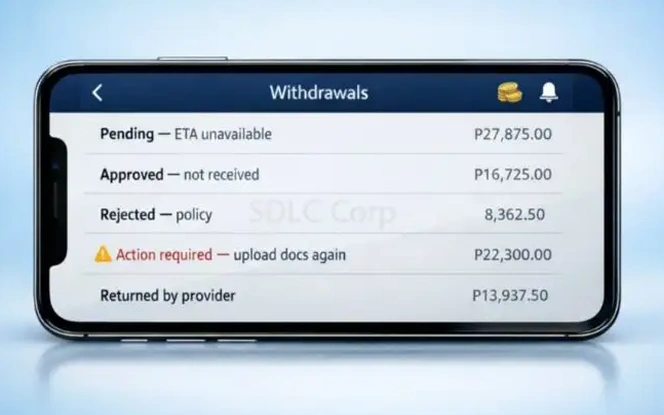
Users don’t usually complain just because a withdrawal takes time. However, they complain when the app stays silent or the status feels unclear. So the real problem is uncertainty: they can’t tell what’s happening or when they’ll get paid.
Typical dispute triggers
- “Pending” with no meaning or ETA
- “Approved” but money not received
- Rejected withdrawal with a vague “policy” message
- Repeated document requests at cash-out
- No receipt, no reference ID, no timeline
What stops disputes
- A stage-based flow users can understand
- Method-based SLAs that match reality
- Status codes that match backend states
- Receipts and proof users can export
- A support runbook tied to status + reason code
Expected Impact of Better Withdrawal UX
A structured withdrawal UX should not only look clearer. It should reduce repeat tickets, payout disputes, and manual support work. Operators can use these pilot benchmark targets to measure whether the new withdrawal flow is working.
| UX Improvement | Expected Operational Impact | Why It Helps |
|---|---|---|
| 3-stage withdrawal UX with eligibility, review, and provider processing | 40–60% dispute reduction | Users understand where the payout is instead of assuming it is stuck. |
| Clear delay and reject reason codes | 25–35% fewer support tickets | Users see the reason and next step without opening a ticket. |
| Tracking screen with ETA, last updated time, and reference ID | Up to 50% fewer “where is my money?” tickets | Users can self-check payout progress before contacting support. |
| First-attempt KYC during deposit or onboarding instead of withdrawal | 60%+ reduction in support drag | Users avoid surprise document requests during cash-out. |
| Mapping internal states to a small set of user-facing statuses | Around 30% lower dispute volume | The app shows simple progress while ops keeps detailed backend states. |
Teams solving disputes usually rely on structured tracking, audit evidence, and fast UX - topics covered deeper in Audit Logs Operators Miss: The Evidence You Need in Disputes and performance-focused UX guidance from Mobile-First iGaming UX in PH: Low-Data, Fast Lobby, Lite Onboarding.
Casino Withdrawal Workflow UX: 3 Stages Users Must See
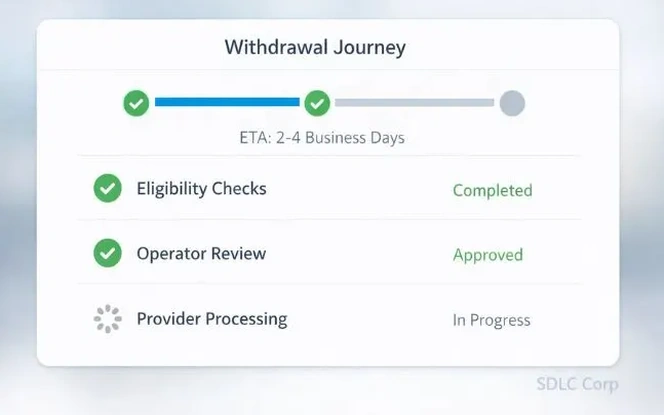
Withdrawals aren’t a single action that instantly becomes money in the user’s account. Your UI should show the real stages-checks, review, and provider processing-in simple words with an ETA and proof at each step.
The same withdrawal workflow also matters in slot game development, where users expect fast deposits, clear cash-out stages, and simple payout tracking.
In pilot benchmark targets, operators using a clear 3-stage withdrawal UX can aim for a 40–60% reduction in payout disputes because users understand the current payout stage.
Stage 1: Eligibility checks (before money moves)
These checks decide whether a withdrawal can proceed.
Eligibility checks
- KYC state: complete, missing, or needs retry
- Method verification: payout method belongs to the user
- Bonus eligibility: wagering rules met or not met
- Limits: daily/weekly caps, staged payouts, and minimum withdrawal amounts such as ₱500 or ₱1,000.
- Basic fraud/risk triggers: unusual behavior, mismatched details
Moving first-attempt KYC earlier in the journey, instead of waiting until withdrawal, can reduce support drag by 60%+ during cash-out.
Operators improving early verification should align this stage with KYC Drop-Off Fix for Philippines operators, withdrawal checks should also align with responsible gaming controls, because PAGCOR requires licensed gaming entities to follow responsible gaming practices that reduce harm, prevent addiction, and prohibit underage gambling. For Betting Apps (Without Weak Verification) and foundational player protection flows from Responsible Gaming Controls to Ship on Day 1 (PH Operator List).
Stage 2: Operator review (risk + approvals)
This stage protects payouts and reduces abuse. However, it must not feel like a black box.
PAGCOR’s Internet Gaming License requirements also include documents such as a Money Laundering and Terrorist Financing Prevention Plan, security compliance officer declaration, independent testing laboratory certification, AMLC registration certificate, and responsible gaming program.
- Fast lane: automated checks, clean history
- Slow lane: manual review, edge cases, high-risk flags
- Escalation: payout trace, risk approval, compliance review
Risk teams usually pair review workflows with detection signals and compliance architecture described in Anti-Fraud Signals PH Operators Should Track From Day 1 and Compliance-by-Design iGaming Platform Blueprint for the Philippines.
Stage 3: Provider processing (after approval)
After approval, external rails still take time. So the status must shift from “our review” to “provider processing.”
Provider realities
- Some methods confirm in minutes
- Meanwhile, bank-based rails can take business days
- Provider delays can happen even after you approve
- “Completed” must mean “provider confirmed,” not “we pressed send."
BSP’s National Retail Payment System framework is built around interoperability, inclusivity, and industry cooperation, which makes payment rail behavior important when setting realistic withdrawal SLAs.
This stage connects directly with deposit routing and PSP logic explained in iGaming Payment Architecture: Designing Deposits Under PH Restrictions and real wallet behavior covered in PH iGaming Deposits: Cash-In → GCash/Maya → Bet (UX Guide).
Smart Withdrawal SLA Time Bands That Reduce Payout Disputes
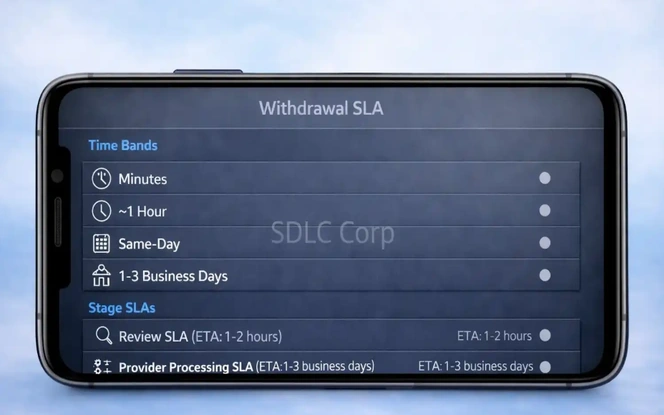
Promising “instant withdrawals” backfires because some methods and review stages can’t be instant, so users feel misled when delays happen. Publish realistic time bands by payment method and withdrawal stage (review vs sent to provider) so expectations stay aligned and disputes drop.
Use time bands (method-based)
For example, a clean ₱1,000 e-wallet withdrawal may move faster than a ₱25,000 bank payout that needs manual review.
We recommend a simple set of bands users can remember.
Time band example
- Minutes: real-time methods (when available)
- ~1 hour: fast wallet flows
- Same-day: standard methods with light review
- 1–3 business days: bank-dependent rails and settlement windows
Rules that keep SLAs honest
- Publish an average and an “up to” range
- Also call out conditions that extend time (manual review, weekends, provider delays)
- If you can’t guarantee it, don’t imply certainty
- Show users when larger payouts, such as ₱20,000 or above, may need extra review before release.
Add SLAs per stage (ops + user)
Stage SLAs reduce confusion because users know what is slow.
Stage SLA checklist
- Eligibility action time (user-controlled)
- Review SLA (operator-controlled)
- Provider processing SLA (external)
- Support response SLA (first reply time)
Status Codes That Reduce Tickets (User-Facing + Internal)
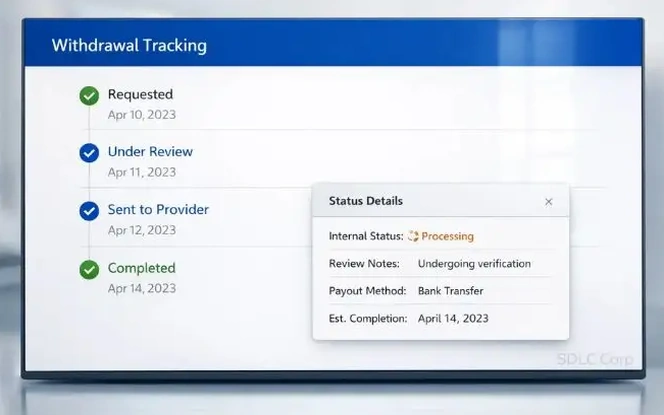
Users need a short, clear list of statuses that tell them what’s happening, what it means, and when to expect the payout. Meanwhile, ops needs detailed internal states behind those labels so reviews, provider handoffs, SLAs, and support actions stay accurate and consistent.
User-facing statuses (keep it small)
- Requested - “We received your request.”
- Action required - “We need info to continue.”
- Under review - “We’re checking details.”
- Approved - “Approved. Preparing payout.”
- Sent to provider - “Sent. Your bank/wallet is processing.”
- Completed - “Paid. Receipt available.”
- Rejected - “Not eligible. See reason.”
- Returned - “Provider returned funds. Fix details.”
Status Code Mapping
Map backend states to simple user messages so support, product, risk, and payments teams all speak the same language.
| Internal State | User-Facing Message | What It Means | User Action |
|---|---|---|---|
| WITHDRAWAL_REQUESTED | Requested | We received your withdrawal request. | Wait for the next update. |
| KYC_REQUIRED / KYC_RETRY_REQUIRED | Action required | More verification is needed before payout. | Upload or correct documents. |
| RISK_REVIEW / KYC_IN_REVIEW | Under review | The withdrawal is being checked. | Wait for review ETA. |
| APPROVED_SENDING | Approved | The operator approved the payout. | Wait while payout is prepared. |
| SENT_TO_PROVIDER | Sent to provider | Bank or wallet provider is processing it. | Track provider SLA. |
| PROVIDER_CONFIRMED | Completed | Payment has been confirmed. | Download receipt if needed. |
| WAGERING_NOT_MET / LIMIT_CHECK_FAILED | Rejected | The withdrawal is not eligible. | Review the reason and fix it. |
| RETURNED_BY_PROVIDER | Returned | Provider returned the payout. | Update payout details and resubmit. |
Internal states (precision for ops)
These states power automation, queues, and logs.
Examples
- KYC_REQUIRED
- KYC_RETRY_REQUIRED
- KYC_IN_REVIEW
- WAGERING_NOT_MET
- LIMIT_CHECK_FAILED
- RISK_REVIEW
- APPROVED_SENDING
- SENT_TO_PROVIDER
- PROVIDER_CONFIRMED
- RETURNED_BY_PROVIDER
Mapping rule (the key to fewer disputes)
Each user-facing status must map cleanly to a defined internal state group (like KYC, review, provider processing, or completed). If the mapping is inconsistent, the app will show the wrong progress, which creates confusion, repeat tickets, and disputes-even when the backend is working.
Mapping detailed internal states to a smaller user-facing status set can target around 30% lower dispute volume because users see simple, consistent progress.
Implementation note- Store both user_status and internal_state
- Also store last_updated_at and eta_band
- Then render the timeline from events, not guesses
Reason Codes That Stop Arguments (Delay + Reject Taxonomy)
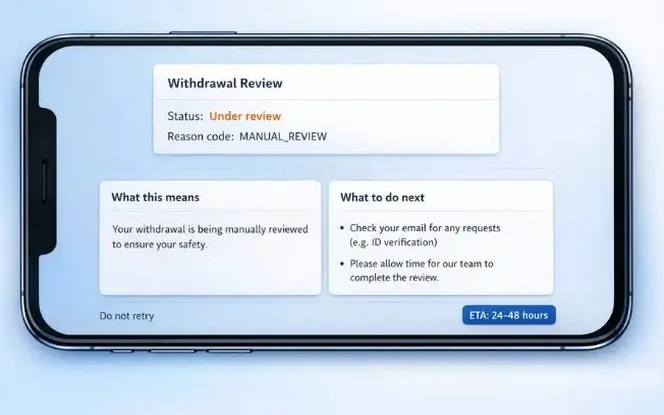
A vague “Failed” message makes users assume the worst, so tickets turn emotional and repetitive. Use clear reason codes that explain what category caused the stop and what the user should do next.
Clear delay and rejection reason codes can reduce avoidable support tickets by 25–35% because users know what happened and what to do next.
Delay reason codes (with user fix + ops fix)
Keep reasons simple.
Also avoid leaking sensitive risk logic.
Delay reason code set
- KYC incomplete / unclear docs
- User: upload again with guidance
- Ops: route to KYC retry lane
- Method mismatch (deposit vs withdrawal method differs)
- User: switch to verified method or verify ownership
- Ops: enforce method rules consistently
- Manual review needed
- User: wait for review ETA
- Ops: SLA timer + escalation if overdue
- Limits exceeded
- User: reduce amount or wait for reset
- Ops: show limit screen before submit
- Provider processing delay
- User: wait for provider SLA
- Ops: enable trace workflow
- Incorrect payout details
- User: update details and re-submit
- Ops: validate fields before submission
- Weekend/holiday/banking window
- User: expect business-day timing
- Ops: show “business day” badge
Delay Reason Codes
Use these reason codes when a payout is delayed but not rejected. Each code should show one user fix and one ops fix.
| Code | Trigger | User Fix | Ops Fix |
|---|---|---|---|
| KYC_INCOMPLETE | Missing or unclear verification document | Upload clear documents again | Route to KYC retry lane |
| METHOD_MISMATCH | Withdrawal method does not match verified method | Use verified payout method | Enforce method rules consistently |
| MANUAL_REVIEW_NEEDED | Risk or edge-case review required | Wait for review ETA | Start SLA timer and escalation |
| LIMIT_EXCEEDED | Daily, weekly, or amount limit crossed | Reduce amount or wait for reset | Show limit before submit |
| PROVIDER_DELAY | Wallet, bank, or PSP has not confirmed payout | Wait for provider SLA | Start trace workflow |
| DETAILS_INVALID | Incorrect payout account or wallet details | Update payout details | Validate fields before submission |
| BANKING_WINDOW_DELAY | Weekend, holiday, or batch cutoff | Wait for next business window | Show business-day timing badge |
Reject reason codes (must be specific)
If you reject a withdrawal, give the exact reason in one clear line, and immediately show the next step the user can take to fix it.
Reject reason code set
- NOT_ELIGIBLE_WAGERING_NOT_MET
- METHOD_NOT_VERIFIED
- DETAILS_INVALID
- POLICY_RESTRICTION
- DUPLICATE_REQUEST
- ACCOUNT_REVIEW_REQUIRED
Cashier UX That Prevents Disputes by Design
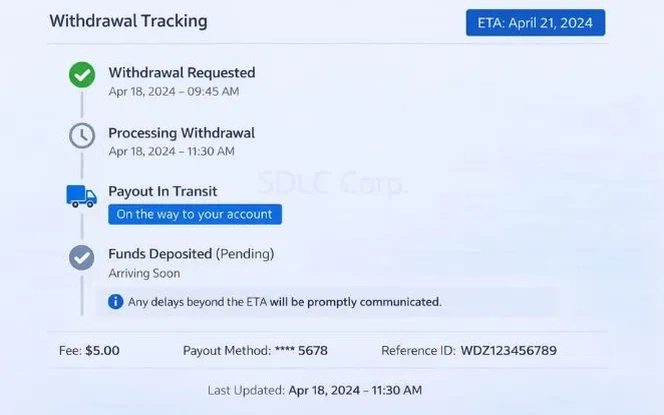
A good cashier should feel like parcel tracking - users see each step, the current stage, and the ETA, so they don’t guess or spam support.
For products like blackjack game development, a clear cashier flow helps users understand winnings, withdrawals, fees, and payout timing.
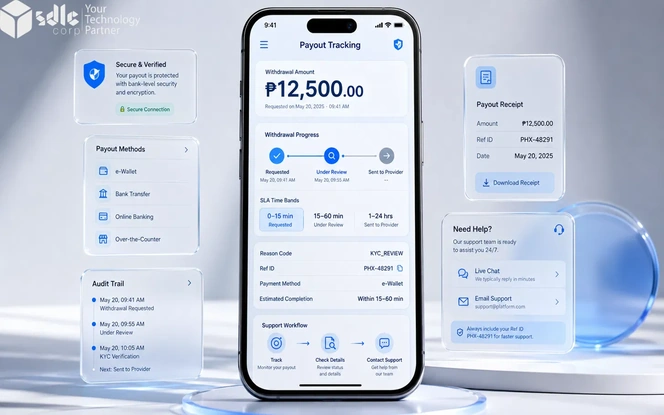
A tracking screen with ETA, reference ID, and last updated time can reduce “where is my money?” tickets by up to 50%.
Withdrawal tracking screen (non-negotiables)
This screen should load fast and show proof.
UI components
- Timeline view (stage-by-stage)
- Current status + reason category
- ETA band + “last updated” timestamp
- Amount + fees line items, such as ₱5,000 withdrawal amount, ₱15 provider fee, and final receivable amount.
- Method used (masked details)
- Reference ID with copy button
- “Contact support” button that attaches the withdrawal ID
- “Upload missing docs” entry point (only if needed)
Receipt + proof pack (auto-generated)
Users escalate when they can’t prove anything.
So generate proof by default.
Proof pack contents
- Withdrawal receipt page
- Status history (events with timestamps)
- Reference ID + provider trace fields (where available)
- Ticket ID linking (one chain)
- Terms snapshot indicator (what rules applied at request time)
Support Runbook for Resolving Stuck Casino Withdrawals
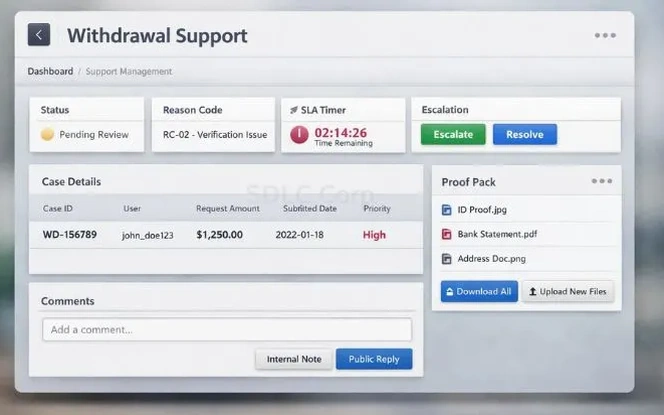
Support shouldn’t rely on assumptions. It should read the current status and reason code, then follow the matching runbook step-by-step for a fast, consistent resolution.
Triage steps (support reads the tracking screen first)
Support flow
- Confirm user-facing status
- Confirm internal state family
- Check KYC state
- Check method verification state
- Check wagering/limits state (if relevant)
- Check provider handoff state
- Respond using the matching macro
Standard support packet (what support asks for)
Ask for the minimum that unlocks tracing. Then stop asking for the same details twice.
Support packet
- Reference ID
- Timestamp of request
- Method name (not full details)
- Screenshot of tracking screen
- Error text shown (if any)
Escalation ladder (internal)
Define escalation triggers so support doesn’t delay cases.
Escalation rules
- If UNDER_REVIEW exceeds SLA → route to Risk queue
- If SENT_TO_PROVIDER exceeds provider SLA → route to Payments Ops
- If “completed but not received” → start provider trace flow
- If repeated attempts or inconsistent details → route to Risk review
Payout Ops Tools and Partner Checks for Philippines Operators
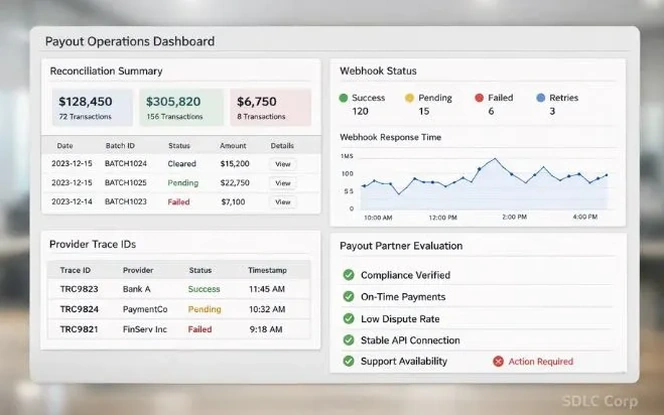
Your tooling decides whether you can prove what happened in a withdrawal. So judge systems by how well they handle disputes, logs, traceability, and evidence export, not by how good the demo looks.
Operators offering games such as roulette game development also need payout tools that support reconciliation, trace IDs, dispute logs, and provider checks.
Tooling checklist (what you need)
Core capabilities
- Ledger + reconciliation
- Provider webhooks + polling fallback
- Manual review queues with SLA timers
- Case management (withdrawal ↔ ticket linking)
- Evidence export (proof pack)
- Monitoring + alerts (SLA breach, provider failures)
Payout partner evaluation questions
Ask questions that reduce disputes later.
Partner questions
- Settlement times by method
- Trace workflow and reference IDs
- Failure code quality
- Cutoff times and batch windows
- Support response SLAs
- Returned/chargeback handling process
Payout Partner Evaluation Checklist
Use this checklist before choosing or renewing a payout provider, because poor provider visibility becomes support pressure later.
| Criterion | Pass Threshold | Conditional | Fail Signal |
|---|---|---|---|
| Settlement time clarity | Clear timing by method | Timing depends on batches | No clear SLA shared |
| Reference ID support | Unique reference ID for each payout | Only internal ID available | No traceable ID |
| Failure code quality | Specific failure and return codes | Limited failure categories | Generic failed status only |
| Trace workflow | Documented trace process | Manual support request needed | No trace process |
| Cutoff and batch windows | Cutoff times clearly documented | Cutoffs vary by method | No cutoff visibility |
| Returned payout handling | Clear return and retry process | Manual correction needed | Returned funds unclear |
| Support SLA | Defined first response and escalation SLA | SLA only for premium accounts | No support SLA |
Metrics Dashboard to Track Withdrawal Disputes and SLA Breaches
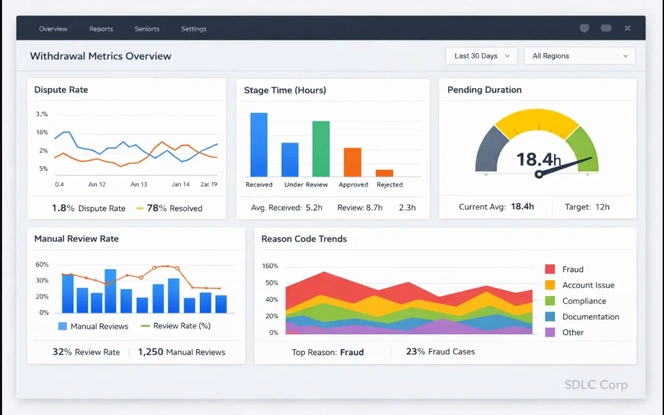
If you don’t measure withdrawal performance, you won’t fix disputes. Track the metrics that directly explain complaints; stage times, pending duration, ticket volume, and dispute rate by method and reason code.
Core metrics
- Tickets per 1,000 withdrawals
- Dispute rate by method
- Average and P95 time per stage
- Pending window duration
- Manual review rate
- “Approved but not received” rate
- Reopen rate
- Top delay reason codes (weekly)
Metrics Dashboard KPIs
Track these KPIs weekly so teams can see where withdrawal disputes start and who owns the fix.
| KPI | Target | Alert Threshold | Owner |
|---|---|---|---|
| Tickets per 1,000 withdrawals | Keep trending down weekly | Sudden weekly spike | Support Lead |
| Dispute rate by method | Low and stable by payout rail | One method rises above normal | Payments Ops |
| Average time per stage | Within published SLA | Stage exceeds SLA | Operations Team |
| P95 withdrawal time | Within “up to” SLA band | P95 crosses SLA limit | Payments Ops |
| Pending window duration | Short and explained | Long pending with no update | Product/Ops |
| Manual review rate | Controlled and justified | Sharp increase in reviews | Risk Team |
| Approved but not received rate | Very low | Repeated provider complaints | Payments Ops |
| Reopen rate | Low after first resolution | Same issue reopened often | Support Lead |
| Top delay reason codes | Reviewed weekly | Same reason stays high | Product + Ops |
Launch Checklist for Casino Withdrawal UX and Payout Operations
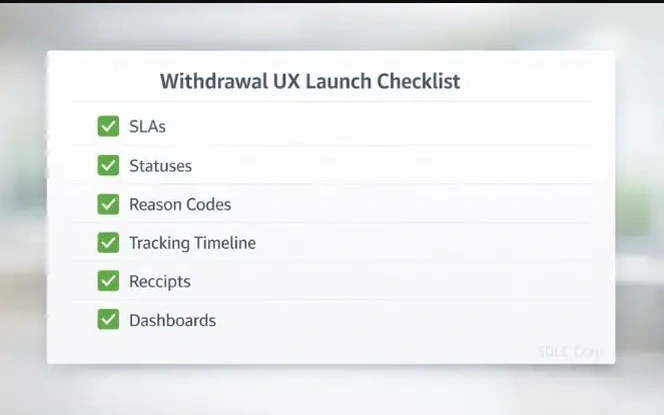
This keeps the rollout clean.
Also it prevents “UI promises vs ops reality” gaps.
Launch steps
- Define method-based time bands
- Define stage SLAs (review, provider processing, support response)
- Implement user statuses + internal states mapping
- Implement delay and reject reason codes
- Ship tracking timeline + receipt + reference ID
- Ship support macros + escalation ladder
- Add dashboards and weekly review cadence
Conclusion
A strong casino withdrawal UX Philippines strategy is not about speed alone. It is about clarity, proof, and predictable payouts. When users see stages, SLAs, and receipts, disputes drop, trust grows, and support pressure reduces. Operators that align UX with real payout rails build long-term retention and safer payment ecosystems.
Reduce Casino Withdrawal Disputes with Better UX
Help users track payouts clearly with stage-based statuses, ₱ payout visibility, SLA bands, reason codes, receipts, and support-ready reference IDs.
FAQs
What does “pending withdrawal” mean in an online casino app, and what happens during pending?
“Pending” means the app received your request, but it has not finished checks or released funds. Usually, the app checks verification, limits, and review rules during this time. Therefore, a good app shows the stage and ETA instead of only “pending.”
What is a realistic withdrawal SLA for e-wallet payouts versus bank payouts in the Philippines?
E-wallet payouts often clear faster because rails confirm quickly. However, bank payouts can take business days due to settlement windows. So operators should publish method-based time bands, not one universal promise.
Why do casino withdrawals take 24–72 hours even when deposits are instant?
Deposits can approve fast because risk sits lower at entry. Meanwhile, withdrawals trigger stricter checks because money leaves the system. Therefore, KYC, manual review, and provider processing can add time.
Why do casino apps ask for KYC at withdrawal time even after deposits work?
Many systems allow small deposits with limited checks. However, withdrawals often require full verification to protect payouts and prevent abuse. So apps should prompt KYC early to avoid “surprise checks” at cash-out.
Why does switching withdrawal methods cause delays or extra verification checks?
Switching methods can break ownership checks and increase fraud risk. Therefore, systems often trigger extra review when users change payout rails. So operators should encourage one verified payout method per account.
Why is a withdrawal marked “approved” but still not received in the wallet or bank?
“Approved” can mean the operator finished reviewing. However, the provider or bank still needs to process the transfer. So apps should show “sent to provider” and a provider SLA band after approval.
What status codes should casino apps show to reduce withdrawal disputes and support spam?
Apps should show small, clear statuses such as: Requested, Action required, Under review, Approved, Sent to provider, Completed, Rejected, Returned. Also each status should include an ETA and next step. Otherwise, users open tickets because they can’t self-serve.
Does PAGCOR require fixed withdrawal SLAs for licensed operators?
PAGCOR does not give one public fixed withdrawal time for every payment method. Operators should show clear SLA bands based on method, review stage, and provider processing time.
How should casino apps explain wagering requirements on the withdrawal screen without causing disputes?
Apps should show a simple eligibility line: “Withdrawable now” or “Not withdrawable yet.” Then apps should show the exact remaining wagering amount in plain numbers, such as “₱1,250 remaining before withdrawal”. Therefore, users understand the rule before they submit a request.
Can casino apps use BSP NRPS rails directly or need an aggregator?
Most casino apps should use a licensed bank, EMI, PSP, or payment aggregator. The app should show payout timing based on the real provider, method, cutoff time, and confirmation flow.
What is the difference between PIGO withdrawal SLAs and offshore operator SLAs?
PIGO-style operations focus on local Philippine rules, local payment behavior, KYC, AML, and responsible gaming. Offshore models are different, so this blog should focus on licensed local payout rules and clear withdrawal tracking.