Introduction
Philippines iGaming trust is now a product problem, not only a marketing problem. Online betting in the Philippines keeps growing. However, trust still blocks adoption. A Kadence study on online gambling in the Philippines found that 27% of traditional gamblers avoid online betting because they do not trust digital platforms. The same research also points to scams, unreliable payouts, and unregulated operators as common deterrents. So, if you operate iGaming in the Philippines, trust is not a slogan. It is a system outcome.
At the same time, the Philippines has moved fast on cashless flows. The BSP 2024 e-payments report shows why digital payment reliability now matters more in everyday transactions. Therefore, your product must feel fast and feel safe. This article breaks down why Philippines bettors hesitate. Then, it shows what to build across payments, withdrawals, KYC, fraud controls, and UX.
of dual players in the Kadence study prefer online games over traditional options.
of online gamblers own smartphones, which makes mobile-first trust flows essential.
of online players gambled daily in 2023, up from 29% in 2022.
Quick trust wins: show deposit status, publish withdrawal SLAs, explain KYC holds, give every payment a reference ID, and keep support decisions audit-ready.
What the Philippines iGaming Trust Gap Means for Operators
Trust is not liking your brand. Instead, trust is predictability under stress.
In practice, bettors run these checks:
- Deposit certainty: “My money will not vanish in pending.”
- Withdrawal certainty: “My cashout arrives on time, or I get a clear reason.”
- Fairness certainty: “The game rules feel consistent and provable.”
- Accountability certainty: “If something breaks, support can prove what happened.”
So, when 27% avoid online due to distrust, you are seeing failed checks, not bad marketing. For regulated products, responsible play also matters. PAGCOR’s responsible gaming guidance shows why safeguards, age checks, limits, and clear support paths should be visible in the product experience.
That is why a strong online casino software development approach should connect payments, KYC, fraud monitoring, and support logs into one trust system.
Turn player doubt into product clarity
Find the gaps in payments, KYC, fraud checks, and support logs before they hurt trust.
2024 POGO Ban Background
The 2024 POGO ban changed the Philippines online gaming conversation. PAGCOR said it stopped issuing and renewing internet gaming licenses from July 22, 2024, and that by December 31 all 42 licensed POGOs plus 18 authorized service providers had been canceled, with 304 sites closed nationwide. That matters for trust because players now see “licensed online gaming” through the lens of shutdowns, enforcement, and illegal offshore operators that still target Filipino customers.
For domestic operators, the relevant frame is PIGO, not POGO. PIGOs serve Filipino customers through casinos and online games, while the old POGO model targeted offshore customers. PAGCOR also reported that 61 PIGO licenses had been issued. So, any Philippines launch needs domestic-only controls: local player eligibility, Philippine payment rails, PAGCOR-approved brands and domains, responsible gaming controls, and audit logs that separate regulated domestic play from offshore traffic.
PAGCOR’s internet gaming application requirements show the baseline seriousness of the regime. A new applicant needs gaming in its corporate purpose, an authorized capital stock of at least ₱100 million, paid-up capital of at least ₱25 million, beneficial ownership information, a Money Laundering and Terrorist Financing Prevention Plan, a Security Compliance Officer declaration, and BIR registration.
- PAGCOR application requirements: use ₱100 million authorized capital and ₱25 million paid-up capital as hard planning references.
- Earlier internet gaming rules: model minimum guaranteed fee exposure separately from platform build cost.
- Later fee updates: confirm current recurring charges, MGF thresholds, and tax treatment with PAGCOR and local counsel before launch.
For budget planning, do not treat licensing as a small one-time line item. Model PAGCOR fees, minimum guaranteed fees, local tax, AML compliance, platform support, and payment integration cost as separate workstreams.
Operator takeaway: the strongest Philippines trust stack now needs licensing proof, local payment readiness, domestic-only access controls, responsible gaming controls, AML monitoring, and a clean evidence trail for disputes.
Current Challenges Philippines Bettors Face Online
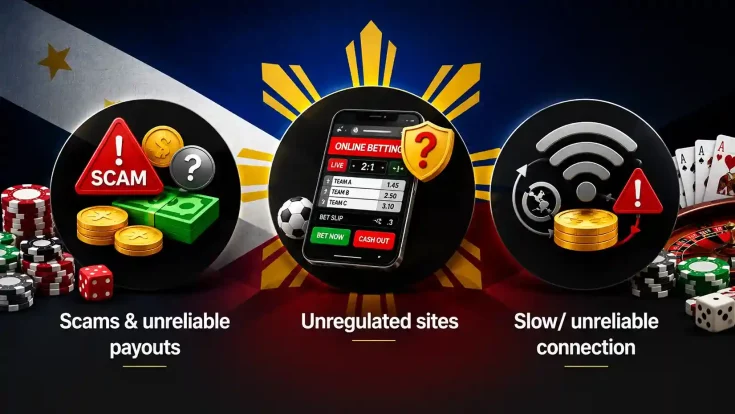
Kadence gives operators a clearer view of the trust gap. Among people who play both traditional and online formats, 65% prefer online games, while 35% still prefer traditional gambling because trust, reliability, competitiveness, and cost still matter. Traditional formats also remain strong, with 8 in 10 Filipino bettors preferring them over online options.
The same study adds more useful signals. It reports that 85% of online gamblers own smartphones, daily online gambling rose from 29% of players in 2022 to 39% in 2023, and 27% of traditional gamblers avoid online betting because they do not trust digital platforms. It also names scams, unreliable payouts, unregulated operators, and lack of internet access as adoption blockers. Therefore, the product problem is not only “make the app modern.” It is “make every regulated step easy to verify.”
1) Scam fear and payout fear come first
Philippines bettors do not start with features. Instead, they start with risk. Research explicitly links avoidance to scams and unreliable payouts. Therefore, your first job is to make money movement boring and predictable.
2) Unregulated platforms shaped expectations
This is uncomfortable, but it matters. Many players still use unregulated platforms. A study reported that about 55% of surveyed online gamblers said they were unaware of legal risks tied to unregulated sites. Also, only 12% said rules felt clear. So, many users do not make decisions using a “regulated vs unregulated” lens.
Even more, the same survey says behavior is shaped by profitability and convenience, not legality or safety. Therefore, regulated operators must match convenience while adding safeguards. The same research also shows a fairness confidence gap. For example, 39% said they felt skeptical about fairness, while 27% said they felt confident. So, your platform must prove fairness, not only claim it.
3) Access and connectivity create “false scam” signals
Some drop-offs come from trust. However, some come from access. The trust study also notes 14% cite lack of internet access as a barrier. Also, Philippines digital markets still deal with a digital divide and slow access. So, if your deposit flow breaks on reconnection, users interpret it as fraud.
4) Offline trust still wins for many bettors
Online can be convenient. However, familiar systems still feel safer. The Kadence research notes that many bettors still prefer government-backed PCSO games because they see them as more reliable. Also, it frames trust and credibility as key reasons bettors stick with traditional formats. So, you are not only competing with other apps. You are competing with known legitimacy.
5) Policy pressure makes users more suspicious
Public narratives shape user trust. So, regulation debates matter even before laws change. For example, the Philippine News Agency reported Senate discussions on online gambling controls, including e-wallet access, age safeguards, and stronger oversight. Therefore, users may assume online gambling is under scrutiny, which raises distrust unless your product proves control, safety, and legitimacy.
6) Economic pressure increases trust sensitivity
When budgets are tight, uncertainty hurts more. So, payout clarity becomes even more important. If deposits go missing or withdrawals stay pending without a reason, users react quickly. Therefore, bettors respond better to receipts, timestamps, reference IDs, and clear support ownership than to vague reassurance.
Make deposits and payouts feel predictable
Review failed payments, pending withdrawals, reference IDs, and dispute flows with a cleaner build plan.
What to Build for Philippines iGaming Trust
Trust is a stack. So, you need both engineering controls and visible proof. The goal is simple: every user should know where their money is, why a review happened, and what happens next.
| Trust layer | What it proves | Primary KPI | Anti-pattern to avoid |
|---|---|---|---|
| Layer 1: deposits | Funds do not disappear during payment retries, redirects, or reconnects. | Deposit success rate, pending deposit age, failed-deposit reason coverage. | One PSP route, no idempotency, no payment reference shown to users. |
| Layer 2: withdrawals | Cashout reviews are predictable and not used as vague delay tactics. | SLA hit rate, average review time, payout reversal rate, dispute reopen rate. | Manual holds with no reason code, no timestamp, and no support ownership. |
| Layer 3: KYC/AML | Identity and AML checks protect the platform without trapping good users. | KYC completion rate, resubmission rate, review queue age, AML alert quality. | Hard KYC walls before value is clear, unclear rejections, weak AML evidence. |
| Layer 4: fraud controls | Risk rules catch abuse while keeping false blocks low. | False positive rate, linked-account detection, bonus abuse prevented, chargeback rate. | Black-box risk scores with no case notes or appeal path. |
| Layer 5: fairness proof | Players can verify rules, outcomes, certifications, and complaint evidence. | Certified game coverage, audit trail completeness, complaint resolution time. | Fairness claims without RNG proof, lab testing, or visible terms. |
| Budget item | Indicative Philippines planning range | What is included |
|---|---|---|
| Layer 1 payment architecture | ₱2M–₱5M setup | PSP routing, GCash/Maya/QR/bank transfer setup, idempotency, reconciliation, payment status UI, and monitoring. |
| Layer 2 payout integrity | ₱1.2M–₱3M setup | Cashout tracker, SLA rules, payout hold reasons, support workflow, and dispute evidence. |
| Layer 3 KYC/AML gating | ₱1M–₱2.5M setup | Progressive KYC, risk-based limits, AML alert routing, document resubmission, and audit logs. |
| Layer 4 fraud controls | ₱1.5M–₱4M setup | Device signals, velocity rules, wallet switching checks, linked-account detection, and case review tooling. |
| Layer 5 fairness and evidence | ₱800K–₱2M setup | Rules pages, certification evidence, complaint evidence logs, responsible gaming visibility, and reporting exports. |
| PIGO/licence readiness | ₱100M authorized capital and ₱25M paid-up capital planning reference | PAGCOR application readiness, MTPP, corporate documents, BIR registration, security compliance, and recurring fee modelling. |
Budget note: these implementation ranges are planning estimates for software and integration work, not legal, tax, or PAGCOR fee quotes. Validate licence, tax, and recurring fee exposure with PAGCOR, BIR, and local counsel before launch.
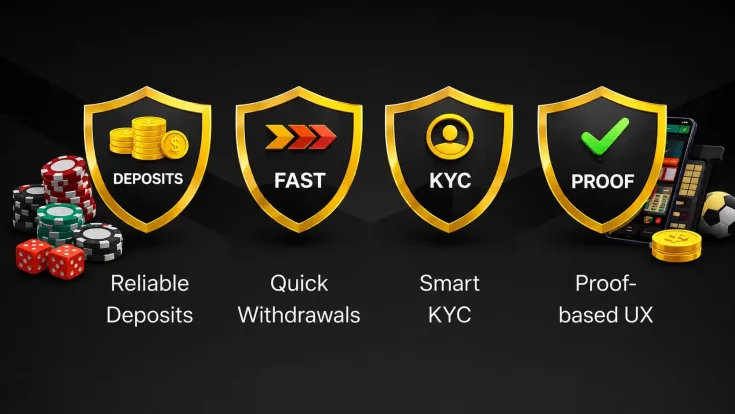
Layer 1: Build Deposit Trust with Payment Architecture
Because e-wallets drive frictionless behavior, your deposits must stay stable under retries and reconnects. In the Philippines, that means naming the rails in your architecture, not hiding them behind a generic “wallet” label.
What to build:
- A deposit status tracker
- Show: Submitted → Processing → Confirmed → Credited.
- Show failed payments with a reason and a next step.
- Therefore, users do not assume a scam during pending status.
- PSP routing and failover
- Route by method, provider health, player risk level, and transaction amount.
- Fail over when a payment provider degrades.
- So, one provider outage does not hurt conversion.
- Controlled retries and idempotency keys
- Retry only safe transient errors.
- Use one key per deposit intent.
- As a result, refreshes do not create duplicate charges.
- Ledger and reconciliation
- Store provider references, internal IDs, amounts, method, rail, and timestamps.
- Reconcile provider reports to your ledger continuously.
- Therefore, support can prove outcomes fast.
| Philippines rail | Recommended integration approach | Trust KPI benchmark to monitor |
|---|---|---|
| GCash | Use a licensed PSP/aggregator or approved acquiring route with redirect handling, PHP settlement, webhook confirmation, and a fallback status check. | Target 92%–97% completed deposits and payment status update inside 60 seconds for normal traffic. |
| Maya / PayMaya | Use Maya Checkout, Maya Wallet, Maya QRPh, or a PSP route. Keep payment links and app redirects tied to one deposit intent. | Target 90%–96% completed deposits, with failed payments mapped to clear retry reasons. |
| InstaPay / PESONet | Use bank or e-wallet partners under the BSP National Retail Payment System. Use InstaPay for real-time low-value credit push and PESONet for batch/same-day flows. | Target 95%+ successful matched deposits for valid references; monitor PESONet against cutoff and same-day settlement rules. |
| GrabPay | Route through a payment partner where available, then treat app authentication, wallet balance errors, and failed redirects as separate failure buckets. | Target 88%–94% completed deposits and keep wallet-auth failures visible in reporting. |
| 7-Eleven CLiQQ | Use payment code or payment link flows for cash-in users. Show code expiry, cashier instructions, receipt capture, and reference matching clearly. | Target 70%–85% code completion before expiry and reconcile cash-in deposits by reference ID. |
- GCash API reference: useful when planning PHP redirect handling, webhooks, and fallback status checks.
- Maya developer docs: useful for checkout, wallet, QR, payment links, and API-based integration options.
- BSP NRPS rail overview: useful for PESONet and InstaPay routing logic, including low-value real-time transfer planning.
- BSP Circular 1108: review only when virtual assets or VASP exposure affects the roadmap.
- GrabPay: validate wallet availability and settlement handling through the PSP or aggregator contract.
- 7-Eleven CLiQQ and CLiQQ cash payment documentation: validate cash-in flow, code expiry, and reconciliation before committing the method to users.
Visible deposit proof: receipt page, pending explanation, support link with the same reference ID, and a timeline of status changes.
For a broader payment build, connect this flow with your iGaming payment solutions roadmap.
Layer 2: Build Withdrawal Trust with Payout Integrity
Withdrawals define trust more than deposits. So, treat payouts like a core product feature.
What to build:
- A payout SLA
- Define target payout times by tier.
- Also define what triggers review.
- Therefore, users know what normal looks like.
- A cashout tracker with timestamps
- Show: Submitted → Under review → Approved → Sent.
- Include provider reference IDs when sent.
- So, users can verify progress.
- Clear hold categories
- KYC incomplete
- Payment method mismatch
- Risk review triggered
- Velocity or device anomaly
- Duplicate account suspicion
- A dispute playbook
- Charged but not credited
- Credited then reversed
- Approved but not received
- KYC rejected
- Bonus locked funds confusion
Because unregulated platforms often win on fast transactions, you must match speed where possible. However, when you slow down, explain the reason in plain language.
Layer 3: Build KYC and AML Gating That Feels Fair
KYC can protect users. However, KYC can also feel like a trap. So, you need progressive gating.
Progressive KYC approach:
- Let users start with small limits.
- Require more verification before larger withdrawals.
- Raise limits only after verification.
Because some users choose unregulated sites for convenience, you must reduce friction early. Yet you still need controls, because public scrutiny is real.
KYC UX that reduces distrust:
- Explain what you collect and why.
- Show exactly what verification complete unlocks.
- Provide clear rejection reason codes.
- Provide a simple re-submit flow.
Also, add betting limits and responsible controls, because safeguards matter for credibility. AML should not sit outside the product either. Use risk scoring, wallet checks, transaction monitoring, and case notes that can support suspicious transaction workflows.
- AMLC internet-based casino study: useful for AML risk context and monitoring priorities.
- PAGCOR AML/CTPF compliance guide: useful for policy, monitoring, and case evidence design.
- KYC drop-off fixes for betting apps: use this when verification friction is hurting completion without reducing risk.
Layer 4: Build Fraud Controls That Do Not Punish Good Users
Fraud controls build trust when they prevent harm. However, false blocks destroy trust fast. So, design controls that prioritize accuracy.
Controls to implement:
- Wallet ownership checks
- Match name signals where allowed.
- Detect wallet switching patterns.
- Therefore, you reduce mule abuse.
- Velocity limits
- Cap deposit attempts per time window.
- Cap cashout attempts per time window.
- So, you reduce abuse and chargeback behavior.
- Device and account integrity
- Detect account farms and multi-account patterns.
- Detect sudden device changes before cashouts.
- Therefore, you reduce payout fraud.
Also, log every decision. So, you can justify holds and reversals to users.
Layer 5: Prove Fairness and Transparency Users Can Verify
Fairness claims do not land without proof. So, make proof visible.
What proof looks like in product:
- Clear game rules and payout terms.
- Clear bonus terms, including wagering, max cashout, and expiry.
- Visible fairness or certification signals when available.
- An audit-ready event trail for balances and outcomes.
Also, publish who you are:
- Legal entity details.
- Licensing disclosures where applicable.
- Support channels and response expectations.
Because many users trust PCSO-backed formats for perceived legitimacy, you must show legitimacy clearly. Independent testing can support that proof, but only when the certification applies to the game, system, or supplier in question.
Use GLI PAGCOR accreditation and eCOGRA only when the tested scope matches the product claim.
Use the US iGaming compliance checklist and iGaming compliance challenges guide when planning audit logs and market-by-market controls.
Build a safer Philippines iGaming experience
Connect payment logic, progressive KYC, fraud controls, and audit-ready logs into one trust system.
UX Settings That Build Player Confidence

UX settings should reduce uncertainty, not add clutter. In Philippines iGaming, settings are especially important because players want control over money, identity, notifications, and risk limits.
What UX settings should show
Keep the most trust-heavy controls easy to find: login security, payment methods, withdrawal status, KYC status, betting limits, notification preferences, and support history. As a result, users can confirm their account state without contacting support for every concern.
Why settings matter in trust UX
Beginners need simple defaults. Experienced users want deeper control. So, settings should start clean, but still let users verify payments, update risk controls, and see account changes. Good settings make the product feel transparent and predictable.
Conclusion
Philippines iGaming trust improves when money feels certain and every decision has proof. You can earn that trust when your platform behaves predictably: reliable deposits, clear withdrawals, progressive KYC, accurate fraud controls, and audit-ready logs. Also, show timelines, receipts, and reason codes, not vague reassurance. Because when users can verify outcomes, trust stops being a promise. Instead, it becomes a habit.
FAQs
Why don’t Philippines bettors trust online betting platforms?
Because research points to distrust, scam fear, unreliable payouts, unregulated operators, and internet access issues as reasons people avoid online betting.
How can operators build trust in Philippines iGaming?
Start with predictable deposits and withdrawals. Then add progressive KYC, clear hold reasons, visible fairness proof, domestic-only access controls, and support logs that can prove what happened.
Why do players still use unregulated platforms?
Many users prioritize convenience, perceived wins, and easy access over legality or safety. Some also do not understand the legal and financial risks tied to unregulated sites.
What payment features reduce payout fear?
Publish a clear withdrawal SLA, show step-by-step cashout status, add timestamps, provide a reference ID after every payout, and separate GCash, Maya, bank transfer, and cash-in failure reasons in reporting.
How should KYC be handled without losing trust?
Use progressive KYC. Let users start with small limits, explain what verification unlocks, show rejection reason codes, and make re-submission simple.
What should an operator build to make fairness feel real?
Fairness needs proof, not claims. Add clear rules, payout terms, applicable certification signals, RNG or game testing proof, and audit-friendly logs for outcomes and disputes.
What is PAGCOR’s annual licence fee for PIGO operators?
Public sources point to capital requirements and recurring PAGCOR fee exposure rather than one simple annual fee. Plan around ₱100 million authorized capital, ₱25 million paid-up capital, recurring PAGCOR fees or minimum guaranteed fees, and local tax obligations. Confirm the current figure directly with PAGCOR and counsel before launch.
Can I integrate GCash directly or do I need an aggregator?
Many operators use a licensed PSP or aggregator because it simplifies approval, routing, settlement, reconciliation, and failover. Direct commercial routes may be possible only after provider approval and compliance review. In either case, build webhook confirmation, status checks, and reference-level reconciliation.
Is BSP approval needed for an iGaming payment rail?
If you are only using BSP-regulated banks, e-wallets, or registered payment partners, the provider usually carries the payment license. If your business operates the payment system, stores e-money, offers remittance, or handles virtual asset services, separate BSP registration or licensing may apply. PAGCOR approval is still separate for gaming activity.