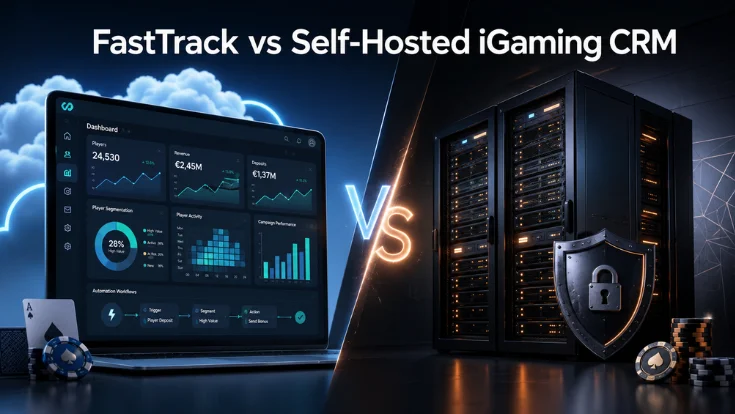
Fast Track vs Self-Hosted iGaming CRM
Fast Track and a self-hosted iGaming CRM solve similar CRM problems in different ways. One gives operators a managed engagement platform. The other gives direct control over hosting, data structure, integrations and product direction.
For casino and sportsbook operators, the CRM layer affects more than campaigns. It connects player engagement, segmentation, bonus communication, compliance checks, PAM events, reporting and support activity. Choosing the right iGaming CRM software model depends on how much control the operator needs over data, integrations and day-to-day CRM operations.
Fast Track is a vendor-managed iGaming CRM and player engagement platform built around real-time automation, campaign orchestration and lifecycle communication. It reduces the setup effort for structured CRM activity because the core platform is already built.
A self-hosted iGaming CRM is deployed on infrastructure controlled by the operator, its cloud account or its technical partner. It gives wider flexibility over data models, custom CRM modules, hosting choices, reporting logic, API behavior and roadmap decisions when the operator wants CRM, wallet, back office and reporting systems to share cleaner data flows.
Fast Track fits operators that need a managed CRM platform, ready campaign tools and faster operational setup. A self-hosted iGaming CRM fits operators that need deeper data access, custom PAM integrations, custom bonus logic, internal BI connections, market-specific compliance processes or stronger roadmap control.
What Is Fast Track iGaming CRM?
Fast Track is used by operators to manage player journeys, segmentation, automation and real-time engagement triggers. Its platform documentation highlights real-time player data, AI-supported CRM activity and personalized engagement for iGaming teams.
For most CRM teams, the main value is execution speed. Instead of building campaign tooling, event triggers, segmentation logic and communication infrastructure from scratch, teams work inside a ready platform and adapt supported workflows to their player lifecycle needs.
Real-time engagement
Supports player communication triggered by sessions, deposits, inactivity and lifecycle events.
Player segmentation
Helps CRM teams group players by behavior, activity, value and campaign eligibility criteria.
Campaign journeys
Useful for onboarding, retention, reactivation, VIP communication and promotional messaging.
Personalization
Helps teams send more relevant messages using available player data and CRM event history.
CRM team usability
Gives marketing and retention teams an existing interface rather than requiring custom admin development.
Managed platform
Reduces internal infrastructure responsibility compared with a self-hosted CRM build.
Fast Track works well when the CRM team needs ready campaign tooling, real-time player triggers, segmentation, journey orchestration and managed platform operations. Operators with proprietary bonus logic, unusual data structures or deep in-house risk and compliance systems should review integration and data requirements carefully before committing.
What Is a Self-Hosted iGaming CRM?
This model is common when CRM is treated as a core business system rather than a third-party marketing tool. It is especially relevant for operators with custom PAM systems, proprietary bonus rules, multiple brands, internal BI pipelines or strict governance requirements that cannot be fully addressed through a vendor's supported configuration.
A self-hosted CRM is not the right route for every operator. It fits teams that need ownership, customization and technical control — and have the internal resources or the right development partner to maintain the platform properly over time.
Fast Track vs Self-Hosted iGaming CRM: Side-by-Side Comparison
| Factor | Fast Track | Self-Hosted iGaming CRM |
|---|---|---|
| Platform type | Vendor-managed CRM platform | Custom or operator-controlled CRM environment |
| Deployment | Faster to launch because the platform already exists | Requires discovery, development, testing and rollout |
| Data structure | Works within vendor-supported data models and configuration | Can be designed around operator-specific player, bonus and risk data |
| Customization | Strong for supported CRM use cases | Stronger for unique business logic and custom modules |
| Integrations | Depends on available APIs, vendor support and technical fit | Can be built around PAM, payments, KYC, BI, fraud and internal tools |
| Compliance processes | Configured within platform capabilities and vendor environment | Can be mapped to internal policies, audit requirements and market rules |
| Roadmap | Vendor-led roadmap | Operator-led roadmap |
| Typical profile | CRM teams that need managed infrastructure and ready campaign automation | Operators that need ownership, flexibility and deeper integration control |
For budget planning, finance teams can use the separate SaaS vs self-hosted iGaming CRM cost comparison to model setup, support, infrastructure, and long-term operating cost.
Where Fast Track Works Well
Fast Track can help when an operator wants CRM execution speed without building the full CRM layer internally. This is most effective when campaign needs align with standard iGaming CRM journeys and the team is comfortable working within a vendor-managed environment.
- A ready CRM platform rather than a custom build.
- Campaign automation without heavy internal development effort.
- Player journeys that follow standard iGaming CRM patterns.
- Vendor-managed infrastructure and platform updates.
- A current stack that can connect through supported API paths.
- Faster path to structured lifecycle campaigns.
- Less internal responsibility for CRM infrastructure maintenance.
- An established interface for marketing and retention teams.
- A practical route when deep product ownership is not a priority.
Where Fast Track Can Create Limits
Fast Track is not a weak CRM choice. The limitation is structural: it remains a vendor-managed platform. Operators work within supported data models, integration routes, configuration options and a roadmap owned by the vendor rather than the operator.
Infrastructure ownership
Operators that need direct hosting control and data residency control will find a self-hosted model more suitable.
Custom CRM logic
Specific bonus eligibility rules, VIP tier logic or responsible gaming automation may require custom development outside the platform.
Integration dependency
Custom PAM, BI, payment or fraud processes may depend on vendor API availability and delivery timelines.
Roadmap dependency
New CRM requirements depend on the vendor's release cycle unless they can be handled within existing configuration options.
Migration planning
Moving to a different CRM later requires careful export, field mapping and reconstruction of data, journeys, templates and reports.
Operational dependency
Long-term CRM activity can become tied to the vendor's structure, permission model and release schedule.
A self-hosted CRM can provide stronger direct control when it is designed, hosted and governed correctly. It also requires disciplined DevOps, maintenance, testing and security ownership — costs that should be factored in during the evaluation process.
Where a Self-Hosted iGaming CRM Fits Complex Operations
A self-hosted CRM fits operators that need CRM to match their own infrastructure, product logic and governance model. This is common for custom PAM environments, multi-brand operations, internal data teams and region-specific compliance processes where a vendor's supported configuration cannot cover all requirements.
Data model control
Design player profiles, segment structures and event tracking around your own business logic rather than adapting to a vendor's schema.
Custom modules
Build CRM tools tailored for VIP teams, bonus operations, risk management, compliance reviews and support workflows.
Deep integrations
Connect directly with PAM, sportsbook, casino platform, payments, KYC, AML, affiliate and BI systems without waiting on a vendor integration roadmap.
Governance alignment
Map access control, audit logs, consent handling and reporting to internal policies and market-specific regulatory requirements.
Multi-brand flexibility
Support separate brands, markets, languages, currencies and campaign rules from one controlled system with clean data separation.
Roadmap ownership
Prioritize CRM improvements based on operator strategy rather than waiting for a vendor release cycle to address specific needs.
Integration Comparison
Integration depth is one of the most significant practical differences between Fast Track and a self-hosted CRM. Most iGaming operators depend on several systems — PAM, payments, KYC, bonus engine, BI and affiliate — that need to share player data, campaign triggers and reporting events cleanly. Fast Track publishes a Fast Track integrations page, which operators should review carefully against their specific PAM, sportsbook, casino platform and data pipeline requirements.
| System | Fast Track Fit | Self-Hosted CRM Fit |
|---|---|---|
| PAM platform | Works when the PAM fits supported integration paths and event data requirements. | Can be built around custom PAM data structures, event schemas and session logic. |
| Payment gateways | Depends on available API access and event data support from the vendor. | Can connect with payment status, risk scoring and internal payment workflow rules. |
| KYC / AML tools | Can support processes through platform-compatible integrations where available. | Can map checks, flags, audit logs and review queues directly to internal compliance policy. |
| Bonus engine | Works well when bonus logic fits within the platform's configuration options. | Can support proprietary bonus rules, eligibility criteria and manual approval workflows. |
| BI / data warehouse | Depends on export capabilities, API access and reporting configuration options. | Can push raw and modeled data directly into internal BI pipelines and data warehouses. |
| Support tools | Can integrate when compatible routes and event data are available through the platform. | Can create custom views and workflows for support, VIP, fraud and retention teams. |
Migration from Fast Track to a Self-Hosted CRM
Migration should be treated as a structured CRM transformation, not only a data export task. Operators need to protect live campaigns, player history, consent records, segmentation logic and business reporting continuity throughout the process.
- Data mapping: Identify all player profile fields, tags, consent records, campaign events and historical engagement data that need to be preserved and correctly mapped in the new environment.
- Journey mapping: Document all live lifecycle journeys, event triggers, suppression rules, VIP flows and bonus communication logic before switching off any active campaigns.
- Template transfer: Rebuild email, SMS, push notification and in-app message templates in the new CRM environment, including localized variants and A/B test versions.
- Integration rebuild: Reconnect PAM, payments, KYC, AML, affiliate, BI and customer support tools, verifying data accuracy at each integration point.
- Compliance validation: Test access control settings, audit log completeness, consent record handling and responsible gaming triggers against internal policy requirements.
- Parallel testing: Run controlled test campaigns in the new environment before switching core CRM operations to reduce the risk of errors affecting live players.
| Question | Why it matters |
|---|---|
| Can all player and campaign data be fully exported? | Prevents loss of CRM history, engagement records and reporting continuity. |
| Are all active journeys fully documented? | Reduces campaign downtime and prevents broken player communications during migration. |
| Which integrations are business-critical? | Helps prioritize PAM, payment, KYC and BI connections for early rebuild. |
| Which compliance records must be retained? | Protects audit trails, consent records and responsible gaming evidence required by regulators. |
Use Cases by Operating Model
- Faster CRM launch without building the full platform internally.
- Marketing and retention teams that want managed infrastructure.
- CRM requirements that align with standard iGaming journey patterns.
- Operators that do not need custom CRM modules or proprietary data logic.
- Stacks that can connect through supported API paths without custom integration work.
- Direct control over data hosting, permissions and infrastructure.
- Custom PAM, bonus engine, BI stack or payment processes that cannot fit vendor configuration.
- Multi-brand operations or region-specific compliance and campaign rules.
- Custom KYC, AML, responsible gaming or player risk logic.
- A CRM roadmap that follows operator product strategy rather than vendor release cycles.
Operating Model Check
Need Help Reviewing a Self-Hosted CRM Build?
SDLC Corp helps casino and sportsbook operators evaluate whether a self-hosted CRM build fits their data, integration, compliance and multi-brand requirements.
Fast Track vs Self-Hosted iGaming CRM: Final Comparison
Fast Track generally suits operators that want a managed iGaming CRM platform, ready player engagement tools and faster CRM execution without building infrastructure internally.
A self-hosted iGaming CRM suits operators that need deeper ownership over data, integrations, hosting, CRM logic, compliance processes and long-term roadmap control. This typically means operators with custom PAM systems, multiple brands, in-house BI teams or regulatory environments that require bespoke process design.
Review your CRM stack before selecting a model
Review your PAM, player records, compliance processes and integration requirements before committing to a vendor-managed or self-hosted CRM route.
Talk to SDLC Corp