
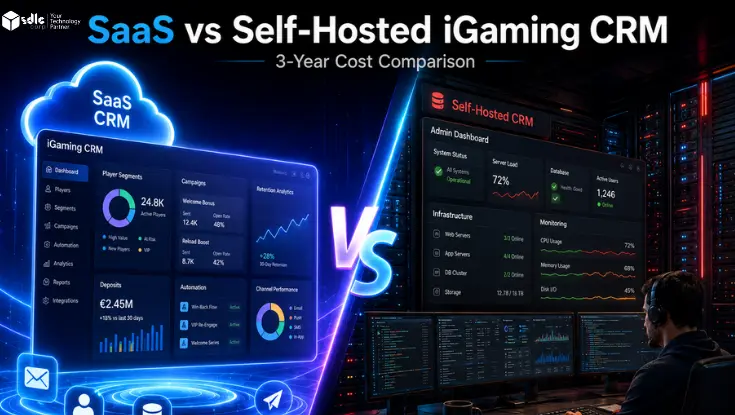
SaaS vs self-hosted iGaming CRM cost is not only a licence-versus-hosting comparison. Operators need to review player volume, CRM modules, PAM integration, sportsbook and casino data feeds, campaign channels, compliance, support, maintenance, and migration risk before choosing a CRM model for a three-year cost view.
Compare hosted and owned CRM models with a practical cost framework before choosing your architecture, vendor, or self-hosted CRM route.
Plan Your CRM Cost ModelKey Takeaways
- A 3-year total cost of ownership view gives a clearer picture than monthly or per-MAU pricing alone.
- SaaS iGaming CRM cost can range from about $3,000 to $100,000+ per month, based on MAU, brands, modules, channels, and support scope.
- Self-hosted iGaming CRM usually shifts cost into setup, hosting, DevOps, integrations, security, and maintenance.
- Break-even often becomes worth modelling around 100,000 to 250,000 MAU, multi-brand operations, or high-volume campaign usage.
- A complete cost analysis should include vendor pricing, infrastructure, compliance, integration effort, support, switching risk, and exit cost.
Why a 3-Year SaaS vs Self-Hosted iGaming CRM Cost Comparison Matters
An iGaming CRM connects player data, PAM events, wallet activity, KYC status, bonus rules, loyalty tiers, sportsbook behavior, and campaign channels. As the player base grows, cost can rise through licence tiers, message volume, integrations, and support needs.
- For SaaS, pricing may rise with MAU growth, modules, message volume, support tier, and renewal changes.
- By contrast, self-hosted CRM adds control but needs budget for infrastructure, DevOps, security, upgrades, and support.
- In addition, both models need PAM, sportsbook, wallet, KYC, bonus, reporting, and channel planning.
- Casino operators may need loyalty, VIP, bonus, and gamification workflows.
- Sportsbook operators may need live-event triggers, odds segmentation, parlay behavior, and real-time campaigns.
A SaaS iGaming CRM may cost about $3,000 to $100,000+ per month, depending on MAU, brands, modules, channels, and support tier.
A self-hosted iGaming CRM may require about $60,000 to $800,000+ in setup or development. After launch, operators may spend about $3,000 to $60,000 per month on hosting, DevOps, monitoring, support, and upgrades. These are planning ranges, not fixed vendor quotes.
Because SaaS pricing can shift with usage, renewals, and expansion, operators should model CRM cost beyond Year 1. Broader SaaS benchmark data, such as the High Alpha SaaS Benchmarks Report, also supports multi-year cost planning instead of only comparing monthly licence fees.
For CRM architecture context, review iGaming CRM software requirements across pricing, support, integrations, data access, exit terms, and campaign limits.
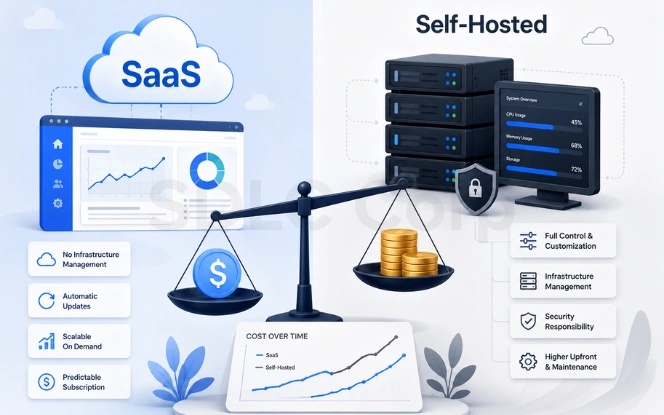
What iGaming CRM 3-Year Total Cost of Ownership Should Include
The 3-year total cost of ownership means the complete cost of running player engagement, including setup, operations, scaling, support, security, and future migration. Instead of comparing only monthly subscription with server bills, the model should compare subscription cost, infrastructure, integrations, support ownership, compliance effort, and migration effort together.
Integration cost also depends on PAM events, sportsbook feeds, wallet activity, bonus logic, and KYC status. Operators should estimate API work, event pipeline effort, testing scope, reporting needs, and post-launch maintenance before comparing SaaS and self-hosted CRM options.
Cost Benchmarks to Model Before Vendor Shortlisting
| Cost Item | SaaS iGaming CRM Planning Range | Self-Hosted iGaming CRM Planning Range | Operator Checkpoint |
|---|---|---|---|
| Initial Setup | $5,000–$50,000 for onboarding, data import, journey setup, and training. | $60,000–$350,000 for deployment, infrastructure, access rules, database setup, and hardening. | Compare setup effort, migration depth, launch timeline, and internal team involvement. |
| Monthly Platform Cost | $3,000–$100,000+ per month, usually affected by MAU, modules, brands, support, and event volume. | $3,000–$60,000 per month for hosting, monitoring, support, DevOps, and maintenance. | Check how cost changes when players, brands, events, and campaigns grow. |
| PAM and Sportsbook Integrations | $10,000–$75,000 depending on connector availability, real-time event needs, and vendor scope. | $25,000–$150,000 when the operator owns APIs, pipelines, testing, monitoring, and support. | Review deposit, bet placed, wallet, KYC, bonus, and segmentation data needs. |
| Campaign Channels | Messaging vendors often bill email, SMS, push, WhatsApp, onsite, and in-app usage separately. | Operators usually pay gateways or messaging providers directly outside the CRM platform. | Estimate message volume, channel mix, deliverability, attribution, and reporting needs. |
| Compliance and Security | $5,000–$50,000+ for access rules, audit support, data retention, and compliance configuration. | $20,000–$150,000+ for security reviews, logging, recovery tests, jurisdiction setup, and audit readiness. | Review GDPR, responsible gambling, self-exclusion, AML workflows, access control, and audit logs. |
| Exit or Migration | $10,000–$100,000+ for data export, journey rebuild, retraining, and reintegration. | $15,000–$150,000+ for handover, dependency cleanup, documentation, and hosting migration. | Check how easily player data, reports, segments, and journeys can move later. |
Compliance, Security, and Hosting Checks
Compliance cost should also include security, audit, and hosting requirements. For example, the UKGC remote gambling technical standards outline technical and security expectations for licensed remote gambling operators, while the MGA technical infrastructure guidance gives operators another reference point for hosting gaming and control systems.
Estimated iGaming CRM Cost Ranges by Operator Size
Exact pricing depends on vendor quote, MAU volume, brands, channels, integrations, and support scope. However, operators can use these planning ranges before requesting formal SaaS or self-hosted CRM proposals.
| Operator Scenario | Typical MAU Range | SaaS CRM Planning Range | Self-Hosted CRM Planning Range | Likely Cost Pattern |
|---|---|---|---|---|
| Small single-brand operator | 10,000–50,000 MAU | $3,000–$12,000/month plus setup and channel spend. | $60,000–$150,000 setup plus $3,000–$10,000/month operations. | SaaS is usually easier to justify because setup and IT ownership stay lower. |
| Growing casino or sportsbook | 50,000–200,000 MAU | $12,000–$40,000/month depending on modules, brands, and messages. | $150,000–$350,000 setup plus $8,000–$25,000/month operations. | Break-even depends on campaign volume, integration scope, support tier, and renewal movement. |
| Multi-brand operator | 200,000–500,000+ MAU | $40,000–$100,000+/month with enterprise modules and support. | $350,000–$800,000+ setup plus $20,000–$60,000/month operations. | Self-hosted may become more practical if vendor pricing rises across brands and MAU tiers. |
SaaS iGaming CRM Cost Model
SaaS CRM works well when an operator needs faster launch, managed infrastructure, ready automation, and less technical ownership. However, pricing can change with MAU, brand count, feature tier, message volume, support level, and integration scope.
SaaS CRM 3-Year Cost = Subscription + Setup + MAU Growth + Add-ons + Integrations + Channel Usage + Support + Renewal Changes + Exit Cost
Where SaaS iGaming CRM Costs Usually Increase
- Per-MAU pricing can rise as the player base grows.
- Advanced segmentation, loyalty, gamification, AI, or reporting may sit in higher tiers.
- Email, SMS, push, WhatsApp, onsite, and in-app sends can add channel cost.
- Custom PAM, sportsbook, wallet, bonus, KYC, and analytics integrations may need separate project budgets.
- Multi-brand operators may need new tiers, extra workflows, or per-brand configuration.
- Priority support, stronger SLAs, or dedicated account management can add to contract value.
- Renewals may change with volume, packaging, usage, or vendor pricing updates.
Named iGaming CRM Vendors Operators Commonly Compare
Operators often compare SaaS or managed CRM platforms such as Optimove, Smartico, Xtremepush, Fast Track, Solitics, Symplify, and similar customer engagement systems. These platforms differ by pricing model, real-time data depth, gamification, sportsbook triggers, campaign channels, AI features, and integration ownership.
Vendor pricing also needs direct validation. For example, Optimove is commonly reviewed for iGaming player engagement and CRM use cases, while Smartico references MAU-tier pricing for CRM automation and gamification. This makes MAU forecasting important before signing a SaaS CRM contract.
| Vendor Type | Examples | Cost Variable to Check | Why It Matters |
|---|---|---|---|
| CRM and engagement platform | Optimove, Xtremepush, Fast Track | MAU, channels, data events, brands, support tier, and add-on modules. | Costs may rise when player volume and campaign automation increase. |
| CRM plus gamification platform | Smartico, Solitics-style engagement tools, Symplify-style tools | Gamification, loyalty, mission engine, tournament logic, and real-time triggers. | Bundled modules may reduce separate tool spend, but integration scope still needs review. |
| Self-hosted CRM | Operator-owned or partner-built CRM | Development, infrastructure, DevOps, support, upgrades, and security reviews. | More control, but higher ownership responsibility. |
Self-Hosted iGaming CRM Cost Model
Self-hosted CRM fits operators that need direct control over player data, hosting, workflows, and integrations. Therefore, it works better when a technical team or delivery partner can manage the wider platform.
Self-Hosted CRM 3-Year Cost = Infrastructure + Setup + Licence/Support + DevOps + Integrations + Security + Backups + Maintenance + Upgrades + Channel Spend
With self-hosted CRM, the operator or delivery partner owns more post-launch work. As a result, the budget should include monitoring, backups, patching, security reviews, release testing, documentation, incidents, and core integrations.
Where Self-Hosted iGaming CRM Costs Usually Increase
- Infrastructure scales with MAU, event volume, campaign frequency, and reporting load.
- DevOps effort grows with deployments, upgrades, monitoring, and incident response.
- Security work includes access control, audit logs, encryption, testing, and backup recovery checks.
- Version upgrades need testing because they may affect PAM, sportsbook, payment, bonus, or reporting flows.
- Downtime response stays with the operator unless a managed support contract covers it.
- Knowledge risk grows when only a few engineers understand the setup.
Self-hosted iGaming CRM is not cheaper only because there is no per-MAU fee. Real cost depends on DevOps capacity, integration ownership, compliance work, release testing, incident response, and live upgrade handling.
Year-by-Year Cost Behavior
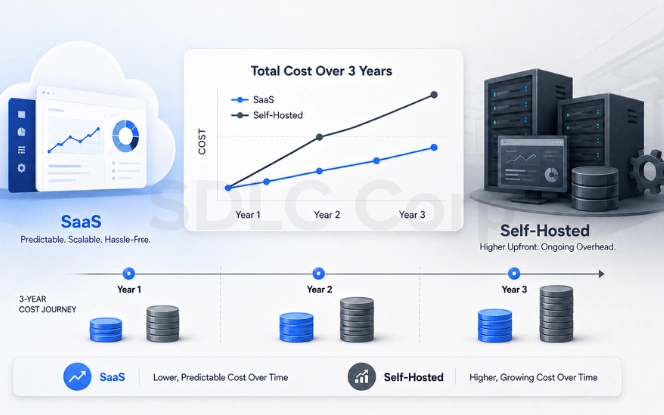
The cost comparison becomes clearer by phase. First, the model reviews setup. Next, it measures operations and channel scaling. Finally, it checks renewal, expansion, or migration planning.
Setup and Launch
SaaS includes onboarding, segments, templates, channel setup, and first integrations. Meanwhile, self-hosted adds licence, infrastructure, deployment, connectors, and compliance setup.
Operations and Channel Scaling
SaaS spend can grow with MAU, channels, and modules. At the same time, self-hosted cost can grow through scaling, monitoring, backups, and DevOps capacity.
Brand Expansion and Renewal
SaaS may face renewals, new-brand fees, or tier changes. However, self-hosted may need upgrades, tuning, and capacity planning.
Migration Readiness
SaaS exit needs data export, segment rebuild, campaign migration, and reintegration. Likewise, self-hosted exit needs handover, documentation, and partner or team transition.
Total Cost Analysis: Comparing Both Routes Correctly
A strong total cost analysis compares invoices with hidden operating effort. Hidden costs often appear through integration friction, manual segment work, channel spend, renewals, DevOps gaps, compliance reviews, and migration effort.
Questions for the SaaS Route
- Check whether pricing is based on MAU, events, messages, modules, brands, or support level.
- Confirm whether segmentation, automation, loyalty, gamification, and reporting are included in the base tier.
- Review which PAM, wallet, sportsbook, bonus, KYC, and analytics integrations are already available.
- Ask what happens when player volume or campaign activity grows faster than the original forecast.
- Check how easily the operator can export player data, campaign history, and journey logic on exit.
Questions for the Self-Hosted Route
- Define who will own infrastructure, deployment, monitoring, upgrades, and incident response.
- Map the database, event-processing, and message-logging setup required for live CRM operations.
- Review how the platform will connect with PAM, sportsbook, casino, wallet, and bonus systems.
- Document the backup, recovery, and security review process before go-live.
- Assign ownership for journeys, segments, dashboards, reports, and compliance documents.
How SDLC Corp Helps Operators Compare SaaS and Self-Hosted iGaming CRM
SDLC Corp compares both models using MAU growth, brand count, PAM integration, sportsbook feeds, channel usage, compliance scope, and support ownership. The review covers licence cost, infrastructure, integrations, migration risk, and long-term operating control.
What the Cost Model Should Cover
- A total cost view across licence, infrastructure, integration, channels, compliance, and migration.
- MAU forecasts for each brand and projected licence impact.
- Integration scope across PAM, sportsbook, payments, KYC, BI, and reporting.
- Compliance ownership for GDPR, responsible gambling, self-exclusion, and audit needs.
- Switching cost for SaaS exit or self-hosted handover.
Build vs Buy Cost Analysis for iGaming CRM
A build vs buy cost analysis compares speed, control, ownership, support, and long-term cost. SaaS sits closer to a buying decision, while self-hosted sits closer to an ownership decision where the operator controls deployment, integrations, data access, and upgrade timing.
For a vendor-specific platform comparison, review this Fast Track vs self-hosted iGaming CRM guide, which explains managed CRM delivery, integration fit, migration planning, and operator control.
SaaS is often better for fast launches, single-brand operators, and lean teams that want lower IT burden. By contrast, self-hosted can be better when multi-brand control, data residency, custom workflows, or long-term ownership matter more.
Example 3-Year Cost Scenarios
Scenario 1: Single-Brand Casino With 25,000 MAU
SaaS usually fits better when the operator needs faster launch, standard journeys, and limited internal DevOps. The 3-year SaaS cost may stay lower if modules and message volume remain controlled.
Scenario 2: Sportsbook With 150,000 MAU
The decision becomes more balanced. SaaS may still reduce technical burden, but event volume, real-time sportsbook triggers, and channel usage can push renewal cost higher.
Scenario 3: Multi-Brand Operator With 300,000+ MAU
Self-hosted CRM may become stronger when the operator needs shared infrastructure, custom segmentation, direct data control, and lower long-term dependency on vendor MAU tiers.
How to Build a 3-Year Cost Model for Each Option
A useful 3-year cost model should show what each route costs in Year 1, Year 2, and Year 3. Keep fixed costs, growth-based costs, and operator effort separate so the comparison does not hide support or migration work.
List Year 1 Setup and Go-Live Costs
Start with onboarding, segment build, campaign templates, channel setup, PAM connector, sportsbook feed connector, KYC integration, compliance configuration, and operator training.
Estimate Year 2 Operating Costs
For Year 2, include MAU-driven licence, channel spend by volume, premium modules, DevOps capacity, monitoring, backups, security reviews, and integration maintenance.
Estimate Year 3 Growth and Brand Costs
In Year 3, account for MAU growth, new-brand fees, channel volume increases, tier upgrades, infrastructure scaling, version upgrades, performance tuning, and new jurisdiction work.
Add Hidden and Risk Cost
Finally, add vendor lock-in, migration scope, knowledge concentration, compliance audit work, manual segment rebuild, integration drift, and CRM downtime risk during high-traffic events.
Which Option Has Lower 3-Year Cost?
The lower-cost route depends on brand count, MAU growth, campaign volume, technical capacity, and the level of control the operator needs over data, reporting, integrations, and deployment rules.
- For SaaS, costs are often lower when one brand uses standard CRM workflows and wants vendor-managed infrastructure.
- By contrast, self-hosted can become more cost-efficient when multiple brands, steep MAU growth, or high campaign volume increase vendor-side pricing.
- Therefore, a better decision comes from modelling renewal movement, integration ownership, channel spend, migration cost, and support ownership across three years.
CRM cost can also rise when operators add predictive segmentation, loyalty tiers, bonus triggers, and VIP player identification workflows for high-value player management.
Compare SaaS and self-hosted iGaming CRM before you commit
SDLC Corp can review your MAU forecast, brand roadmap, channel mix, integration scope, and compliance jurisdiction, then build a 3-year SaaS vs self-hosted cost comparison side by side.
Final Thoughts
A 3-year SaaS vs self-hosted cost comparison for iGaming CRM should not compare a monthly fee with a server bill. It should compare growth shape, data ownership, integration responsibility, support effort, compliance needs, switching risk, brand roadmap, MAU forecast, campaign volume, channel mix, and available technical support.
FAQs
1. What is a 3-year SaaS vs self-hosted iGaming CRM cost comparison?
It compares the complete 3-year total cost of ownership for both routes. This includes setup, subscription or licence, infrastructure, PAM and sportsbook integrations, channel spend, support, security, maintenance, and migration cost.
2. Is a SaaS iGaming CRM cheaper than self-hosted?
SaaS may be cheaper in Year 1 for single-brand operators with moderate MAU and standard workflows. However, a self-hosted route may become more cost-efficient later when player volume, brand count, channel usage, or customization needs increase.
3. How much does a SaaS iGaming CRM cost?
For early planning, SaaS iGaming CRM cost may range from about $3,000 to $100,000+ per month. The final cost depends on MAU, module mix, brand count, campaign channels, support level, integrations, and contract scope.
4. What affects self-hosted iGaming CRM cost?
Infrastructure scaling, DevOps capacity, PAM connector maintenance, version upgrades, compliance audit work, channel gateway management, and engineering effort shape the real ownership cost. These items may not sit on the licence line, but they still affect long-term spend.
5. What MAU level can change the SaaS vs self-hosted decision?
The break-even discussion often becomes more important around 100,000 to 250,000 MAU, especially when the operator runs multiple brands, high-volume campaigns, custom segmentation, or heavy real-time sportsbook triggers.
6. Which route is better for multi-brand operators?
Self-hosted can become more practical for multi-brand operators when data control, shared infrastructure, custom rules, and long-term ownership matter more than vendor-managed speed.
7. How does build vs buy cost analysis apply to iGaming CRM?
SaaS is closer to buying access to a ready platform because the vendor owns roadmap, hosting, and updates. By contrast, self-hosted is closer to ownership because the operator owns deployment, infrastructure, and player data control.
8. How do I calculate the break-even point between SaaS and self-hosted CRM?
Build a cost model for each option. Start with the SaaS curve using forecast MAU, modules, channels, and support needs. Then compare it with the self-hosted curve using licence or development cost, infrastructure, integrations, DevOps, security, and maintenance.