
Retrieval-Augmented Generation (RAG) is widely used to build enterprise AI assistants, knowledge-search systems, copilots, support applications, and domain-specific question-answering platforms. But connecting a large language model to a knowledge base does not automatically make its answers accurate, grounded, or trustworthy.
A production-ready RAG system needs a repeatable evaluation process that measures retrieval quality, generation faithfulness, citation accuracy, answer usefulness, and human acceptance independently. The pattern itself dates back to the original RAG paper by Lewis et al, but the evaluation practice around it has matured far beyond a single accuracy number.
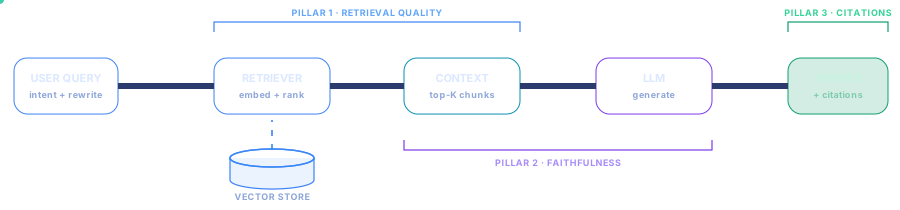
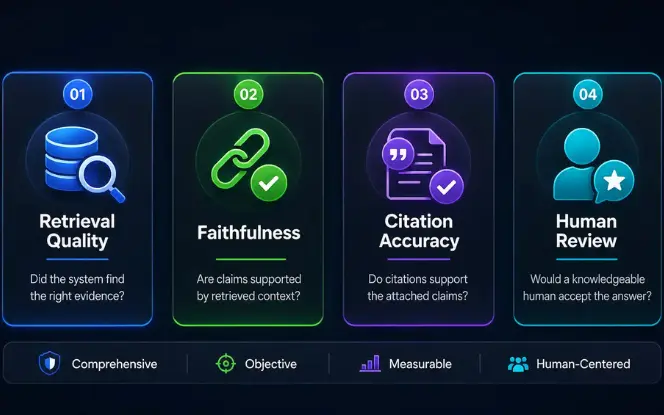
In short: a reliable RAG evaluation framework should answer four questions. Did the system retrieve the right evidence? Did the model stay faithful to that evidence? Do the citations support the claims? Would a knowledgeable human accept the answer?
Key Takeaways
What Is RAG Evaluation?
RAG evaluation is the systematic measurement of how well a retrieval-augmented generation pipeline finds evidence, supplies that evidence to a model, generates an answer from it, and attributes claims to appropriate sources.
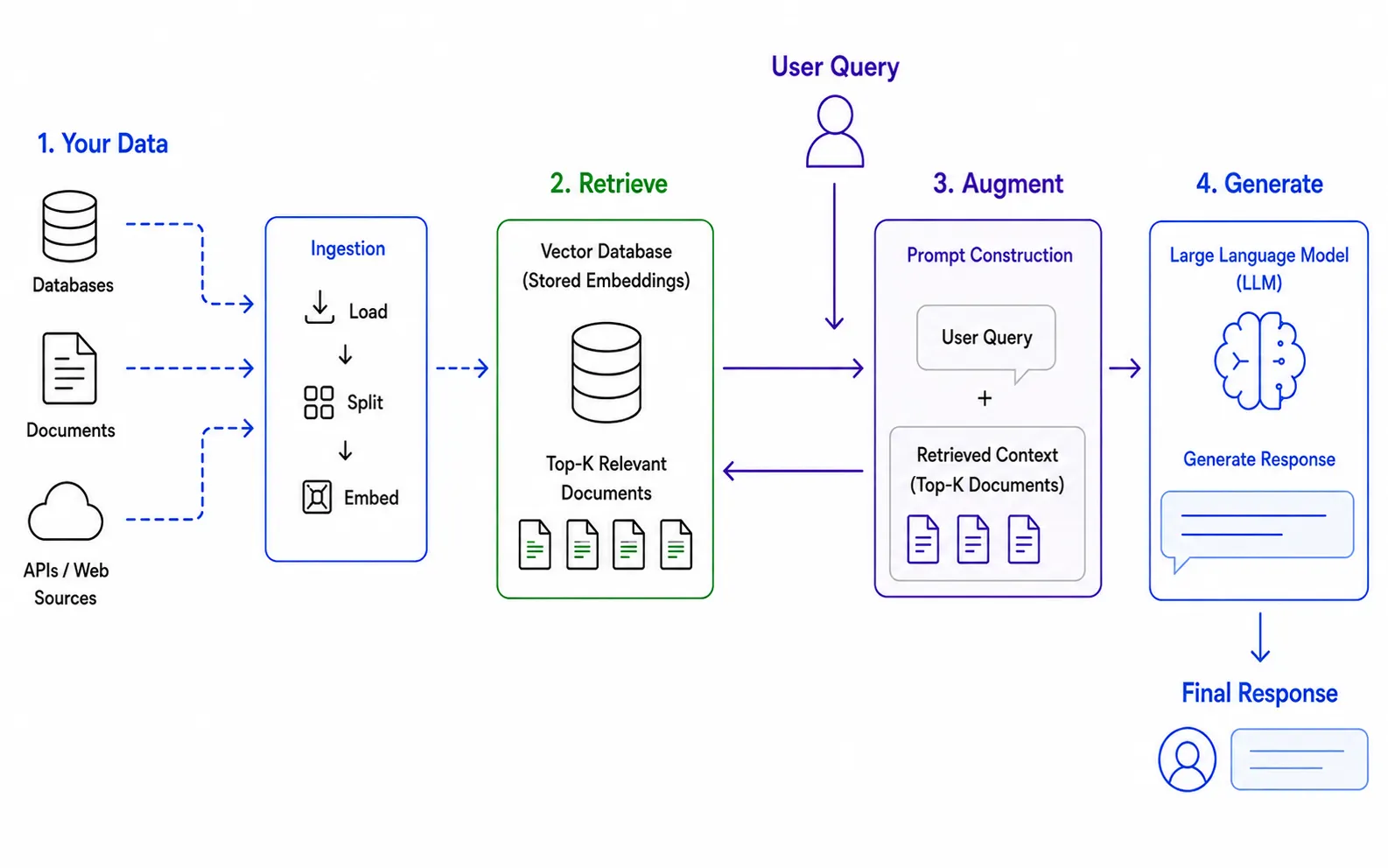
Unlike simple chatbot evaluation, RAG evaluation should not judge only the final answer. A RAG system has multiple stages, and each stage can fail independently.
Two Failure Modes That Look Identical From Outside
Both failures produce a wrong answer, and both look the same to the end user. Only component-level measurement separates them.
Retrieval Failure
The model may produce a well-written and fully grounded answer from the wrong document. In that case, generation behaved correctly but retrieval failed.
Generation Failure
The retriever may return the exact evidence, yet the model can still add unsupported details, omit critical facts, or attach the wrong source.
Why this matters: a single accuracy score cannot show whether the problem is retrieval, ranking, context quality, generation, citation, or user experience. Component-level evaluation makes failures diagnosable.
The Four Pillars of a Reliable RAG Evaluation Framework
A mature RAG evaluation framework should separate the system into measurable quality layers. This prevents strong performance in one area from hiding a dangerous weakness in another.
The Four Pillars at a Glance
| Pillar | Core Question | Typical Metrics | Main Risk Detected |
|---|---|---|---|
| Retrieval Quality | Did the system find the evidence needed to answer? | Precision@K, Recall@K, Hit Rate, MRR, nDCG, Context Precision, Context Recall | Missing or noisy evidence |
| Faithfulness | Are generated claims supported by retrieved context? | Faithfulness, groundedness, unsupported-claim rate | Hallucinated or ungrounded statements |
| Citation Accuracy | Does each cited source support the attached claim? | Citation Precision, Citation Recall, Citation Completeness | Incorrect or incomplete attribution |
| Human Review | Would a knowledgeable user accept the answer? | Correctness, completeness, clarity, usefulness, safety | Nuanced quality failures automated metrics miss |
Pillar 1 — Retrieval Quality: Did the System Find the Right Evidence?
Every RAG response begins with retrieval. Before measuring the quality of the generated answer, determine whether the retriever found the information the model actually needed.
Retrieval evaluation asks whether relevant evidence was found, whether enough evidence was found, whether the best sources were ranked near the top, and whether irrelevant chunks consumed valuable context-window space. These are classical information-retrieval questions, and benchmarks such as BEIR, the heterogeneous retrieval benchmark, remain a useful reference point for how they are measured.
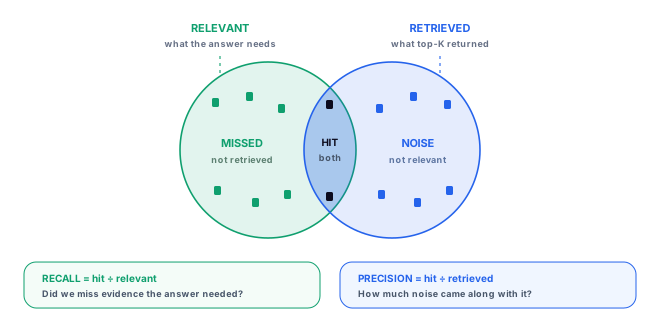
Retrieval Metrics, With Worked Examples
Every row below uses one running scenario so the numbers can be compared directly: a 200-question test set, a retriever configured for K = 5, and a target question whose gold answer needs 4 relevant chunks and 8 distinct facts. Of the K = 5 chunks returned, 3 are relevant.
| Metric | Formula | Worked Example, K = 5 | Result vs Gate | Status |
|---|---|---|---|---|
| Precision@KAre we retrieving too much noise? | relevant in top-K ÷ K | 3 of the K = 5 returned chunks are relevant → 3 ÷ 5 | 0.60gate ≥ 0.60 | Pass |
| Recall@KAre important documents being missed? | relevant in top-K ÷ all relevant | 3 of the 4 required chunks reach the top-K → 3 ÷ 4 | 0.75gate ≥ 0.85 | Blocked |
| Hit Rate@KCan the retriever find a usable source at all? | queries with ≥ 1 relevant hit in top-K ÷ queries | 188 of the 200 test queries return at least one relevant chunk → 188 ÷ 200 | 0.94gate ≥ 0.95 | Watch |
| MRR@KHow quickly does useful evidence appear? | mean of 1 ÷ rank of first relevant hit | The first relevant chunk sits at rank 2 on average → 1 ÷ 2 | 0.50gate ≥ 0.70 | Blocked |
| nDCG@KAre the strongest sources ranked above weaker ones? | DCG@K ÷ ideal DCG@K | Graded relevance 3, 1, 2, 0, 1 gives DCG 5.02 against an ideal ordering (3, 2, 1, 1, 0) of 5.19 → 5.02 ÷ 5.19 | 0.97gate ≥ 0.85 | Pass |
| Context PrecisionHow clean is the supplied context? | answer-bearing tokens ÷ tokens supplied | 1,400 of the 2,000 tokens placed in the prompt carry answer-bearing content → 1,400 ÷ 2,000 | 0.70gate ≥ 0.70 | Pass |
| Context RecallDoes the model receive everything it needs? | gold facts present ÷ gold facts needed | 7 of the 8 facts in the gold answer appear somewhere in context → 7 ÷ 8 | 0.88gate ≥ 0.90 | Watch |
Gates are illustrative starting points for a general enterprise knowledge assistant, measured on a 200-question set. Regulated and high-risk domains normally raise recall and context recall and accept lower precision in exchange. Two rows here sit below gate, so this retriever configuration is not ready to ship.
Precision and Recall Should Be Evaluated Together
A retriever that returns every possibly related document may achieve high recall while flooding the LLM with irrelevant context. A highly selective retriever may produce excellent precision while missing an essential policy, clause, product detail, or supporting source. In the worked example above, precision looks acceptable at 0.60, but recall of 0.75 and MRR of 0.50 are the real problems: one of the four required chunks never reached the model at all, and the evidence that did arrive was ranked below a noisy result. No amount of prompt tuning downstream can recover either.
Chunking Strategy
Oversized or poorly segmented chunks can retrieve successfully while still giving the model mixed or weak evidence.
Metadata and Filters
Incorrect metadata, access filters, date filters, or tenant restrictions can silently remove the correct source.
Reranking
Good candidates can still be buried if reranking or top-K selection does not reflect actual answer usefulness.
Store the retrieval trace: document ID, chunk ID, rank, similarity score, reranker score, applied filters, query rewrite, and source timestamp. Without this trace, a retrieval score tells you something is wrong but not why.
Retrieval scores flat despite prompt changes?
Our engineers audit chunking, embeddings, filters, and reranking as one system rather than in isolation.
Pillar 2 — Faithfulness: Is the Answer Supported by the Retrieved Context?
Finding the correct document does not guarantee that a large language model will use it correctly. RAG faithfulness measures whether the factual claims in the generated answer are supported by the retrieved evidence supplied to the model.
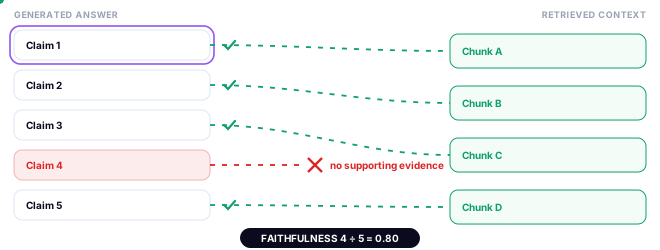
Faithfulness = Supported factual claims ÷ Total factual claimsIf a response contains five factual claims and four can be supported by the retrieved context, the approximate claim-level faithfulness is 4 ÷ 5, or 0.80.
Faithfulness Is Not the Same as Correctness
| Situation | Faithful? | Correct? | What It Tells You |
|---|---|---|---|
| Context is accurate and the model summarizes it accurately | Yes | Yes | The healthy case. Both layers worked. |
| Context is accurate but the model invents an unsupported claim | No | Possibly no | Generation problem. Tighten prompts and grounding constraints. |
| Context is outdated and the model accurately repeats it | Yes | No | Knowledge-layer problem. Faithfulness alone will never catch it. |
| Model ignores the supplied evidence and answers from internal knowledge | No | Possibly yes | Dangerous pass. Right answer today, unverifiable tomorrow. |
Evaluate Faithfulness at the Claim Level
Whole-answer scoring can hide serious errors. If a paragraph contains five factual statements and only one is unsupported, labeling the entire paragraph simply correct or incorrect loses valuable diagnostic information.
For organizations investing in private large language model development, claim-level evaluation provides a clearer way to tune prompts, context assembly, retrieval orchestration, and guardrails.
Pillar 3 — Citation Accuracy: Does Each Citation Really Support the Claim?
Citations make AI-generated answers appear more trustworthy, but a source link or reference number does not automatically prove that the associated claim is supported.
For enterprise RAG applications, citation quality should be evaluated at the same claim level as faithfulness. The ALCE benchmark, published at EMNLP 2023, formalised this idea by scoring citation precision and recall separately from answer quality, and it defines the entailment test each citation has to pass.
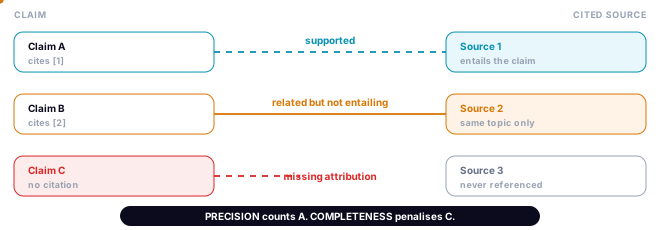
Two Metrics That Must Move Together
Citation Precision
Measures how many included citations genuinely support the claim they are attached to. A citation about the same topic is not enough, because it should entail the specific factual statement.
Citation Completeness
Measures whether important factual claims that require evidence actually receive citations. Perfect citation precision can still coexist with poor coverage.
Citation Precision = Supporting citations ÷ Total citationsClaim-Level Citation Review Fields
| Evaluation Field | Reviewer Question | Fails When |
|---|---|---|
| Citation Present | Does the claim have a source when one is needed? | A number, date, or policy statement carries no reference |
| Correct Source | Is this the right document, page, or record? | The reference points to the previous version of the policy |
| Entailment | Does the cited evidence actually support the claim? | The source discusses the topic but never states the fact |
| Placement | Is the citation clearly attached to the right sentence or claim? | One marker at the end of a paragraph covering four claims |
| Sufficiency | Does the evidence fully support the details, numbers, and qualifiers? | Source says "up to 30 days", answer says "30 days" |
| Authority | Is the source authoritative enough for the use case? | An internal draft is cited instead of the approved policy |
| Freshness | Is the cited information current enough to rely on? | A superseded document is still indexed and retrievable |
Important distinction: an answer can be faithful to the combined retrieved context but still have incorrect citation attribution if it attaches the wrong source to an otherwise supported claim.
Pillar 4 — Human Review: Where Automated RAG Evaluation Stops
Automated metrics make it possible to test hundreds or thousands of RAG interactions quickly. They do not replace expert judgment in ambiguous, regulated, high-risk, or domain-sensitive situations.
Human review is especially valuable when answers involve conflicting documents, nuanced business policies, medical or financial language, incomplete user questions, subjective usefulness, or consequences that cannot be represented by a simple metric. Governance frameworks such as the NIST AI Risk Management Framework treat this kind of human oversight as a core control rather than an optional extra.

A Nine-Dimension Human Review Rubric
| Dimension | Reviewer Question | Scoring |
|---|---|---|
| Correctness | Is the answer factually correct? | 0 to 2 (wrong / partly / fully) |
| Faithfulness | Is each factual claim supported by retrieved evidence? | Claim-level pass rate |
| Citation Accuracy | Do citations support their associated claims? | Claim-level pass rate |
| Completeness | Did the response answer the important parts of the question? | 0 to 2 |
| Relevance | Does the response directly address user intent? | 0 to 2 |
| Clarity | Is the answer understandable and logically structured? | 0 to 2 |
| Source Quality | Are authoritative and current sources being used? | 0 to 2 |
| Safety | Could the response create material harm or unacceptable risk? | Pass / fail (blocking) |
| Abstention | Did the model decline appropriately when evidence was insufficient? | Pass / fail |
Safety is deliberately blocking: a failure there should stop a release regardless of how strong every other dimension looks.
Review More Than Random Samples
Random sampling is useful, but difficult slices are more likely to reveal the failures that matter in production.
RAG Evaluation Metrics by Pipeline Layer
A strong evaluation program maps metrics to the exact component they are intended to diagnose.
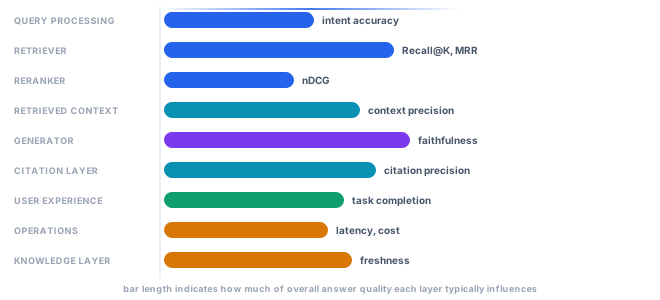
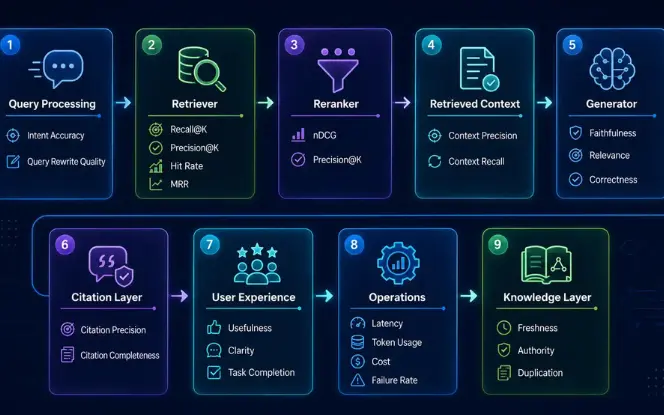
Layer-by-Layer Metric Map
| Pipeline Layer | Recommended Metrics | Typical Failure | Owner |
|---|---|---|---|
| Query Processing | Intent accuracy, query-rewrite quality | Search query changes the user's meaning | Applied ML |
| Retriever | Recall@K, Precision@K, Hit Rate, MRR | Correct evidence is not retrieved | Search / IR |
| Reranker | nDCG, Precision@K | Useful results are ranked too low | Search / IR |
| Retrieved Context | Context Precision, Context Recall | Context is noisy or incomplete | Applied ML |
| Generator | Faithfulness, answer relevance, correctness | Unsupported, incomplete, or irrelevant output | Applied ML |
| Citation Layer | Citation Precision, Citation Completeness | Sources do not support claims | Applied ML |
| User Experience | Human usefulness, clarity, task completion | Technically correct but unusable response | Product / Design |
| Operations | Latency, token usage, cost, failure rate | Quality is too expensive or slow | Platform / SRE |
| Knowledge Layer | Freshness, authority, duplication | Model faithfully uses obsolete or weak information | Data / Content Ops |
How to Build a Production RAG Evaluation Framework
RAG evaluation becomes much more useful when it is integrated into the development lifecycle rather than added as a final QA step.
An Eight-Step Implementation Path
Build a Representative Evaluation Dataset
Recommended trace: question, then retrieved chunks, prompt and context, generated response, citations, metric scores, human label, and model or configuration version. This makes regression analysis much faster.
Organizations designing enterprise evaluation roadmaps can connect these practices with broader AI consulting services and AI/ML implementation services so testing, deployment, monitoring, and optimization remain part of one lifecycle.
Need an evaluation harness, not just a checklist?
We build test sets, judge prompts, release gates, and dashboards against your own knowledge base.
Reference-Based vs. Reference-Free RAG Evaluation
One important design decision is whether an evaluation metric requires a known correct answer or can judge the response directly from the query, retrieved context, and generated output.
Reference-Based Evaluation
Uses gold-standard answers or known relevant evidence. It is valuable for regression testing, controlled benchmarks, and high-confidence release checks, but creating strong reference data requires expert effort.
Reference-Free Evaluation
Uses automated evaluators to judge the query, context, and answer without a human-authored reference for every example. It scales more easily, but its reliability depends on evaluator quality and calibration.
Best practice: use a carefully reviewed reference set for regression, automated reference-free scoring for broad coverage, and human review for calibration and high-risk cases.
Common RAG Evaluation Mistakes
Many evaluation programs fail because they optimize one convenient number rather than measuring the specific failure modes that affect user trust.
Why RAG Evaluation Needs Both Automation and Human Judgment
Automated metrics and human review solve different parts of the evaluation problem. The strongest production programs use both rather than forcing a choice between them.
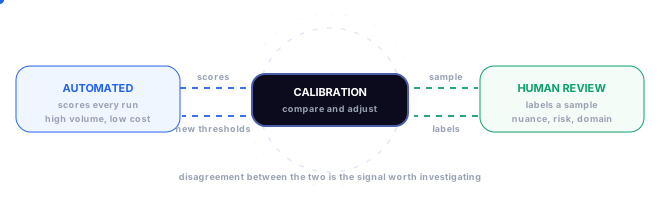
A Hybrid Evaluation Model
Automate high-volume, repeatable checks and reserve human review for calibration, ambiguity, risk, and expert interpretation.
The goal is not human versus automated evaluation. The goal is to automate what can be measured reliably and escalate what requires judgment.
RAG Evaluation for Enterprise Applications
Evaluation becomes more important as RAG moves from demonstrations into systems that influence customer support, contracts, internal policies, financial records, engineering documentation, healthcare information, or executive decisions.
The Enterprise RAG Evaluation Lifecycle
An enterprise RAG lifecycle should treat evaluation as a continuous operating process rather than a one-time gate.
Teams exploring generative AI development services should design evaluation alongside the RAG architecture instead of treating it as a post-launch reporting layer.
Choosing the Right RAG Evaluation Metrics
There is no universal best RAG metric. The right metric depends on the failure you are trying to detect and the business risk associated with that failure.
Use Recall@K
When missing critical evidence is your biggest retrieval risk.
Use Precision@K
When irrelevant retrieval noise is degrading answer quality.
Use Faithfulness
When unsupported generation and hallucinated claims are the central concern.
Use Citation Precision
When users depend on exact sources to verify generated statements.
Use Correctness
When reliable gold answers or domain-reviewed answer criteria exist.
Use Human Review
When usefulness, nuance, domain interpretation, or risk cannot be reduced to one automated score.
A Practical RAG Evaluation Scorecard
A production dashboard should keep quality dimensions separate. Avoid hiding a severe regression behind one weighted average. The example below compares a single release candidate against the build it would replace, scored on the same 400-question internal test set.
Example Scorecard: Release Candidate v2.4 vs. v2.3
| Evaluation Dimension | v2.4 | v2.3 | Change | Release Gate | Status |
|---|---|---|---|---|---|
| Recall@KRequired evidence reaching the model | 0.91 | 0.88 | +0.03 | ≥ 0.85 | Pass |
| Context PrecisionShare of supplied context that is answer-bearing | 0.74 | 0.79 | −0.05 | ≥ 0.70 | Watch |
| FaithfulnessClaims supported by retrieved context | 0.93 | 0.92 | +0.01 | ≥ 0.90 | Pass |
| Answer CorrectnessAgreement with reviewed gold answers | 0.86 | 0.87 | −0.01 | ≥ 0.85 | Pass |
| Citation PrecisionCitations that entail their claim | 0.88 | 0.90 | −0.02 | ≥ 0.90 | Blocked |
| Citation CompletenessClaims needing evidence that received it | 0.81 | 0.78 | +0.03 | ≥ 0.80 | Pass |
| Correct Abstention RateNo-answer questions declined correctly | 0.72 | 0.65 | +0.07 | ≥ 0.70 | Pass |
| Human Acceptance (high-risk)Expert-reviewed slice, 80 questions | 0.89 | 0.91 | −0.02 | ≥ 0.90 | Blocked |
| Safety ReviewBlocking dimension, no tolerance | 0 issues | 1 issue | −1 | 0 issues | Pass |
| P95 LatencyEnd-to-end, retrieval plus generation | 3.4 s | 3.1 s | +0.3 s | ≤ 4.0 s | Pass |
| Cost per QueryEmbedding, retrieval, and generation tokens | $0.021 | $0.018 | +$0.003 | ≤ $0.030 | Pass |
Illustrative figures from a 400-question internal test set, with an 80-question high-risk slice reviewed by domain experts. Nine of the eleven dimensions sit at or above gate, but citation precision and high-risk human acceptance do not, so this candidate does not ship. Context precision passes its gate yet drops five points against v2.3, which is the kind of trend worth investigating before it becomes a failure. Replace the gate column with thresholds agreed by your own risk owners.
Release-gate principle: define separate minimum thresholds for critical dimensions such as retrieval recall, faithfulness, citation support, and high-risk human acceptance. Do not allow strong metrics elsewhere to compensate for a critical failure.
Want this scorecard running against your own RAG stack?
We wire gates, traces, and dashboards into your CI so a regression blocks the release instead of reaching users.
RAGAS, ARES, and ALCE: Where They Fit
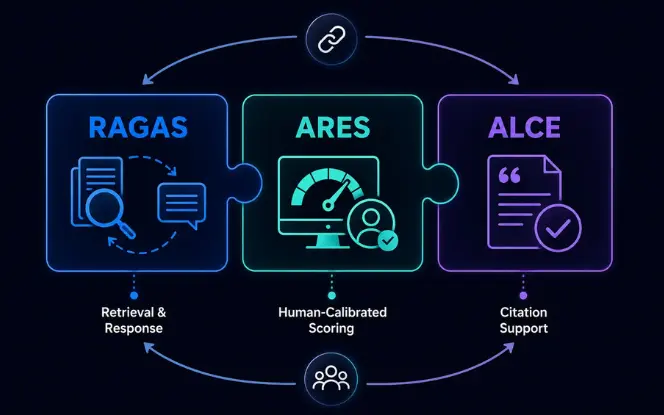
Several evaluation frameworks and research approaches are useful when designing a modern RAG evaluation stack. They are best treated as complementary ideas rather than mutually exclusive choices.
RAGAS
Useful for component-level RAG evaluation concepts such as faithfulness, response relevance, context precision, and context recall. See the RAGAS documentation.
ARES
Demonstrates a hybrid approach combining automated judges with a smaller human-annotated set for calibration. See the ARES paper on arXiv.
ALCE
Separates answer quality from how accurately and completely claims are supported by citations. See the ALCE paper on arXiv.
A production RAG evaluation architecture can combine these ideas with domain-specific thresholds, safety checks, operational metrics, human review, and business KPIs.
How SDLC Corp Can Support Enterprise RAG and Generative AI Initiatives
Building a production RAG application involves more than connecting an LLM to a vector database. Reliable systems require data architecture, retrieval engineering, LLM integration, secure application development, evaluation, deployment, monitoring, and continuous optimization.
AI Development
Design and build AI-powered applications, intelligent workflows, enterprise assistants, and domain-specific systems.
Generative AI
Develop GenAI applications using LLMs, retrieval workflows, enterprise data, evaluation, and production integrations.
AI/ML Implementation
Operationalize AI models and workflows with integration, deployment, monitoring, and ongoing improvement.
Explore SDLC Corp's AI development services, generative AI development services, AI consulting services, and AI/ML implementation services for enterprise AI initiatives.
Planning an Enterprise RAG or Generative AI Application?
SDLC Corp can help design retrieval architecture, LLM workflows, evaluation frameworks, enterprise integrations, deployment pipelines, and production monitoring for AI systems that need measurable quality and traceability.
Talk to a Generative AI Expert
- Retrieval architecture
- Evaluation harness
- Release gates
- Production monitoring
Final Thoughts
A reliable RAG application cannot be evaluated with one generic accuracy number. Retrieval-Augmented Generation is a multi-stage system, so its evaluation framework should reflect the same architecture.
Retrieval quality determines whether the model receives the right evidence. Faithfulness measures whether the model stays grounded in that evidence. Citation accuracy determines whether users can verify important claims. Human review determines whether automated metrics align with real-world quality, risk, and domain expectations.
The strongest approach combines component-level metrics, claim-level verification, representative evaluation datasets, human calibration, release gates, and continuous production monitoring.
As organizations build increasingly sophisticated applications around large language models and generative AI, evaluation should become part of the engineering lifecycle rather than a final QA activity.
Release Gates, Score Drops and Evaluation Tooling
Turn scores into release gates
An evaluation suite only changes behaviour when a number can block a release. Agree a floor per metric before the next candidate is built, and write it where the release process can see it: retrieval recall at K, faithfulness, citation precision and correctness each get a minimum, plus a rule for what happens when a candidate sits between the floor and the current production score. Gates should differ by risk: an internal knowledge assistant and a customer-facing regulated answer do not deserve the same threshold.
Diagnosing a drop
When a score falls, the useful question is which stage moved. Work in this order:
- Retrieval first. If recall dropped, the generation numbers are unreliable. Check the index, chunking, embedding model version and any filter that changed.
- Then grounding. Stable retrieval with falling faithfulness usually points at prompt changes, model version changes or context truncation.
- Then citations. High faithfulness with low citation precision normally means the mapping between answer spans and sources is broken, not the reasoning.
- Then the judge. If nothing in the pipeline changed, verify the evaluator itself: model updates shift judge behaviour and can move scores without any product change.
Annotate both stages of the pipeline
An evaluation set that only labels final answers cannot separate retrieval failures from generation failures. Each example needs the question, the passages that should be retrieved, the acceptable answer and the sources that should be cited. That extra annotation is what makes a regression traceable.
Frameworks and judge calibration
RAGAS and DeepEval cover metric computation and test suites; TruLens, Phoenix and Opik lean toward tracing and run comparison. The choice matters less than calibration: whichever harness runs the scores, sample its judgements against human labels regularly, and re-calibrate when the judge model version changes. An uncalibrated LLM judge produces confident numbers that drift quietly.
FAQs About RAG Evaluation
What Is a RAG Evaluation Framework?
A RAG evaluation framework is a structured process for measuring how well a retrieval-augmented generation system retrieves evidence, uses that evidence, generates relevant answers, supports factual claims, and performs against human and operational quality expectations.
What Are the Most Important RAG Evaluation Metrics?
Important metrics include Precision@K, Recall@K, Hit Rate, MRR, nDCG, context precision, context recall, faithfulness, answer relevance, answer correctness, citation precision, citation completeness, abstention quality, latency, cost, and human acceptance.
What Is Faithfulness in RAG Evaluation?
Faithfulness measures whether the factual claims in a generated answer are supported by the retrieved context supplied to the model. A response can sound plausible and still be unfaithful when it introduces unsupported information.
What Is the Difference Between Faithfulness and Citation Accuracy?
Faithfulness evaluates whether retrieved evidence supports the generated answer overall. Citation accuracy evaluates whether the specific source attached to a claim is actually the source that supports it.
How Do You Evaluate Retrieval Quality in a RAG System?
Retrieval can be evaluated using metrics such as Precision@K, Recall@K, Hit Rate, MRR, nDCG, context precision, and context recall. Teams should also inspect chunking, metadata, filters, query rewriting, reranking, and top-K selection.
Why Is Human Evaluation Needed for RAG?
Human review is valuable for domain correctness, ambiguity, usefulness, completeness, safety, policy interpretation, and calibration of automated evaluators. It is especially important for high-risk or regulated applications.
What Is RAGAS?
RAGAS is an evaluation framework and library for LLM and RAG applications. It is commonly associated with metrics such as faithfulness, response relevance, context precision, and context recall.
How Often Should RAG Systems Be Evaluated?
RAG systems should be evaluated during development, before releases, after meaningful changes to models, prompts, embeddings, rerankers, retrieval settings, or knowledge sources, and continuously through production monitoring.
Can RAG Completely Eliminate Hallucinations?
No. Retrieval improves access to external evidence, but a language model can still ignore, misinterpret, combine, or extend that evidence incorrectly. That is why retrieval quality and faithfulness should be evaluated separately.
What Should Enterprises Evaluate Beyond RAG Accuracy?
Enterprise teams should also evaluate citation traceability, knowledge freshness, abstention behavior, latency, cost, source authority, security, user task completion, and performance across high-risk query categories.