iGaming CRM integration decides whether your retention program works. The CRM brand you choose matters far less than the quality and speed of the data flowing into it. A capable CRM with weak integration will always lose to a simpler CRM that receives clean, real-time player events.
New to the category? Start with our guide to what is iGaming CRM before going deeper.
Key Takeaways
- Integration quality drives retention. The data feeding the CRM matters more than the CRM brand.
- Your CRM needs live player events. Registrations, deposits, sessions, bonuses, and KYC status should arrive in real time.
- Real time beats batch. Nightly syncs break lifecycle triggers that depend on the active session.
- Compliance belongs inside the pipeline. Responsible gambling limits and self-exclusion must gate targeting before a campaign sends.
- Plan for migration and monitoring. Go-live is the start, not the finish.
Why CRM and PAM Integration Decides CRM Value
The Player Account Management (PAM) system holds the source of truth for player identity, balances, and activity. The CRM reads from it and acts on the player through campaigns and journeys. When these systems sit in silos, data arrives late and campaigns fire at the wrong moment.
PAM
Source of truth for identity, balances, and activity.
CRM
Reads that data and acts through campaigns and journeys.
The cost shows up fast. A reactivation email that triggers hours after a failed deposit misses the window when the player was ready to play.
Closing that gap is the core of strong player retention, and tight CRM and PAM integration is how operators close it.
The iGaming CRM Integration Map: What Connects to What
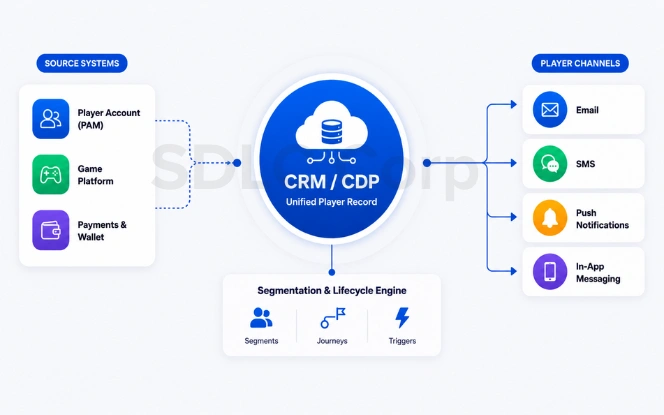
In practice, a CRM does not connect to one system. It consumes events from across the stack, then acts on the player. The core systems are the PAM, the game platform, the sportsbook feed, payments and wallet, KYC and AML, responsible gambling tooling, and the CRM or CDP layer.
These sources feed an event-driven data layer that unifies them into one live player record. The CRM or CDP then reads that record to build segments and trigger lifecycle journeys, which go out across channels such as email, SMS, push, and in-app messaging.
To integrate a CRM with your iGaming platform, you map each source to the player record and decide which events need real-time delivery. Teams building the wider stack usually settle these data contracts during iGaming software development.
What Your CRM Needs: Events and the Event-Driven Data Layer
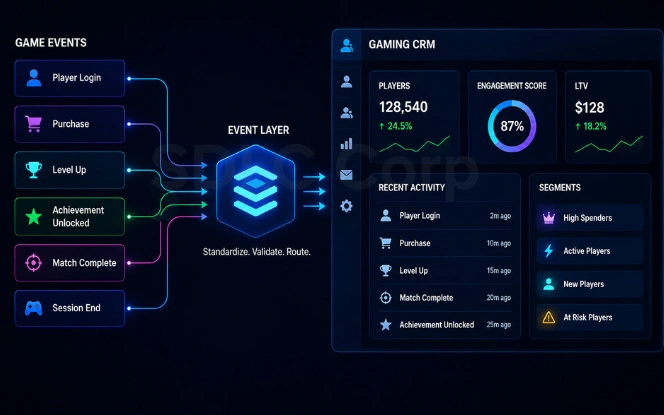
The Event Taxonomy
Your CRM is only as good as the events it receives. Each event below maps to a moment in the player lifecycle, and most of them need to reach the CRM the instant they happen.
| Event | Source system | Why the CRM needs it | Real time? |
|---|---|---|---|
| Registration | PAM | Starts the onboarding journey | Yes |
| First deposit (FTD) | Payments / PAM | Triggers welcome and conversion flows | Yes |
| Deposit / withdrawal | Payments | Value signals and churn risk | Yes |
| Session start / end | Game platform | Engagement and game preference | Yes |
| Bonus issued / wagered | Bonus engine | Bonus lifecycle and abuse checks | Yes |
| KYC status | KYC / AML | Holds promotions until a player is verified | Yes |
| RG limit / self-exclusion | RG tooling | Suppresses targeting | Critical |
From Events to Live Segments
An event-driven data layer turns raw events into segmentation attributes such as deposit frequency, game preference, and session length. It also builds a single customer view by unifying PAM, behavioral, and channel data into one player record. As a result, segments should update on each event, not overnight. Engineers who have built event-driven architecture for casino games will recognize the pattern.
Integration Architecture: Real Time, Webhooks, and APIs
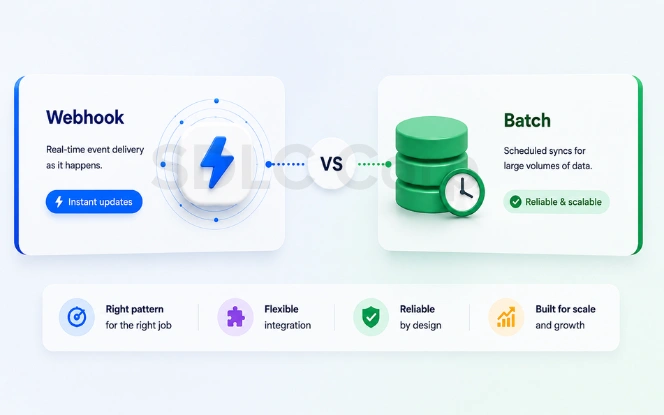
Real Time vs Batch
Three patterns cover most cases. Each one fits a different job in the pipeline.
Webhooks
Push events the moment they happen.
Use for lifecycle & RG triggersAPI polling
Pulls data on a schedule.
Use for near real-time needsBatch ETL
Moves large volumes overnight.
Use for reconciliation & reportingWebhook and API Patterns
A reliable integration acknowledges every event with a fast 2xx response, retries with back-off when delivery fails, and verifies each payload's signature before processing, in line with the OWASP API Security Top 10. It also stays idempotent, so a repeated event is never counted twice. Keep one source of truth per data point and avoid write-back loops between systems.
A typical event payload looks like this:
POST /crm/events
{
"event": "player.deposit_made",
"player_id": "P-48213",
"amount": 50.00,
"currency": "EUR",
"timestamp": "2026-05-29T10:14:22Z"
}Reliability here rests on the same fundamentals as any casino backend architecture: clean contracts, retries, and a single source of truth.
Not sure which events your CRM is actually receiving?
An integration audit traces your event flow, flags missing real-time triggers, and shows where retention value is leaking.
Explore our iGaming CRM softwareConnecting Sportsbook Feeds and Payments
Sportsbook Feed Integration
Sportsbook operators also need bet placement and settlement events in the CRM. In-play and settled markets carry different timing, so same-event triggers depend on fast feed delivery. Speed matters here as much as it does when you integrate live odds into a betting product.
Payment and Wallet Integration
In addition, payment events give the CRM accurate value signals. Deposits, withdrawals, chargebacks, and failed payments should reach the CRM with their transaction state and currency. Failed-payment events are especially useful, since they let you trigger a recovery message before the player leaves.
Routing Compliance and Responsible Gambling Data
Compliance cannot sit outside the integration. Responsible gambling limits and self-exclusion status must gate promotional targeting before any campaign sends, not after. The UK Gambling Commission, for example, requires operators to remove or flag self-excluded individuals in marketing databases within two days of notification, which is only realistic when suppression runs inside the pipeline. Marketing consent and permission states should sync alongside player events, and the pipeline should keep audit logs that show regulators how targeting decisions were made.
Gate before sending
RG limits and self-exclusion suppress targeting before any campaign sends, not after.
Sync consent states
Marketing consent and permission states travel alongside player events.
Keep audit logs
Logs show regulators how each targeting decision was made.
Build these controls in from the start as a compliance by design requirement, so suppression and consent are enforced inside the pipeline rather than bolted on later.
Generic CRM vs Purpose-Built CRM
A generic CRM can work, but it carries a cost. By contrast, a system designed for the model removes most of that overhead. The difference is not about the brand name on the tool. It is about how much custom work it takes to model iGaming data correctly.
Generic CRM
More custom workTools like HubSpot or Salesforce need custom development to model iGaming events, bonuses, and responsible gambling states. That work adds time and ongoing maintenance.
- Heavy custom build to model iGaming data
- Higher ongoing maintenance
- Slower time to live
Purpose-built iGaming CRM
Native fitA purpose-built iGaming CRM maps these natively, which shortens time to live and reduces ongoing maintenance.
- Models events, bonuses, and RG states natively
- Lower ongoing maintenance
- Faster time to live
For that reason, the heavier your plans for predictive analytics on player data, the stronger the case for a purpose-built system.
Migration, Reconnection, and Post-Deployment
PAM Reconnection and API Migration
Operators change PAM providers and API versions over time. A safe migration uses versioning, dual-running during cutover, and event replay or backfill so no player events are lost. Careful reconnection logic prevents gaps and duplicate records. Replay and reconnection are really questions of data consistency across systems.
After Deployment
Integration work continues after go-live. Treat the launch as the point where monitoring begins:
iGaming CRM Integration Requirements Checklist
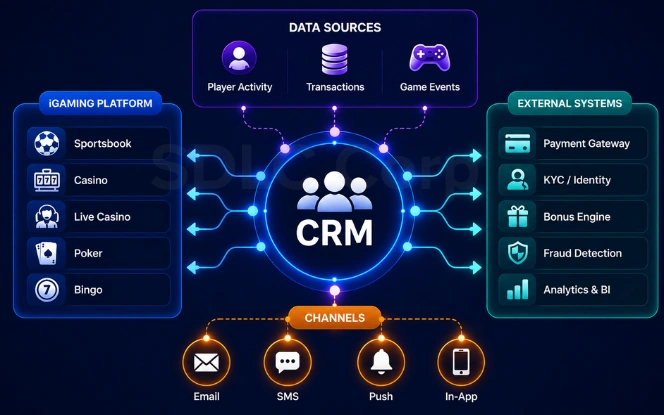
Check these before integration starts:
- Event list and schemaConfirmed for each source system.
- Real-time deliveryFor lifecycle and responsible gambling events.
- Security in placeSignature verification, encryption, access control.
- Suppression rulesFor self-excluded and limit-reached players.
- Monitoring and alertingPlus a reconciliation plan.
- Migration and backfill planFor future PAM or API changes.
- How fast do triggers fire?
- How are responsible gambling states handled?
- What support exists for migration and replay?
Pair this with a broader iGaming compliance checklist for regulated markets.
SDLC Corp connects PAM, feeds, payments, KYC, and responsible gambling data into a CRM that acts on clean, real-time events. If campaigns are firing late or player data sits in silos, an integration review is the fastest way to find the gaps.
Conclusion
iGaming CRM integration is what turns a CRM from a contact database into a system that acts on real-time player data. The brand of CRM you pick matters far less than the events flowing into it from the PAM, the game platform, the sportsbook feed, and payments. Get the integration right, route responsible gambling data inside the pipeline, and plan for migration and monitoring, and your retention program finally has a foundation it can build on.
When CRM and PAM integration fires late or player data sits in silos, the problem is almost always the integration, not the CRM. SDLC Corp helps operators connect these systems into one clean, real-time data flow, so the right message reaches the right player at the right moment.
Lifecycle triggers slow or player data fragmented?
If your integration is leaking retention value, it needs a system-level review.
Talk to our iGaming CRM software teamFrequently Asked Questions
What is the difference between a CRM and a PAM in iGaming?
The PAM manages player accounts, balances, and activity as the source of truth. A CRM then reads that data to run segmentation, campaigns, and lifecycle journeys. Strong integration between them is what makes the CRM effective.
What player data does an iGaming CRM need?
It needs registration, deposits and withdrawals, session activity with game type, bonus events, KYC status, and responsible gambling states. Most of these should arrive in real time.
Should iGaming CRM integration use real time or batch?
Use real time for lifecycle and responsible gambling events, since these drive in-session triggers. Batch is fine for reconciliation and reporting where a short delay is acceptable.
Can I use HubSpot or Salesforce as an iGaming CRM?
Yes, but they need custom development to handle iGaming events, bonuses, and compliance states. A purpose-built iGaming CRM models these natively and is faster to integrate.
How long does an iGaming CRM integration take?
It depends on the number of source systems, data quality, and real-time requirements. A clear event map and a clean PAM API are the biggest factors in a faster go-live.