
Home / Blogs & Insights / iGaming CRM Pricing Guide: Models, Costs & Comparison

iGaming CRM Pricing Guide: Models, Costs & Comparison

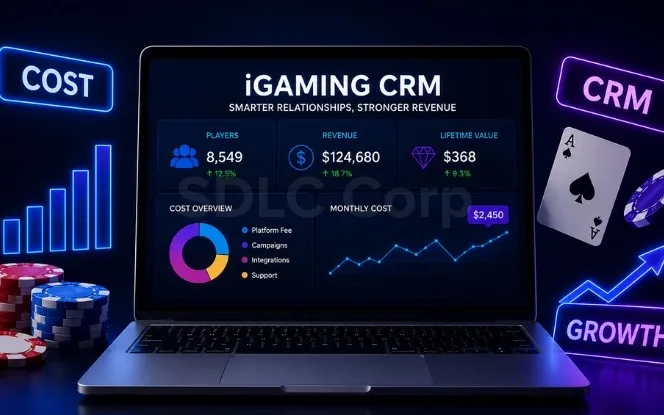
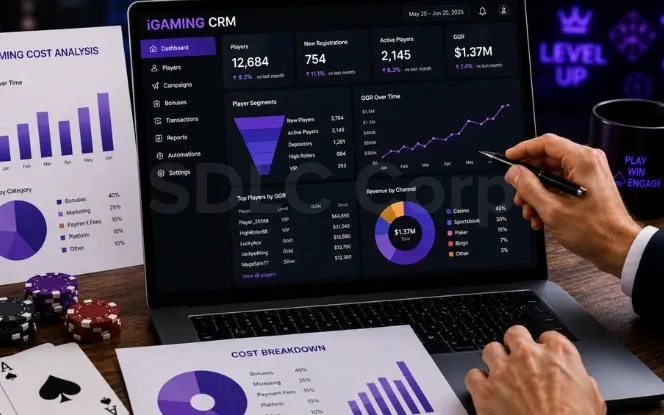
iGaming CRM cost and pricing concept image

Table of Contents

Most iGaming operators receive a CRM quote and focus only on the licence fee. The real cost is often 2 to 2.5 times that number once implementation, integrations, compliance modules, and overage fees are counted.

This guide breaks down every iGaming CRM pricing model, shows how costs scale with your player base, and compares the top platforms so you can budget accurately from day one. To understand what drives these costs, start with a clear picture of what iGaming CRM software actually delivers.

Key Takeaways

  • iGaming CRM costs range from $500 to $40,000 per month: Startup operators under 20,000 MAU pay $500 to $2,000 per month. Enterprise platforms above 500,000 MAU are priced on custom quotes starting from $20,000 per month.
  • The licence fee is only 30 to 40 percent of your real spend: Implementation, integrations, compliance modules, and overage fees routinely push total annual cost to 2 to 2.5 times the headline price.
  • MAU-based pricing suits growing operators: Your CRM bill scales with player volume, which aligns spend with revenue but overage fees during traffic spikes need careful contract attention.
  • Flat-fee models win at scale: Once your player base passes 30,000 MAU, flat-fee pricing almost always costs less than per-player billing at standard rates.
  • Revenue-sharing models lower entry cost: Paying a percentage of GGR removes upfront risk for new operators, but margins reduce as revenue grows. Most operators switch to fixed pricing once GRR is stable.
  • A 3-year TCO calculation is the most accurate comparison: First-year licence quotes exclude the costs that drive real budget overruns. Always model implementation, migration, compliance, and escalators before signing.

What Does iGaming CRM Actually Cost?
iGaming CRM monthly cost by operator size from startup to enterprise — four-tier cost breakdown

iGaming CRM pricing depends on three things: your operator size, the pricing model you choose, and the platform you sign with. Here is what operators at each stage typically pay per month.

According to EGR Global, the iGaming CRM and player engagement platform market continues to grow as operators prioritise retention over acquisition to offset rising player acquisition costs.

Startup

Under 20,000 MAU

$500 – $2,000per month

Mid-Market

20,000 – 100,000 MAU

$3,000 – $10,000per month

Large

Above 100,000 MAU

$15,000 – $40,000per month

Enterprise

500,000+ MAU

Custom Quotenegotiated directly

Why the Licence Fee Is Only 30 to 40 Percent of Your Real Spend

The licence fee covers platform access only. It does not cover implementation, API integrations, data migration, add-on modules, volume overages, or compliance features. Internal engineering hours alone can double the headline price for most operators.

A documented industry case shows an operator paying $850,000 in annual licence fees while their true annual spend exceeded $2.1 million once all indirect costs were included. Always request a full cost breakdown before signing any contract.

SDLC Corp operator engagement: In a real-world iGaming CRM implementation, total TCO came in 147% above the headline licence fee in year one once implementation, integration, compliance modules, and overage costs were fully accounted for.
Budget rule of thumb: Take the quoted licence fee and multiply by 2 to 2.5. That range is your working total annual spend estimate until you have a full line-item breakdown from the vendor.

5 iGaming CRM Pricing Models Explained

5 iGaming CRM pricing models explained for casino operators in 2026

Understanding casino CRM pricing models helps you compare vendors on equal terms. Each model suits a different operator size and growth stage. Before reviewing the models, it helps to understand what iGaming CRM platforms are built to do at their core.

Per-User Pricing

Per-user pricing charges a fixed monthly fee for each team member who accesses the CRM. It works well for small, stable teams but becomes expensive quickly as your operation grows.

Best for: Small, stable teams

MAU-Based (Per-Player) Pricing

MAU-based pricing charges based on the number of monthly active players on your platform. It scales with your revenue but watch for overage fees during peak traffic events like major sports tournaments.

Best for: Growing operators

Flat-Fee Pricing

Flat-fee pricing charges a fixed monthly amount regardless of player volume or feature usage. It suits operators with a high, stable player base but is rarely the cheapest option below 30,000 MAU.

Best for: High-volume, stable operators

Revenue-Sharing Model

Revenue-sharing CRM models charge a percentage of your monthly gross gaming revenue instead of a fixed fee. It removes upfront cost for new operators but reduces margins as revenue grows.

Best for: New operators at early GGR stage

Modular Pricing

Modular pricing lets you pay for features individually, starting with a base subscription and adding modules as needed. It suits operators who want cost control by activating only what they need right now and expanding the stack as their platform scales.

Best for: Feature-selective operators

iGaming CRM Cost Breakdown by Model

iGaming CRM cost comparison — per-player vs flat-fee across player volume tiers from 10k to 500k MAU

The most important comparison most operators skip is per-player cost versus flat-fee cost at their actual player volume. Getting this wrong at contract stage locks you into the more expensive model for two to three years. Understanding the broader cost to develop casino software also helps you place CRM spend in the context of your full platform budget.

Per-Player vs Flat-Fee: Side-by-Side Cost Breakdown

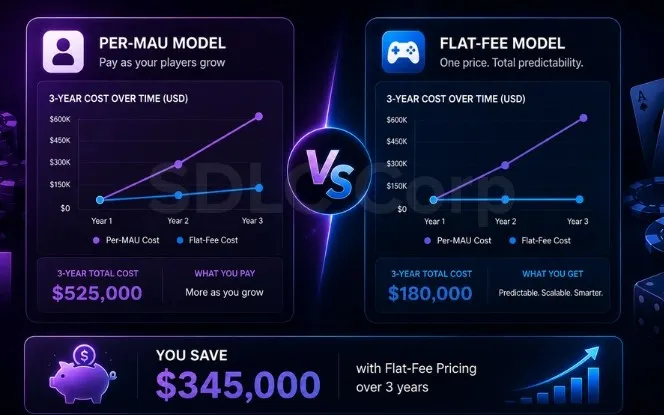
At a standard rate of $0.05 per MAU, here is how the two models compare across player volumes:

Monthly PlayersPer-MAU Cost ($0.05/MAU)Flat-Fee CostCheaper Option
10,000$500$1,500Per-MAU
50,000$2,500$1,500Flat-fee
100,000$5,000$1,500Flat-fee
250,000$12,500$4,000Flat-fee
500,000$25,000$4,000Flat-fee
Breakeven point: ~30,000 MAU. Below that, per-MAU pricing is usually cheaper. Above it, flat-fee saves money. Always request your vendor's exact per-MAU rate in writing so you can run this calculation against your own player data before signing.
Industry analysis from iGaming Business shows that operators switching from per-user to MAU-based pricing models report more predictable annual budgets as player volumes grow beyond the 30,000 MAU threshold.

Compare iGaming CRM Pricing

Not Sure Which CRM Pricing Model Fits Your Operation?

Talk to SDLC Corp and get a clear cost breakdown matched to your player volume, compliance requirements, and growth stage.

Talk to a CRM Expert →

How iGaming CRM Costs Scale by Player Volume

Per-MAU pricing links your CRM bill directly to player growth. The faster your player base grows, the faster your CRM cost rises. The challenge is that growth often accelerates unpredictably. A single marketing campaign or sports event can push you into the next billing tier mid-month.

Knowing how player retention in real money games drives your active player count helps you model CRM costs more accurately before committing to a tier.

Per-MAU Pricing: What Each Tier Actually Costs

MAU RangeTypical Monthly CostOperator Stage
0 to 5,000 MAUFrom $100/monthEntry level, some free tiers available
5,000 to 20,000 MAU$500 to $1,500/monthStartup plans
20,000 to 100,000 MAU$1,500 to $5,000/monthCore growth window, model choice matters most here
100,000 to 500,000 MAU$5,000 to $20,000/monthMid to enterprise, flat-fee often cheaper here
500,000+ MAUFrom $20,000/monthCustom enterprise negotiation only
Overage warning: Many operators discover their overage rate is significantly higher than the standard per-MAU rate only after exceeding their tier. Request overage terms in writing before signing.

The Player Lifecycle: 6 Stages iGaming CRM Must Cover

iGaming CRM player lifecycle diagram showing 6 stages from registration KYC and first deposit through active play at-risk detection churn recovery and VIP management

Every player moves through a predictable journey. Your CRM needs a specific strategy at each stage rather than treating all players the same.

StageCRM Action
Stage 1: Registration & KYCWelcome sequence fires. KYC status syncs automatically. Communication adjusts to verification level.
Stage 2: First Deposit (FTD)Personalized welcome bonus triggers within seconds. Game recommendation and onboarding email deliver immediately.
Stage 3: Active PlayBehavioral segmentation updates in real time. Game recommendations and cross-sell opportunities activate.
Stage 4: At-Risk & DecliningInactivity flag triggers. Reactivation sequence fires before the player makes a conscious decision to leave.
Stage 5: ChurnPlayer reactivation campaign for casino. Win-back campaign for sportsbook. Personalized by historical preference.
Stage 6: VIP & LoyalTiered rewards activate. Exclusive offers deliver. VIP activity drop triggers escalation workflow.

Also read: Best practices for player retention in real money games show that early intervention at Stage 4 dramatically improves recovery rates compared to waiting until the player has fully churned.

See how SDLC Corp implements lifecycle CRM into platform architecture in our casino game development case study.

Hidden Costs You Must Budget For

iGaming CRM hidden costs beyond the licence fee — implementation, migration, integration, compliance, overages

Most iGaming operators underestimate their true CRM spend by 40 to 60 percent. The licence fee is visible. The costs below are the ones that cause budget overruns six months after go-live.

Understanding the full scope of regulatory compliance challenges in iGaming explains why compliance modules alone can add tens of thousands of dollars to your annual CRM bill.

Implementation, Migration and Integration

Implementation and onboarding: $5,000 to $30,000 depending on platform complexity and the scope of your initial setup.
Data migration from an existing CRM: $5,000 to $50,000 and can take several weeks to complete cleanly.
API integration (PAM, payments, game providers): $2,000 to $15,000 upfront, plus $1,000 to $5,000 per month in ongoing maintenance.
Internal engineering hours: Most operators spend 20 to 80 engineering hours per month keeping integrations running cleanly, a cost that rarely appears in vendor quotes.
According to SBC News, operators who invest in structured player segmentation report retention improvements of 15 to 25 percent within the first year.

Add-ons, Overages and Compliance Modules

  • UKGC or MGA compliance module: $10,000 to $35,000 added to your total cost depending on jurisdiction.
  • Volume overage fees: Typically 10 to 30 percent above your contracted tier rate, usually discovered only after you exceed your tier.
  • Advanced analytics or BI add-ons: An additional $500 to $3,000 per month on top of your base subscription.
  • Annual price escalator: Many contracts include a 5 to 15 percent annual increase that operators overlook when comparing first-year quotes.
Action before signing: Request a complete line-item cost breakdown covering implementation, migration, integrations, compliance modules, overage terms, and annual escalators. First-year quotes without these items are incomplete.

iGaming CRM Platform Pricing Comparison 2026
iGaming CRM platform pricing comparison 2026 - Optimove, Xtremepush, Fast Track, Smartico, Symplify compared

The five platforms below cover most of the iGaming CRM market. They differ significantly in pricing model, target operator size, and what is included in the base price. No single platform suits every operation.

For operators whose requirements go beyond what any off-the-shelf platform offers, custom iGaming software development is worth considering as a long-term alternative.

For independent market context on iGaming CRM trends, iGaming Business publishes regular operator technology reports worth reviewing alongside this comparison.
PlatformPricing ModelEstimated CostBest ForFree Trial
OptimoveMAU-based$5,000 to $15,000+/monthEnterprise, predictive AINo
XtremepushMAU-basedCustom quoteMid to enterpriseDemo only
Fast TrackMAU + modules$15,000 to $40,000/monthLarge multi-brand operatorsNo
SmarticoMAU-basedCustom quoteMid-market, gamificationDemo
SymplifySubscriptionLower mid-rangeSmaller operatorsYes
Prices are estimates based on publicly available data and third-party reviews as of May 2026. Contact each vendor directly for a current quote. Optimove pricing reflects mid-market to enterprise contracts. At 25,000 MAU, total annual cost typically falls between $60,000 and $180,000 depending on modules and contract terms. Confirm directly with Optimove for your operator tier.

Which Pricing Model Fits Your Operator Size?
iGaming CRM pricing model decision guide by operator size and MAU stage

The right model depends on your current MAU, how predictably it grows, and how much budget variance your operation can absorb. Small operators often pair a modular CRM with a white label casino solution to keep total monthly costs under $500 in their first year of operation.

Startup Under 20,000 MAU

Start with Modular or Revenue-Sharing

Flexibility matters more than features at this stage. Locking into a high flat-fee or large MAU contract before your player base is established creates unnecessary financial risk. Revenue-sharing removes upfront cost entirely if your GGR is still building.

Growth 20,000 to 100,000 MAU

MAU-Based Pricing Gives the Best Balance

MAU-based pricing gives the best balance of cost and capability at this stage. Your CRM spend grows proportionally with your revenue. Monitor your MAU closely to anticipate tier changes before they hit.

Scale 100,000 to 500,000 MAU

Run the Flat-Fee vs MAU Comparison Carefully

Flat-fee almost always saves money at this volume and simplifies budget approvals. Always run the calculation with your exact player data before your next renewal, not the vendor's sample numbers.

Enterprise Above 500,000 MAU

Negotiate a Custom Enterprise Agreement

Standard pricing tiers at this scale are never the best deal available. Enterprise operators have significant leverage. Go directly to negotiation and benchmark quotes from at least two vendors before committing.

Conclusion

iGaming CRM pricing depends on your player volume, your pricing model, and the hidden costs most vendors do not mention upfront. The licence fee is only 30 to 40 percent of what you will actually spend.

Calculate your 3-year total cost of ownership before signing any contract. The right platform pays for itself through better retention and lower churn within 6 to 12 months.

Build Your iGaming Platform

Ready to Build a CRM-Integrated iGaming Platform?

Talk to SDLC Corp and get a platform where CRM, PAM, bonus engine, and responsible gaming connect from day one. Whether you are launching a casino, sportsbook, or lottery platform, our team builds the full stack.

See What Fits My Budget →

Frequently Asked Questions

Common questions operators ask when evaluating iGaming CRM pricing and total cost of ownership.

1

How much does iGaming CRM cost per month?

iGaming CRM pricing ranges from $500 per month for startup operators to over $40,000 per month for enterprise platforms. The exact casino CRM software cost depends on your pricing model, player volume, and which modules you activate. Always calculate your 3-year TCO, not just the first-year licence fee.

2

What is MAU-based pricing in iGaming CRM?

MAU-based pricing charges a fee for each monthly active player who logs in, deposits, or bets within a 30-day window. The rate typically falls between $0.03 and $0.10 per MAU. Costs rise when player volume increases or during peak traffic events like major sports tournaments.

3

What are the hidden costs of iGaming CRM?

The most common hidden costs are implementation fees, data migration, API integration, compliance modules, volume overages, and annual contract escalators. These costs typically push real annual spend to 2 to 2.5 times the headline licence price. A documented case shows an operator paying $850,000 in licence fees while true annual spend exceeded $2.1 million.

4

Can small casino operators afford iGaming CRM?

Yes. Affordable casino CRM software is available for operators under 20,000 MAU, with some platforms starting below $500 per month on modular or subscription plans. Revenue-sharing models remove the upfront cost entirely for operators who are not yet generating strong GGR.

5

How do I calculate iGaming CRM ROI?

Start with your current player churn rate and average revenue per user. Estimate a 10 to 20 percent improvement in retention from CRM automation. Multiply the retained players by their average monthly value and compare that figure to your total CRM cost including all hidden costs. Most operators reach payback within 6 to 12 months. Explore our online casino software solutions if you are evaluating a full platform upgrade alongside your CRM investment.

6

Which iGaming CRM pricing model saves the most money long term?

Flat-fee pricing saves the most money for operators above 30,000 MAU because your cost stays fixed regardless of player growth. MAU-based models are cheaper in the early stage but become the most expensive option as your platform scales. Revenue-sharing models appear cheapest upfront but cost the most over a 3-year period once your GGR grows. Run a 3-year TCO calculation across all three models before committing to any contract.

7

What is the difference between iGaming CRM cost and casino CRM total cost of ownership?

The CRM cost is the monthly or annual fee you pay the vendor. The total cost of ownership includes that fee plus implementation, data migration, API integrations, compliance modules, internal engineering hours, staff training, and annual price escalators. For most operators, the total cost of ownership over three years runs 2 to 2.5 times the headline licence price. Always calculate TCO, not just the monthly quote, when comparing platforms.

ABOUT THE AUTHOR

Michael Klein

iGaming Expert

Michael Klein is an iGaming expert with 18 years of experience in the gaming industry. He helps businesses innovate and scale by applying cutting-edge strategies and technologies that drive growth, enhance player experiences, and optimize operations in the ever-evolving iGaming landscape.
PLAN YOUR SOLUTION

More Insights
You Might Find Useful

Explore expert perspectives, practical strategies, and real-world solutions related to this topic.

Best iGaming affiliate software dashboard with partner tracking, commission, payout, and performance analytics icons

Best iGaming Affiliate Software in 2026: Top 10 Platforms Compared

The top iGaming affiliate software in 2026 combines automatic commission

AI-based KYC for iGaming with biometric fingerprint scanning, identity verification, and fraud-resistant player onboarding

AI-Based KYC for iGaming: Faster, Fraud-Resistant Verification

AI-based KYC for iGaming gives operators fast, fraud-resistant checks that

Casino affiliate marketing operator guide featured image with operator dashboard and affiliate channel icons

Casino Affiliate Marketing: Operator Guide

Casino affiliate marketing helps operators acquire high-intent players through performance-based

Let’s Talk About Your Product

Get expert guidance on scope, architecture, timelines, and delivery approach so you can move forward with confidence.

What happens next?