Home / Blogs & Insights / iGaming CRM RFP Template: Vendor Selection Framework

iGaming CRM RFP Template: Vendor Selection Framework

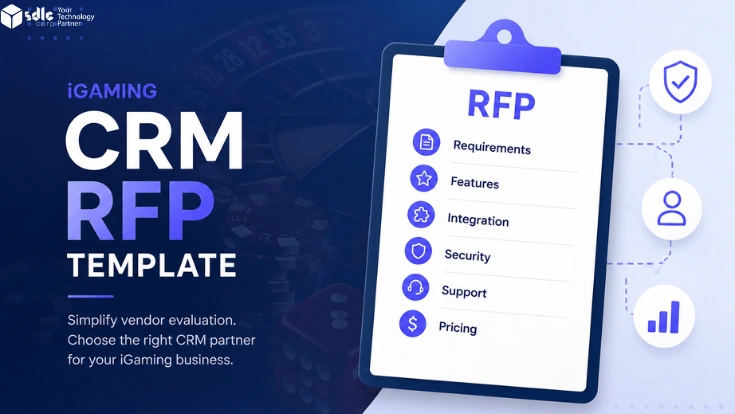
iGaming CRM RFP template for vendor evaluation and CRM selection, featuring proposal checklist, compliance review, integration assessment, and subtle casino gaming elements in a professional blue business design.

Table of Contents

Most iGaming CRM purchases fail within 18 months, and the breakdown almost always starts before the contract is signed. Operators see polished demos, sign multi-year contracts, then discover the platform cannot ingest a Bet Placed event without three months of custom engineering.

However, a focused iGaming CRM RFP template prevents that outcome. It forces vendors to prove what they can do for casino, sportsbook, and hybrid operations before commercial conversations begin.

The framework below was built by the SDLC team for operators procuring iGaming CRM software in real-world conditions.

Key Takeaways

  • Generic CRM RFPs miss iGaming logic: Bet Placed events, FTD, GGR, and PAM integrations are not in standard CRM templates.
  • 12 vendor questions matter most: Schema proof, latency, native PAM connectors, and TCO surface real differences.
  • Plan a 6 to 8 week formal process: Alignment, shortlist, distribution, scoring, finalist deep-dive, contract.
  • Weight scoring around outcomes: Must-haves 40%, performance 30%, commercial 20%, qualitative 10%.
  • Document compliance per jurisdiction: UKGC, MGA, Curacao, Ontario AGCO, and US state-level rules each carry different responsible gambling and reporting needs.

Why a Generic CRM RFP Fails in iGaming
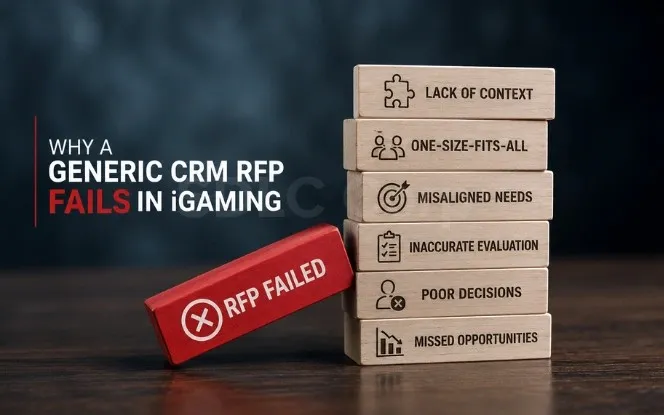
Visual representation of CRM RFP challenges in iGaming with blocks symbolizing generic requirements, evaluation gaps, and business risks.

Generic CRM RFP templates cover Salesforce-style sales pipelines. They assume contacts, deals, and email blasts, not real-time player events or regulator-driven messaging.

However, iGaming runs on different mechanics. The CRM has to ingest events like FTD, deposit cadence, bet placed, session length, GGR, NGR, and self-exclusion status in near real time. In short, What iGaming actually is at a data level differs from standard SaaS. As a result, generic platforms cannot bridge that gap without months of custom build.

A specialized iGaming CRM RFP catches the mismatch upfront and forces vendors to prove their data model, peak-load latency, native PAM connectors, and jurisdiction-specific compliance triggers before the contract.

ElementGeneric CRM RFPiGaming CRM RFP
Data modelContacts, deals, accountsFTD, GGR, NGR, bet events, session P&L
Real-time SLAHours acceptableSub-second required
ComplianceGDPR onlyGDPR plus UKGC, MGA, Curacao, Ontario, US states
IntegrationsSalesforce, HubSpotPAM, wallet, bonus engine, KYC, fraud
ChannelsEmail, SMSEmail, SMS, push, in-app, WhatsApp, on-site, ad networks
Pricing modelPer userPer MAU (Monthly Active Users), message volume, brand count

What to Include in Your iGaming CRM RFP
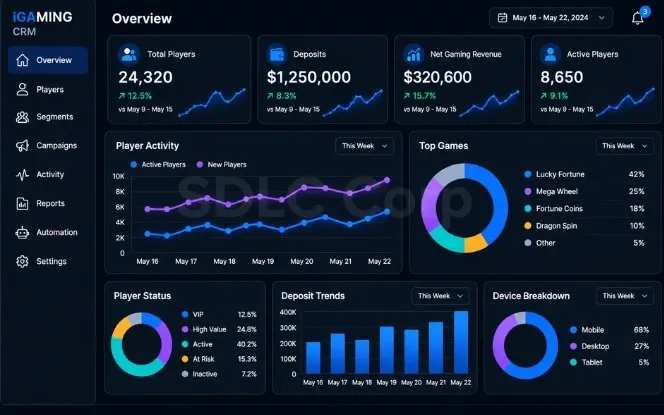
Four-block iGaming CRM RFP framework: Platform and Player Data, Engagement and AI, Integrations and Compliance, Reporting and Commercial

A complete iGaming CRM RFP covers 16 elements across four blocks.

Platform and Player Data

Operator background, vendor company background, hosting and data residency, the player data model (FTD, GGR, NGR, bet events, session P&L), and real-time eventing with latency SLAs.

The architecture defined here shapes every downstream integration in your iGaming software development roadmap.

Engagement, AI and Channels

Real-time segmentation, predictive AI personalization, lifecycle automation for FTD conversion, reactivation, and VIP progression. Multichannel delivery across email, SMS, push, in-app, on-site, WhatsApp, and ad networks.

A CRM passing this section can run loyalty programs in online casino gaming. One that fails it sends broadcast emails.

Integrations and Compliance

First, native PAM, wallet, and bonus engine connectors form the technical baseline. Most generic CRM RFPs break here because iGaming regulatory compliance challenges vary by jurisdiction.

Next, responsible gambling triggers need full coverage. For example, self-exclusion sync, deposit limit messaging, and time-on-device prompts must run by default, not as add-ons.

Finally, document jurisdiction coverage across UKGC, MGA, Curaçao, Ontario AGCO, and major US states, plus security standards like GDPR, SOC 2 Type II, ISO 27001, and PCI DSS.

Reporting, Commercial and References

KPI dashboards, attribution methodology, BI integration (Looker, Tableau, Power BI), implementation timeline, support model, pricing with 1, 3, and 5 year TCO, and at least three reference customers in your market segment.

CRM-triggered bonuses interact directly with the wallet layer, so commercial scoring depends on how vendors handle payouts and financial security post-implementation.

Free iGaming CRM RFP Template

Skip the Guesswork. Use a Battle-Tested RFP Framework.

Get the 16-section RFP document plus a pre-weighted scoring matrix used by real iGaming operators across casino, sportsbook, and hybrid stacks.

Get the Free Template

12 Questions Every Operator Must Ask CRM Vendors

Vendor demos are designed to impress. They are not designed to expose limits. The twelve questions below cut through rehearsed pitches and force vendors to put numbers, schemas, and customer names on the table. Each one targets a specific failure pattern we have seen on real iGaming CRM implementations, and the answers separate vendors who genuinely understand player data from those selling a generic platform with an iGaming label. Use these in writing during the RFP, then again live during finalist sessions to test consistency.

    Technical Schema and Integration Questions

  1. Show me your Bet Placed integration schema.
    A generic CSV template means the iGaming data model is not native.
  2. What is the exact time-to-first-campaign for our setup?
    Beyond 90 days for a single brand signals heavy custom build.
  3. Which PAMs do you have native connectors for?
    A vague "we can integrate with anything" means your engineers write the integration.
  4. Who owns custom field mapping?
    If the answer is "your team," budget 40 to 80 engineering hours per brand.
  5. Performance and Compliance Questions

  6. What is the trigger-to-delivery latency at peak load?
    Sub-second is the baseline for live betting. Multi-minute latency breaks live engagement.
  7. How do you handle responsible gambling compliance per jurisdiction?
    Real iGaming vendors describe mandatory messaging by license. Generic vendors say "you can configure it."
  8. Can your platform support multi-brand, multi-currency, multi-language out of the box?
    A "yes with customization" answer is a red flag for fast-growing operators. The same logic applies if you run sports betting app development alongside casino.
  9. Commercial and Strategic Questions

  10. What is the full TCO over years 1, 3, and 5, including integrations?
    Year 1 pricing often hides an integration tax that doubles by Year 3.
  11. Give me two reference customers in our market segment.
    Same product mix, same scale, same regulatory exposure.
  12. What happens to our data if we terminate the contract?
    Look for written commitments on export format, timeline, and retention.
  13. How is your CRM different from a CDP, and which do we actually need?
    Force vendors to explain the architectural split before committing.
  14. What does your 12 to 24 month roadmap look like?
    Watch for AI features, new channels, and compliance updates for upcoming jurisdictions.

The RFP Evaluation Process: Long-List to Contract

Six-step iGaming CRM RFP evaluation timeline from internal alignment through contract signing across eight weeks

In total, the process runs six steps across roughly eight weeks. However, compressing the timeline usually means skipping a stakeholder, which is the most common cause of post-implementation regret. The schedule below assumes a typical mid-market or tier-two operator with one or two brands. Treat each step as a checkpoint with its own deliverable, and you protect the project from late-stage surprises during contract negotiation and rollout.

From SDLC Corp iGaming Practice

Across the iGaming CRM RFPs the SDLC Corp team has supported, the median end-to-end timeline lands at 8.5 weeks, and the single most common red flag surfacing at finalist stage is the inability to demonstrate a live Bet Placed schema in a sandbox. Roughly 4 out of every 10 vendors we have evaluated have failed this test on the first pass, regardless of how strong their demo deck looked.

Weeks 1 to 3: Setup and Distribution

  1. 1

    Internal alignment

    2 weeks

    Map stakeholders across CRM, Marketing, BI, Compliance, IT, and Finance. Lock KPIs, budget envelope, and success criteria before any vendor sees a single line of the RFP.

  2. 2

    Long-list to short-list

    1 week

    Light RFI. Narrow from 10 or 15 vendors to 5 or 7. Operators evaluating a full stack replacement, such as a turnkey casino solution, need slightly longer.

  3. 3

    Distribute the RFP

    Week 1

    Send the document, open a clarification window, and host a single vendor Q&A call so every shortlisted vendor gets the same answers.

Weeks 4 to 6: Scoring and Contract

  1. 4

    Independent scoring

    Week 2

    Each stakeholder scores separately, then reconciles in one meeting. Independent scoring before discussion stops the loudest voice from anchoring the room.

  2. 5

    Finalist deep-dive

    Weeks 3-4

    Technical sessions, peer reference calls, and sandbox or POC access for 2 or 3 finalists. This is where the Bet Placed schema test happens in a real environment.

  3. 6

    Decision and contract

    Weeks 5-6

    Final scoring, sign-off, contract negotiation, and kickoff planning. Lock data exit clauses and TCO escalators here, not in year two.

How to Score Vendor Responses
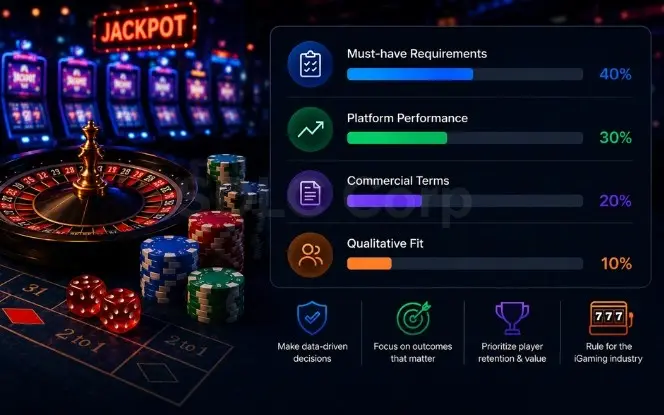
iGaming CRM vendor scoring matrix preview with weighted requirements, 1 to 5 score columns, and TCO tab

First, weighted scoring turns subjective debate into a structured decision. Therefore, weight requirements around outcomes that move player retention, not feature counts. The framework below assigns a percentage weight to each evaluation category so every requirement maps to a measurable outcome rather than a personal preference. Use the defaults as a starting point, then adjust upward or downward based on your jurisdiction mix, brand count, and product split between casino and sportsbook.

Default Scoring Weights

Must-have requirements40%
Platform performance30%
Commercial terms20%
Qualitative fit10%

Each requirement scores 1 to 5. Sum the weighted scores across all categories to produce a single ranked total per vendor, and use that ranking to drive your finalist selection.

Auto-Disqualify Red Flags

  • No real Bet Placed schema demonstrable in a live sandbox
  • No two reference customers in your market segment
  • No written latency SLAs at peak load
  • No standard-format data export on contract termination
  • No responsible gambling triggers for your primary license

Common Mistakes in iGaming CRM RFPs

In practice, the same set of mistakes shows up across almost every failed CRM selection, and most of them happen long before a vendor is signed. Spotting these patterns early protects the budget, the timeline, and the team that has to live with the platform for the next three years.

Process Mistakes

Weighting features over performance

For example, a long checklist with no peak-load latency test produces a CRM that breaks on Champions League nights.

Skipping peer reference checks

However, the 30-minute reference call reveals what the RFP cannot.

Not testing peak load

For instance, 10,000 events per second in a demo can fail at 200,000 on NFL Sunday.

Excluding IT, data, and compliance from day 1

In addition, skipping CRM to KYC testing leads to KYC drop-off in betting apps that only shows after go-live.

Commercial Mistakes

Ignoring TCO beyond Year 1

As a result, integration costs, channel overage fees, and module add-ons can double effective spend by Year 3.

Trusting "iGaming native" claims without proof

Specifically, the Bet Placed schema test cuts through marketing language faster than any other question.

Forgetting data exit clauses

Moreover, a two-year contract without portability terms locks you in.

iGaming CRM Vendors Commonly Shortlisted in 2026

The eight platforms below show up on the majority of operator shortlists this year, ranging from enterprise predictive engines down to mid-market gamification tools. Each carries different strengths around player data, native PAM integration, and pricing model, so use this list as a starting point rather than a ranking.

Optimove

Enterprise predictive analytics leader, with 52% of EGR Power 50 operators reported as clients.

Fast Track

Automation-first, real-time triggers, strong in European casino markets.

Smartico

Unified CRM and gamification with transparent pricing.

Xtremepush

Multichannel engagement with native PAM connectors.

Symplify

Drag-and-drop omnichannel platform with a user-friendly interface.

OptiKPI

Operational simplicity for growing mid-market operators.

Solitics

Real-time data activation focus.

Salesforce Marketing Cloud

Enterprise governance for large groups using the iGaming build.

iGaming CRM RFP: The Bottom Line

An iGaming CRM purchase locks in three to five years of tooling, integration debt, and retention impact. The RFP decides which side of that outcome you land on. A structured, iGaming-native RFP forces vendors to prove data model, latency, compliance, and TCO before sales pressure starts.

SDLC Corp builds iGaming platforms, CRM systems, and player engagement infrastructure for casino, sportsbook, and hybrid operators across UKGC, MGA, Curacao, Ontario, and US state licenses. The free template and scoring matrix below cut typical procurement cycles by several weeks.

Run the process. Score on outcomes. Sign on evidence.

Free iGaming CRM RFP Template

Run a Defensible CRM Selection with SDLC Corp

Get the 16-section RFP, pre-weighted scoring matrix, and 12 vendor questions built by the SDLC iGaming team. Cut weeks off your procurement cycle and score vendors on player data, latency, and compliance, not on demos.

Talk to an iGaming CRM Expert

Frequently Asked Questions

1

What is an iGaming CRM RFP?

A structured request for proposal sent to CRM vendors that specifies player data model, real-time eventing, PAM integration, responsible gambling triggers, and jurisdiction-specific compliance requirements unique to casino and sportsbook operations.

2

How is an iGaming CRM RFP different from a standard CRM RFP?

Standard CRM RFPs focus on sales pipelines, contacts, and email blasts. iGaming CRM RFPs focus on player events (FTD, bet placed, GGR), PAM and wallet integrations, sub-second latency, and per-jurisdiction responsible gambling and reporting rules.

3

How many vendors should receive the RFP?

Five to seven. For instance, fewer than four limits comparison, while more than eight makes independent scoring too slow.

4

How long does iGaming CRM vendor selection take?

A full process runs 6 to 8 weeks after internal alignment. The end-to-end cycle including internal alignment is 8 to 10 weeks.

5

How is a casino CRM RFP different from a sportsbook CRM RFP?

Sportsbook RFPs prioritize live event triggers, odds-change reactions, and peak load handling. In contrast, casino RFPs prioritize session-level segmentation, slot bonus mechanics, and live dealer engagement. Multi-product operators need both. US-licensed operators should also reference the US iGaming compliance checklist in parallel.

6

Do I need a separate RFP for CRM and CDP?

Not usually. Most modern iGaming CRM platforms include CDP-style profile unification. Send a combined RFP and let vendors propose the architecture.

7

How much does iGaming CRM software cost?

Annual contracts range from 40,000 USD for mid-market operators to 500,000 USD or more for tier-one multi-brand groups. Integration and module add-ons sit outside the base license.

8

Should I include budget in the RFP?

Optional. On one hand, sharing a range helps vendors propose realistic packages. On the other hand, keeping it private maintains bargaining room.

ABOUT THE AUTHOR

Michael Klein

iGaming Expert

Michael Klein is an iGaming expert with 18 years of experience in the gaming industry. He helps businesses innovate and scale by applying cutting-edge strategies and technologies that drive growth, enhance player experiences, and optimize operations in the ever-evolving iGaming landscape.
PLAN YOUR SOLUTION

More Insights
You Might Find Useful

Explore expert perspectives, practical strategies, and real-world solutions related to this topic.

AI in iGaming operator guide featured image with AI dashboard, player insights, personalization, risk management, and campaign performance visuals

AI in iGaming: Operator Guide

Learn how AI helps iGaming operators improve fraud control, CRM,
Futuristic iGaming CRM banner showing a VIP player profile, predictive analytics dashboards, segmentation charts, and risk-check panels.

VIP Player Identification for iGaming CRM

VIP identification for iGaming CRM should detect emerging high-value players

Player churn detection in iGaming showing player behavior analysis, churn risk identification, and retention-focused gaming insights with casino elements in a realistic dark environment.

Player Churn Detection in iGaming: 8 Early Warning Signals

Winning a single iGaming player now costs somewhere between $250

Let’s Talk About Your Product

Get expert guidance on scope, architecture, timelines, and delivery approach so you can move forward with confidence.

What happens next?