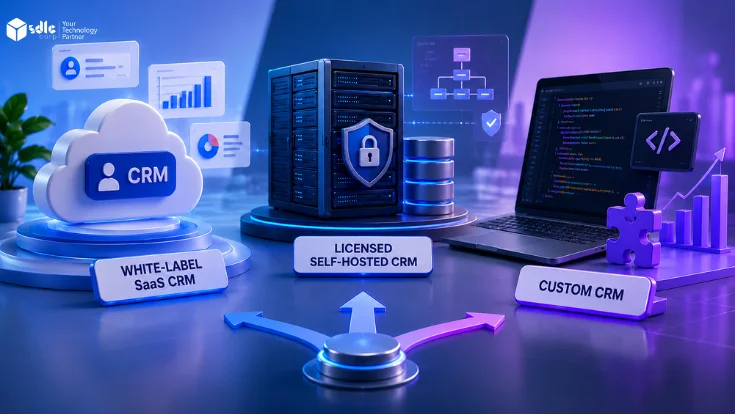
Choosing between white-label, custom, and licensed self-hosted iGaming CRM affects how much control an operator has over player data, retention workflows, integration depth, and long-term cost. This guide compares all three ownership models so operators can pick the right CRM architecture for their business.
Compare white-label, custom-built, and licensed self-hosted iGaming CRM models side by side before locking in a multi-year contract or build commitment.
Plan Your CRM ModelKey Takeaways
- White-label iGaming CRM works best for faster launch and lower setup effort, but it increases vendor dependency.
- Custom iGaming CRM gives the highest control over code, data, workflows, and integrations, but it needs a larger build and maintenance budget.
- Licensed self-hosted iGaming CRM gives operators stronger data control without building the full CRM from zero.
- SaaS and white-label costs can grow with MAU, message volume, modules, brands, and support scope.
- Choosing the right CRM model depends on launch speed, player data ownership, compliance needs, technical capacity, and long-term migration risk.
Decision Factors Behind Every CRM Contract
An iGaming CRM controls how players are segmented, reactivated, rewarded, and retained. The ownership model an operator picks decides where player data lives, how costs scale, and how easily the brand can switch vendors later.
- Revenue impact: CRM drives segmentation, reactivation, rewards, and retention.
- Cost compounding: Per-MAU pricing can rise with growth, while licensed self-hosted models may offer more predictable software costs when licence terms are clear.
- Data ownership: The model decides whether player records leave with you or stay inside the vendor's environment.
- Compliance evidence: Regulated markets require clear records on player data handling, audit trails, and responsible gaming workflows.
- Roadmap dependency: In SaaS, vendor priorities shape how quickly retention capabilities can evolve.
New to the category? Start with iGaming CRM software for operator-owned deployment, then read what iGaming means for online betting and casino operations if you need wider market context.
The right question is not which CRM is cheaper. It is which model gives enough control without unnecessary build cost or long-term vendor dependency.
CRM Ownership Models at a Glance
Each CRM model gives operators a different level of speed, control, cost predictability, and migration flexibility. The table below compares white-label CRM, custom CRM, and licensed self-hosted CRM across the main decision areas.
| Decision Area | White-Label CRM | Custom-Built CRM | Licensed Self-Hosted CRM |
|---|---|---|---|
| Launch speed | Fast | Slow | Fast to moderate |
| Upfront cost | Lower | Higher | Medium |
| Ongoing cost | MAU or platform fee | Team, hosting, and maintenance | Licence plus hosting |
| Data location | Vendor environment | Operator infrastructure | Operator infrastructure |
| Customisation | Basic configuration | Full control | Configurable and extendable |
| Source code | No ownership | Operator owns the code | Licensed use of vendor core |
| Maintenance | Vendor-managed | Operator-managed | Vendor core plus operator hosting |
| Lock-in risk | High | Low, but engineering-heavy | Lower when APIs and exports stay open |
| Best fit | Fast validation | Mature custom operations | Growing operators needing ownership |
White-Label iGaming CRM
White-label iGaming CRM gives operators speed and lower setup effort. The vendor controls hosting, updates, data exports, roadmap changes, and pricing structure. Commercial terms may combine monthly subscription, per-MAU pricing, module fees, or revenue share depending on the vendor contract.
What Operators Usually Get
- Ready-to-use CRM workflows out of the box
- Vendor-managed hosting, security patching, and uptime
- Standard segmentation, journeys, and dashboards
- Fast time-to-launch with minimal engineering effort
CRM Trade-Off
- The vendor controls the data: Player records sit in the vendor's cloud and depend on the contract's API and export terms.
- Roadmap control stays with the vendor: Custom bonus triggers and unusual segmentation depend on what the vendor already supports.
- Costs scale with success: Per-MAU pricing, message volume, brand count, or modules can increase recurring spend.
- Migration friction is contractual: Exit terms are shaped when you sign, not when you decide to leave.
Choose White-Label When
- Launch timeline is weeks, not months
- CRM workflows are still basic
- Internal technical capacity is limited
- Standard segmentation is enough
- The brand is testing retention assumptions
- Vendor-led hosting is acceptable
Avoid White-Label When
- Full data control is required
- Campaigns need advanced segmentation
- Bonus and VIP workflows need custom logic
- Reports need to go beyond standard dashboards
- PAM, wallet, or analytics integrations need deeper control
- Multi-brand growth is planned
Custom-Built iGaming CRM
With a custom iGaming software development route, the operator controls source code, hosting, roadmap, data structure, and integration logic. That control can support proprietary retention workflows, but it also makes development, security, QA, compliance evidence, and maintenance the operator's responsibility.
Where Custom CRM Is Strongest
- Complete ownership of code, data, and infrastructure
- Unlimited customisation depth across CRM workflows
- No vendor dependency on the product roadmap
- Deep integration with PAM, wallets, KYC, bonus engines, and BI dashboards
- No vendor MAU fee when the system is fully operator-owned
The Operational Responsibility
- High build cost: Production-grade development takes months and depends heavily on scope.
- Permanent maintenance: Annual upkeep covers bug fixes, integrations, security updates, and feature changes.
- Compliance burden sits internally: Audit trails, security controls, and RG triggers must be planned correctly.
- Opportunity cost: Engineers building CRM are not building other operator-side product features.
Choose Custom When
- CRM is central to growth strategy
- Proprietary segmentation is part of the IP
- Multi-brand operations are active
- Internal engineering support exists long-term
- Reporting needs exceed standard tools
- Independence from vendor pricing matters
Avoid Custom When
- Launch timeline is short
- CRM requirements are not yet defined
- Budget is constrained
- No maintenance plan exists
- Compliance ownership is unclear
- Technical governance is missing
Licensed Self-Hosted iGaming CRM
With licensed self-hosted iGaming CRM, the operator runs vendor-built software on its own infrastructure. The vendor maintains the core product, while the operator controls hosting, data location, integrations, and deployment governance. Pricing is usually licence-based and should be checked against contract terms.
What Licensed Self-Hosted CRM Delivers
- Player data stays inside operator-managed infrastructure
- More predictable software cost when contract terms are clear
- Vendor-maintained core with operator-controlled deployment
- API access for PAM, wallet, payment, and analytics integration
- Stronger migration freedom if data access and export rights are documented
What Stays on the Operator's Plate
- Infrastructure responsibility: Hosting, backups, monitoring, scaling, and incident response need planning.
- Engineering capacity: DevOps plus one or two engineers may be needed for integration work.
- Higher upfront commitment than SaaS: Licence, setup, hosting, and support scope should be reviewed together.
- Update governance: The vendor ships updates, but rollout timing is an operator decision.
Choose Licensed Self-Hosted When
- Ownership matters without building from scratch
- Player data must stay on operator-managed servers
- Cost predictability matters as volume grows
- DevOps and integration capacity exist internally
- Open API access is required for PAM and wallet
- Multi-brand operations are active or planned
Avoid Licensed Self-Hosted When
- No internal technical capacity at all
- Hosting and monitoring cannot be planned
- Vendor deployment documentation is weak
- APIs are heavily restricted
- Licence terms block useful extensions
- SaaS-level zero-ops simplicity is expected
How SDLC Corp Helps Operators Choose the Right CRM Model
SDLC Corp compares all three ownership models using MAU forecast, brand roadmap, PAM and wallet integration depth, compliance scope, and internal technical capacity. For multi-brand operators that want stronger data control without a full custom build, licensed self-hosted CRM can place player data, infrastructure rules, and deployment governance closer to the operator.
What the model review should cover
- Ownership scope across code, data, infrastructure, and roadmap.
- MAU growth forecast per brand and projected licence impact.
- Integration depth across PAM, sportsbook, payments, KYC, and BI reporting.
- Compliance ownership for GDPR, data residency, responsible gambling, and audit needs.
- Switching cost for white-label exit or licensed self-hosted handover.
iGaming CRM Cost Structure: Setup, MAU Growth, and Migration Risk
Each ownership model carries a different cost composition. The differences are structural, not only numerical.
How Each Model Usually Bills
- White-label or SaaS CRM: Monthly subscription combined with per-MAU pricing, message volume, module fees, or revenue share.
- Custom-built CRM: One-time build cost plus ongoing engineering, hosting, monitoring, security, and feature maintenance.
- Licensed self-hosted CRM: Licence-based pricing plus operator-managed hosting, DevOps, and support scope.
Public pricing is rare in the iGaming CRM market. Third-party pricing directories report Optimove pricing from around $4,000 per month, while iGaming CRM benchmark pages list platform tiers and revenue-share models. Operators should verify current pricing directly because enterprise CRM contracts are usually quote-based.
| Cost Element | White-Label CRM | Custom CRM | Licensed Self-Hosted CRM |
|---|---|---|---|
| Pricing structure | Subscription + variable | Build + maintenance | Licence + hosting |
| Vendor charges | Monthly, per-MAU, modules | None after build | Licence fee + support |
| Operator charges | Minimal infrastructure | Hosting + engineering team | Hosting + DevOps |
| Cost scaling | Can rise with player count and usage | Rises with engineering scope | Depends on licence, support, and infrastructure |
| Migration cost | Contract-dependent | Lower if cleanly built | Lower with open APIs |
| Hidden cost | Lock-in and export limits | Permanent engineering | Operational governance |
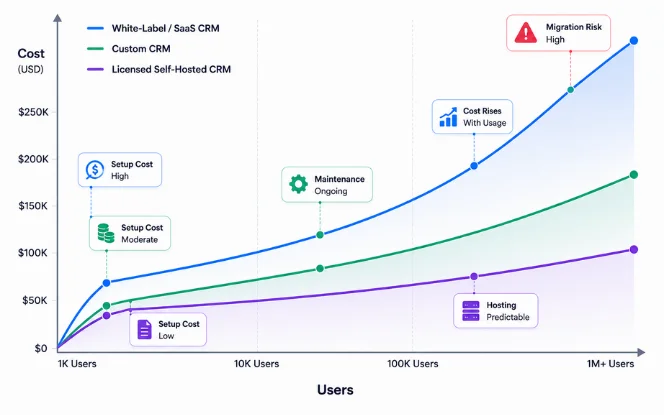
For CRM ownership and MAU-linked cost modelling, read FastTrack vs Self-Hosted iGaming CRM cost and control comparison. For wider platform budgeting, review online casino software development cost in 2026.
Data Ownership: Why CRM Export Rights Decide Lock-In
Player data is the most valuable asset in any CRM. Lock-in usually shows up at exit when an operator wants to leave a vendor and discovers what the contract actually allows. Vendor consolidation makes this harder to ignore. The Optimove and Smartico acquisition announcement made CRM vendor concentration harder to ignore. Although both brands continue to operate independently, operators should review roadmap dependency, pricing leverage, and exit risk before committing to a multi-year SaaS CRM contract.
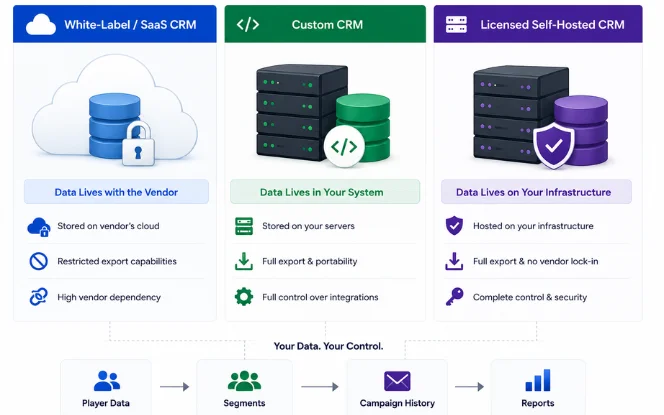
Where the data sits in each model
- White-label CRM: Player records, event history, segments, and campaign history live in the vendor's cloud. Access depends on the vendor's UI, APIs, and export terms.
- Custom CRM: Data sits in the operator's database. Full ownership comes with full responsibility for security, backups, governance, and compliance evidence.
- Licensed self-hosted CRM: The vendor maintains the software core; data lives on operator-managed servers. Migration quality depends on schema documentation, API openness, and export rights.
- Where does player data physically live?
- Who controls the database?
- Can player records be exported in full?
- Can campaign history and segments be exported?
- What format is the export delivered in?
- How long does migration support take?
- Are export operations charged separately?
- Can the operator use historical data after exit?
iGaming CRM Customisation: Configuration vs Custom Control
Vendor demos show drag-and-drop journeys, pre-built segments, and ready dashboards. Configuration is not the same as customisation.
- Configuration: Adjust what the vendor already supports.
- Customisation: Change the data model, trigger logic, reporting structure, or integration flow when business needs shift.
| CRM Need | White-Label CRM | Custom CRM | Licensed Self-Hosted CRM |
|---|---|---|---|
| Add new player event | Vendor-dependent | Fully controlled | API-dependent |
| Change bonus attribution | Limited | Fully controlled | Extension model |
| Build custom segments | Basic to moderate | Fully controlled | Strong with open event model |
| Create custom dashboard | Limited | Fully controlled | Possible with data access |
| Connect new payment events | Vendor-dependent | Fully controlled | API/integration-led |
| Change player ID logic | Usually limited | Fully controlled | Architecture-dependent |
Compliance and Data Residency: Who Holds the Audit Evidence?
Compliance affects deployment, reporting, data storage, access control, audit trails, responsible gaming workflows, and incident response. CRM decisions must support market-specific requirements that vary across the UK (UK Gambling Commission), Malta (Malta Gaming Authority), Germany (German gambling regulator GGL), Ontario (Alcohol and Gaming Commission of Ontario), and Brazil.
Areas Operators Should Verify for Compliance
- Technical and security standards: How the CRM supports audit trails, secure access, activity records, and operational evidence.
- Data residency: Where player records, campaign history, behavioural events, and consent logs are stored.
- Responsible gaming workflows: How risk flags, self-exclusion, session limits, and intervention triggers are recorded.
- Market-specific documentation: Vendor evidence for each target market before launch.
- Exit and migration records: Whether historical player data can be exported in a usable format.
| Compliance Area | White-Label CRM | Custom CRM | Licensed Self-Hosted CRM |
|---|---|---|---|
| Data residency | Vendor-dependent | Operator-controlled | Operator-controlled |
| Audit trails | Vendor-defined | Custom-built | Platform + operator |
| Access control | Vendor tools | Custom rules | Configurable + infrastructure |
| RG triggers | Provider-defined | Custom-built | Configurable / extendable |
| Audit evidence | Vendor documentation | Operator documentation | Vendor + operator |
| Security ownership | Shared / vendor-heavy | Operator-heavy | Shared / operator-heavy |
iGaming CRM MAU Pricing and the Scaling Cost Trap
- SaaS or white-label pricing: Lower upfront, but recurring cost can rise with monthly active users, message volume, brand count, and modules.
- Licensed self-hosted pricing: Usually needs more upfront commitment, but may create more predictable software cost depending on licence terms, support scope, and hosting needs.
- The crossover point: Can appear as operators scale. The exact point depends on vendor terms, brand count, channel mix, support requirements, and infrastructure cost.
SaaS CRM at 10,000 MAU and SaaS CRM at 100,000 MAU can look like completely different products on the invoice. Model the MAU growth curve before signing a multi-year contract.
What You Need to Run a Licensed Self-Hosted iGaming CRM
Self-hosted does not mean building from zero. It means running vendor-built CRM software in your own environment.
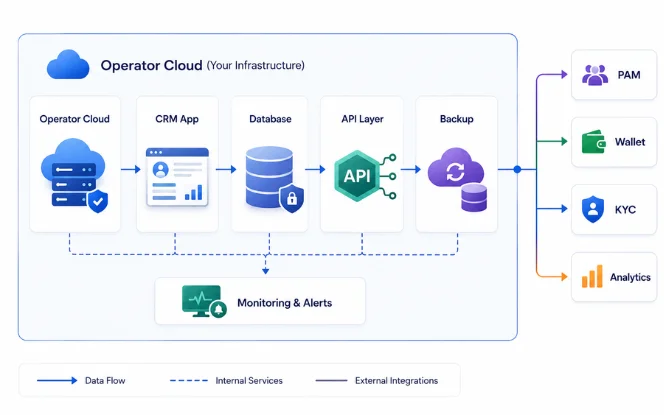
Operator-side requirements
- Cloud or server environment
- Deployment documentation from the vendor
- Domain, SSL, and database setup
- Backup, recovery, and monitoring policy
- API integration with PAM, wallet, and player systems
- Access controls and security review before go-live
- Testing across major workflows
Licensed self-hosted CRM is more work than SaaS, but less work than full custom development. The model works best when operators can manage infrastructure, review deployment rules, and document export rights before launch.
How to Choose the Right iGaming CRM Model
Four questions narrow the decision quickly.
How fast do you need to launch?
- Weeks → white-label or licensed self-hosted
- Months → all three viable
- Year or longer → custom becomes practical
How much player data control do you need?
- Basic reports → white-label works
- Raw event access and custom dashboards → licensed self-hosted or custom
- Multi-brand reporting with proprietary IP → custom
What is your technical capacity?
- None → SaaS or white-label only
- DevOps + 1–2 engineers → licensed self-hosted can be practical
- Full development team → all three viable
How big do you plan to scale?
- Single brand, limited MAU → SaaS economics may work
- Multi-brand growth stage → licensed self-hosted may reduce MAU-linked cost pressure
- Multi-market proprietary engine → custom fits better
| Operator Situation | Best-Fit Model |
|---|---|
| Fast launch, low technical capacity | White-label CRM |
| Early brand validation | White-label CRM |
| Growing operator with CRM maturity | Licensed Self-Hosted CRM |
| Data control without full build cost | Licensed Self-Hosted CRM |
| Multi-brand operator | Licensed self-hosted or custom |
| Complex bonus and VIP logic | Custom iGaming CRM |
| Proprietary retention engine | Custom iGaming CRM |
| Strict infrastructure ownership | Licensed self-hosted or custom |
When White-Label CRM Still Makes Sense
- New operator testing the market: Validate retention before tying up capital in licence fees or build cost.
- Affiliate moving into operator status: A bundled stack with platform, payments, games, and CRM reduces decision load.
- Small sub-operator under a master licence: The CRM choice may already be made above.
- Single-brand operation staying small: SaaS economics work without scaling pressure.
Before signing any white-label contract, review the data export rules, campaign history access, player record ownership, support response, pricing escalation, and exit clauses. The terms shape what is possible 12 to 24 months later.
Final Recommendation: Choose by Ownership, Not Demo Strength
- Choose white-label when speed, simplicity, and low technical workload matter most.
- Use custom iGaming CRM when full ownership, proprietary workflows, and deep technical control justify the build cost.
- Pick licensed self-hosted CRM when stronger data control, more predictable cost, and infrastructure ownership matter without building from zero.
Start the decision with ownership questions, not vendor demos: who controls the data, the infrastructure, the campaign logic, the reporting, the migration path, and the cost curve as player volume grows. If most answers sit with the vendor, the CRM may be easy to launch but harder to leave.
FAQs
1. Which iGaming CRM model is best for a fast launch?
White-label CRM is usually the fastest route because the vendor already manages hosting, standard workflows, dashboards, and basic segmentation. Operators should still check data export and exit terms before signing.
2. When does licensed self-hosted iGaming CRM make sense?
Licensed self-hosted CRM makes sense when an operator wants vendor-built software, stronger data control, and more predictable software cost without building from scratch. It still requires hosting, DevOps, backups, and integration support.
3. Is licensed self-hosted iGaming CRM the same as open-source CRM?
No. Licensed self-hosted iGaming CRM is commercial software that an operator deploys on its own infrastructure under a vendor licence. The vendor maintains the core product and ships updates. Open-source CRM has no vendor maintenance commitment and usually requires more in-house engineering effort.
4. Is custom iGaming CRM always better?
No. Custom iGaming CRM is better only when the operator has clear requirements, enough budget, technical capacity, compliance planning, and long-term maintenance support. Without those, custom CRM can become slow and expensive.
5. Which iGaming CRM model gives the most data control?
Custom CRM gives the highest control because the operator owns the entire system. Licensed self-hosted CRM also gives strong control because player data sits on operator-managed servers. White-label CRM gives less practical control because access depends on vendor contracts.
6. Can operators migrate from white-label CRM to licensed self-hosted CRM?
Yes, but the path depends on what the original contract allows the operator to export. Player records, segments, campaign history, and event streams all need to move. Export rights should be negotiated before signing the first CRM agreement.
7. When should an operator move away from white-label CRM?
Operators should review alternatives when white-label CRM limits advanced segmentation, raw event export, custom dashboards, custom bonus logic, multi-brand reporting, PAM or wallet integration depth, or jurisdiction-specific compliance evidence.
8. Which CRM model is best for multi-brand operators?
Licensed self-hosted or custom CRM is usually stronger for multi-brand operators. Both models support brand-level reporting, shared player intelligence, deeper integration flexibility, and stronger data control than basic white-label setups.
9. What should operators check before signing with any CRM vendor?
Operators should check data export rules, API access depth, pricing at scale, uptime guarantees, support process, response times, integration limits, campaign history access, responsible gaming workflow support, and contract exit clauses.