



ML Consulting and Feasibility
We check whether machine learning fits your problem before you spend on a build. You get a use-case brief, a data review and a clear go or no-go decision.

Machine learning development turns business data into models that predict outcomes, score risk and automate routine decisions. SDLC Corp's machine learning development services cover the full build, from data review to deployment and monitoring. As a result, your teams forecast more accurately, catch problems earlier and spend less time on manual review.
Proven Machine Learning Delivery
Trusted by Fortune Global 500 leaders, governments & top universities across 30+ countries







Powered by leading cloud & AI platforms
Awards & industry recognition


Our ML development services cover the full path from a business question to a monitored model in production. Each one is also part of our wider machine learning and intelligent systems practice.
We check whether machine learning fits your problem before you spend on a build. You get a use-case brief, a data review and a clear go or no-go decision.
Our custom machine learning development covers feature design, model training and tuning. We start with a simple baseline, then keep only a model that beats it on your metric.
Models fail on messy data. So our data engineering services build the pipelines, feature sets and quality checks that keep training and live data consistent.
Our machine learning integration services connect models to your ERP, CRM or product through APIs, batch jobs or event streams. As a result, predictions appear where your teams already work.
We package each model with versioning, automated tests and a rollback path. For larger estates, our MLOps services add model registries, CI/CD for models and production monitoring.
Already have a model that underperforms? We audit its data, features and evaluation. Then we retrain or compress it to improve accuracy, latency or cloud cost.
Our machine learning software development focuses on problems with a clear owner and measurable value. These are the solutions we deliver most often.
Predict
Forecast demand, revenue, churn or risk from historical data. For example, a demand model can set reorder points for each product and location.
See
Inspect products, read documents or monitor sites from images and video. Our computer vision development services cover detection, segmentation and edge deployment.
Read
Classify tickets, extract fields from invoices or contracts, and score sentiment in customer feedback. Meanwhile, low-confidence results go to a person for review.
Recommend
Suggest the next product, article or action based on behavior and context. Before rollout, we test each engine against your current rules.
Detect
Flag unusual transactions, logins or sensor readings in real time. We also tune thresholds to cut false alerts, not just raise detection rates.
Score
Score leads, credit applications, claims or tickets so teams act on the highest-value cases first. In addition, every score shows the factors behind it.
Our enterprise machine learning development work centers on sectors where data is large and decisions repeat daily.
Visual quality inspection, predictive maintenance and yield forecasting on production lines.
Credit scoring, transaction fraud detection and cash-flow forecasting, with explainable scores for auditors.
Patient risk scoring, clinical document processing and staffing forecasts, with privacy controls in every step.
Demand forecasting, product recommendations and dynamic pricing across stores and online channels.
Route and ETA prediction, shipment document processing and warehouse demand planning.
Fraud and collusion detection, player churn prediction and in-game personalization.
The right approach depends on your data, timeline and need for control. In practice, they often overlap: an AutoML baseline sets the target, and a custom or fine-tuned model must beat it. That follows Google's Rules of Machine Learning, which favor a solid pipeline over a complex first model.
Option 01
Best for structured business data, such as transactions, sensor logs or CRM records. Here, models like XGBoost often beat larger networks, and they are easier to explain. Typical first version: 6 to 10 weeks.
Option 02
Best for images, text and speech, where pre-trained networks already know the basics. Fine-tuning needs far less labeled data. For language tasks, our LLM development services cover fine-tuning and private deployment. Typical first version: 3 to 6 weeks.
Option 03
Best for a quick benchmark on a standard problem. AutoML tools in SageMaker, Vertex AI or Azure ML can produce a baseline in days. However, they give you less control over features, cost and explainability.
Each project below started with an agreed metric. Here is what the models achieved once they went live.
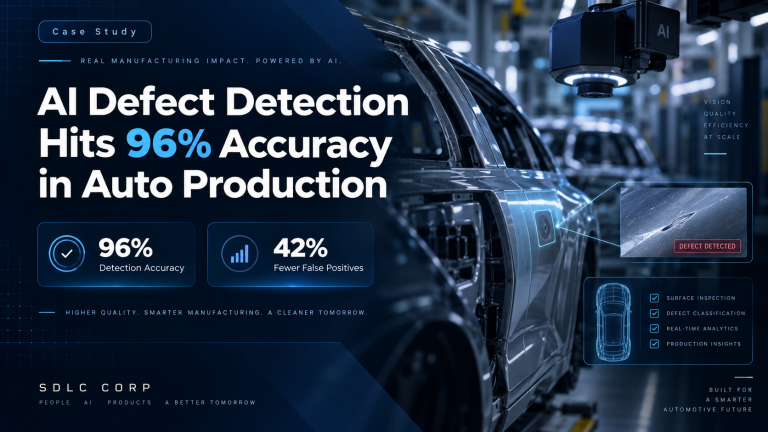
Automotive ManufacturingComputer Vision
96%Detection Accuracy
Challenge: A Tier-1 paint shop needed to catch sub-millimetre surface defects without stopping the conveyor or adding cloud latency.
What we did: We trained a deep learning vision model, ran it on edge hardware and linked it to the PLCs.
Result: The model reached 96% detection accuracy with 42% fewer false positives and 180 ms inference at the edge.
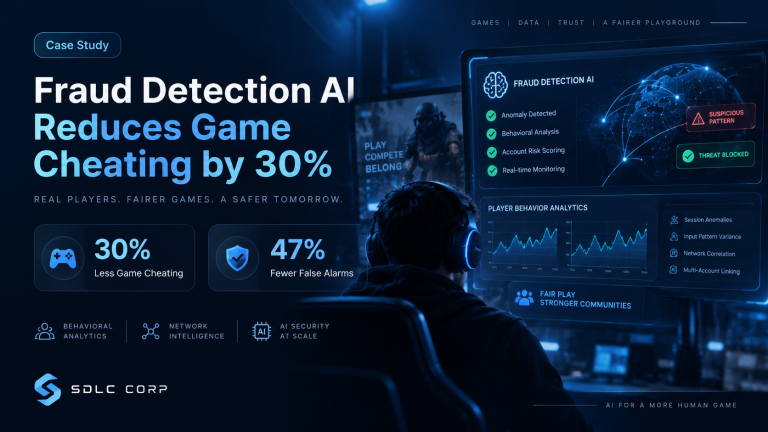
iGamingGraph Machine Learning
92%Collusion Capture
Challenge: The network processes 62,000 hands per minute. It needed to catch collusion, chip-dumping and bonus abuse without slowing live play.
What we did: We built graph machine learning models with real-time risk scoring on GPU inference.
Result: The system caught 92% of collusion, cut false positives by 47% and saved 5,100 analyst hours.
LogisticsDocument AI
48h to 4hDocument Turnaround
Challenge: Transworld needed shipment documents processed faster and with fewer errors inside its logistics ERP.
What we did: We added AI document processing that extracts and validates shipment data before it enters the ERP.
Result: Turnaround fell from 48 hours to 4 hours on 2,000+ daily documents, and errors dropped by 98%.

Clients rate SDLC Corp 5.0 out of 5 on Clutch and GoodFirms. Below, founders and CEOs explain what it is like to build with our team.
Eric Leist
CEO, Edgerton Strategies

Doug Schmidt
CEO, Roofaid USA

Reyzal Razmi
All Star Influencers
Their AI consulting expertise completely transformed how we manage and predict our logistics flow. The predictive shipping models they implemented have saved us both time and cost while improving our accuracy and customer satisfaction.
They've quickly understood our business context, moved fast, and brought recommendations rather than questions.
Their data-driven methodology and exceptional command of artificial intelligence made a significant impact on our business operations.
What impressed us most about SDLC Corp was their ability to understand our clinical requirements.
They asked the hard questions that revealed weaknesses in our data structure and highlighted risks other firms didn't even bring up. That level of scrutiny gave us confidence to proceed with them.
Share your use case and data sources. Then we outline a first model, a realistic timeline and a cost range.
Buyers choose a machine learning development company for proof, not promises. Here is what you get with us.
Proof
We set the success metric and baseline before any build starts. So every review compares results with the number you approved.
Ownership
Trained models, source code, pipelines and documentation transfer to you. Therefore, you face no lock-in to our tools or accounts.
Team
Data engineers, ML engineers and MLOps specialists work as one team. This removes handoffs between separate vendors.
Delivery
We design for latency, cost and rollback from the first sprint. As a result, pilots do not stall when real traffic arrives.
Six steps take a model from idea to production. You get a clear output after each one, so you can stop or change course with evidence.
We define the business decision, the success metric and the current baseline.
Deliverable: Use-case brief with a go or no-go decision
Next, we check data volume, quality, labels and access. Then we build training and test sets.
Deliverable: Data readiness report and versioned datasets
We train a baseline first and then compare stronger models in tracked experiments.
Deliverable: Experiment log and model evaluation report
Before launch, we test the model on unseen data and check bias, explainability and edge cases.
Deliverable: Validation report and sign-off checklist
After sign-off, we ship the model as an API, batch job or edge service behind a feature flag.
Deliverable: Deployed model, CI/CD pipeline and rollback plan
Once live, we track accuracy, drift and cost, and we retrain when the metric slips.
Deliverable: Monitoring dashboard, alert rules and retraining schedule
Machine learning development cost depends on data readiness, model complexity and integration work. Each stage below shows a typical price, timeline and way to work with us.
| Stage | Typical cost | Timeline | Engagement | What you get |
|---|---|---|---|---|
| Proof of Concept | $15,000 to $40,000 | 3 to 6 weeks | Fixed scope | Baseline model and an evaluation report with a go or no-go decision. |
| Production ML System | $60,000 to $250,000 | 3 to 6 months | Fixed scope or dedicated team | Tuned model, data pipelines, integration and monitoring. For longer roadmaps, add our dedicated development team services. |
| Managed ML Operations | $3,000 to $10,000 per month | Ongoing | Monthly | Machine learning as a service: monitoring, retraining and support, priced by models in production. |
We pick tools that fit your cloud and your team's skills. That way, you can run and extend the system after handover.
Your data and models stay protected at every step. In addition, every model ships with the evidence your risk and compliance teams ask for.
Our delivery runs under ISO 27001 and SOC 2 Type II controls. You can review the details in our trust center.
Training data stays in your cloud or region. We also mask personal data and follow GDPR and HIPAA rules where they apply.
We use SHAP and LIME to show which factors drive each prediction. As a result, reviewers can question a score instead of simply accepting it.
Before launch, we compare model results across customer groups. Then we fix gaps in the data or the decision thresholds.
We test each model on unseen data before release, then track accuracy and drift after launch. Our reviews map to the NIST AI Risk Management Framework.
A model registry logs every dataset, version and approval. That record supports AI management systems built on ISO/IEC 42001.
Deeper reading on the monitoring, data and latency decisions behind production models.
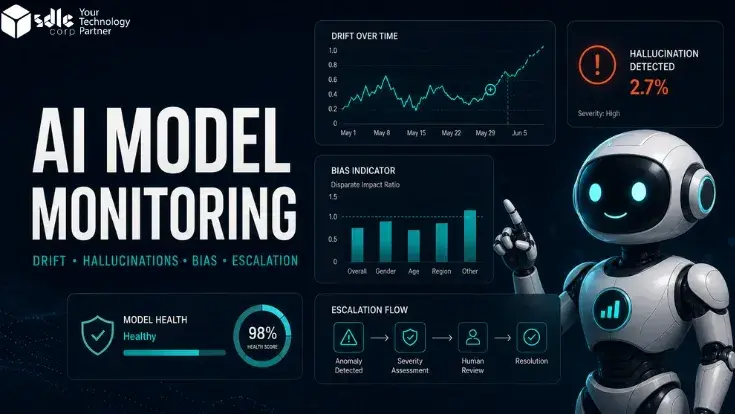
MonitoringWhat to watch once a model is serving real traffic, from drift and bias to alerting thresholds.
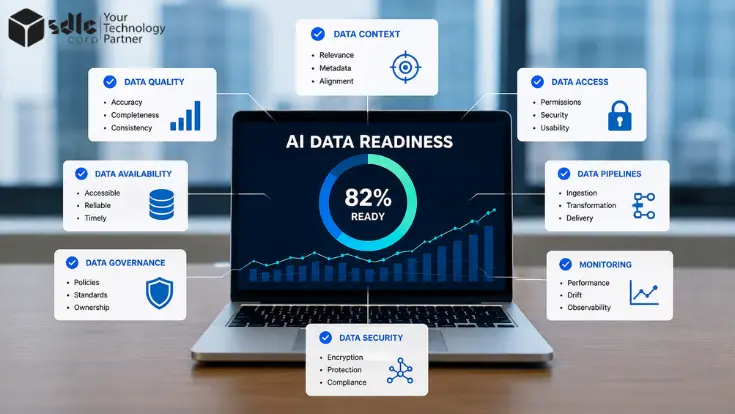
Data ReadinessHow to judge whether your data, governance and integration are ready before an AI system goes live.
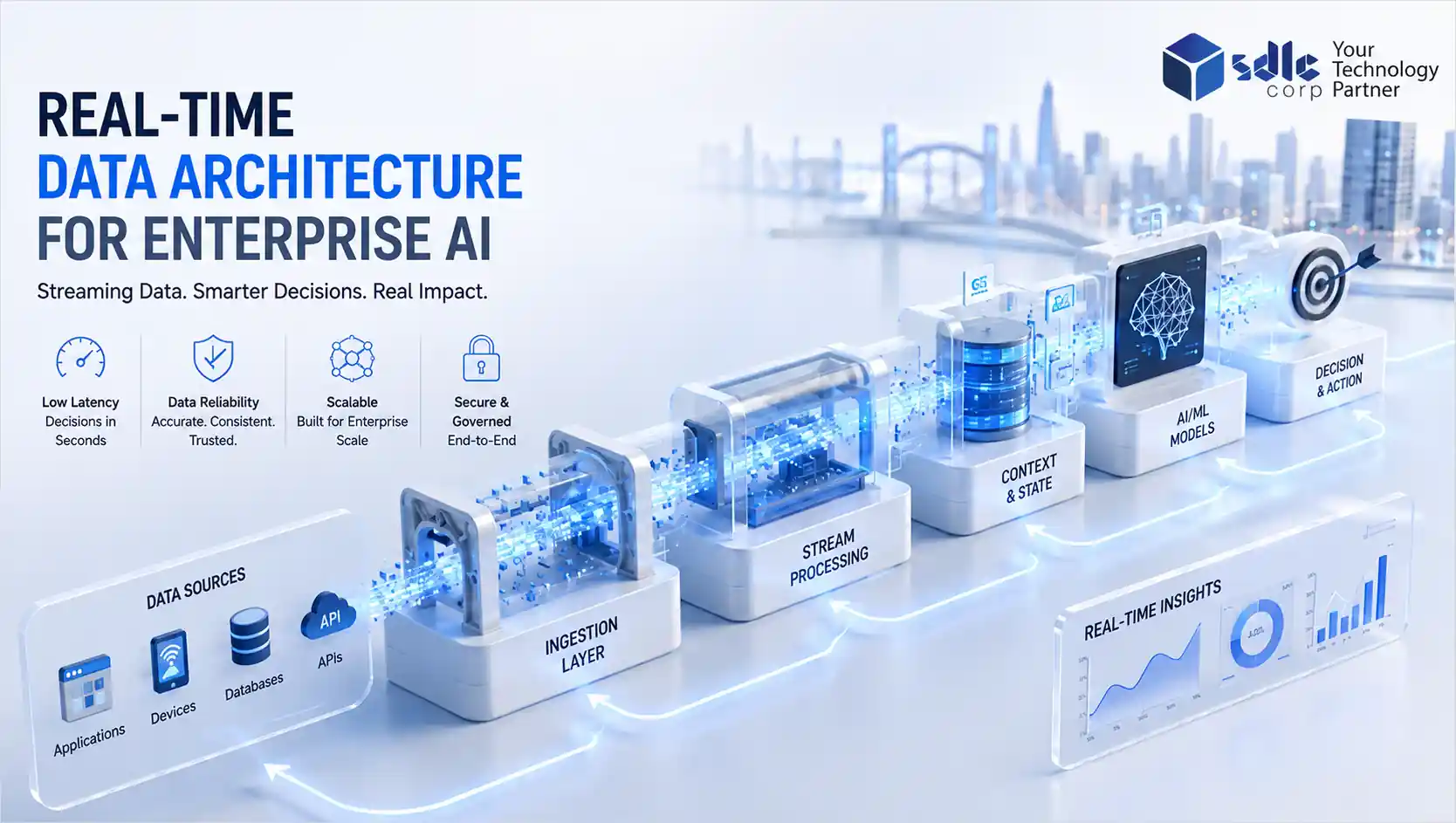
Data ArchitectureHow streaming, event handling and state design support decisions that have to happen in seconds.

Tell us the decision you want to improve and the data you have. Then an ML engineer will suggest a first step, from a feasibility check to a scoped proof of concept.
Machine learning development services cover the work needed to turn data into a model that makes useful predictions in production. That includes feasibility checks, data preparation, training, testing, integration and monitoring. A good provider also agrees a success metric with you first. As a result, you judge the model on business value, such as fewer defects, not only on technical scores.
Most projects cost $15,000 to $250,000, from a proof of concept to a full production system. The main cost drivers are data readiness, the number of data sources, real-time needs and integration work. For example, pulling data from five systems costs more than training on one clean table. After a short discovery call and data review, we share a fixed estimate.
A first working model takes 3 to 10 weeks, while a production system takes 3 to 6 months. The approach matters most. Fine-tuning a pre-trained model is often the fastest route, whereas a custom model on new data takes longer. Clean, labeled data shortens every stage, so we check data early.
The answer depends on the problem, not a fixed number. For example, a tabular model may need a few thousand labeled records that include the outcome you want to predict. Image or text tasks can need fewer examples when we fine-tune a pre-trained model. Quality matters as much as volume, so every project starts with a data readiness review.
Fine-tune when your task involves images, text or speech and a strong pre-trained model already exists. That route needs less data and less time. However, build from scratch for structured business data or when you need full control over features, cost and explainability. In many projects, we test both on a sample and let the metric decide.
We expose the model as a REST API, a batch job or an event-driven service. Then we connect it to your ERP, CRM or product through the methods those systems already support. Predictions appear inside the screens your teams use every day. We also add logging, so you can trace every prediction back to its input.
You do. Trained model files, source code, training pipelines, prepared datasets and documentation all transfer to you under the contract. Where possible, we deploy to your own cloud accounts. That way, your team or another vendor can run, retrain and extend the system without us.
We offer two options. First, our managed ML operations team monitors the model, retrains it on schedule and fixes issues under an agreed SLA. Alternatively, we train your team and hand over runbooks, so you can run the system yourselves.
We track the metric agreed during discovery, such as precision, recall or forecast error, against live outcomes. Our dashboards also show input data health, latency and cost per prediction. When real outcomes arrive late, we use proxy signals and sample reviews until the labels come in.
Drift means live data no longer matches the training data, so accuracy slips over time. Our monitoring raises an alert when drift crosses a set threshold. Next, we find the cause, retrain on fresh data and release the new version after the same validation tests. Because a model registry keeps every version, we can also roll back fast if a release underperforms.
A PoC proves the idea on sample data, while production must handle live data, real users and failures. So we add data pipelines, security, integration, monitoring and a rollback plan before go-live. We also run a limited pilot first. Our article on how to move AI pilots into production covers the full checklist.
Ready to Innovate?

United States:
2457 Kane Lane, Batavia, Illinois
60510

United Kingdom:
30 Charter Avenue, Coventry, CV4 8GE, United Kingdom

United Arab Emirates:
Unit No: 729, DMCC Business Centre Level No 1, Jewellery & Gemplex 3 Dubai, United Arab Emirates

India:
715, Astralis, Supernova, Sector 94 Noida, Delhi NCR India. 201301

Qatar:
B-ring road zone 25, Bin Dirham Plaza building 113, Street 220, 5th floor office 510 Doha, Qatar

© 2026 SDLC Corp. All Rights Reserved.