
Multiplayer Ludo Game
SDLC Corp developed a real-time Ludo game app for a gaming company, with synchronized matches, timed turns, public and private rooms, and Classic, Quick, and 2v2 game modes for Android and iOS.
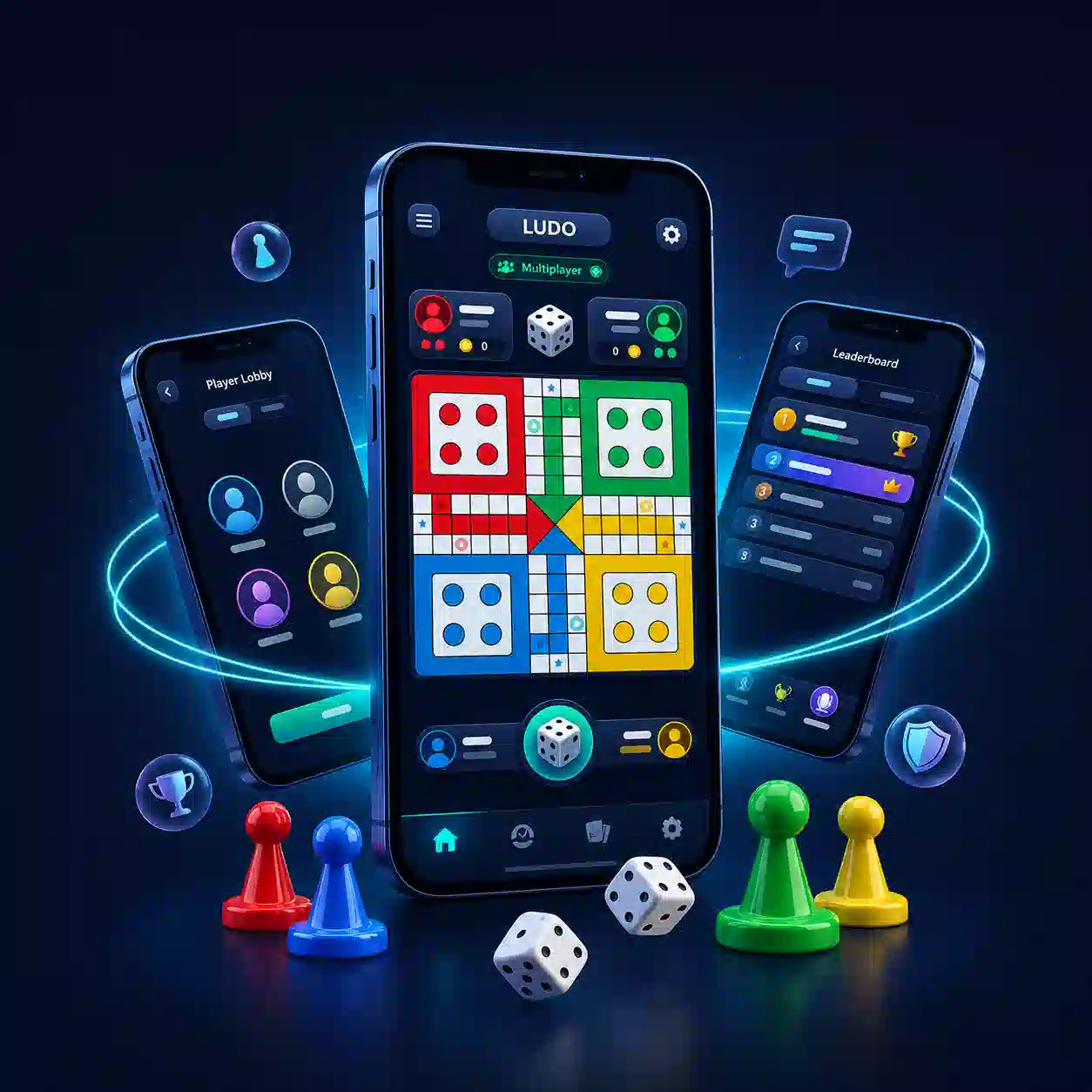

The Project at a Glance
An overview of the project timeline, gameplay modes, supported platforms, and real-time architecture behind the Ludo game app.
The Client and the Project
A four-player Ludo title taken from concept to release-ready Android and iOS builds.
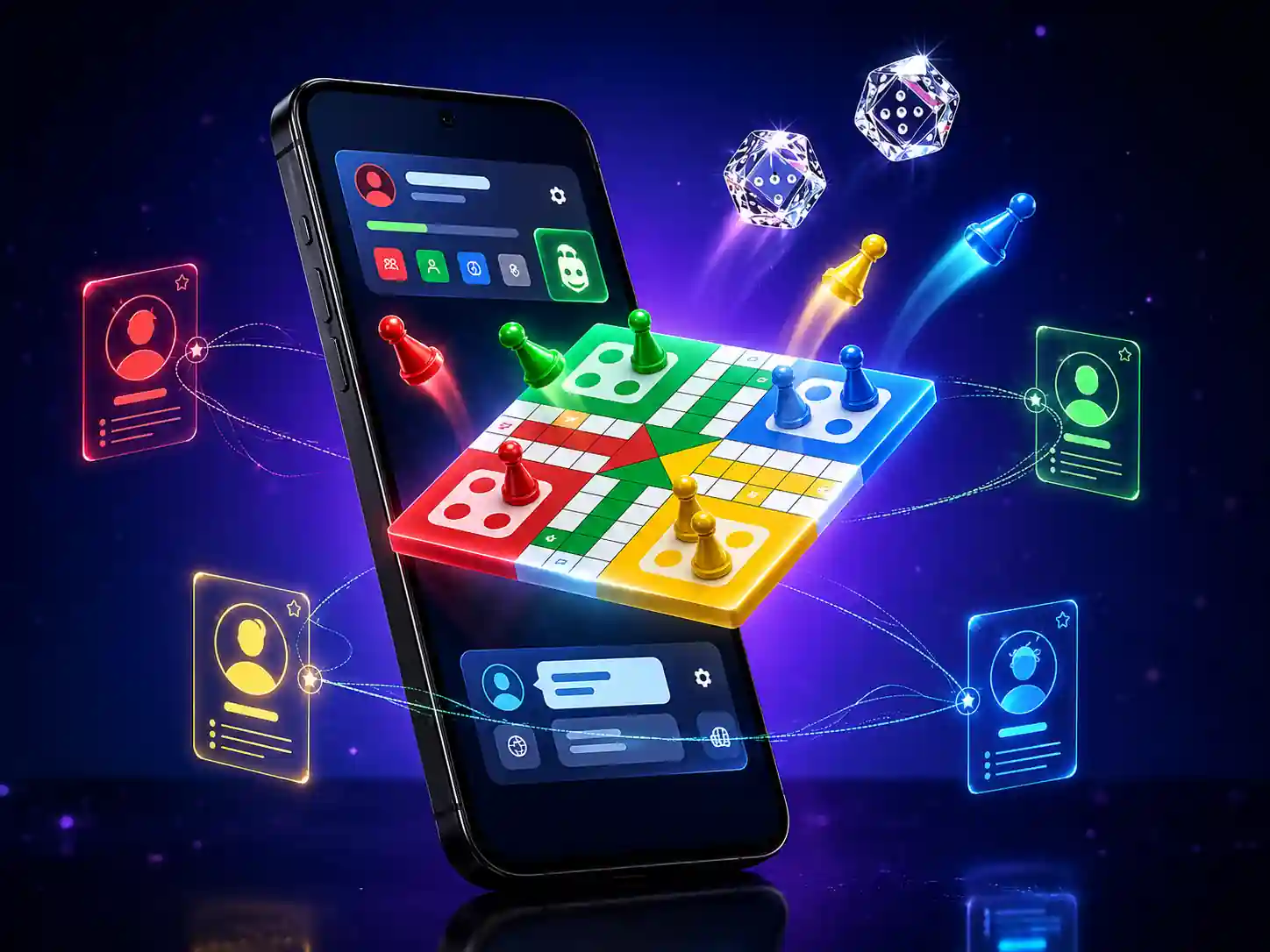
Delivered & Release-ReadyA mobile gaming company building a casual board-game portfolio approached SDLC Corp to take a real-time Ludo title from concept to release-ready Android and iOS builds.
They needed a real-time Ludo app with public matchmaking, private rooms, timed turns, and synchronized match updates, delivered under SDLC Corp’s game development services, covering planning, the Unity client, real-time systems, backend APIs, QA, and release preparation.
What the client needed
- Four players staying perfectly in sync, with no drifting board states between devices.
- Protection against dice and move tampering, since results feed rewards, coins, and leaderboards.
- Open matchmaking and private rooms, without shipping two separate apps.
- An admin panel their own operations team could run without a developer.
Building a Reliable Real-Time Board Game
Every active match had to keep turns, dice results, token positions, and room status consistent across connected devices. Server-side validation, reconnect handling, player access, and administrative controls also formed part of the game system.
Keeping Match States Consistent
Turns, dice results, and token positions had to update consistently across every device connected to the match.
Server-Side Action Validation
Turn order, dice results, token movements, and match outcomes required server-side validation rather than relying on data from an individual device.
Recovering Interrupted Sessions
Temporary network loss had to be handled without immediately ending the match, allowing players to reconnect and restore the latest available match state.
Public and Private Room Control
Room management covered public matchmaking, private room creation, invitation codes, player limits, readiness checks, and match-start conditions.
Guest and Registered Player Access
Separate access flows were required for guest users and registered players while maintaining profiles, progress, balances, and account information.
Administrative Game Controls
Central controls were required for reviewing players, monitoring matches, configuring rewards, managing referrals, and checking game activity.
How We Built the Live Match System
The engineering decisions behind live matches: a Unity client, Socket.IO services, and a Node.js backend where the server, not the phone, decides every dice roll and token move.
Unity Mobile Client
The mobile client was built with Unity to handle the game board, token animations, touch controls, in-game screens, and the shared Android and iOS codebase.
Room and Match Services
Socket.IO services manage public matchmaking, private room codes, player readiness, match creation, and live room events.
Server-Validated Turn Logic
The server verifies turn order, dice results, token movement, captures, time limits, and match completion before sending updates to connected players.
Reconnection and State Recovery
After reconnecting, players return to the latest available match state, including token positions, player status, and the active turn.
Player and Progress Data
Backend services store account details, match history, scores, reward balances, referral activity, and leaderboard records.
Administrative Operations
The admin panel provides controls for player accounts, matches, rewards, referrals, and recorded game activity.
Ludo Game Architecture
The Unity client and admin panel reach a Node.js backend through an AWS load balancer. Live match traffic runs over Socket.IO, while an authoritative engine rolls the dice and validates every move before MongoDB stores the result.
Swipe to explore the full architecture →
- 1 The player signs in through Firebase Auth over HTTPS and the REST API issues a session token.
- 2 The Unity client opens a secure WebSocket to the Socket.IO gateway and authenticates the connection.
- 3 Matchmaking places the player in a public queue or a private room code, then creates the match room.
- 4 The player taps roll; the client sends the intent only, it never decides the result.
- 5 The server generates the dice value, validates the token move, applies captures and safe zones, and updates the in-memory match state.
- 6 The validated state is broadcast to all four players, and every client snaps to the server board.
- 7 The turn timer starts for the next player, and the loop repeats until a player brings all four tokens home.
- 8 On match end, results, rewards, and leaderboard changes are written to MongoDB through the REST services.
Ludo Game App Features
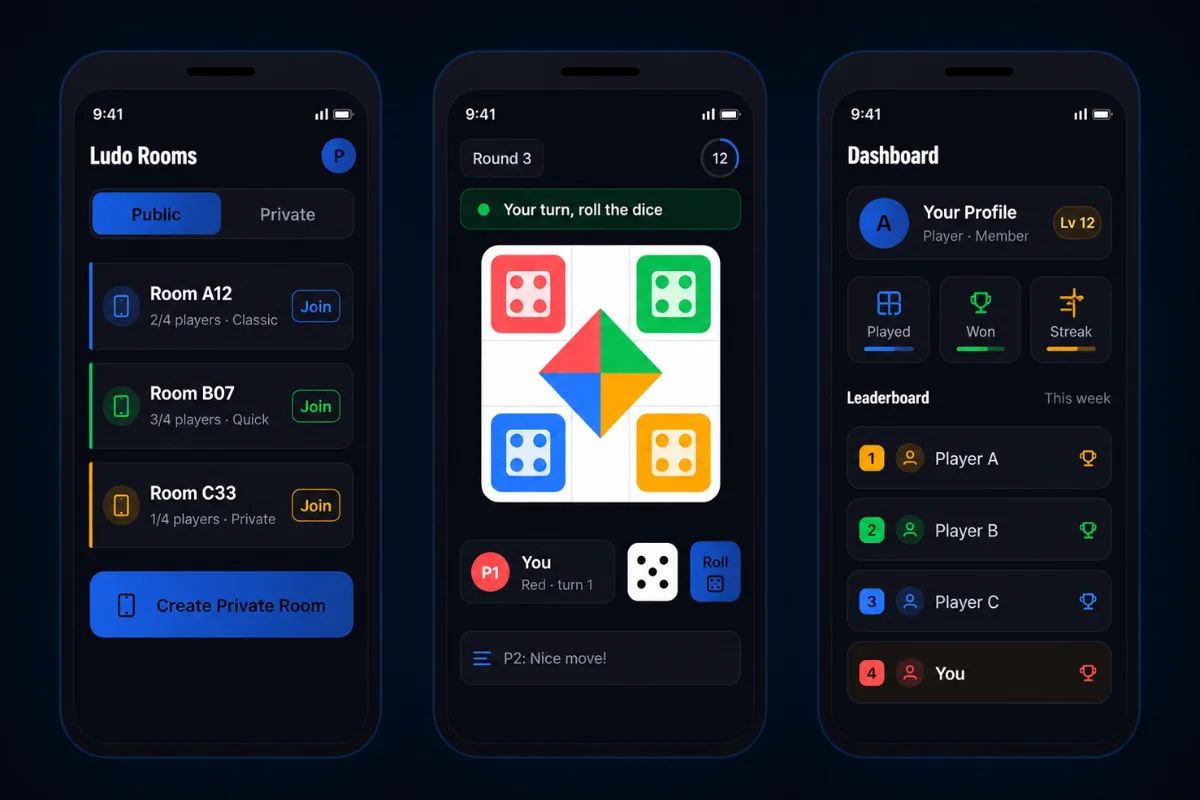
The application supports live matches, multiple game modes, player profiles, rewards, referrals, communication tools, and game administration.
Room lobby, live match, and player dashboard.
How the Features Fit the Player Journey
Every feature sits on the path a player takes from sign-in to results, built around a server-authoritative turn loop.
Swipe to explore the full feature map →
Live Multiplayer Matches
Live turn, dice, and token updates.
Classic, Quick, and 2v2 Modes
Three formats: standard, short, and team play.
Public and Private Rooms
Open matches, or code-based rooms for friends.
Guest and Registered Access
Play instantly, or sign in to keep progress.
Player Profile and Match History
Account details, past matches, and scores.
Leaderboards
Rankings built from recorded match results.
Rewards and Coin Balance
Login rewards, earned coins, and balance.
Referral Codes and Links
Shareable codes to invite new players.
Emoji and Quick Chat
Preset messages and emoji during matches.
Server-Validated Dice and Moves
The server checks every roll and every move.
Game Administration
Manage players, matches, rewards, and referrals.
Turn Recovery and Reconnection
Dropped players resume at the current turn.
The Five-Stage Journey Behind the Ludo Game
Five stages across 14 to 16 weeks, from scope to store-ready builds.
Discovery
Scope, rules, and game-flow mapping.
Weeks 1 to 2Design
UI/UX screens and game logic design.
Weeks 2 to 4Architecture
Real-time match and backend design.
Weeks 4 to 6Build
Unity client, game server, and admin panel.
Weeks 6 to 13QA & Release
Match testing and store-ready builds.
Weeks 13 to 16Technology Stack for the Ludo Game App
The application combines a Unity mobile client, backend APIs, real-time communication, cloud services, persistent data storage, authentication, notifications, analytics, and crash reporting.
Release-Ready on Android and iOS
Final builds were prepared for both stores, with the Unity client, real-time services, backend APIs, and admin panel running as one system.
What We Built, and What It Fixed
The delivered scope, and the engineering decisions that removed desync and dice tampering from live four-player Ludo matches.
Match desync eliminated
Moving dice generation and move validation to the server made one authoritative board the single source of truth, so four devices can no longer drift apart mid-match.
Dice and move tampering closed off
The client never decides a roll or approves its own move, so the reward, coin, and leaderboard data downstream stays trustworthy.
Dropped players keep their match
Snapshot-based recovery returns a reconnecting player to the exact turn, token positions, and timer state instead of forfeiting the game.
Operations handed to the client
The admin panel lets the client’s own team manage players, matches, rewards, and referrals directly, with no developer in the loop.
Game Development Services
SDLC Corp provides Ludo, board game, and Unity development services for mobile, cross-platform, and real-time game projects.
Board Game Development
Development services for digital Ludo, card, and turn-based board games with matchmaking, private rooms, score tracking, rewards, and player profiles.
View Board Game Services ServiceUnity Game Development
Unity development for 2D and 3D games across mobile, desktop, and other supported platforms, including gameplay systems, real-time integration, testing, and release preparation.
View Unity Game Services ServiceLudo Game Development
Custom Ludo game development with real-time multiplayer, private rooms, anti-cheat game logic, rewards, and a scalable backend built for live matches.
View Game Development ServicesOne Managed Game Team, Scope to Launch
“They delivered our VR experience on the Orange 5G network with sub-20ms responsiveness , exactly to spec, on time, and the live demo landed flawlessly.”
Orange Jordan · 5G Launch ✓ Verified
Plan Your Multiplayer Game
Build a Ludo game , real-time mobile game, or digital board game with support for game planning, technical architecture, development, testing, release preparation, and ongoing updates.
- Contact Us
Let's Talk About Your Product
What happens next?
- We review your requirements
- Strategy call with experts
- Clear roadmap & estimate
- NDA Protected
- Enterprise Grade Delivery
- Global Clients