Choosing between casual game development and real-money game development affects cost, compliance, monetization, app store approval, and time to revenue. However, both models can work when the roadmap is clear. In addition, each model needs a different team, risk plan, and launch strategy. Therefore, the right choice should come from your market, budget, and compliance readiness.
Casual games use free-to-play monetization, ads, cosmetics, and optional purchases. In most cases, they are faster to build and easier to publish. However, this applies only when there is no staking, cash-out, or cash prize. By contrast, real-money games can earn more per active user. However, they need gambling licences, RNG certification, KYC, AML, secure payments, and compliance systems before launch.
Compliance note: Real-money gaming is regulated as gambling in most markets. Therefore, it usually needs jurisdiction-specific licences. In addition, India's 2025 online gaming framework broadly prohibits online money games. This guide is for planning only, not legal advice. Before you build, always consult qualified legal counsel.
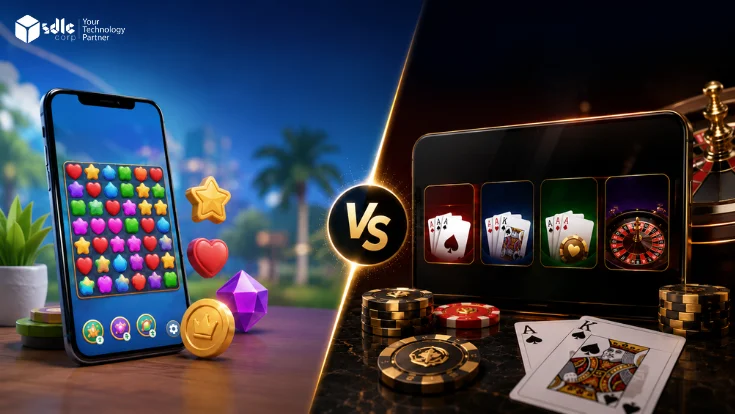
Casual Game Development vs Real-Money Game Development
Casual / Free-to-Play
Lower barrier, broader audience- No gambling licence required when there is no staking, cash-out, or real-money prize.
- Simpler app store approval.
- Faster to build and launch.
- Broader addressable audience.
- Lower per-user compliance cost.
- RNG certification generally not required unless random outcomes affect prizes or wagering.
- Payment processing is generally simpler for F2P - though store billing rules, digital goods policies, taxes, and regional restrictions still apply.
- Lower revenue per active user.
- Ad revenue highly dependent on scale.
- IAP conversion is limited to a small share of players - casual revenue depends heavily on scale, retention, and user acquisition efficiency.
- Competitive market - high user acquisition cost.
Real-Money Game
Higher revenue, higher compliance cost- Higher average revenue per active user.
- Direct relationship with high-value players.
- Rake, house edge, or tournament fees provide recurring revenue.
- Player LTV can be significantly higher than casual games when the product is licensed, compliant, and retaining high-value players.
- Gambling licence required in most markets.
- RNG certification required in regulated markets.
- KYC/AML identity verification required.
- Longer time to launch - compliance overhead.
- App store eligibility conditional on licence.
- Payment processor relationships harder to establish.
- India: online money games prohibited under 2025 framework.
- Ongoing audits, compliance reporting, and responsible gaming controls increase operating cost.
Choose the Right Game Development Model
Answer five questions. Then, get a model recommendation with the key reasons behind it. As a result, you can compare product fit before spending on development.
Casual vs Real-Money Recommender
Five questions - about 60 seconds
What is the primary goal of the game?
Which markets are you targeting?
What is your compliance and legal readiness?
What is your development and compliance budget?
What monetization model do you prefer?
Need help choosing the right game model?
Before you commit budget, get expert guidance on casual, social casino, or real-money game development.
Casual and Real-Money Game Development Cost
| Factor | Casual / free-to-play | Real-money game |
|---|---|---|
| Base development cost | $8K – $150K depending on scope | $30K – $500K+ depending on scope |
| Compliance and legal | Minimal - standard terms, age rating | Gambling licence, legal preparation, compliance setup, and ongoing regulatory fees vary widely by jurisdiction |
| RNG certification | Usually not required unless random outcomes affect prizes, wagering, or regulated gameplay | Required in most regulated markets ($5K–$120K) |
| Payment infrastructure | Standard App Store / Play billing or Stripe | Dedicated payment gateway, fraud prevention, chargeback management |
| KYC/AML | Usually not required for standard F2P games with no cash-out or real-money rewards | Commonly required for licensed real-money products; timing and scope vary by jurisdiction |
| Backend complexity | Standard - sessions, leaderboards, analytics | High - wallet, transaction logs, audit records, dispute replay |
| Time to launch | Shorter - scope-dependent; a simple F2P MVP can launch faster than a licensed real-money product | Longer - licensing can take several months to over a year depending on jurisdiction and compliance readiness |
| Ongoing compliance cost | Low | High - recurring licence fees, audits, responsible gaming tools |
For example, review a detailed cost breakdown by game type, platform, and complexity in our game development cost guide. In addition, review compliance costs before finalizing your budget.
Monetization in Casual and Real-Money Game Development
Casual game monetization
Advertising
Rewarded video, interstitials, and banner ads. However, revenue scales with daily active users and requires a large audience to generate meaningful income.
Cosmetics and skins
Character outfits, card backs, table themes, and avatar frames. Also, direct-sale cosmetic items are generally accepted by app stores when they avoid cash-out, gambling mechanics, and regulated prize value.
Battle pass / season pass
Regular subscription that unlocks content tiers. As a result, it creates recurring revenue and a strong retention incentive.
Virtual currency
Chips, gems, or tokens can support a virtual economy when there is no staking, withdrawal, transfer, resale, or real-world value conversion. However, legal risk rises if virtual value can be exchanged or monetized outside the game.
Real-money game monetization
Rake
Usually, the operator takes a percentage of each pot (card games, poker). Typically 2–5% capped per hand. Therefore, revenue is tied directly to player activity.
House edge
A built-in mathematical advantage applies to each bet in casino games, slots, and roulette. Therefore, revenue depends on total wagering volume, not only player count.
Tournament entry fees
Players pay to enter, and the operator takes a percentage of the prize pool. In addition, this model creates high engagement and viral loops, but it requires prize pool management.
VIP and loyalty
High-value players receive cashback, bonus credits, and exclusive tables in exchange for volume commitments. However, VIP systems must follow responsible gaming, bonus rules, affordability checks, and jurisdiction-specific marketing limits.
Real-Money Game Development Compliance Requirements
Licensing checks
Player safety controls
Market and advertising rules
For RNG certification details, see our RNG certification for casino games guide. For regulated iGaming game development, labs such as GLI iGaming testing and certification and eCOGRA certification help validate RNG, game fairness, platform controls, and compliance readiness before launch.
Planning a compliance-ready real-money game?
Build wallet, KYC, AML, RNG, audit logs, and responsible gaming systems with a launch-ready architecture.
App Store Rules for Casual and Real-Money Games
| Platform | Casual / F2P | Real-money game |
|---|---|---|
| Apple App Store | Standard review | Requires licence, geo-restriction, and free listing |
| Google Play | Standard review | Approved markets with licence; India pilot ended Jan 2026 |
| Web / browser | No approval needed | Payment processor and banking policies apply |
For casual games, standard app store review usually applies. However, real-money games need more checks before approval. Apple requires licences, permissions, geo-restriction, and a free listing. In addition, Google Play needs operator approval, licence documents, and store-policy compliance. Therefore, confirm current rules before submitting.
Choose Casual or Real-Money Game Development
- You want to launch quickly without licensing delays.
- Your target market includes India or markets where real-money gaming is restricted.
- Your budget is under $100K and cannot cover compliance infrastructure.
- You are targeting a broad, casual audience at scale.
- Ad and cosmetic revenue can support the business model.
- You want uncomplicated app store distribution.
- You can obtain a gambling licence in the target market.
- Your budget covers development plus compliance ($200K+).
- You are targeting players in regulated markets - UK, Malta, select US states.
- Your game type is suited to wagering - poker, casino, fantasy sports.
- You have or plan a VIP acquisition and retention strategy.
- Long-term LTV per player is more important than player volume.
Time to First Revenue for Game Development
In addition, time to first revenue is one of the clearest ways to compare both models. Therefore, use it as a practical filter before choosing your build path.
Common Game Development Model Mistakes
Licensing and compliance mistakes
Building a real-money game without understanding the licensing timeline. Licensing can take several months to over a year depending on the jurisdiction, documentation quality, and compliance readiness. Therefore, teams should run licensing and development in parallel. Without that track, the code may be ready before the business can legally operate.
Adding cash-out to a casual game mid-development. Adding real-money withdrawal to a virtual-currency game changes the product's regulatory status. As a result, the wallet, payment, compliance, and audit requirements change as well. This is usually a product rebuild, not a small feature update.
Revenue and market mistakes
Assuming casual IAP revenue will scale without user acquisition. Casual game revenue depends heavily on daily active users. However, only a small share of players usually convert to in-app purchases. Therefore, retention, user acquisition cost, and audience scale matter as much as the game build.
Targeting India with a real-money wagering model. India's 2025 online gaming framework prohibits online money games, related advertising, and payment facilitation. Therefore, social casino, virtual chips, and entertainment-only formats are safer build directions for India. However, they must avoid staking, deposits, cash-out, monetary prizes, and equivalent money-game structures.
Budget and readiness mistakes
Underestimating the infrastructure cost of real-money games. For this reason, real-money products need wallet controls, KYC, AML, transaction logs, dispute tools, RNG certification, and responsible gaming systems. In addition, licensing, legal, payment, audit, and compliance operations are separate cost centres. As a result, total launch cost is often higher than the game build alone.
Choosing the model based on revenue potential rather than readiness. Although real-money games have higher revenue ceilings, they need stronger operating readiness. However, casual games have shorter paths to launch. Therefore, choose real-money only when you also have a credible licensing plan, compliance budget, and payment infrastructure strategy.
Questions Before Choosing a Game Development Model
- Is real-money wagering legal in your primary target market?
- Do you have or can you obtain a gambling licence within your timeline?
- Does the budget cover development plus compliance, legal, and certification?
- What is the realistic monetization revenue at your projected user volume?
- Will the game be distributed via app stores, and what are the store policies?
- Is there a user acquisition strategy and budget beyond development?
- What payment processors will work for the intended model in target markets?
- Is there a plan for responsible gaming controls - required for real-money, recommended for casual?
- Can users cash out, withdraw, or convert in-game value to real money?
- What is the long-term model - one game, a series, or a platform?
Building a casual or real-money game?
SDLC Corp develops casual games, casino games, social casino platforms, and real-money game engines with compliance-aware architecture.
Choose the Right Game Development Model for Your Market
Choosing between a casual game and a real-money game depends on budget, target market, monetization plan, and compliance readiness. Casual games are easier to launch. In addition, they support broad user growth through ads, in-app purchases, and social engagement.
At maturity, real-money games can create higher revenue per user. However, they need licensing, KYC, AML checks, RNG certification, secure payments, and responsible gaming tools before launch. Therefore, choose the model that fits your market, legal readiness, and long-term business goals.
Related Game Development Models to Compare
Before you decide, compare nearby models such as casual game development, social casino game development, casino game development, iGaming game development, and real-money game development. Also, review how each model changes revenue, compliance, and launch timing. In addition, these related keyphrases matter because each model has a different revenue path, compliance risk, and launch timeline. In addition, this comparison helps match search intent with the right service page.
Casual vs Real-Money Game Development FAQs
Launch and model questions
Can I start with a casual game and add real-money features later?
You can evolve from casual to real-money. However, it is not a simple feature addition.
Adding wagering or cash-out changes the product's regulatory classification. Therefore, the wallet, KYC, AML, audit logging, RNG certification, and responsible gaming systems must be planned as architecture requirements.
If real-money is a future option, design the backend with that in mind from the start.
Is a social casino the same as a real-money casino?
No. A social casino uses virtual chips with no real-money value. Players cannot cash out, withdraw, or convert chips to money.
As a result, it is usually treated as a free-to-play product, not a gambling product. A real-money casino involves deposits, wagers, and withdrawals. Therefore, it is regulated as gambling in most jurisdictions.
Revenue and market questions
Which model makes more money - casual or real-money?
By contrast, real-money games can generate higher revenue per active user because players deposit real money directly. However, casual games can produce strong total revenue when they reach large scale.
Therefore, the right answer depends on execution. Choose casual if you can acquire users at scale. Choose real-money if you can obtain licences and serve high-value players.
Can I launch a real-money game in India?
India's 2025 online gaming framework has significantly restricted real-money online gaming. Online money games involving fees, stakes, deposits, or monetary winnings face central prohibition and varied state-level controls.
Therefore, real-money wagering is not a viable compliant path for India-facing products under the current framework. Social casino, virtual-currency, and entertainment-only formats are more practical.
However, those formats must avoid staking, deposits, cash-out, monetary prizes, and equivalent money-game structures. Always confirm the current legal position with qualified counsel.
Licence and compliance questions
How much does a gambling licence cost?
Licence costs vary widely by jurisdiction. Curaçao is still considered lower-cost than many tier-one jurisdictions. However, under its newer LOK framework, operators should budget beyond the application fee.
Annual regulator fees, legal preparation, corporate setup, compliance systems, and technical requirements can raise the total cost. In addition, Malta, UK, and US state licences usually involve higher ongoing compliance costs.
Therefore, budget for 12 to 24 months of licensing cost in parallel with development.
What is the fastest way to get a game generating revenue?
A casual free-to-play game with ad monetization can reach first revenue within 4 to 10 weeks of development. In addition, in-app purchases can be added without the same licensing delay.
In contrast, licensed real-money games generate first revenue only after the licence is issued. Therefore, casual is faster for speed to first revenue. However, real-money can win on revenue quality per user at maturity.