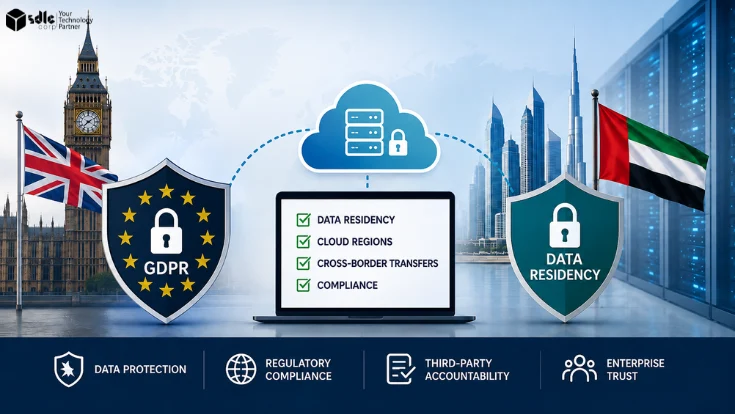
Enterprise websites rarely keep customer data in one place. Forms, databases, cloud platforms, APIs, CRM systems, analytics tools, support platforms, and backups may all process information in different locations.
For UK and UAE enterprises, data residency is therefore more than a hosting decision. Businesses need visibility into where information is stored, processed, backed up, shared, and accessed. A capable web development partner should make those data flows clear before the platform reaches production.
Data residency requirements depend on the organisation, jurisdiction, sector, information involved, contractual obligations, and applicable law. Technical architecture should support the requirements identified by the enterprise's legal, privacy, security, and compliance teams.
What Is Data Residency and How Does It Relate to GDPR?
Data residency describes where an organisation stores or processes information. For an enterprise website, this can include application servers, databases, cloud storage, backups, SaaS platforms, APIs, analytics, and support systems. GDPR is broader because it also governs how personal information is collected, used, secured, shared, retained, deleted, and transferred.
Data Residency
Focuses on the physical or regional locations where information is stored and processed.
GDPR Relationship
Data location matters when infrastructure, suppliers, backups, or access arrangements create international processing or transfers.
Data Localisation
Refers more specifically to requirements that may require certain information to remain within a particular jurisdiction.
Why Data Residency Matters for Enterprise Websites
Enterprise websites can process customer records, transactions, uploaded documents, account information, support conversations, employee data, and behavioural information. However, this data does not always remain within one system. Because different parts of the technology stack may operate in different regions, enterprises need to review more than the location of the main website server.
Cloud Architecture
Applications, databases, storage, monitoring, backups, and recovery systems may use different regional configurations.
Third-Party Platforms
CRM, analytics, payment, email, support, and AI tools may receive information automatically from the website.
Customer Requirements
Enterprise contracts and procurement policies may restrict where sensitive or business-critical information is stored or accessed.
Cross-Border Access
International suppliers and overseas development or support teams can introduce additional international data flows.
Where Does Enterprise Website Data Actually Go?
One customer record can move from the website into a database, CRM, email service, analytics platform, support system, and backup. Therefore, the production hosting region represents only one part of the complete data flow.
| System | Data It May Handle | What to Check |
|---|---|---|
| Web application | Forms, sessions and accounts | Production region |
| Database | Customer records and transactions | Primary and replica regions |
| Cloud storage | Files, reports and uploads | Storage region |
| CRM and support | Leads, tickets and customer details | Processing location |
| Analytics | Visitor and behavioural information | Data collected and processing region |
| Backups | Copies of production information | Region and retention period |
| APIs and AI tools | Information shared with external services | What leaves the platform and where |

UK Data Residency Requirements: What Enterprises Need to Know
UK data-protection law does not create a blanket requirement for every organisation to keep all personal information inside the UK. Enterprises should instead understand where personal information is stored, processed, transferred, backed up, and accessed across the complete technology environment.
The Data (Use and Access) Act 2025
The Data (Use and Access) Act 2025 guidance explains changes to the UK's existing data-protection and privacy framework. Enterprise projects should therefore use current guidance rather than relying only on older GDPR interpretations.
How UK International Data Transfers Work
A restricted transfer can arise when personal information is sent or made accessible to a separate organisation outside the UK. The ICO guide to international transfers explains how organisations can identify restricted transfers and determine the appropriate transfer route.
Where a restricted transfer applies, organisations should first consider whether it is covered by UK adequacy regulations. If not, appropriate safeguards, such as an International Data Transfer Agreement (IDTA), may be required together with a transfer risk assessment. In certain circumstances, a UK GDPR exception may also provide a lawful route for the transfer.
What the Web Partner Should Document
Legal and privacy teams determine which transfer mechanism or assessment applies. However, the web partner should provide accurate technical information about application regions, database locations, backups, vendors, subprocessors, integrations, encryption, and overseas production access.
When UK Hosting Still Makes Sense
UK hosting may still support customer contracts, internal security policies, procurement requirements, sector rules, or corporate governance. However, local hosting does not remove the need to review international SaaS services, APIs, backups, subprocessors, and remote access.
UAE Data Residency Requirements: What Enterprises Need to Know
UAE data-residency requirements depend on the organisation, jurisdiction, sector, and information involved. There is no one hosting rule that should automatically be applied to every UAE enterprise, so the applicable framework should be identified before architecture decisions are finalised.
UAE PDPL and Cross-Border Transfers
Federal Decree-Law No. 45 of 2021 provides the UAE's federal personal data protection framework within its scope and includes provisions concerning cross-border transfers. Therefore, UAE PDPL compliance should not be reduced to the statement that every item of personal information must always remain inside the UAE.
DIFC Data Protection Requirements
Organisations operating within the Dubai International Financial Centre should also consider DIFC's separate data-protection framework under Data Protection Law No. 5 of 2020. The applicable jurisdiction should therefore be confirmed before selecting hosting, processors, or international integrations.
ADGM Data Protection Requirements
Abu Dhabi Global Market maintains its own regime under the Data Protection Regulations 2021. Official ADGM data-protection guidance covers areas including international transfers, controller and processor responsibilities, data protection by design, DPIAs, security, and personal data breaches.
Sector-Specific Requirements
Some UAE sectors can have additional requirements, including restrictions that affect certain categories of health information. Enterprises should therefore check sector-specific requirements before deciding where sensitive workloads, databases, backups, and recovery environments will operate.
Saying that a website is “hosted in the UAE” does not describe the complete data-residency position. APIs, SaaS platforms, backups, processors, and remote access still need review.
UK vs UAE Data Residency Requirements
Both markets require enterprises to understand where information travels, but the legal framework and jurisdiction-specific rules behind those technical decisions differ.
| Area | United Kingdom | UAE |
|---|---|---|
| Main framework | UK GDPR, Data Protection Act 2018 and DUAA amendments | Federal PDPL where applicable |
| General local hosting rule | No blanket UK-only requirement | Depends on framework, sector and information |
| Cross-border transfers | UK international-transfer rules may apply | Federal or jurisdiction-specific transfer rules may apply |
| Special regimes | UK data-protection framework | DIFC and ADGM maintain separate regimes |
| Sector requirements | Additional requirements may apply | Some sectors can have specific requirements |
| Web partner role | Document infrastructure, vendors and access | Document infrastructure, jurisdiction, vendors and access |
How Web Architecture Creates Data Residency Risk
Data-residency risk often comes from ordinary architecture decisions. Database replicas, backups, APIs, SaaS services, monitoring platforms, and remote access can each introduce another processing location even when the primary application runs in an approved region.
Databases, Replicas and Backups
A primary database may remain in the required region while replicas, snapshots, exports, archives, or recovery systems exist elsewhere. Therefore, primary, replica, backup, and recovery locations should be documented separately. Enterprises should also review how backups are monitored, retained, accessed, and restored.
APIs and SaaS Platforms
CRM, payment, analytics, email, support, and AI platforms can receive information automatically through APIs. Each important integration should therefore appear in the enterprise's data-flow map.
Remote Developer and Support Access
Infrastructure location is only part of the picture. In addition, enterprises should control who can access production information through role-based permissions, MFA, least-privilege access, activity logging, and regular permission reviews.

What Enterprises Should Expect from a Web Partner
A capable web partner should explain how the proposed platform handles enterprise information instead of relying on broad compliance claims. This is especially important for larger enterprise software projects involving multiple systems, vendors, teams, and regional environments.
Clear Data Mapping
Map where information enters the platform, where it is stored, which systems receive it, and where additional copies are created.
Regional Cloud Planning
Plan key infrastructure regions carefully. Software consulting services can help align architecture with compliance needs.
Processor Transparency
Provide visibility into the suppliers, processors, subprocessors, APIs, and SaaS platforms involved in processing enterprise information.
Data Protection by Design
Consider data collection, access, replication, integrations, credentials, retention, and deletion during architecture and development.
DPIA Technical Support
Supply accurate technical information about systems, data flows, vendors, security controls, access, and transfers when a DPIA or privacy review is required.
Controlled Production Access
Design appropriate administrator access, MFA, privileged permissions, logging, credential controls, and access reviews for production environments.
Questions to Ask a Web Partner Before You Sign
Enterprise buyers should ask direct technical questions instead of relying on general statements such as “GDPR-ready” or “data-residency compliant.”
- Where will our application, database, storage, and backups operate?
- Which external suppliers and subprocessors receive our information?
- Can overseas teams access production systems or personal information?
- Which international transfers does the architecture create?
- Can workloads remain inside approved regions when required?
- How do you support privacy by design and DPIA reviews?
- What process controls retention, deletion, and backup copies?
- Which process is used to review new third-party integrations?
- What is your incident-response process?
- At contract end, what happens to our systems and information?
Common Data Residency Mistakes
Most data-residency problems come from incomplete data mapping, uncontrolled access, or assumptions about cloud regions rather than from one obvious technical failure.
Assuming the Cloud Region Solves Everything
A UK or UAE cloud region does not automatically control database replicas, backups, SaaS services, APIs, or external support access. Therefore, enterprises should review the full data flow rather than relying on the primary hosting region alone.
Adding Vendors Without Updating the Data Map
A new CRM, analytics platform, payment service, support tool, or AI integration can change where customer information is processed.
Forgetting Backup and Recovery Regions
Backups may contain complete copies of production information. Therefore, their location, retention period, and access model also need review.
Giving Developers Too Much Production Access
Permanent unrestricted administrator access creates avoidable exposure. Production access should match actual responsibilities and be reviewed regularly.
Treating GDPR as a Cookie Banner
Cookies are only one part of data protection. In addition, enterprise architecture involves hosting, security, processors, transfers, retention, deletion, access controls, and data flows.
Assuming the Web Partner Owns Legal Compliance
A technology partner can support compliance through architecture, documentation, implementation, and security controls. However, the enterprise should still involve its legal, privacy, compliance, procurement, and security teams.
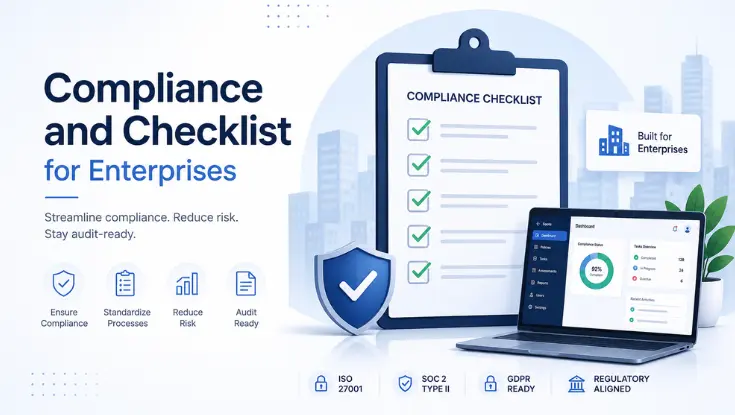
Data Residency Checklist for UK and UAE Enterprises
Before launch, verify the key infrastructure, third-party, access, lifecycle, and transfer decisions that affect the platform's data-residency position.
- Application, database, storage, backup, and recovery regions are documented.
- Important APIs, SaaS platforms, processors, and subprocessors are identified.
- Overseas production access and privileged permissions have been reviewed.
- Appropriate access controls and MFA are implemented where required.
- Data retention, deletion, and backup-handling requirements are documented.
- Applicable international-transfer requirements have been reviewed.
- Incident-response responsibilities and processes for reviewing new integrations are defined.
Building One Web Platform for UK and UAE Operations
Enterprises operating across both markets do not always need two separate applications. Depending on legal, contractual, security, and operational requirements, one platform can use regional data stores, controlled replication, and region-specific access rules. This approach is especially relevant when custom software development must support different regional workflows from one platform.
Regional Data Stores
A multi-region platform can route UK customer information to a UK environment and UAE customer information to a UAE environment when this architecture supports the organisation's approved requirements.
UK customer data → UK regional environment
UAE customer data → UAE regional environment
Reduce Unnecessary Replication
Not every dataset needs to move between regions. Where business requirements allow, systems can exchange only the information another region or central service genuinely needs.
Apply the Same Rules to Backups and Access
Regional databases provide limited control if backups are copied elsewhere or global teams have unrestricted production access. Infrastructure, backups, vendors, and human access should therefore follow the same architecture policy.
What a Strong Enterprise Web Partner Should Deliver
Before production, enterprises should receive clear technical documentation that records how data flows through the platform, where systems operate, which third parties are involved, and how access and data lifecycle requirements are managed.
Build Data Requirements into Your Web Architecture
Data residency is easier to address during architecture planning than after an enterprise platform has already been deployed. SDLC Corp can support regional cloud planning, data-flow mapping, API integrations, access-control planning, and multi-region enterprise web architecture.
Discuss Your Enterprise Web RequirementsFAQs
1. What is data residency?
Data residency describes where an organisation stores or processes information. For an enterprise website, this can include applications, databases, backups, cloud storage, SaaS platforms, and connected systems.
2. Does UK GDPR require all personal data to stay inside the UK?
No. UK GDPR does not create a general UK-only hosting requirement. However, international-transfer requirements may apply when personal information is transferred or made accessible to a separate organisation outside the UK.
3. What is the Data (Use and Access) Act 2025?
The DUAA makes changes to the UK's existing data-protection and privacy framework rather than replacing UK GDPR or the Data Protection Act 2018.
4. What is a restricted international transfer?
A restricted transfer can arise when personal information is sent or made accessible to a separate organisation outside the UK and the UK international-transfer rules apply.
5. What are UAE data residency requirements?
Requirements depend on the organisation, jurisdiction, sector, type of information, and applicable framework. Enterprises should establish these requirements before choosing hosting and processing locations.
6. Do DIFC and ADGM have separate data-protection frameworks?
Yes. DIFC and ADGM maintain separate data-protection regimes that can affect areas such as controller responsibilities, security, and international transfers.
7. Can UAE sectors have additional data-location requirements?
Yes. Certain sectors and categories of information can be subject to additional requirements, so enterprises should review sector-specific rules before selecting their architecture.
8. Does overseas developer access matter for data residency?
It can. Overseas access to production information may need to form part of the organisation's processing, security, and international-transfer assessment.
9. Why do backup locations matter?
Backups may contain the same information as production systems. Their region, retention period, recovery process, and access controls should therefore be documented.
10. What should enterprises ask a web partner about data residency?
Ask about infrastructure regions, databases, backups, processors, subprocessors, overseas access, international transfers, retention, deletion, and incident response.
Global NGOs must map ERP copies, country-office access and donor-related records to their hosting and transfer decisions. See NGO ERP data residency.
Final Thoughts
Data residency is more than choosing a server location. UK and UAE enterprises should also understand databases, backups, third-party platforms, international access, and the requirements that apply to their organisation.
A reliable web partner should make these data flows clear and build regional, security, and access requirements into the architecture from the start. Before choosing a provider, enterprises can also use this software development vendor evaluation framework to assess security, delivery capability, and partner fit.