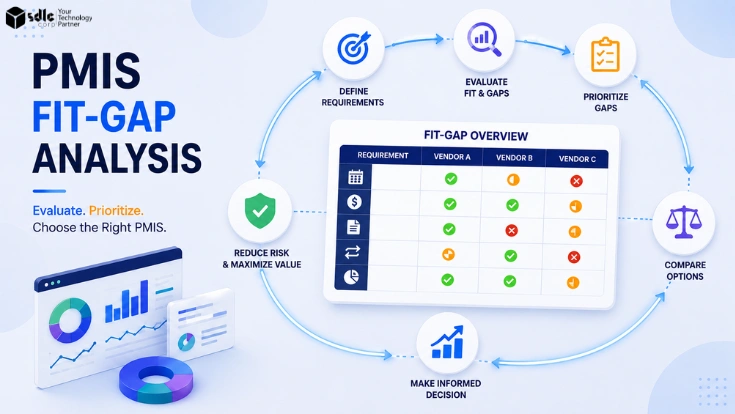
Selecting a Project Management Information System should start with requirements, not a vendor feature list. A PMIS fit-gap analysis tests how well each system meets functional and non-functional requirements, then connects every Fit, Partial Fit, and Gap to evidence, cost, risk, and a resolution path.
The PMI Requirements Management Practice Guide emphasizes structured requirements development and management. For a PMIS fit-gap analysis, convert stakeholder needs into testable requirements before vendor scoring begins. SDLC Corp builds a PMIS called Trestle, so we are not a neutral party; however, this framework applies the same evaluation rules to Trestle and other PMIS options.
Definition
What Is a PMIS Fit-Gap Analysis?
A PMIS fit-gap analysis compares documented requirements with what a Project Management Information System actually delivers. Each requirement receives a weight, classification, supporting evidence, and resolution path. A feature comparison may confirm that a platform supports change orders. A fit-gap analysis asks whether it supports your actual change-order process.
That process may include approval thresholds, cost and schedule impacts, role-based access, ERP synchronization, and complete audit history. ERP fit-gap evaluations often focus on enterprise processes and application modules. PMIS fit-gap analysis focuses on project controls, project records, collaboration, and the systems used to deliver projects.
A vendor claim does not earn a Fit on its own. The capability should be demonstrated, tested, or supported by suitable evidence before the row is finalized.
When Should You Run a PMIS Fit-Gap Analysis and Who Should Be Involved?
Run the analysis before your organization becomes committed to a product. Start once the core requirements are defined, then refine the matrix through the RFP, shortlist, demonstrations, technical review, and commercial evaluation.
- Selecting a new PMIS
- Replacing a legacy project system
- Consolidating several project tools
- Expanding a PMIS across a program or portfolio
- Adding major modules or integrations
- Planning significant customization
- Modernizing project controls
- Improving program reporting
The evaluation team should extend beyond IT. Project controls can own scheduling and forecasting requirements. Finance can define budget and reconciliation rules. Procurement may own contract workflows, while security teams evaluate access, hosting, and data controls.
Include document control, project delivery, executives, and representative end users. Programs that depend on external consultants or partners should involve them because outside participation affects the completeness of the project record. Separate mandatory requirements from preferences before scoring begins.
Build a Weighted PMIS Fit-Gap Matrix
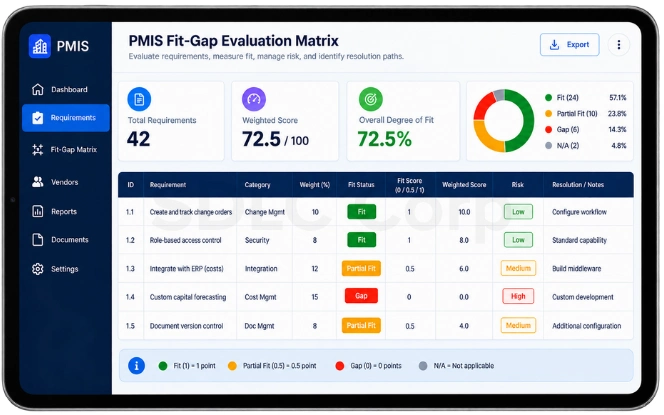
A checklist records whether a feature exists. A weighted PMIS fit-gap matrix connects every requirement to importance, evidence, gap status, cost, risk, and resolution.
- Requirement ID and traceability
- Required business or technical outcome
- Functional or non-functional category
- Priority and weight
- Vendor response
- Delivery method
- Fit status and score
- Evidence
- Gap description
- Resolution path
- Cost impact
- Risk and owner
Why Weighting Matters
Not every requirement has the same business value. An executive may prefer a different dashboard layout, while finance may require an approval rule that prevents unauthorized commitments. Both matter, but they should not influence the final evaluation equally.
Without weighting, many low-value feature fits can hide one critical control gap. Requirements connected to financial control, security, compliance, governance, and core operations should have greater influence over the final score.
How Do You Calculate PMIS Degree of Fit?
Requirement Weight
Critical = 5
High = 4
Medium = 3
Low = 2
Optional = 1
Fit Score
Fit = 1.0
Partial Fit = 0.5
Gap = 0
N/A = excluded
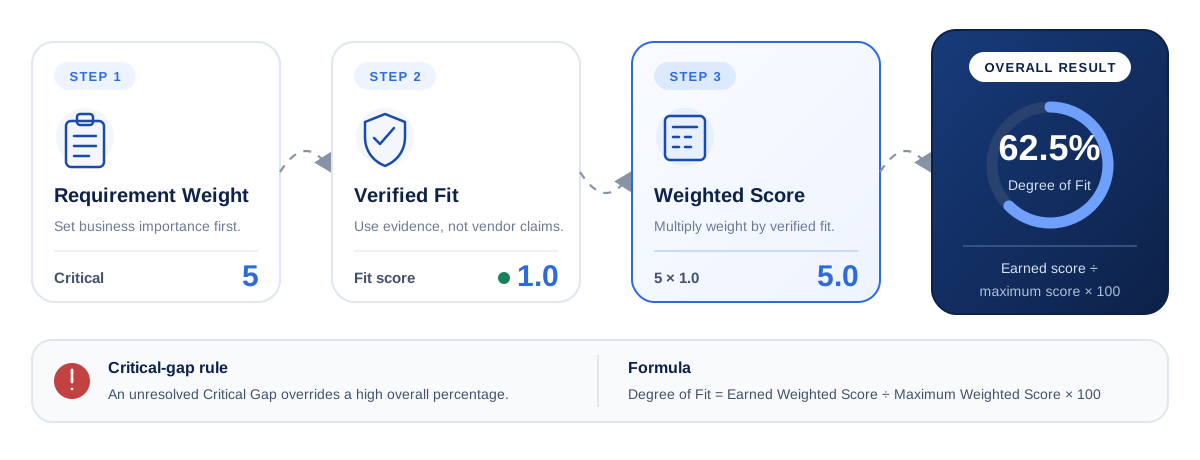
Why a High Fit Percentage Can Still Be a Reject
The overall percentage is only a summary. For example, a platform may score 92% while still failing a financial-control, cybersecurity, or data-residency requirement that the organization cannot waive.
Do not give a vendor an acceptable final rating while a Critical requirement remains an unresolved Gap.
Report both the weighted degree of fit and the number of unresolved Critical gaps. The percentage shows overall fit. The Critical-gap count shows whether the result is acceptable.
Risk-Rate Every PMIS Gap
Rate each gap by business criticality, resolution effort, and operational impact. Use the rating to separate acceptable limitations from gaps that need mitigation before the PMIS is selected.
Low-Risk Gaps
These gaps mainly affect convenience or preference. Examples include dashboard formatting, optional alerts, or a minor reporting difference.
Medium-Risk Gaps
These gaps require planned work, but the resolution path is understood. A supported API integration or controlled configuration change may be sufficient.
High-Risk Gaps
These gaps can affect financial control, security, compliance, auditability, data integrity, or system stability and should not be accepted casually.
Decision Test
Check both the effort required to close the gap and the consequence of leaving it unresolved. Critical unresolved gaps can override a strong overall fit score.
How to Resolve Each PMIS Gap
A Partial Fit or Gap does not automatically mean rejecting the platform. Review the available resolution paths in order.
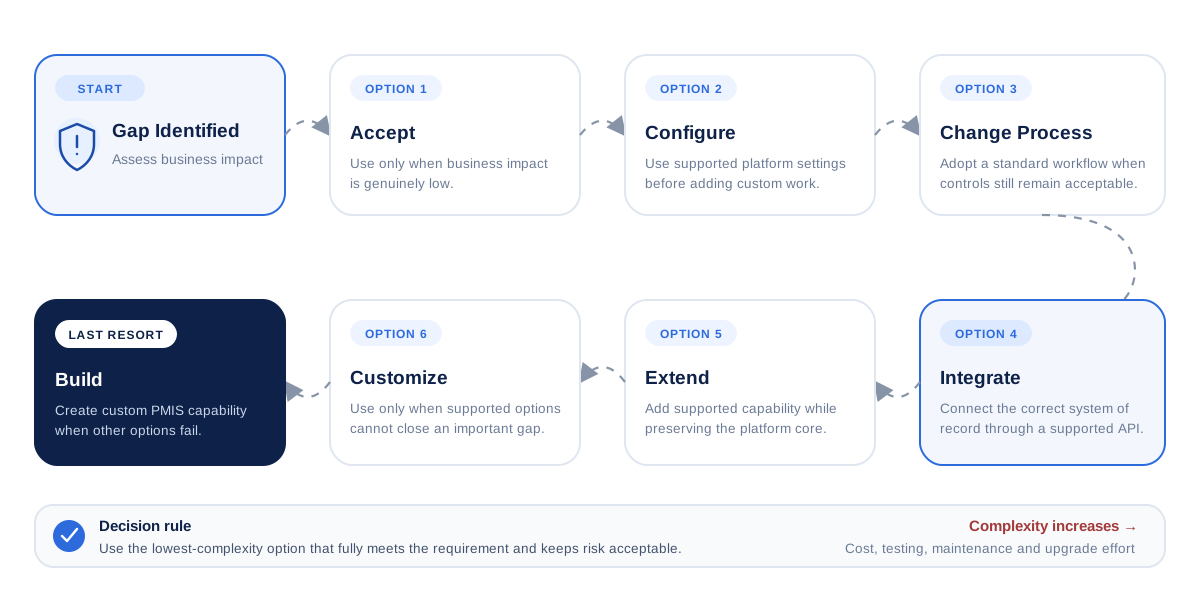
Accept
Accept a gap only when its business impact is genuinely low. Record the decision so the limitation does not return during implementation as an unexpected requirement.
Configure
Configuration should normally come before customization. Approval routes, thresholds, roles, fields, dashboards, notifications, and workflow rules can often be changed through supported settings.
Change the Process
A standard PMIS workflow may be simpler than the organization's existing process. Changing the process can be reasonable when the new approach still meets business and control requirements. A product limitation should not automatically be described as process improvement.
Integrate
Integration is often appropriate when another system legitimately owns the data. An ERP may remain the financial system of record while the PMIS manages forecasts, approvals, and project workflows. An ERP consulting and system integration assessment can help define ownership, interfaces, and control boundaries before implementation.
Evaluate synchronization frequency, data ownership, API limits, reconciliation, monitoring, retry logic, and failure recovery before marking the gap resolved. SDLC Corp's software integration services page covers delivery options, while the ERP integration strategy guide explains API, middleware, event-driven, batch, and hybrid patterns in more detail.
Extend or Customize
Extension can make sense when the core platform fits but a small number of high-value workflows need additional capability. Customization needs more scrutiny because it increases testing, maintenance, and upgrade effort.
| Factor | Configuration | Customization |
|---|---|---|
| Delivery effort | Lower | Higher |
| Upgrade risk | Lower | Higher |
| Maintenance | Easier | Requires ongoing ownership of custom components |
| Flexibility | Bounded by the platform | Greater |
| Long-term cost | Usually lower | Often higher |
Build
Custom development belongs at the end of the resolution process. It becomes a realistic option when critical requirements remain unresolved across available products or adapting a standard platform becomes excessively complex. At that point, enterprise software development can be evaluated against the same requirements and risk rules as packaged PMIS options.
For a broader comparison of SaaS and custom development, see SDLC Corp's build vs buy guide.
Functional and Non-Functional Requirements in a PMIS Fit-Gap Analysis
Functional requirements define what the PMIS must do. Non-functional requirements define how well the system must perform those functions.
A system may support a financial approval workflow and still create a serious gap. Incomplete audit history, weak performance, or permissions that fail to enforce separation of duties can make the requirement unacceptable.
Functional PMIS Requirements
| Area | What to Evaluate | Verification |
|---|---|---|
| Scheduling | Baselines, dependencies, milestones, variance | Import and re-baseline a real schedule |
| Cost management | Budgets, commitments, actuals, forecasts | Trace a change to forecast at completion |
| Change management | Requests, impacts, routing, approvals | Run a scripted change scenario |
| Document control | Versions, permissions, metadata | Upload, revise, and retrieve a prior version |
| RFIs and submittals | Routing, deadlines, escalation, review cycles | Complete a lifecycle including an overdue path |
| Contracts and payments | Awards, amendments, closeout, invoice approval | Process a pay application with a deliberate mismatch |
| Risk management | Registers, owners, mitigation, escalation | Create and escalate a risk |
| Portfolio reporting | Cross-project KPIs on common definitions | Build a portfolio view without manual reconciliation |
| Workflow automation | Rules, thresholds, alerts, approvals | Configure a workflow without vendor help |
| External participation | Contractors submitting, not only viewing | Have an external tester complete a real submission |
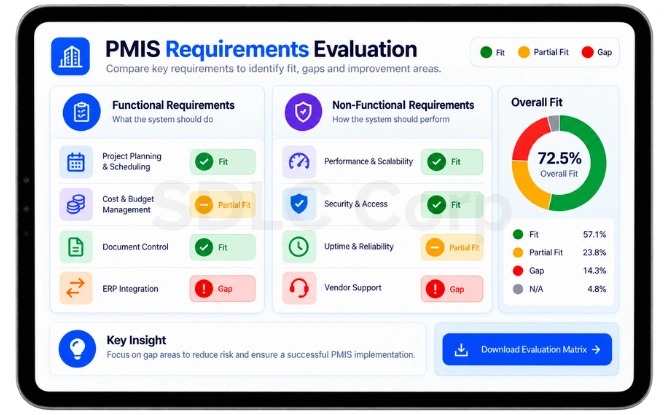
Non-Functional PMIS Requirements
These requirements often receive less attention, yet they can create some of the most expensive gaps. ISO/IEC 25010:2023 provides a recognized product-quality model that can support requirements definition, evaluation, testing, and acceptance criteria.
| Requirement | What to Evaluate | Evidence |
|---|---|---|
| Performance | Response and processing targets at expected data volume | Performance test |
| Availability | Contracted uptime and stated remedy | SLA clause |
| Scalability | Users, projects, files, and records at expected future scale | Load test or reference at scale |
| Security | Encryption, MFA, and federated identity | Security review and assessment |
| Authorization | Role-based access and segregation of duties | Permission test with an over-reach attempt |
| Auditability | Who changed what, when, and the previous value | Audit-log test |
| Data residency | Approved hosting and backup jurisdictions | Architecture evidence and contract |
| Reliability | Stable processing, error handling, and behavior when transactions or integrations fail | Failure-handling test and operational evidence |
| Recoverability | Backup controls, Recovery Point Objective, Recovery Time Objective, and disaster recovery procedures | DR documentation and latest recovery test |
| Interoperability | Documented APIs, supported objects, and rate limits | Integration test |
| Mobile and offline | Field usability without stable connectivity | Device and offline test |
| Maintainability | Upgrade path, configuration model, extension points, and custom components | Architecture and upgrade review |
| Usability | Efficiency, clarity, and consistency of common workflows | User acceptance testing |
| Portability | Full export of the project record at exit | Request and inspect a sample export |
Write each requirement so it can be tested. “The dashboard should load quickly” cannot be scored objectively. “The main dashboard loads within three seconds for 95% of requests at the agreed user load” can be tested and evidenced.
Validate Vendor Claims Before Marking a Fit
Questionnaires are useful, but they should not become the final source of truth. Give every shortlisted vendor the same scripted scenario and use realistic project data. Make the scenario cross module boundaries because hidden workflow and integration gaps often appear at those handoffs.
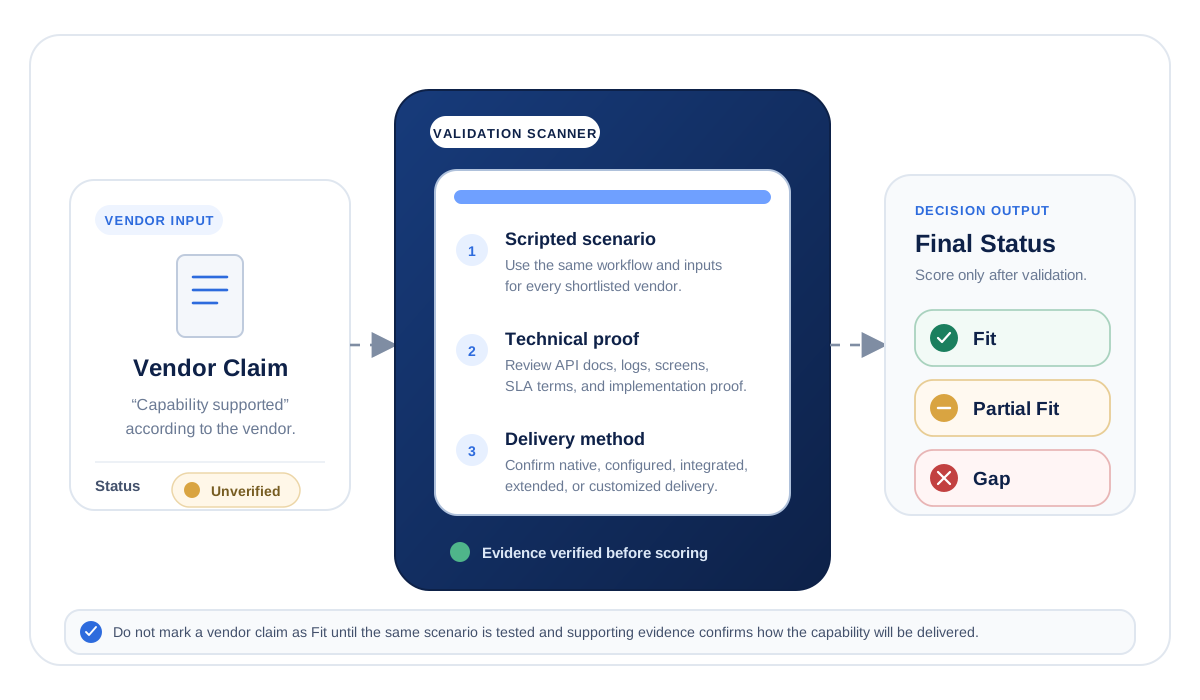
Let your own users drive the scenario where possible. A cost controller completing the workflow can expose issues that a vendor-led demonstration may not show.
- Native
- Configurable
- Third-party
- Custom
- Roadmap
- Unsupported
A roadmap item should be treated as delivery risk unless the vendor provides a firm contractual commitment. Suitable evidence may include demonstrations, configuration screens, API documentation, architecture diagrams, security documents, test results, SLAs, and contractual commitments.
Worked PMIS Fit-Gap Example
A forecast revision above 7% of the approved control budget must route through project controls and finance, preserve the previous baseline, synchronize to the ERP within 15 minutes, and retain failed synchronization events for audit and retry.
The requirement has a Critical weight of 5. During scripted testing, approval routing and baseline retention work. The standard ERP connector runs hourly and misses the 15-minute threshold. Failed events are logged, but automatic retry requires an extension.
| Evaluation Item | Result |
|---|---|
| Approval workflow | Fit |
| Baseline retention | Fit |
| Failed-event logging | Fit |
| ERP sync within 15 minutes | Partial Fit |
| Automatic retry | Gap |
| Overall result | Partial Fit |
| Resolution | Integration + extension |
| Risk | Medium |
A questionnaire might record this requirement as “Yes.” The fit-gap analysis shows the actual position. The core workflow works, but two technical gaps still need a resolution path, cost estimate, and risk rating.
Second Requirement: A Clean Critical Gap
All PMIS production data, audit logs, backups, and disaster-recovery copies must remain within the approved hosting region. The vendor must also provide contractual evidence that the residency rule applies to every copy of the data.
This requirement also carries a Critical weight of 5. The vendor can host the production environment in the approved region, but its backup and disaster-recovery service uses locations that cannot be contractually restricted. Configuration and integration do not change that hosting limitation, so the final classification is Gap.
| Evaluation Item | Result |
|---|---|
| Production data residency | Fit |
| Audit-log residency | Fit |
| Backup and disaster-recovery residency | Gap |
| Contractual evidence | Gap |
| Overall result | Gap |
| Resolution | Reject vendor or formally change/waive the requirement |
| Risk | High |
Unlike the first example, this is not a Partial Fit that can be closed through integration or extension. Because a Critical requirement remains unresolved, the evaluation should either reject the vendor or document an approved change to the requirement before selection.
How PMIS Gaps Affect Cost and Total Cost of Ownership
License cost is easy to compare. Gaps often determine what the organization actually pays. Include configuration, integration, custom development, migration, testing, training, support, monitoring, maintenance, and upgrade work in the Total Cost of Ownership.
A broad statement such as “ERP integration: Partial Fit” is difficult to estimate. A better description states that approved commitment updates require event-driven ERP synchronization, the standard connector runs hourly, and reconciliation, failure monitoring, and retry are required.
The Project Management Institute's estimating guidance recommends using a more detailed breakdown because greater detail improves estimate accuracy and makes the scope easier for the team to understand.
Apply that principle to PMIS gaps by documenting the exact workflow, integration frequency, exception handling, monitoring, ownership, and delivery method. The fit-gap matrix then gives vendors and architects a clearer basis for pricing and Total Cost of Ownership comparison.
When a Custom PMIS Is the Right Answer
Custom development should follow from fit-gap evidence. It can make sense when several Critical requirements remain unresolved across shortlisted products.
A custom PMIS may also be justified when workflows differ materially from standard PMIS processes, integrations form the core operating model, required controls cannot be compromised, or adapting an existing platform approaches replacement-level complexity.
A standard platform is usually the better answer when it already satisfies Critical and high-value requirements and the remaining gaps can be closed through configuration or controlled integrations.
Custom development may also be unsuitable when requirements are still changing or the organization lacks long-term product ownership.
Evaluate Trestle, another commercial PMIS, and a custom build against the same requirements, weights, evidence standards, and Critical-gap rule. A fit-gap analysis can also show when custom development is unnecessary.
PMIS Fit-Gap Checklist
- Defined the business outcomes the PMIS must support.
- Mapped existing systems, reports, and project data.
- Documented functional requirements with internal and external participants.
- Written non-functional requirements as measurable acceptance criteria.
- Separated mandatory requirements from preferences.
- Assigned priorities and weights before product evaluation begins.
- Built the PMIS fit-gap matrix.
- Written scripted vendor scenarios that cross module boundaries.
- Classified each requirement as Fit, Partial Fit, or Gap against evidence.
- Recorded how each capability is delivered.
- Described every unresolved gap in enough detail to estimate it.
- Risk-rated each gap based on business impact and resolution complexity.
- Selected a resolution path for every Partial Fit and Gap.
- Estimated the cost of closing each gap.
- Calculated the weighted degree of fit.
- Reviewed unresolved Critical gaps separately from the overall score.
- Compared lifecycle cost and implementation risk across vendors.
- Obtained stakeholder approval for the final evaluation.
Need Help Evaluating Your PMIS Options?
Share your requirements, current systems, and key gaps with our team. We can help structure the fit-gap evaluation, validate technical risks, and plan the right implementation path.
Final Thoughts
A PMIS fit-gap analysis should tell you more than whether a platform contains the required features. It should show whether each functional and non-functional requirement is met and how the result was verified.
The analysis should also identify the gaps that remain, their risk, the resolution path, and the cost of closing them.
The best PMIS is rarely the one with the longest feature list. Instead, choose the system that meets high-value requirements with strong evidence, manageable gaps, acceptable risk, and a sustainable cost of ownership.
Run the analysis before the demo cycle, not after it.
Frequently Asked Questions
What is a PMIS fit-gap analysis?
A PMIS fit-gap analysis compares documented PMIS requirements with a proposed system's capabilities. Each requirement is classified as Fit, Partial Fit, or Gap and then reviewed for evidence, risk, cost, and resolution.
What is a PMIS requirements matrix?
A PMIS requirements matrix records functional and non-functional requirements together with priority, weight, vendor response, delivery method, fit score, evidence, gap description, resolution, cost, risk, and ownership.
What are functional requirements in a PMIS?
Functional requirements describe what the PMIS must do. Examples include scheduling, cost management, change control, RFIs, submittals, document control, contracts, payments, risk management, reporting, workflow automation, and external collaboration.
What are non-functional PMIS requirements?
Non-functional requirements describe how the system must operate. They cover performance, availability, scalability, security, authorization, auditability, reliability, recoverability, interoperability, maintainability, usability, data residency, mobile access, and portability.
What is the difference between Fit, Partial Fit, and Gap?
Fit means the requirement is met without material compromise. Partial Fit means configuration, integration, extension, or an acceptable process change is still needed. A Gap requires significant additional work or cannot be met acceptably.
How do you calculate PMIS degree of fit?
Multiply each requirement's weight by its fit score. Add the earned weighted scores, divide by the maximum possible weighted score, and multiply by 100. Review unresolved Critical gaps separately.
How should PMIS vendor claims be verified?
Use scripted demonstrations, API tests, configuration screens, architecture and security documentation, SLAs, audit records, test results, and contractual commitments. Roadmap items should be treated as delivery risk.
When should an organization consider a custom PMIS?
Consider a custom PMIS when Critical requirements remain unresolved across available products, workflows are highly specialized, or adapting standard platforms creates excessive cost and risk. If commercial platforms meet the important requirements, configuration or integration is usually the better option.