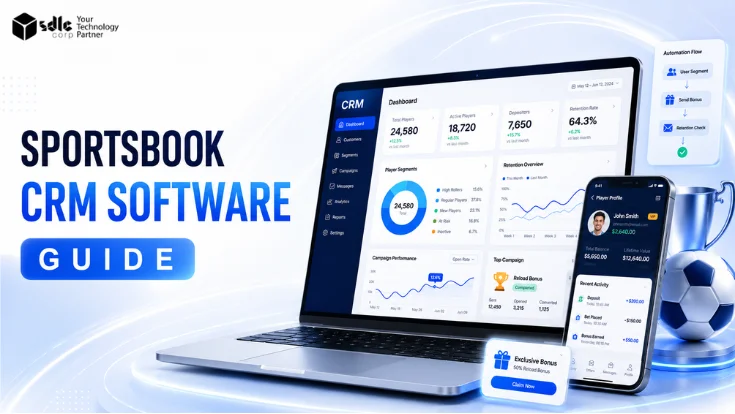
Sportsbook CRM software: the operations layer between acquisition and margin
In regulated sports betting markets, acquiring a first-time depositor is one of the largest variable costs on the operator's P&L. Recovering that cost depends on what happens next: the welcome offer, the second-deposit nudge, the personalized free bet on a favorite team, the VIP track when wagering scales, the responsible-gambling intervention when it scales too fast. Sportsbook CRM software runs all of it.
For operators looking for a broader casino and betting CRM solution, SDLC Corp also provides custom iGaming CRM software for multi-product platforms.
What is sportsbook CRM software?
The system pulls in signup details, KYC status, deposits, withdrawals, every wager (sport, stake, market, odds, settled outcome), session activity, device and channel preferences. It pushes out personalized communications, bonuses and risk-based interventions - the difference between a one-bet visitor and a multi-season bettor.
Core capabilities
Why sportsbook operators need CRM
Once a player makes the first deposit, the operator's priority shifts from acquisition to lifecycle value. Generic email tools cannot manage that shift, because the data and workflows are betting-specific - bet events, sport preferences, deposit cadence and real-time risk signals.
Player retention
The bettor who places one wager and leaves rarely justifies the acquisition spend. The bettor who deposits repeatedly, wagers across multiple events and stays active over time gives the operator a much stronger path to lifetime value. CRM closes the gap between those two outcomes.
Retention workflows cover re-engagement nudges after inactivity, win-back offers for churned players, frequency rewards for steady bettors and personalized sport reminders ahead of major events.
Personalized betting campaigns
Generic email lists do not work in sports betting. A football bettor does not want odds boosts on cricket. A live-betting user does not want pre-match offers sent a day too late.
Sportsbook CRM uses real-time betting behavior to send the right offer at the right moment - not the next-day batch send that generic CRM systems default to.
Bonus and promotion management
Bonus economics make or break a sportsbook. The CRM controls free bets sized to player value, deposit bonuses with rollover and wagering rules, odds boosts on specific markets, cashback campaigns on a daily or weekly cadence, loyalty rewards with tier upgrades, and referral incentives.
Each bonus needs a budget envelope, eligibility rules, expiry, wagering requirement and tracking. The CRM enforces all of it without exposing operators to bonus abuse.
Compliance and responsible gambling
Sportsbook CRM operates inside the regulator's perimeter. Workflows include KYC document reminders and expiry warnings, self-exclusion enforcement, risk flags triggered by deposit velocity or chasing behavior, deposit-limit nudges, cooling-off period messaging and manual review escalations for suspicious patterns.
Compliance messaging stays separate from marketing campaigns - both for regulatory clarity and to protect the player relationship.
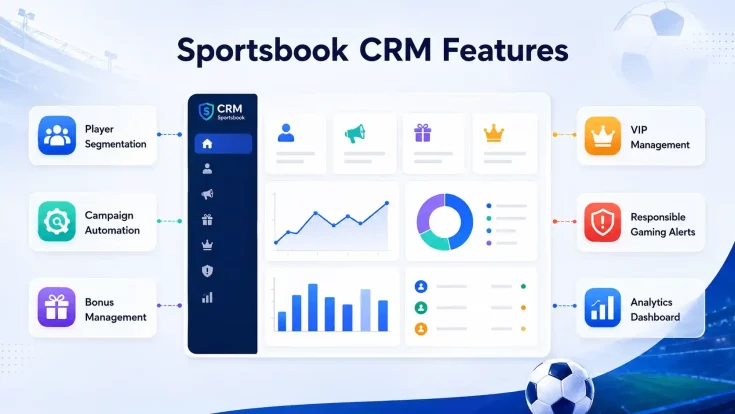
Core features of sportsbook CRM software
| Feature | Why it matters for sportsbook operators |
|---|---|
| Player segmentation | Groups users by betting behavior, value, sport preference and risk profile |
| Campaign automation | Sends offers based on real-time user actions instead of batch schedules |
| Bonus management | Controls free bets, odds boosts, cashback and rewards with rollover, expiry and eligibility rules |
| VIP management | Tracks high-value bettors with dedicated managers, exclusive offers and account reviews |
| Churn prediction | Identifies players likely to stop betting before they actually do, triggering proactive workflows |
| Responsible gambling alerts | Triggers safer-gambling messages on risk patterns and supports compliance reporting |
| Omnichannel messaging | Delivers campaigns across every channel the operation already uses to reach players, from a single system |
| Analytics dashboard | Tracks campaign ROI, retention curves, deposits, bonus ROI and lifetime value by cohort |
Sportsbook CRM workflows operators should build
The difference between a generic CRM and a sportsbook CRM shows up in the workflows. Five matter most.
New player onboarding workflow
- Signup→New account created→Welcome email + KYC start prompt
- KYC submitted→Document upload→Verification status SMS
- First deposit→Payment cleared→Welcome bonus credited + sport preference question
- First bet placed→Wager confirmed→Confirmation + odds boost on next bet
- Sport tagged→Bet history→Add to behavioral segment (football / cricket / NFL etc.)
First-deposit retention workflow
- First deposit cleared→Payment status→Welcome offer activated
- First bet placed→Settled wager→Personalized offer for second bet
- 48 hours, no second bet→Behavior gap→Reminder push + free bet
- Second deposit→Payment cleared→Loyalty enrollment + lifecycle email
- No second deposit in 7 days→Inactivity flag→Reactivation campaign
Inactive-bettor reactivation workflow
- 7 days no login→Activity threshold→Light reminder email
- 14 days no login→Continued inactivity→Sport-specific comeback offer (free bet)
- 30 days no login→At-risk segment→Personalized win-back (deposit match)
- 60+ days→Churned→Final win-back with high-value bonus
- 90+ days→Lost→Move to suppression list; analyze for product gaps
VIP bettor workflow
- Deposit volume crosses threshold→Lifetime value calc→VIP tag assigned
- VIP tag→Profile flagged→Account manager notified
- Account manager→Manual outreach→Exclusive offer + private channel invite
- Risk monitoring→Real-time alerts→Deposit cap reviewed; KYC re-checked if needed
- VIP downgrade→Activity drop→Personalized retention path (no automated bonuses)
Responsible gambling workflow
- Risk pattern detected→Deposit velocity, chase behavior, time on site→Internal alert raised
- Alert raised→Risk score crosses threshold→Safer-gambling message sent
- Deposit limit hit→Player nears self-set limit→Reminder + tools page link
- Continued risk→Pattern persists→Manual review by compliance team
- Self-exclusion request→Player initiates→Account restricted, marketing suppressed, wallet handled per operator policy and regulator requirements
Sportsbook CRM vs generic CRM
A generic CRM treats players like leads in a sales funnel. A sportsbook CRM treats them as bettors with measurable value and live risk.
| Area | Generic CRM | Sportsbook CRM |
|---|---|---|
| User data | Basic customer profile | Betting history, deposits, wagers, sport preference, risk score |
| Campaigns | General email and SMS | Bonus, odds boost, free bet and cashback campaigns |
| Segmentation | Demographic or sales-stage based | Sport, stake size, frequency, value, churn risk |
| Compliance | Basic consent tracking | KYC, AML, responsible gambling triggers, audit logs |
| Integrations | Sales and support tools | Sportsbook platform, payment gateway, odds feed, KYC, wallet |
| Analytics | Leads and revenue | Player lifetime value, deposit cadence, retention, bonus ROI |
| Real-time logic | Mostly batch processing | Event-driven (bet placed, deposit, login, settled wager) |
How much does sportsbook CRM software cost?
Cost scales with integration depth, automation complexity and compliance scope. List prices for sportsbook CRM projects land in four tiers.
Basic CRM module
Mid-level sportsbook CRM
Advanced custom CRM
Enterprise CRM with AI, VIP, risk and automation
What drives the cost
- Number of platform integrations (5 vs 15+)
- Campaign automation depth (rule-based vs ML-driven)
- Bonus engine logic and wagering controls
- Compliance scope (single- vs multi-jurisdiction)
- Analytics dashboard depth and BI integration
- AI / predictive segmentation features
- Communication channel breadth — more channels, more delivery cost
- Multi-currency and multi-language support
Evaluate CRM cost against retention lift, bonus ROI, churn reduction and player lifetime value, rather than the upfront build figure alone. For CRM bundled with platform work, see how sports betting app development services scope across feature sets and jurisdictions.
Custom sportsbook CRM vs ready-made CRM
| Option | Best for | Pros | Cons |
|---|---|---|---|
| Ready-made CRM | Fast launch | Faster setup, lower upfront cost, vendor support | Less control, limited sportsbook-specific logic, data shared with vendor |
| Custom sportsbook CRM | Scaling operators | Full control, custom workflows, better data ownership, no per-user fees long term | Higher upfront cost, longer build (8–20 weeks) |
| Hybrid CRM | Mid-market operators | Faster launch with custom modules where it matters most | Integration planning required; technical-debt risk |
The decision usually comes down to whether the operator's workflows are standard enough to fit a vendor's product, or whether the differentiation (VIP program, risk engine, regional bonus rules) is significant enough to justify a custom build.
When not to build custom: market validation, limited budget, sub-six-month timeline or standard workflows. A ready-made CRM or platform CRM module is the lower-risk first step.
Which CRM approach fits your sportsbook?
Five inputs - player scale, market count, budget, workflow uniqueness and launch timeline - map to one of three approaches: ready-made, hybrid, or custom.
Ready-made CRM - fastest path to first launch
A vendor CRM or platform CRM module covers the operation's needs without a custom build. Lower upfront cost, faster setup, vendor support included. Best when workflows are standard and the operation is validating a single market.
Why this matches the profile
- Player base and market scope sit inside a vendor product's design envelope
- Budget favors a packaged solution over a custom build
- Workflows are similar enough to other operators to fit the vendor's default model
- A 6–8 week launch matters more than long-term flexibility
Hybrid CRM - custom modules on a packaged base
A ready-made foundation with custom modules where the operation actually differentiates - bonus engine, VIP program, risk model. Faster than full custom, more flexible than pure vendor. The mid-market sweet spot.
Why this matches the profile
- Mid-market scale with growing complexity across 2–3 jurisdictions
- Budget supports custom work on top of a packaged base
- Some workflows fit standard models; others need source-level control
- A 3–4 month build is acceptable for the level of differentiation
Custom sportsbook CRM - built around the operation
A purpose-built CRM owned end-to-end by the operator. Full control of the data model, workflows, bonus engine and risk layer. The right path when scale, differentiation and data ownership justify the investment.
Why this matches the profile
- Player base and multi-jurisdiction footprint exceed what vendor products handle cleanly
- Differentiated VIP, bonus or risk workflows justify owning the codebase
- Budget and timeline support a phased custom build
- Long-term data ownership matters more than time-to-launch
Sportsbook CRM software architecture
Nine layers. Each layer reads from and writes to the others in close to real time - batch sync breaks campaign relevance.
For operators that need this stack built around an existing platform, custom iGaming CRM development covers the full scope from data model to dashboards.
Sportsbook CRM integrations
The CRM is only as useful as the systems it connects to. Plan for nine integration types.
Most integrations run on REST APIs or webhooks. Real-time matters more than batch - a "you just won big, try this odds boost" message is worthless 24 hours later.
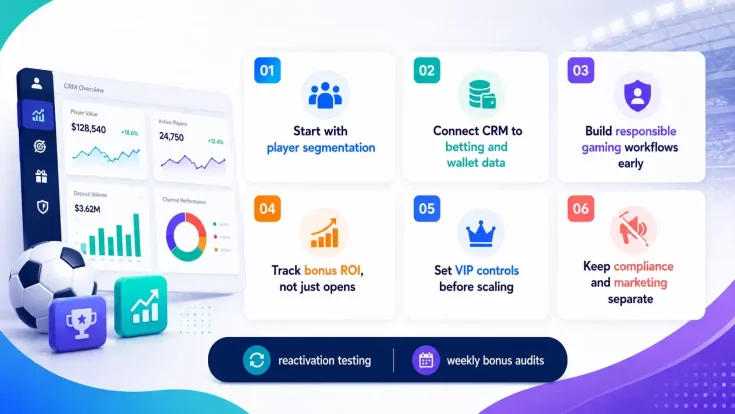
Best practices for sportsbook CRM implementation
Sportsbook CRM KPIs to track
Eight metrics tell the operator whether the CRM is doing its job. Track them by cohort and by sport, not just at the aggregate level.
| KPI | Why it matters |
|---|---|
| Player retention rate | Shows how many users keep betting month over month; the headline CRM metric |
| Churn rate | Identifies inactive or lost users; drives win-back budgets |
| Average revenue per user (ARPU) | Measures user value across cohorts and sport segments |
| Deposit frequency | Indicates payment and engagement health; leading indicator of churn |
| Bonus conversion rate | Measures how often issued bonuses lead to qualifying wagers |
| Bonus abuse rate | Protects margin from professional abusers and stacking patterns |
| Player lifetime value (LTV) | Forecasts long-term revenue per cohort; sets acquisition budget ceilings |
| Reactivation rate | Measures effectiveness of win-back campaigns by recency band |
How SDLC Corp builds sportsbook CRM software
Frequently asked questions
What is sportsbook CRM software?
Sportsbook CRM software is a customer relationship management system built for sports betting operators. It manages player data, automates campaigns, segments bettors by behavior and value, personalizes offers, monitors risk, supports compliance workflows and drives retention. Unlike generic CRM tools, it operates on real-time betting events - bet placed, deposit, settled wager - not batched contact lists.
How is sportsbook CRM different from generic CRM?
The data, the workflows and the integrations are different. Sportsbook CRM operates on betting behavior (sport preference, stake size, frequency, live vs pre-match), wallet data (deposit cadence, withdrawal patterns), KYC and AML status, and responsible-gambling risk signals. Generic CRM tracks contacts, leads and sales-stage progression. The two systems share the "automation" idea but almost nothing else.
What features should sportsbook CRM software include?
At minimum: player segmentation by behavior and value, campaign automation with real-time triggers, bonus management with rollover and abuse controls, VIP workflows, responsible-gambling alerts, churn prediction, omnichannel delivery (email, SMS, push, WhatsApp, in-app) and an analytics dashboard covering retention, lifetime value and bonus ROI by cohort.
How much does sportsbook CRM software cost?
Sportsbook CRM projects fall into four tiers: basic CRM module ($10k–$25k), mid-level sportsbook CRM ($25k–$60k), advanced custom CRM ($60k–$150k+) and enterprise CRM with AI, VIP and risk automation ($150k+). Cost drivers include number of integrations, automation depth, bonus engine logic, compliance scope, AI features and the number of communication channels.
Can sportsbook CRM integrate with an existing betting platform?
Yes. Integration runs through REST APIs, webhooks, wallet sync, KYC/AML provider hooks, payment gateway events and bonus engine endpoints. A good integration architecture connects the CRM to bet events in close to real time so campaigns can be triggered on settled wagers and live betting behavior, not batched overnight syncs.
Is sportsbook CRM useful for startups?
Yes - arguably more useful for startups, because the unit economics are tighter. Acquisition is expensive, and the first six months of retention determines whether the operation reaches break-even. Startups should prioritize first-deposit retention, second-bet conversion and lifecycle automation over heavy bonus campaigns.
What is the difference between sportsbook CRM and iGaming CRM?
Sportsbook CRM focuses on sports betting workflows: pre-match and live wagering, sport preferences, odds boosts, free bets and bet-event triggers. iGaming CRM is broader and may also cover casino, poker, lottery and fantasy sports inside one system. An operator running multiple verticals usually needs an iGaming CRM with a sportsbook-specific module; an operator running only a sportsbook needs sportsbook CRM.
Build the CRM that runs the player lifecycle, not just the contact list
The shortest path to a CRM that actually moves the player lifecycle: event-driven integration, sportsbook-specific workflows, and the compliance and analytics scaffolding the operation needs from day one.