Enterprise CRM initiatives rarely succeed because of software selection alone. Long-term business value depends on selecting a development partner that can align technology with business processes, integrations, data quality, and ongoing optimization.
This guide is designed for CIOs, IT leaders, sales operations teams, and procurement decision-makers evaluating CRM development companies. Vendors were assessed using a transparent framework covering implementation expertise, platform specialization, integration capabilities, customer evidence, and post-launch support to help buyers make an objective, evidence-based decision.
Editorial Note: SDLC Corp is the publisher of this guide and is included as one of the evaluated CRM development companies. Rankings and assessments are based on the evaluation methodology described in this article, using publicly available information, official partner ecosystems, customer references, and independent industry recognition available at the time of publication.
Key Takeaways
- Prioritize proven implementation experience over platform certifications alone.
- Evaluate integration capabilities and post-launch support alongside technical expertise.
- Match your CRM development partner to your organization's size, complexity, and long-term goals.
- Compare vendors using consistent, evidence-based evaluation criteria rather than marketing claims.
How to Choose the Right CRM Development Companies
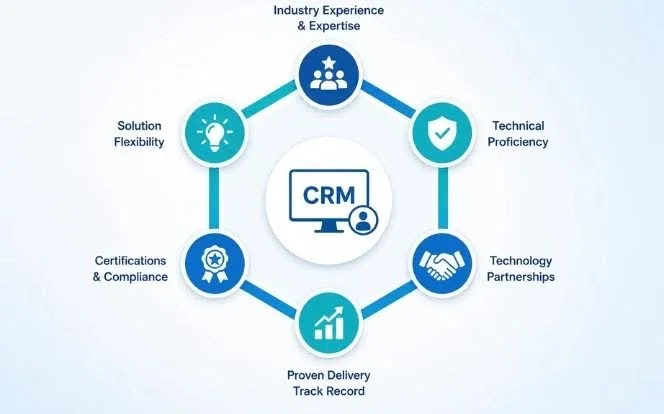
Choosing a CRM development companies means more than looking at certifications or costs. The ideal partner needs to have a proven track record of implementation, integration capabilities, and a long-term business growth strategy. When considering vendor shortlists, review the following six areas:
- Business objectives: Ensure the partner is aware of your growth objectives, operational challenges, and CRM use cases.
- CRM platform expertise: Verify current certifications and partner status through official Salesforce, Microsoft, HubSpot, or Zoho partner directories.
- Enterprise integration capabilities: Share your experience of integrating CRM with ERP, marketing automation, customer support, and other business systems.
- Industry experience: Prioritize partners with implementation experience in your industry and regulatory environment.
- AI and automation readiness: Evaluate readiness for AI in workflows, predictive analytics, copilots, and intelligent automation where applicable.
- Post-launch optimization: Confirm the availability of managed support, user training, SLAs, continuous optimization, and performance monitoring.
Evaluation Criteria
| Evaluation Criteria | Weight |
|---|---|
| Implementation Experience | 25% |
| CRM Platform Expertise | 20% |
| Integration Capability | 15% |
| Industry Experience | 15% |
| AI & Automation Readiness | 10% |
| Post-Launch Support | 10% |
| Customer Evidence & Recognition | 5% |
Apply this scorecard to all vendors in a consistent way. Give each criterion a score from 1 to 5, multiply by the weight, and calculate the total score for each option to make a fairer choice.
CRM Vendor Selection Checklist
- Determine business goals first before involving vendors.
- Verify platform certifications and official partner status.
- Review the experience of integration with other enterprise systems.
- Confirm post-launch support, SLAs, and training.
- Request customer references from projects similar to yours.
Enterprise CRM Development Companies to Consider (2026)
1. SDLC Corp
Headquarters: San Francisco, California, USA
Core CRM Expertise: Salesforce consulting, custom development, CRM integration, and ERP consulting services.
Platform Specialization: Salesforce, Odoo CRM, Microsoft Dynamics.
Best Fit: Mid-market and enterprise organizations requiring integrated CRM and ERP transformation.
Key Strengths: Delivers end-to-end CRM programs covering strategy, implementation, integration, migration, and managed support. The company reports 500+ completed projects and a 96% client retention rate, with additional expertise in AI-enabled business solutions.
Considerations: CRM is part of a broader enterprise software portfolio. Buyers should confirm dedicated Salesforce resources for large, multi-country implementations.
Notable Recognition: Salesforce Agentforce World Tour participant; featured on Clutch, GoodFirms, and SelectedFirms.
2. CloudMasonry
Headquarters: Indianapolis, Indiana, USA
Core CRM Expertise: Salesforce implementation, optimization, and managed services.
Platform Specialization: Salesforce, Data Cloud, Agentforce.
Best Fit: Organizations committed to a Salesforce-first CRM strategy.
Key Strengths: Strong Salesforce specialization supported by AI, data, and automation capabilities, with recognition from G2 and UpCity for consulting excellence.
Considerations: Best suited to Salesforce ecosystems rather than organizations evaluating multiple CRM platforms.
Notable Recognition: G2 High Performer; UpCity Top Salesforce Consulting Firm.
3. Simplus
Headquarters: Salt Lake City, Utah, USA
Core CRM Expertise: Salesforce Revenue Cloud, CPQ, Billing, Sales Cloud, and Service Cloud.
Platform Specialization: Salesforce.
Best Fit: Large enterprises running complex global CRM transformation programs.
Key Strengths: Extensive experience delivering multi-cloud Salesforce implementations supported by Infosys' global consulting network.
Considerations: Engagement model and pricing are generally better suited to enterprise-scale initiatives.
Notable Recognition: IDC MarketScape Leader for Salesforce implementation services.
4. OSF Digital
Headquarters: Québec City, Québec, Canada
Core CRM Expertise: Salesforce advisory, implementation, AI, Data Cloud, and managed services.
Platform Specialization: Salesforce Customer 360 ecosystem.
Best Fit: Global organizations seeking a dedicated Salesforce consulting partner.
Key Strengths: More than two decades of Salesforce delivery experience with deep retail, automotive, and financial services expertise.
Considerations: Focuses exclusively on Salesforce technologies rather than multi-platform CRM environments.
Notable Recognition: Multiple Salesforce partnership and innovation awards.
5. Valtech
Headquarters: Paris, France
Core CRM Expertise: CRM-enabled customer experience, commerce, and digital transformation.
Platform Specialization: Salesforce, Microsoft, Adobe, Google Cloud, Optimizely.
Best Fit: Enterprises combining CRM modernization with broader customer experience initiatives.
Key Strengths: Strong cross-platform consulting capabilities that integrate CRM with digital commerce, marketing, and customer experience programs.
Considerations: Better suited to enterprise transformation than standalone CRM implementation projects.
Notable Recognition: Fast Company's Best Workplaces for Innovators.
6. Perficient
Headquarters: St. Louis, Missouri, USA
Core CRM Expertise: Enterprise CRM consulting, AI-enabled customer engagement, and cloud integration.
Platform Specialization: Salesforce, Microsoft Dynamics 365, Oracle CX.
Best Fit: Large enterprises integrating CRM into broader cloud and AI modernization programs.
Key Strengths: Combines CRM implementation with enterprise architecture, cloud, analytics, and AI expertise across Fortune 500 organizations.
Considerations: CRM represents one practice within a larger digital consulting portfolio.
Notable Recognition: Official partner across Salesforce, Microsoft, Oracle, Adobe, AWS, and Google Cloud.
7. NeuraFlash
Headquarters: Burlington, Massachusetts, USA
Core CRM Expertise: Salesforce Sales Cloud, Service Cloud, Agentforce, and AWS-powered customer service solutions.
Platform Specialization: Salesforce, AWS.
Best Fit: Organizations prioritizing AI-driven customer service and sales transformation.
Key Strengths: Recognized for AI-first Salesforce implementations, combining CRM with generative AI and contact center modernization.
Considerations: Following its acquisition by Accenture, buyers should understand the current delivery and engagement model.
Notable Recognition: Salesforce Summit Partner; AWS Advanced Tier Partner.
8. Coastal
Headquarters: Palm Coast, Florida, USA
Core CRM Expertise: Salesforce implementation, Data Cloud, Revenue Cloud, Agentforce, and managed services.
Platform Specialization: Salesforce, Snowflake.
Best Fit: Enterprises with complex, data-intensive Salesforce environments.
Key Strengths: Strong implementation scale, extensive AppExchange customer ratings, and deep expertise in healthcare, nonprofit, and financial services.
Considerations: Following its acquisition by Tata Consultancy Services, buyers should evaluate how Coastal Cloud's Salesforce expertise aligns with TCS's broader global consulting and delivery model, particularly for enterprise-scale engagements.
Notable Recognition: ISG Provider Lens Salesforce Leader.
9. Aquiva
Headquarters: Orlando, Florida, USA
Core CRM Expertise: Salesforce engineering, AI-native CRM development, Data Cloud, and enterprise integrations.
Platform Specialization: Salesforce.
Best Fit: Growth-stage and enterprise organizations seeking AI-enabled Salesforce engineering.
Key Strengths: Engineering-led delivery model supported by Salesforce certifications, SOC 2 compliance, and strong customer satisfaction.
Considerations: Buyers with highly complex, global transformation programs should validate delivery scale and governance capabilities.
Notable Recognition: Salesforce Expert Navigator and Select Partner.
10. VISEO
Headquarters: Boulogne-Billancourt, France
Core CRM Expertise: Salesforce implementation, customer experience transformation, integration, and data consulting.
Platform Specialization: Salesforce, MuleSoft, Anaplan.
Best Fit: Multinational organizations requiring regional delivery supported by a global consulting model.
Key Strengths: Combines CRM implementation with ERP, analytics, and AI expertise, making it suitable for complex enterprise transformation initiatives.
Considerations: CRM is one part of a broader business transformation portfolio rather than its sole specialization.
Notable Recognition: Enterprise Salesforce delivery across multiple regions, including public-sector transformation projects in Asia-Pacific.
Note: Rankings reflect the evaluation criteria presented above and are based on publicly available evidence at the time of publication. The order is intended to assist buyers in comparing providers using a consistent methodology rather than to represent a definitive industry ranking.
CRM Development Partner Comparison Matrix

| Company | Primary CRM Expertise | Ideal Project Size | Global Delivery | Best For |
|---|---|---|---|---|
| SDLC Corp | Salesforce, Odoo, Dynamics 365 | Enterprise | Yes | CRM + ERP modernization |
| CloudMasonry | Salesforce | Medium–Large | Regional | Salesforce implementation |
| Simplus | Salesforce | Large | Yes | Complex enterprise rollouts |
| OSF Digital | Salesforce | Large | Yes | Global Salesforce programs |
| Valtech | Salesforce, Dynamics 365 | Large | Yes | CRM + CX transformation |
| Perficient | Salesforce, Dynamics 365 | Enterprise | Yes | Enterprise digital transformation |
| NeuraFlash | Salesforce | Medium–Large | Regional | AI-driven Salesforce projects |
| Coastal | Salesforce | Medium–Large | Yes | Data-intensive Salesforce deployments |
| Aquiva | Salesforce | Small–Medium | Regional | Fast AI-enabled CRM delivery |
| VISEO | Salesforce, Dynamics 365 | Enterprise | Yes | Multinational and government projects |
How to Interpret This Matrix
Use this matrix to identify the best-fit provider, not the company with the highest number of high ratings. Start by selecting vendors that align with your existing CRM ecosystem, then compare integration capability, AI readiness, and delivery scale based on your project's complexity.
Based on publicly available service portfolios at the time of writing, Salesforce remains the primary CRM specialization for most companies evaluated, while Perficient and Valtech also maintain established Microsoft Dynamics 365 practices.
Find the Best-Fit CRM Partner for Your Organization Type
Growth-Stage Companies
Aquiva for quick implementation and AI-based engineering.
Scaling Organizations
CloudMasonry and Coastal for flexible integrations and Salesforce expertise.
Large Enterprises
Perficient, Simplus, and OSF Digital for global delivery, governance, and complex transformation programs.
Regulated Industries
Coastal and Simplus for sector-specific implementation experience in healthcare, financial services, nonprofit, and public sector environments.
Why Enterprises Choose SDLC Corp
We align our CRM delivery approach with the same evaluation framework used throughout this guide:
- Enterprise CRM expertise: We deliver Salesforce consulting services, custom CRM development, implementation, migration, and optimization for organizations with complex business requirements.
- Multi-platform capabilities: We integrate CRM platforms with ERP systems, APIs, cloud applications, and other enterprise technologies to create connected business workflows.
- AI-enabled CRM solutions: We build AI-powered automation and intelligent workflows that support sales, service, and operational efficiency.
- Enterprise integration methodology: Our approach includes solution planning, data migration, system integration, testing, and governance to reduce implementation risk.
- Long-term optimization and support: We provide managed services, user training, performance optimization, and ongoing enhancements to help organizations maximize the long-term value of their CRM.
Conclusion
Successful CRM initiatives are built on implementation quality, integration planning, and continuous optimization, not platform selection alone. Rather than relying on vendor claims, use the evaluation framework and comparison matrix in this guide to assess each provider against your organization's business objectives, technical environment, and future growth plans before making a long-term CRM investment.
FAQ
1. What should we look for when choosing a CRM development company?
Choose a CRM development company based on implementation experience, platform expertise, integration capabilities, industry knowledge, post-launch support, and customer success. Rather than focusing only on certifications or pricing, evaluate whether the partner can align CRM technology with your business processes, existing systems, and long-term growth objectives.
2. Which CRM platforms do leading CRM development companies support?
Most enterprise CRM development companies specialize in platforms such as Salesforce, Microsoft Dynamics 365, HubSpot, Zoho CRM, and Odoo. The right platform depends on your business size, operational requirements, integration needs, budget, and future scalability rather than popularity alone.
3. How much does it cost to hire a CRM development company?
CRM development costs vary depending on project scope, platform complexity, customization, integrations, data migration, and ongoing support requirements. Small implementations may require limited customization, while enterprise CRM transformation projects typically involve multi-system integrations, governance, user training, and long-term optimization.
4. Why is post-launch CRM support important?
CRM success depends on continuous optimization after deployment. Post-launch services such as performance monitoring, user training, system enhancements, security updates, and integration maintenance help organizations improve user adoption, maintain data quality, and maximize long-term return on their CRM investment.
5. How can we compare CRM development companies objectively?
Use a consistent evaluation framework that assesses implementation expertise, platform specialization, integration capability, industry experience, AI readiness, customer references, and post-launch support. Comparing vendors against the same criteria makes it easier to identify the partner that best fits your organization's technical and business requirements.