
ERP implementation failures rarely happen because of the software alone. They usually begin when organizations treat enterprise resource planning as a technical deployment instead of a business transformation involving people, processes, data, and governance.
This guide explains the main reasons ERP projects fail and provides practical ways to reduce risk, improve user adoption, and achieve stronger long-term business value.
Quick answer: ERP implementation fails when organizations prioritize software deployment over business readiness, governance, and operational change. The most common causes are unclear objectives, misalignment between scope and business needs, weak data governance, ineffective change management, and low user adoption. Successful ERP programs require executive sponsorship, disciplined scope control, strong business ownership, and continuous optimization from planning through post-go-live.
Key takeaways
- ERP implementation failure often begins during planning, long before system configuration or deployment starts.
- Effective ERP governance aligns decision-making, controls scope, and reinforces business ownership throughout the lifecycle.
- Data quality, integrations, and rigorous testing are essential for achieving operational readiness before go-live.
- ERP user adoption depends on change management, business ownership, and process alignment, not training alone.
- Long-term success requires continuous optimization, KPI measurement, and post-go-live value realization.
The six pillars of ERP implementation success
Click to read the full explanation
The six pillars of ERP implementation success
The six pillars below are part of the SDLC Corp ERP methodology and provide a practical model for improving ERP implementation success, project recovery, and long-term value realization.
Analysis of ERP implementation planning guidance from Oracle, along with industry research from Microsoft and NetSuite, shows that ERP implementation failure is rarely caused by software alone. Instead, successful outcomes depend on disciplined execution across six connected business capabilities.
Because each pillar behaves differently, the sections below show which decisions move the ERP program in the organization's favor, from preventing failure to recovering at-risk projects and choosing the right implementation partner.
The six pillars in detail
The six pillars bring these recurring principles together into a practical model for preventing ERP implementation failure, strengthening an ERP implementation process, supporting ERP project recovery, and evaluating implementation partners.
Strategic business alignment
- Set measurable business outcomes before implementation.
- Align scope and processes with long-term strategy.
ERP implementation governance
- Assign executive sponsorship and clear decision ownership.
- Control scope, budget, risk, and accountability.
Process & master data readiness
- Validate future-state processes before configuration.
- Clean, own, and govern master data early.
Technology & enterprise integrations
- Select the platform based on business and process fit.
- Design integrations early and prioritize configuration.
People & change adoption
- Start change management from project kickoff.
- Use role-based training and consistent communication.
Continuous benefits realization
- Define KPIs and benefits ownership before go-live.
- Review performance and optimize continuously.
Industry perspective. Leading ERP research consistently shows that organizations achieve better outcomes when governance, business ownership, data readiness, change management, and continuous optimization receive the same level of attention as the technology implementation itself.
ERP implementation success framework
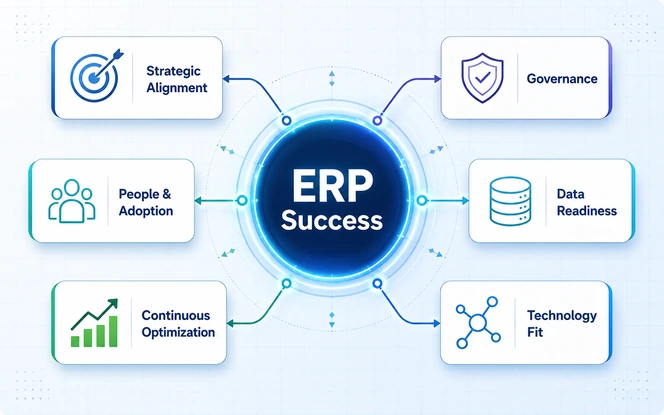
Suggested visual: A clear ERP success framework showing how business alignment, governance, data readiness, technology fit, adoption, and continuous optimization work together.
Planning an ERP program? Start with business readiness, not software.
SDLC Corp aligns objectives, governance, data, and adoption before configuration begins.
The 10 root causes of ERP implementation failure
ERP implementation failure rarely results from a single mistake. Most unsuccessful projects develop multiple risks across strategy, governance, process readiness, technology, and organizational adoption long before go-live. The mapping below links each recurring failure pattern to the pillar that prevents it.
| Root cause | Six-pillar mapping |
|---|---|
| Undefined business outcomes | Strategic alignment |
| ERP scope creep | Strategic alignment |
| Weak executive sponsorship | Governance |
| Poor decision ownership | Governance |
| Poor master data quality | Process & data readiness |
| Excessive customization | Technology & integration |
| Weak ERP integration strategy | Technology & integration |
| Incomplete UAT | Technology & integration |
| Weak user adoption | People & change |
| No benefits-realization ownership | Continuous realization |
Teams discuss features instead of measurable business outcomes.
Investment loses direction, increasing cost and reducing value.
Define measurable goals and align scope with business strategy.
New features and integrations are added after planning ends.
Uncontrolled scope increases risk, cost, and delivery delays.
Use change control and assess each request for value.
Steering meetings are delayed or lack executive attendance.
Slow decisions and weak ownership increase implementation risk.
Assign an executive sponsor for governance and outcomes.
Issues repeat because decision authority remains unclear.
Decision delays create bottlenecks, scope drift, and overruns.
Define clear decision rights, ownership, and accountability.
Data cleansing starts only shortly before migration.
Migration effort, reporting errors, and disruption increase.
Assign data owners and cleanse data early.
Teams customize the ERP to copy every legacy process.
Complexity rises while upgrades and maintenance become harder.
Prioritize configuration and customize only for real value.
Integration planning begins after configuration is already underway.
Data silos, reporting gaps, and inefficiency remain.
Plan integrations during design using secure standard methods.
Testing is shortened to protect the planned go-live date.
Defects, workflow failures, and data issues appear after launch.
Make UAT mandatory before approving go-live.
Employees train but continue using legacy workarounds.
Low adoption reduces productivity and delays ROI.
Combine role-based training, communication, and sponsorship.
Project governance stops immediately after go-live.
Value goes unmeasured and optimization opportunities remain hidden.
Assign benefits owners, track KPIs, and optimize continuously.
Executive insight. Most ERP implementation failures result from weaknesses across multiple pillars rather than a single technical issue. Strengthening strategy, governance, data readiness, technology, adoption, and continuous optimization together significantly improves implementation success and long-term value.
Where ERP implementations fail across the lifecycle
ERP implementation failure rarely occurs at a single stage. Risks accumulate throughout the lifecycle, from planning and discovery to deployment and post-go-live optimization. The phases below highlight where organizations are most likely to encounter challenges and how ERP implementation best practices can reduce delivery risk.
| Lifecycle phase | Common failure risk | Executive prevention priority |
|---|---|---|
| Planning | Undefined objectives and unrealistic scope | Define measurable outcomes before implementation begins |
| Discovery | Incomplete business requirements | Validate requirements through cross-functional workshops |
| Solution design | Excessive customization | Prioritize standard processes before approving custom work |
| Configuration | Uncontrolled scope changes | Apply formal change control and governance |
| Data migration | Poor data quality and migration delays | Complete cleansing and validation early |
| Testing | Incomplete system and user validation | Run full SIT, UAT, and cutover testing before go-live |
| Go-live | Low organizational readiness | Validate readiness, run a structured cutover, provide hypercare |
| Optimization | No ownership for business outcomes | Monitor KPIs, assign benefits ownership, keep optimizing |
Each phase maps to one or more of the six pillars, reinforcing that ERP success depends on disciplined planning, governance, data readiness, testing, adoption, and continuous optimization, not technology deployment alone.
ERP risk and recovery lifecycle
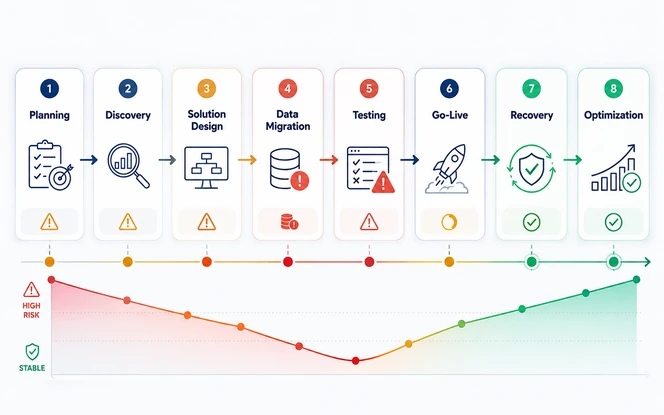
Suggested visual: An ERP lifecycle roadmap highlighting common risks across planning, discovery, design, migration, testing, go-live, recovery, and optimization.
How to recover an ERP project that is off track
Not every struggling ERP project needs a complete replacement, especially when a structured ERP implementation process can identify a practical recovery path. The right recovery strategy depends on assessing process fit, data quality, integration stability, customization, user adoption, supportability, remediation cost, and long-term platform fit. Use these four paths to decide the most appropriate route.
Resolve critical operational issues while keeping the current ERP platform stable and running.
Improve configuration, reporting, workflows, and adoption while the ERP platform remains a strong fit.
Redesign the ERP solution when it no longer aligns with business processes or strategic objectives.
Replace the ERP platform when scalability, integration, or long-term business fit cannot be restored.
Executive insight. Recovery decisions should prioritize long-term business value over short-term cost, supported by a realistic ERP cost assessment that keeps technology, governance, and operational processes aligned with future objectives. Organizations recovering from failure often benefit from experienced ERP consulting to stabilize delivery, improve adoption, and reduce future project risk.
ERP project off track? A structured recovery beats a restart.
We assess fit, data, integrations, and adoption to choose stabilize, optimize, reimplement, or replace.
How SDLC Corp supports ERP implementation and recovery
SDLC Corp helps organizations plan, implement, optimize, and recover enterprise ERP initiatives using the principles of the six pillars.
- ERP consulting services: align business objectives, processes, and implementation strategy.
- End-to-end implementation: configuration, deployment, testing, and go-live support.
- Customization, migration & integration: modernize legacy systems and connect enterprise applications through APIs and third-party platforms.
- Post-go-live optimization & support: focused on user adoption, performance improvements, and continuous business value.
- Broader engineering expertise: cloud services, custom applications, automation, and connected enterprise solutions for complex ERP environments.
- Proven multi-industry experience: deployments across manufacturing, retail, logistics, healthcare, finance, hospitality, construction, and professional services.
How to measure ERP success after go-live
Go-live is the beginning of ERP value realization, not the end of the implementation. Establish success metrics before deployment and measure performance continuously against the original business case, evaluating success across four areas.
- Process cycle time
- Workaround reduction
- Achievement of defined outcomes
- Inventory accuracy
- Financial close time
- Transaction accuracy
- Support volume
- Active user adoption
- Reduction in manual workarounds
- Time to Value
- Total Cost of Ownership (TCO)
- Return on Investment (ROI)
Conclusion
Why ERP implementations fail is rarely determined by the software itself. Sustainable ERP success depends on strong business alignment, disciplined governance, organizational readiness, high-quality data, structured testing, effective user adoption, and continuous benefits realization.
Organizations that apply the six pillars are better positioned to reduce implementation risk, improve operational performance, and maximize long-term business value.
ERP implementation failure FAQ
Why do ERP implementations fail even when the software is working?
ERP implementations fail when business goals, governance, data quality, testing, and user adoption are not aligned, even if the software performs exactly as expected. The technology working is not the same as the organization being ready to run on it.
What are the most common ERP implementation challenges for enterprise projects?
The biggest challenges include scope creep, poor data quality, weak executive sponsorship, integration issues, inadequate testing, and low user adoption. Most enterprise projects face several of these at once rather than a single isolated problem.
How can businesses reduce ERP implementation failure before go-live?
Businesses reduce failure risk by defining clear objectives, strengthening governance, preparing clean data, completing UAT, and managing organizational change effectively. These steps address the business readiness that determines whether the software succeeds.
How do you choose the right ERP implementation partner for your business?
Choose a partner with proven industry experience, strong governance, integration expertise, structured delivery, and reliable post-go-live support. Fit with your business processes and change readiness matters more than a feature checklist alone.
How should organizations measure ERP implementation success after go-live?
Measure success using KPIs such as process efficiency, user adoption, inventory accuracy, financial close time, TCO, and ROI. Tracking these against the original business case shows whether the ERP is delivering long-term value.