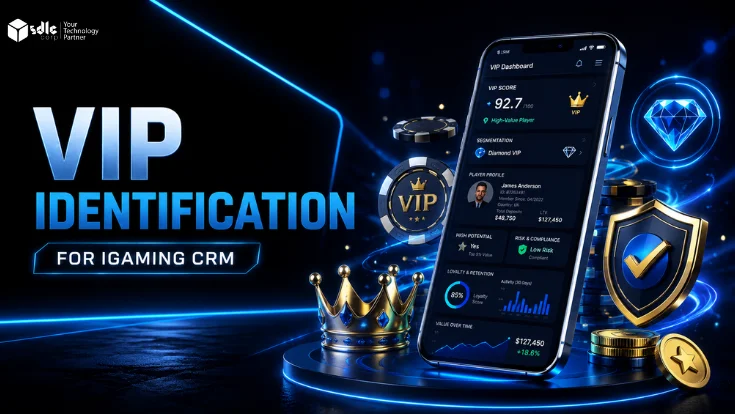
VIP identification for iGaming CRM should detect emerging high-value players inside the first-week window not after lifetime revenue makes them obvious. Combine deposits, sessions, stake profile, RFM, trajectory, and risk signals into a single real-time score, then separate emerging VIPs from confirmed VIPs to apply review gates such as KYC, affordability, AML, and safer-gambling before any treatment is triggered.
VIP identification for iGaming CRM is the process of detecting players who are already high-value, or showing early signs of becoming high-value, using deposits, wagering, sessions, product activity, risk signals, and real-time CRM data.
It helps operators decide which players need account review, loyalty evaluation, responsible-gambling checks, and early retention attention before the first-week window is lost.
Key Takeaways
- VIP identification should detect emerging high-value players before lifetime revenue makes them obvious.
- Revenue-only filters are useful for reporting, but they are often too late for early action.
- Predictive scoring works better when deposits, sessions, stake profile, RFM, trajectory, and risk signals are reviewed together.
- Emerging VIP and confirmed VIP segments should stay separate to avoid over-promoting unreviewed players.
- Responsible-gambling checks must sit inside VIP workflows because high-value signals may also show player-risk concerns.
What Is VIP Identification in iGaming CRM?
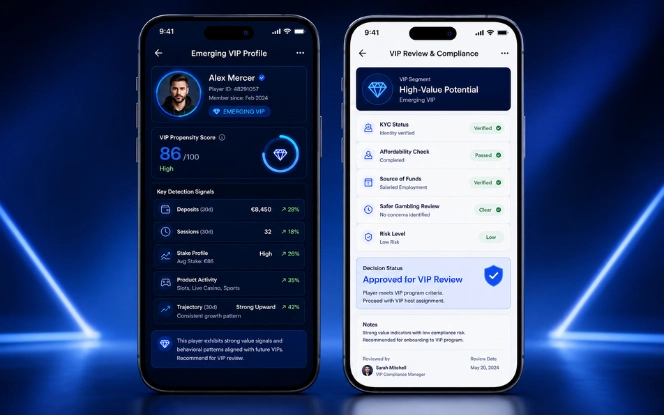
VIP identification in iGaming CRM is the detection layer that finds players with high-value potential before VIP management, loyalty, and retention workflows begin. Instead of relying on one deposit threshold, it combines value and risk signals into a single player view.
Based on that profile, the CRM can route each player into an emerging VIP segment, a confirmed VIP segment, or a review queue. If you need the base CRM concept first, read what is iGaming CRM.
For the wider platform layer, see SDLC Corp's iGaming CRM software.
The right question is not only who spends the most? It is who shows strong value potential, who needs review, and who may require player-protection checks before VIP treatment starts.
Why Early VIP Detection Matters
Early VIP detection matters because high-value players can affect revenue, support workload, retention, and risk monitoring from the first few sessions. If the CRM finds them late, the operator may miss the best time to build the relationship.
A player's first sessions are important. During this period, they test deposit speed, lobby quality, support response, rewards, and trust. If the experience feels slow or generic, they may move to another operator.
Early identification gives the team a faster control point. It can trigger account-manager review, emerging VIP segmentation, safer-gambling checks, KYC review, enhanced due diligence, and personalized onboarding before the player loses interest.
As a result, VIP identification becomes a control system, not only a marketing tool. It helps operators decide when to engage, when to review, when to pause, and when to protect the player.
In practical iGaming CRM builds, early VIP identification works best when deposit activity, session frequency, stake movement, campaign response, KYC status, and risk markers are reviewed inside one player profile. This gives CRM teams an earlier review point during the first-week activity window, instead of waiting for lifetime revenue reports to confirm value later.
Revenue-Based vs Predictive VIP Identification
Many operators still use revenue-based VIP identification. They sort players by deposit total, wagering volume, net gaming revenue, or lifetime value. Then they apply a threshold and create a VIP list.
This method is useful for confirmed VIP reporting. It is too slow for early detection because it answers only one question: who has already generated the most value?
Predictive VIP identification asks a better question: who is showing high-value behavior now? A new player may not have enough lifetime value yet, but their first-week behavior may already look similar to your best long-term players.
| Area | Revenue-Based VIP Identification | Predictive VIP Identification |
|---|---|---|
| Main question | Who has already spent the most? | Who is behaving like a future high-value player? |
| Main inputs | Deposits, wagering, NGR, lifetime value | Deposits, sessions, stake profile, product use, trajectory, risk signals |
| Timing | Late | Early |
| Best use | Confirmed VIP lists and reporting | Early detection and segmentation |
| CRM setup | Static filters | Real-time scoring and event-based triggers |
| Main risk | VIPs found too late | False positives if review rules are weak |
| Best result | Known VIPs are tracked | Emerging VIPs are found sooner |
The strongest model uses both methods. Revenue data confirms value, while predictive signals detect potential value earlier.
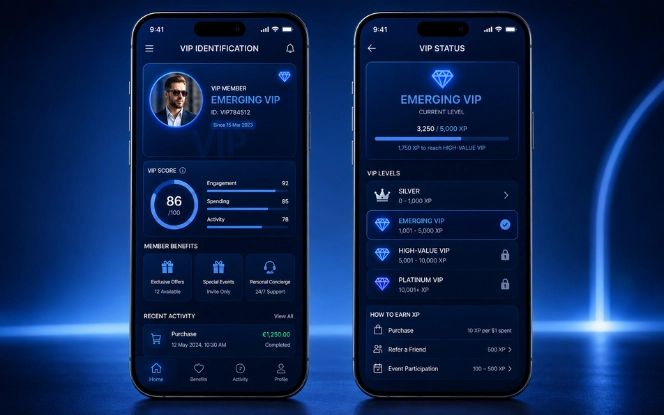
Key Signals for VIP Identification
A strong iGaming CRM uses multiple signal groups. Each signal alone can be misleading. Together, they help the CRM build a more accurate player profile and reduce weak VIP decisions.
1. Monetary Signals
Monetary signals show financial activity, including first-deposit size, deposit frequency, re-deposit speed, average stake size, total wagered amount, NGR, and lifetime value. These signals matter, but they should not decide VIP status alone.
A high first deposit may suggest value. Still, the CRM should also check whether the player returns, deposits again, plays consistently, and passes risk checks.
2. Behavioural Signals
Behavioural signals often appear before lifetime value becomes clear. Session count, login frequency, time from registration to first wager, bet velocity, game preference, campaign response, and support activity all show how the player uses the platform.
For example, a player who deposits quickly, returns the next day, and places above-average stakes may deserve early review even when lifetime value is still low.
3. Product and Game-Mix Signals
Product preference helps the CRM understand player quality and intent. Casino, sportsbook, live casino, table games, high-value sports markets, and multi-product usage can show deeper engagement.
Product mix should always be reviewed with value, frequency, trajectory, and risk signals.
4. RFM Signals
RFM stands for Recency, Frequency, and Monetary value. It helps the CRM measure how recently a player was active, how often they return, and how much value they generate.
RFM is useful as a base model. It works better when combined with real-time behavior, LTV scoring, risk checks, and product-specific data.
5. Trajectory Signals
Trajectory shows whether player activity is rising, flat, or falling. Deposit growth, rising stake size, higher session frequency, faster re-deposit behavior, or a sudden drop after strong activity can all change the VIP score.
This is one of the strongest signals for early VIP detection because steady upward movement is often more useful than one large deposit.
6. Risk and Compliance Signals
VIP identification must include risk and compliance signals. Safer-gambling markers, affordability triggers, rapid deposit escalation, unusual withdrawals, linked-account patterns, bonus-abuse signs, AML flags, self-exclusion status, and source-of-funds checks should all affect the final decision.
A player should not move into confirmed VIP treatment only because they spend more. The CRM should first check whether that spend appears sustainable, compliant, and safe.
How an iGaming CRM Should Identify VIP Players
Pricing also depends on how deep the CRM workflow goes, including data sources, real-time scoring, integrations, review gates, and automation. See our iGaming CRM pricing guide for the cost side.
- Build a unified player view. Combine registration, KYC, deposits, withdrawals, wagering, product activity, sessions, bonus usage, safer-gambling markers, AML flags, and predicted LTV into one profile. This should connect with the wider iGaming platform stack.
- Track real-time events. Update identification as behavior changes across deposits, stakes, sessions, withdrawals, bonus claims, KYC updates, and safer-gambling triggers.
- Create an emerging VIP score. Give each player a value-propensity rating that rises with strong deposits and engagement, then pauses or falls when risk signals appear.
- Separate emerging from confirmed VIPs. Emerging VIPs show strong potential but have not passed full review; confirmed VIPs have met value criteria and passed checks.
- Add review gates before treatment. Check KYC, source of funds, safer-gambling, affordability, bonus-abuse risk, and AML flags before confirmed treatment. For the technical control layer, read the compliance-by-design guide.
- Connect identification to journeys. A VIP flag must trigger the next action: review, monitoring, account-owner assignment, retention journey, or protection workflow.
Emerging VIP vs Confirmed VIP Segments
A common gap in many VIP workflows is that they discuss VIP treatment but do not clearly separate early-potential players from confirmed high-value players. Your CRM should use at least two VIP-related segments.
Emerging VIP
An emerging VIP shows early high-value potential, but the player still needs review. This segment is best for account-owner checks, safer-gambling review, KYC validation, monitored onboarding, and limited personalization.
Confirmed VIP
A confirmed VIP has met value criteria and passed the required checks. This segment can receive dedicated account management, loyalty tier placement, personalized retention journeys, and periodic risk reviews.
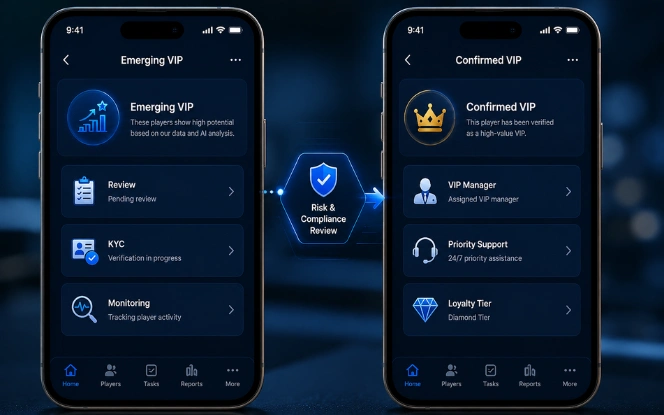
Worked Example: First-Week VIP Identification
A sportsbook and casino operator wants to identify high-value players earlier. Instead of waiting for lifetime value, the CRM reviews activity during the first seven days.
A player enters the emerging VIP review queue when several conditions appear together: three or more deposits in the first week, stake volume above the 90th percentile, above-average bet size, multiple active sessions, clean KYC, no safer-gambling marker, and no linked-account or bonus-abuse pattern.
Once the player enters the queue, the CRM notifies the team. The team reviews the profile before any VIP treatment starts. If the player continues to show consistent activity, passes checks, and maintains safe behavior, the CRM may promote them to confirmed VIP later.
If risk signals appear, the CRM can pause VIP treatment and route the player into review. This model gives operators earlier detection without removing control. It also supports stronger bonus abuse controls before rewards or priority support are triggered.
Turn first-week signals into a review workflow
SDLC Corp works with operators to define signals, scoring logic, and review gates that flag emerging VIPs earlier without over-promoting risky accounts.
Filtering Out False Positives and Bonus Abuse
Early VIP identification creates false-positive risk. Some players may look valuable in the first few sessions but never become high-value. Others may copy high-value behavior to access bonuses, rewards, or faster service.
A strong casino VIP CRM should include filters before meaningful VIP benefits are applied.
Device and IP Checks
Check whether multiple accounts share devices, IPs, payment methods, or location patterns. Unusual overlap may suggest account farming or coordinated abuse.
Deposit-to-Withdrawal Pattern
A player who deposits, clears a bonus, and withdraws quickly may need review before entering a VIP journey.
Bonus Usage Review
Bonus-heavy behavior should not automatically raise a VIP score. The CRM should check whether the player creates real value or only moves through offers.
Safer-Gambling Signals
Rapid spend growth, longer sessions, failed deposits, limit changes, or distress signals should route the player into protection workflows before VIP incentives.
The goal is not to block every strong player. The goal is to avoid treating risk as value. High-value player identification should always include fraud, bonus-abuse, affordability, and responsible-gambling review.
VIP Identification and Responsible Gambling
VIP identification and responsible gambling should work together. The same data that shows high-value potential may also show possible harm. Rising deposits, longer sessions, faster betting, and frequent re-deposits may signal an emerging VIP, but these signals may also require affordability checks, safer-gambling interaction, or customer review.
A responsible iGaming CRM should connect VIP identification with affordability monitoring, deposit-limit prompts, self-exclusion controls, AML review, enhanced due diligence, source-of-funds checks, support escalation, and full decision logs.
These checks should follow the regulator's customer interaction guidance, which explains how licensees should identify and act on signs of gambling harm.
No player should move into VIP treatment only because they spend more. They should also pass the operator's protection, due-diligence, and risk checks. This approach supports safer operations and aligns with the UK Gambling Commission's high-value customer guidance.
From VIP Identification to VIP Treatment
VIP identification is the trigger. VIP treatment is the next step. Once the CRM identifies a player as emerging or confirmed VIP, the operator can decide the right level of attention.
Emerging VIP Treatment
Emerging VIP treatment should stay measured. The player may receive account review, a personalized welcome, safer-gambling status checks, monitored onboarding, and manual approval before major benefits.
Confirmed VIP Treatment
Confirmed VIP treatment can include dedicated account management, VIP tier placement, priority support, personalized retention journeys, and periodic affordability checks.
This keeps VIP management structured. It also prevents the CRM from treating every early high spender as a confirmed VIP too soon.
From VIP Identification to Retention
VIP identification also supports retention. Once the CRM knows which players may be high-value, it can monitor early disengagement signals before the relationship goes cold.
VIP churn signals may include fewer logins, shorter sessions, slower deposits, smaller stakes, reduced campaign response, lower product activity, and withdrawal-only behavior. These signals should trigger review before the player becomes inactive.
This is why VIP identification should connect with player retention strategies. Operators cannot protect a high-value relationship if the CRM recognizes the player only after they have already gone quiet.
Measuring VIP Identification Performance
VIP identification should be measured and tuned over time. The model should not stay fixed because player behavior, market rules, bonus strategy, and product mix can change.
| Metric | What It Measures | Why It Matters |
|---|---|---|
| Detection latency | Time from signup to emerging VIP flag | Shows how fast the CRM finds potential value |
| Early-flag rate | Share of eventual VIPs flagged before revenue threshold | Measures predictive quality |
| False-positive rate | Share of flagged players who never become valuable | Controls waste and abuse risk |
| Emerging-to-confirmed VIP rate | Share of emerging VIPs promoted after review | Shows segment quality |
| Risk review pass rate | Share of flagged players who pass checks | Keeps VIP scoring safe |
| Predicted vs actual LTV | Gap between forecast value and real value | Improves the scoring model |
| VIP retention uplift | Retention difference between early and late identified VIPs | Connects detection to retention |
| VIP share of GGR | Revenue share from identified VIP segments | Shows commercial impact |
| Bonus cost per retained VIP | Bonus spend against retained high-value players | Controls over-incentivization |
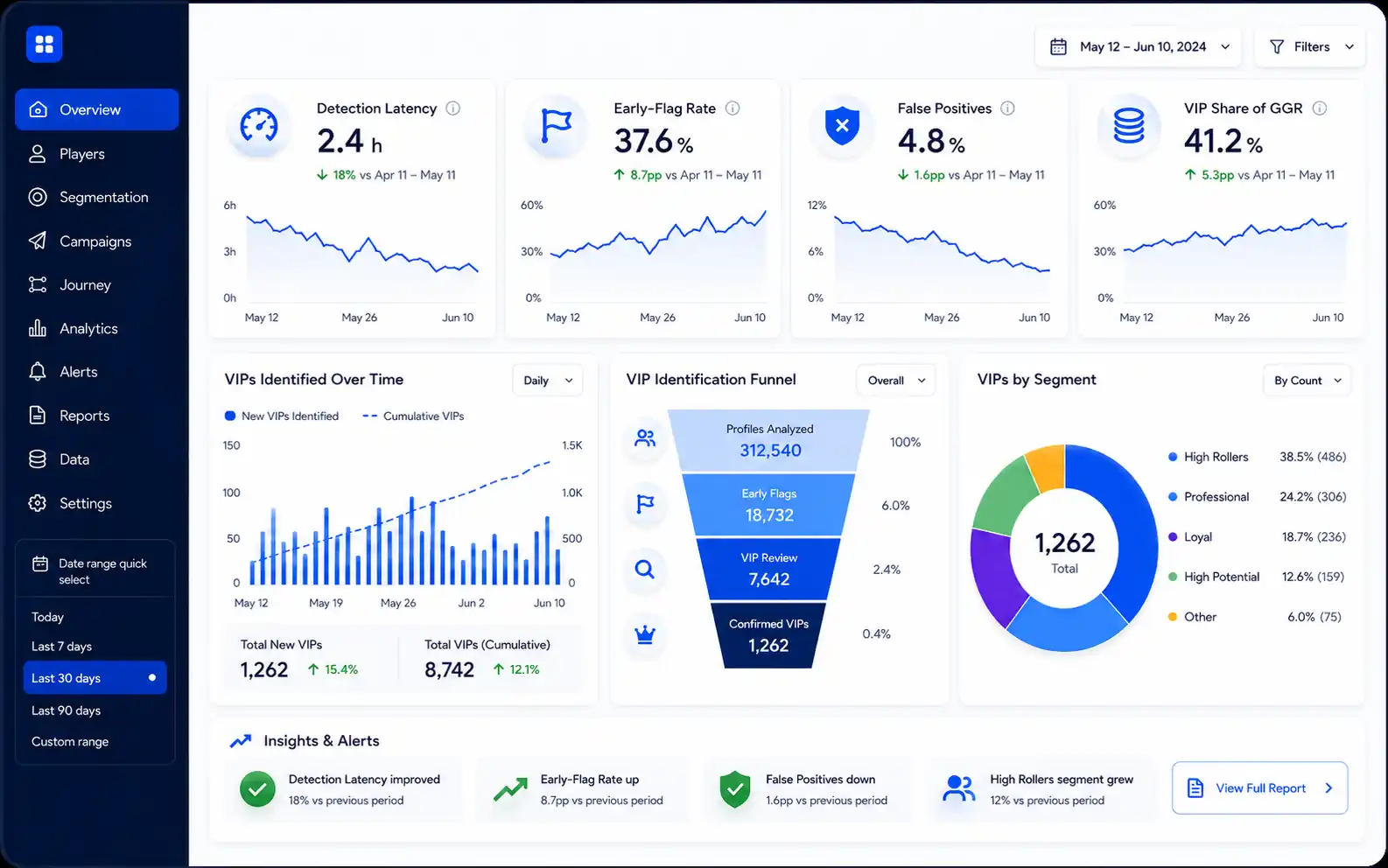
If detection is fast but false positives are high, the model may be too loose. If false positives are low but detection is slow, the model may be too conservative.
A good CRM team reviews these metrics regularly and adjusts rules, scores, and workflows based on real outcomes. For deeper analysis, connect VIP identification with a casino analytics guide so the CRM can compare predicted value with realized value over time.
VIP Identification Across the Player Lifecycle
VIP identification should run across the full player lifecycle. A player's value and risk profile can change, so the CRM should keep updating the segment from registration through retention.
Registration
Capture source, device data, location signals, consent status, and basic profile details.
First Deposit
Review deposit amount, payment method, timing, bonus use, and KYC status.
Activation
Track session count, game choice, stake profile, re-deposit speed, and campaign response.
Early VIP Review
Flag strong activity and route the player into an emerging VIP review queue.
Confirmed VIP Status
Promote players only after value criteria and required checks are complete.
Retention Monitoring
Watch for reduced logins, lower deposits, support friction, and declining activity.
Payment behavior can also change VIP scoring. Deposit speed, payout friction, PSP decline patterns, and wallet activity should be reviewed with the wider iGaming payment layer.
Common VIP Identification Mistakes to Avoid
Using Only Deposit Thresholds
Deposit thresholds are simple, but late. They miss players who show strong early behavior before lifetime value builds.
Ignoring Real-Time Events
Daily or monthly reports are too slow for early VIP detection. The CRM should update when important events happen.
Scoring Fragmented Data
If casino, sportsbook, payments, support, and risk data sit separately, the CRM cannot identify players accurately.
Treating Every High Spender as VIP
High spend is not enough. The player should also pass safer-gambling, affordability, AML, and bonus-abuse checks.
No Emerging VIP Segment
Without one, operators often wait too long or promote players too quickly. Both create risk.
No Measurement Loop
An unmeasured model becomes outdated. Track latency, false positives, confirmed VIP conversion, and retention impact.
Turn VIP identification into a real-time CRM workflow
A CRM built for iGaming operators unifies player data, tracks real-time events, scores emerging value, separates emerging from confirmed VIPs, applies review gates, and keeps player protection visible from the first session.
Conclusion
VIP identification for iGaming CRM should not be a monthly list of players with the highest deposits. It should be a continuous, real-time, behavior-led process that detects emerging value, checks risk, and routes players into the right workflow.
The strongest models combine monetary signals, behavioural signals, RFM, product activity, trajectory, predicted LTV, and responsible-gambling controls. This helps operators find high-value players earlier while keeping responsible-gambling, AML, affordability, and fraud checks in the same decision layer.
FAQs
1. What is VIP identification for iGaming CRM?
VIP identification for iGaming CRM is the process of detecting high-value players and emerging high-value players inside the CRM. It uses player data, segmentation, scoring, and risk checks to trigger review, VIP workflows, and retention monitoring.
2. How do iGaming operators identify VIP players?
Operators identify VIP players by combining deposits, wagering, session behavior, game preference, product use, lifetime value, and risk signals. A modern CRM also uses real-time events and predictive scoring to detect emerging VIPs earlier.
3. What data is needed for VIP player identification?
Operators need deposit and withdrawal data, wagering activity, session frequency, stake profile, game mix, product use, bonus history, campaign response, support history, KYC status, safer-gambling markers, AML flags, and fraud-risk signals.
4. What is the difference between emerging VIP and confirmed VIP?
An emerging VIP shows early high-value potential but has not yet passed the full threshold or review process. A confirmed VIP has met the operator's value criteria and passed the required checks for VIP treatment.
5. Why is predictive VIP identification better than revenue-only filtering?
Predictive VIP identification detects high-value behavior earlier. Revenue-only filtering waits until the player has already built enough history, which can delay outreach, review, and retention action.
6. How early can an iGaming CRM identify an emerging VIP?
An iGaming CRM can often flag emerging VIP behavior during the first sessions or first week when the player shows strong deposits, frequent sessions, above-average stakes, quick re-deposits, and clean risk signals.
7. How does VIP identification support responsible gambling?
VIP identification uses signals that may also show player risk. Rising deposits, longer sessions, faster betting, and frequent re-deposits should trigger both value review and safer-gambling checks.
8. Can VIP identification reduce churn?
Yes. Once the CRM identifies high-value or emerging high-value players, it can monitor disengagement signals such as fewer logins, smaller deposits, lower campaign response, and reduced session activity.
9. Should VIP identification be automated?
Yes, the detection process should be automated. Final VIP treatment decisions should still include review gates for KYC, affordability, safer gambling, AML, bonus abuse, and source-of-funds status.