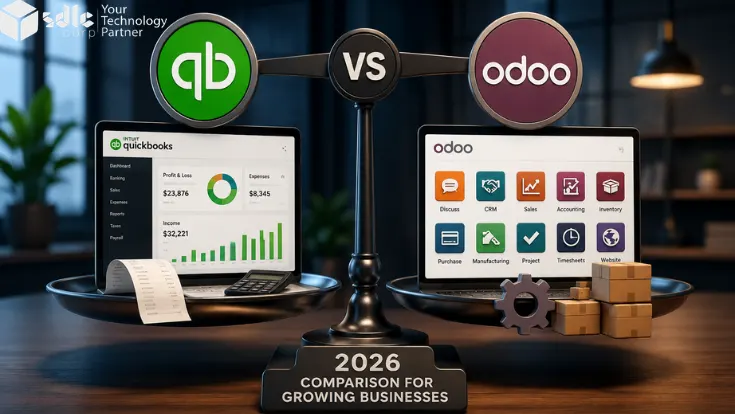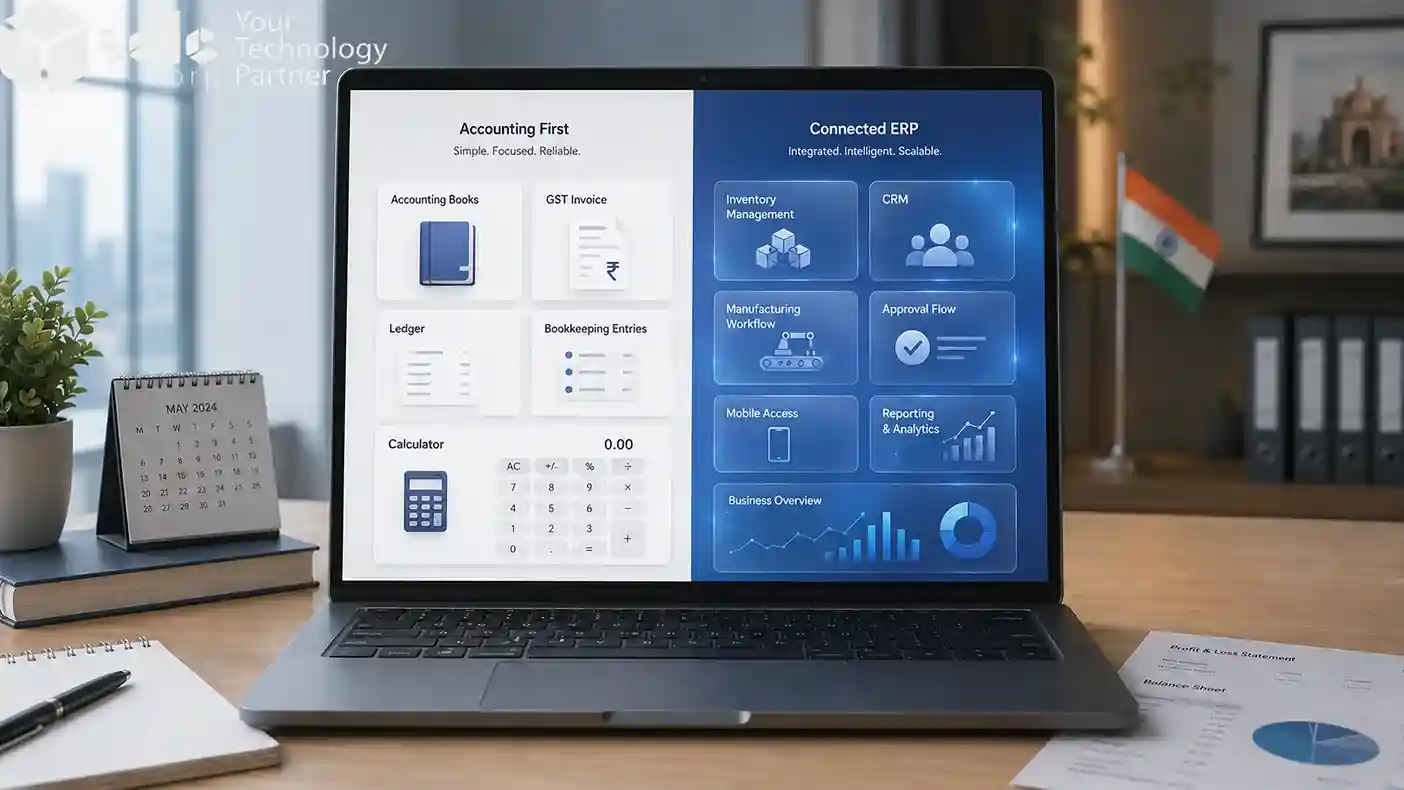
An open-source, modular ERP versus the field.
Odoo prices per user. SAP S/4HANA, Oracle NetSuite, Microsoft Dynamics 365, Zoho One and Salesforce target the same buyers but optimize for different trade-offs: enterprise depth, finance consolidation, Microsoft-stack integration, SMB breadth, or sales-led operations.
Team size, regulatory load, existing stack and budget decide the fit.
Six platforms, six trade-offs
| Platform | Customization | Cost | Time to live | Strength |
|---|---|---|---|---|
| Odoo | From $24.90/user | 2–6 months | Modular open-source | |
| SAP S/4HANA | Quote-based, $$$$ | 12–24 months | Enterprise depth | |
| Oracle NetSuite | Quote-based, $$$ | 6–12 months | Cloud finance | |
| Dynamics 365 | From $70/user | 6–18 months | Microsoft stack | |
| Zoho One | From $37/user | 1–3 months | SMB breadth | |
| Salesforce | From $25/user | 3–12 months | Sales-led |
Six factors that decide the fit
Customization & flexibility
Odoo's modular architecture switches features on per app and rewrites views, fields and workflows in Python. SAP and Dynamics permit equivalent depth at significantly higher consulting cost.
Ease of use
Odoo and Zoho ship with consumer-grade interfaces and drag-and-drop builders. SAP Fiori has improved but still demands training. Dynamics feels familiar to Office users.
Scalability
Odoo scales to hundreds of users on commodity infrastructure. NetSuite and SAP are built for thousand-user multinationals with multi-currency, multi-book consolidation out of the box.
Total cost of ownership
Odoo's per-user license stays predictable as modules are added. Tier-one ERPs front-load license fees and back-load implementation. Three-year TCO favors Odoo by a wide margin under 200 users.
Integrations
Odoo exposes full XML-RPC and JSON-RPC APIs. Dynamics 365 plugs into the Microsoft stack natively. NetSuite uses SuiteTalk. SAP has the deepest connector library with the steepest setup.
Industry depth
For manufacturing, retail and services, Odoo's apps are production-ready. SAP and NetSuite bring richer packs for regulated sectors — pharma, aerospace, public sector — where compliance is non-negotiable.
Process map → ERP fit, in 30 minutes
A scoping call delivers a phased plan, a fit-gap read, and an honest answer on whether Odoo or a tier-one suite is the lower-risk pick.
Where Odoo wins, where it doesn't
- Three-year TCO under 200 users. Community edition plus add-on apps stays well under SAP and NetSuite list pricing.
- One platform across departments. Sales, inventory, accounting, manufacturing, HR and e-commerce share a single data model.
- Source-level control. Python codebase lets competent teams extend behavior in-house rather than wait on vendor releases.
- Fast pilots. Sales-plus-inventory deployment typically lands in 8 to 12 weeks, versus 9+ months for tier-one rollouts.
- Heavily regulated industries. Pharma, public sector and large financial services need certified industry packs that SAP and Oracle spent decades building.
- Thousand-user multinationals. Multi-book consolidation and statutory reporting in 40+ countries are where SAP S/4HANA and NetSuite OneWorld earn their fees.
- Microsoft-native organizations. When Teams, SharePoint and Power BI are the daily reality, Dynamics 365 ships faster through native plumbing.
- Sales-led companies. Salesforce gives richer pipeline tooling than Odoo's CRM module when the business runs out of CRM rather than operations.
Odoo's three published plans
Unlimited users on any single Odoo app. Useful for piloting CRM, Inventory or Accounting in isolation.
All Standard apps, hosted by Odoo. Per-user, billed monthly or annually. The typical SMB entry point.
All Standard plus Custom apps, Odoo Studio, multi-company, external API and on-premise. Required for bespoke development.
Implementation, customization and integration sit outside the license fee. Plan an additional 1–3× the first-year subscription depending on scope.
Match your profile to the right ERP
Odoo — for SMBs and mid-market on one platform
Open-source, modular and priced per user. Implementation typically lands in 8–14 weeks for a sales-plus-inventory pilot, with downstream modules layered in incrementally.
When Odoo is the right choice
- Team size between 25 and 1,000 users
- Cost predictability and source-level control matter more than tier-one brand
- Manufacturing, retail or e-commerce sits at the operational center of gravity
- An 8–14 week first-phase timeline is acceptable
SAP S/4HANA — for large, regulated enterprises
Enterprise scale, deep industry packs and audit-grade reporting justify a tier-one license when compliance and multi-entity reporting are non-negotiable.
When SAP S/4HANA is the right choice
- Thousand-user multinational with statutory reporting in multiple countries
- Regulated industry where certified industry packs are required
- Multi-book consolidation and audit-grade controls are core to operations
- A 12–24 month implementation cycle is acceptable for the depth needed
Oracle NetSuite — for finance-heavy mid-market
Cloud-first finance with multi-book consolidation, suited to SaaS-native mid-market companies with multi-entity needs and a tier-one budget.
When Oracle NetSuite is the right choice
- Finance and multi-entity consolidation are core business needs
- Cloud-only deployment fits the IT strategy
- Budget supports a tier-one finance suite ($80k+ first-year software spend)
- 200 to 1,000 user scale with growth roadmap
Microsoft Dynamics 365 — for Microsoft-native organizations
Native integration with the Microsoft stack shortens time-to-value when Teams, SharePoint and Power BI are already the heartbeat of the business.
When Dynamics 365 is the right choice
- Microsoft 365, Teams and Power Platform are already daily reality
- Mid-market to enterprise scale (200–1,000+ users)
- Power Platform extensibility matches the customization model
- Cloud or hybrid deployment is preferred
Zoho One — for small teams needing broad coverage
A broad-but-shallow toolkit for small teams that need wide functional coverage without ERP-scale implementation overhead.
When Zoho One is the right choice
- Team size under 25 users with a need for many light apps
- Budget under $20k first-year software spend
- A pre-built suite is preferred over a custom rollout
- 1–3 month time-to-live is the priority
Salesforce — for sales-led organizations
Pipeline and customer-service tooling lead when the business runs out of CRM rather than operations. Deepest customization model among the six platforms.
When Salesforce is the right choice
- Sales pipeline and customer service drive the business
- Deep customization on a platform model is a priority
- 200–1,000+ user scale with a tier-one budget
- A CRM-led architecture fits the operating model
By trade-off, not by checklist
For SMBs and mid-market companies under a thousand users, Odoo's modular footprint, open-source codebase and predictable per-user pricing remove the two costs that derail tier-one rollouts: budget creep and vendor lock-in. Implementation typically lands in 8 to 14 weeks for a sales-plus-inventory pilot, with downstream modules layered in incrementally.
For regulated industries, multi-country consolidation or thousand-user organizations, SAP S/4HANA and Oracle NetSuite still earn their fees through compliance depth and statutory reporting that Odoo's community edition cannot match. The right ERP is the one whose strengths match the operations that actually run the business — and whose weaknesses fall outside daily workflow.
Plan a phased Odoo rollout
Walk away with a fit-gap analysis, fixed-price first milestone and a clear view of what custom development is genuinely needed — delivered by a team that has shipped 200+ Odoo deployments.