Odoo vs SAP: which ERP fits your business?
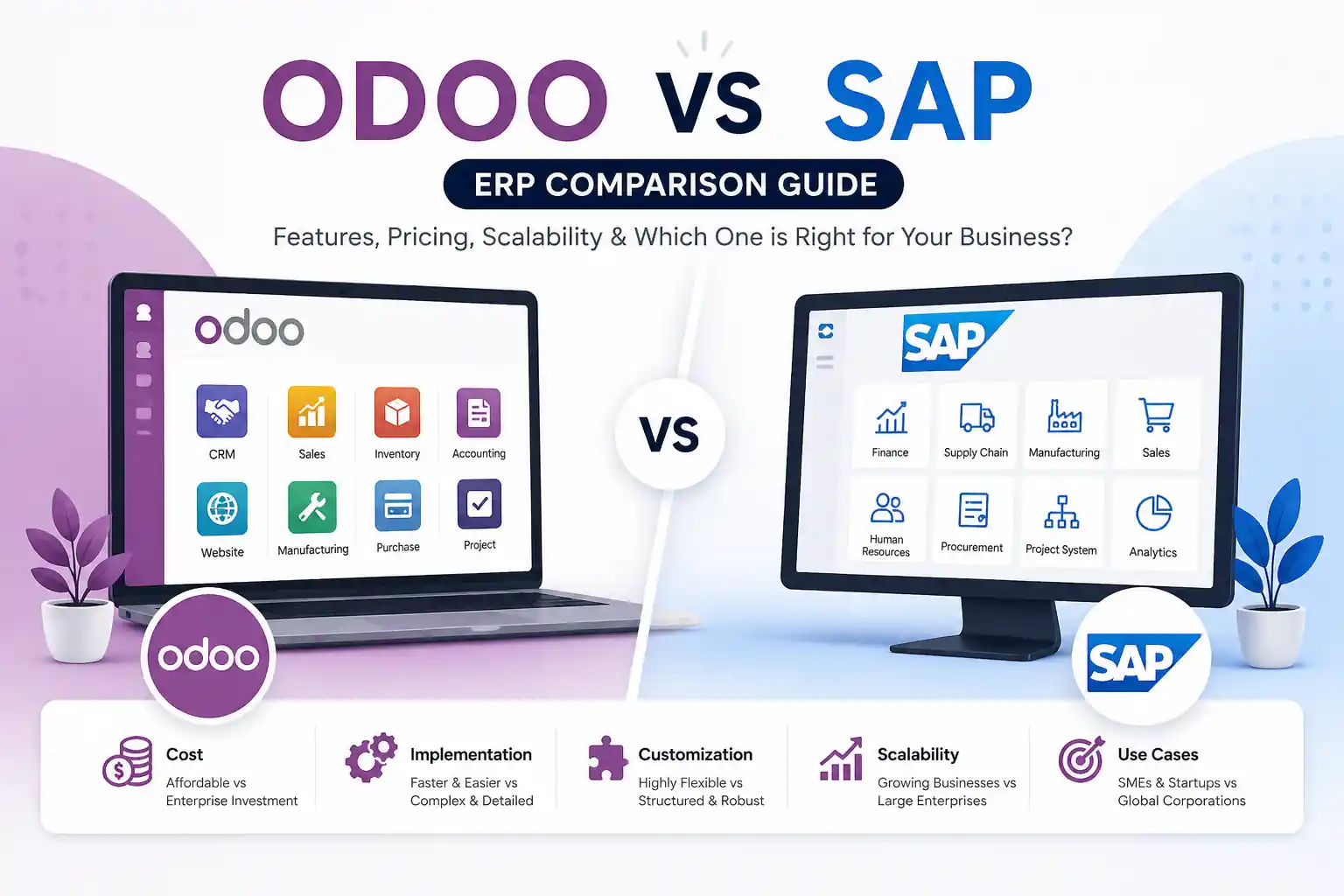
Both are leading ERP platforms, but they target very different buyers. Odoo is open-source and built for SMEs and mid-market firms. SAP is built for large enterprises with deep, global processes.
If you want a flexible ERP at a lower starting cost, Odoo is often the better choice. If you run a large enterprise with complex global operations and the budget for it, SAP can be the stronger fit.
Quick answer
Pick Odoo
If you are an SME or mid-market firm wanting a flexible, modular ERP at a lower starting cost with freedom to customise.
Pick SAP
If you are a large enterprise with complex global operations, deep compliance needs, and the budget for an enterprise-tier rollout.
The two systems serve different buyers. Odoo is open-source and modular. SAP is enterprise-grade with the scale and depth that comes with that. The answer depends on your size, scope, and budget.
Odoo vs SAP: side-by-side
| Area | Odoo | SAP |
|---|---|---|
| Best fit | SMEs and mid-market firms | Large enterprises and global corporations |
| Licensing | Free Community edition or paid plans (vary by region) | Per-user subscription (S/4HANA Cloud) or perpetual licence (on-premise) |
| Starting cost | Free Community edition. Paid plans start low. | Mid-market plans start around $100–$200/user/month. Enterprise tiers go higher. |
| Customisation | Open-source. Full code-level changes possible. | Available, but more controlled. Custom ABAP code possible in Private Cloud and on-premise. |
| Implementation | Often weeks to a few months for SME projects | Often several months to over a year for enterprise rollouts |
| Modules | Modular suite: CRM, sales, inventory, accounting, HR, manufacturing, eCommerce, POS | Deep enterprise modules: finance, supply chain, manufacturing, HR, procurement, with strong industry packs |
| Global scale | Multi-currency, multi-language; works well with the right setup | Built for multi-entity, multi-country, multi-currency operations |
| Who usually picks it | Firms wanting flexibility, lower cost, and faster rollout | Firms wanting enterprise-grade depth, compliance, and global reach |
Best fit
Licensing
Starting cost
Customisation
Implementation
Modules
Global scale
Who usually picks it
The right choice depends on your size, scope, and budget.
Odoo vs SAP pricing
The two platforms price very differently. Odoo offers a free Community edition plus paid plans that vary by region. SAP uses subscription pricing for cloud editions and quote-based pricing for enterprise tiers, with list prices typically negotiated down on larger deals. Treat these figures as directional, since pricing and total cost depend on edition, region, and implementation scope.
Odoo
SAP
When Odoo is the better choice
You want better cost control
Odoo’s open-source Community edition starts at zero licence cost. Paid plans are usually a fraction of SAP’s list prices, especially before factoring in implementation.
You need a flexible, modular ERP
Odoo lets you start with a few apps and add more as you grow. With SAP, you typically commit to a larger enterprise stack from day one.
You want fast rollout
Odoo SME projects often go live in weeks to a few months. SAP enterprise rollouts often take much longer, with bigger consulting bills.
You need deep customisation
Odoo is open-source. Developers can modify any module and shape the system around your process. SAP supports customisation too, but inside a more controlled platform.
When SAP is the better choice
You operate at large enterprise scale
SAP is built for organisations with thousands of users, multiple legal entities, and complex global processes. That scale is where SAP’s depth pays off.
You need deep industry capabilities
SAP offers strong industry packs for manufacturing, automotive, oil & gas, pharmaceuticals, retail, and financial services with pre-built best practices.
Compliance and audit are mission-critical
Heavily regulated industries with global compliance, audit, and reporting requirements often lean toward SAP for built-in governance.
You want enterprise-grade analytics
SAP HANA delivers real-time analytics on large datasets, with embedded AI and machine learning across modules.
How to choose between Odoo and SAP
Match the ERP to your size
SMEs and mid-market firms often outgrow simple tools but cannot justify SAP costs. Odoo usually fits that gap. Large enterprises with deep, global processes often need SAP’s scale.
Price the full project, not the licence
Add implementation, custom work, integrations, training, and support to the licence cost. SAP implementations can run from $75,000 to several million depending on scope, while Odoo SME rollouts are often much lower.
Check your industry needs
If your industry has heavy compliance, multi-entity finance, or complex manufacturing flows, SAP’s pre-built industry packs may save time. For lighter or less regulated needs, Odoo is often enough.
Test it with your own data
Run a pilot with your real workflows, your real data, and a small group of users before signing a multi-year contract on either platform.
Next step: Still weighing your options? Talk to our Odoo team for a comparison based on your own processes and budget.
Frequently asked questions
Is Odoo cheaper than SAP?
In most cases, yes. Odoo’s free Community edition has zero licence cost, and paid plans are usually a fraction of SAP’s. SAP S/4HANA Cloud Public Edition starts around $150–$200/user/month at list price, and Private Edition runs around $350/user/month. SAP implementations also tend to cost much more than Odoo SME rollouts.
Can Odoo replace SAP?
For SMEs and many mid-market firms, yes. Odoo covers finance, CRM, inventory, manufacturing, HR, and eCommerce. For large global enterprises with multi-entity finance, complex industry compliance, or thousands of users, SAP is usually still the stronger fit.
Which ERP is more customisable?
Odoo is more customisable at the code level because it is open-source. Developers can change any module. SAP supports customisation too, especially in Private Cloud and on-premise editions through ABAP code, but inside a more controlled and governed environment.
Which is better for manufacturing?
Odoo Manufacturing handles BOMs, work orders, MRP, and quality control well for small to mid-sized manufacturers. SAP S/4HANA is stronger for large or global manufacturers with complex industry compliance and multi-site operations.
How long does each ERP take to implement?
Odoo SME implementations often take weeks to a few months. SAP S/4HANA Cloud Public Edition projects often run 3 to 6 months. SAP Private Cloud or on-premise rollouts for large enterprises can run a year or more. Actual timelines depend on scope, customisation, and partner experience.
Can Odoo integrate with SAP?
Yes. Some firms use Odoo at subsidiaries and SAP at headquarters in a two-tier ERP setup. The two systems can connect via APIs and partner connectors for data sync between finance, sales, and inventory.
Need help rolling out Odoo?
SDLC Corp is a certified Odoo implementation partner with apps published on the Odoo Apps store. If you are choosing Odoo over SAP, our team can help you scope, plan, and deliver the rollout with a phased approach that lowers project risk.