
Revenue growth
+80%
One year after implementation, compared with the pre-implementation baseline.
This Apex Shoes Odoo ERP case study covers connected retail, inventory, purchasing and finance workflows, supported by demand forecasting, replenishment automation and intelligent reporting.
Project Snapshot
Revenue growth
+80%
One year after implementation, compared with the pre-implementation baseline.
Inventory accuracy
99.2%
Improved from 71%, a gain of 28.2 percentage points.
Excess inventory value
$200K
Reported annual reduction in excess stock value.
The project owner supplied these outcomes. Revenue growth followed the implementation; it is not attributed to Odoo alone. View the measurement notes.
Business context
Apex Shoes manages footwear sales across wholesale and direct-to-consumer channels. However, separate stock, order and finance records made transaction reconciliation, variant tracking and purchasing harder to coordinate.
The Odoo-based platform connected relevant sales, inventory, purchasing and finance records. Meanwhile, Zoho CRM, OpenAI, Slack and Gmail remained integrated with the operating environment.
Operational problems
Because separate tools held orders, stock and customer information, teams repeated reconciliation work.
At the same time, bulk orders and retail transactions needed connected pricing, customer records and business processes.
For example, size and colour variants made accurate stock availability and replenishment especially important.
System overview
Retail and sales channels connect with Odoo workflows for POS and sales, inventory and warehousing, purchasing, finance, CRM and loyalty, and reporting. In addition, the overview separates retained services from ERP and planning capabilities.
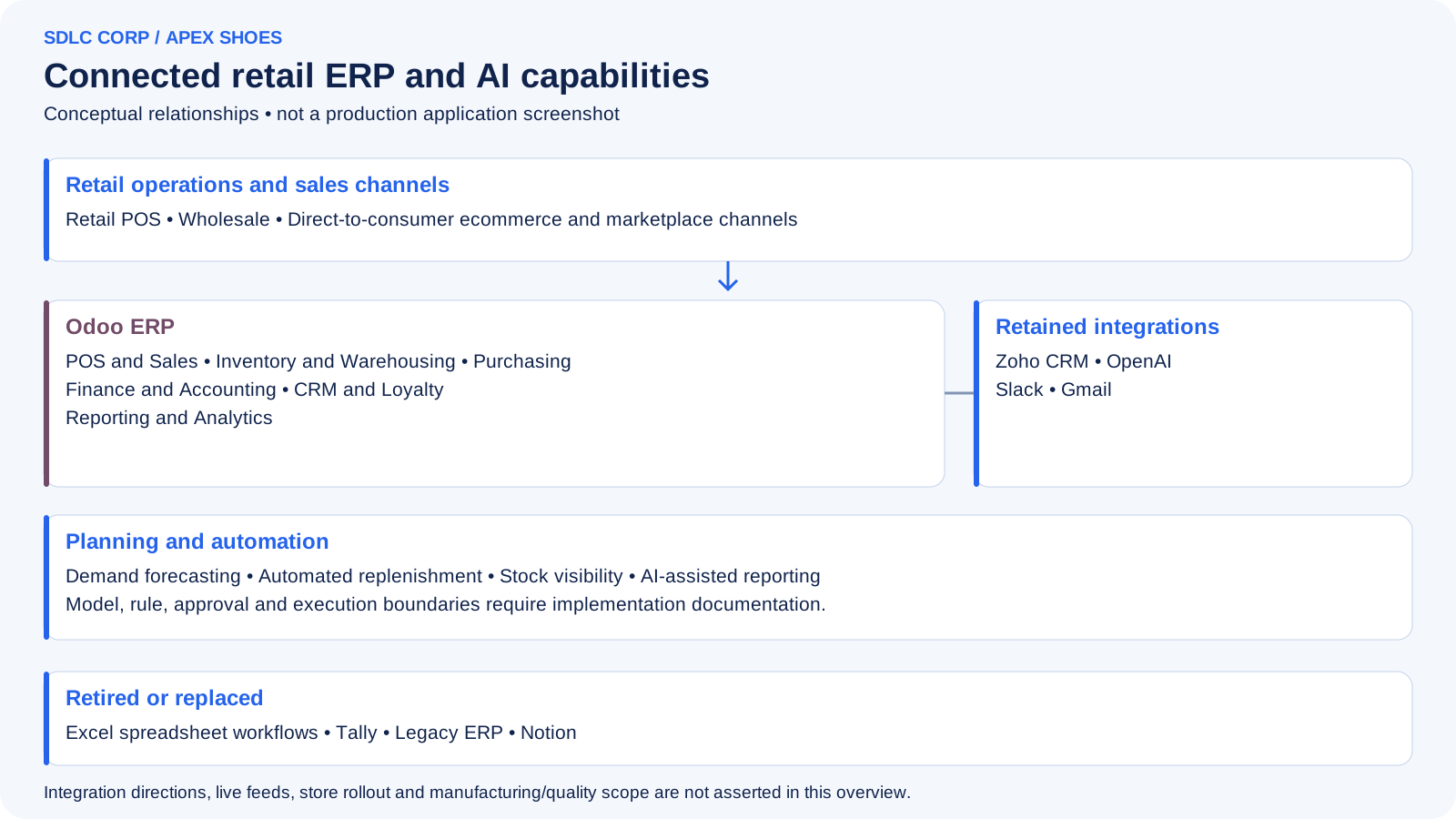
View the full-size architecture diagram
The architecture summarizes confirmed relationships. Manufacturing and quality remain in the supplied capability inventory below; their production configuration still needs verification.
Implementation scope
The project owner identifies 25 business capability areas across five functions. Configuration, workflows and integrations support this scope; the count does not mean 25 custom Odoo applications.
The list records the supplied scope. However, detailed module mapping and production usage still need supporting delivery records.
Connecting retained tools with ERP workflows is part of the integration work supporting this scope.
Delivery approach
The implementation connected the business processes around footwear retail, procurement, inventory, warehousing, finance and sales. First, configuration and integration work connected the existing business workflows.
First, review stock, orders and wholesale/retail workflows to define the ERP scope.
Next, configure Odoo workflows and connect the retained applications.
Then, check business flows, migrated records and integrations before rollout.
Finally, support staff adoption and resolve issues as teams use the connected workflows.
For a similar project, an ERP implementation plan should define scope, data migration, testing and ownership before rollout.
AI and automation
The project owner confirms demand forecasting, automated stock replenishment, and AI-powered reporting and decision support within the implementation.
Forecasting supports inventory planning by helping teams consider demand when reviewing footwear stock and purchasing requirements.
Replenishment automation connects stock planning with purchasing workflows. However, the supplied information does not establish autonomous purchasing or its approval rules.
AI-assisted reporting helps teams interpret business information and supports operational decisions across retail and inventory processes.
OpenAI remains an integrated service. However, the available information does not map specific forecasting models, Odoo rules or OpenAI services to each function.
Reported business impact
Within one year following Odoo ERP implementation, Apex Shoes reported 80% revenue growth compared with its pre-implementation baseline.
Improved from 71%, a gain of 28.2 percentage points.
Reported annual reduction in excess inventory value, rather than realized operating profit.
Together, connected sales, stock, purchasing and finance workflows improved access to operational information. The reported outcomes followed these changes, but do not establish that Odoo or AI alone caused them.
The project owner supplied these outcomes. Revenue compares the pre-implementation baseline with revenue one year after implementation. However, inventory accuracy methods and stock valuation records are unavailable. The stock-value reduction therefore should not be read as audited net savings.
Client proof and next step
The project owner supplied the commercial and inventory figures in this Apex Shoes Odoo ERP case study. The explanatory graphics summarize that information.
The supplied information covers legacy consolidation, retained integrations and three AI and automation capabilities. However, supporting accounting records, inventory measurement details and an approved Apex testimonial remain unavailable.
Start with sales channels, SKU variants, stock locations, purchasing rules and finance requirements when planning ERP for retail and ecommerce. Then define integration boundaries and decision ownership before extending automation.
Discuss Your Retail ERP RequirementsContact Us
Share a few details about your project, and we’ll get back to you soon.
Let's Talk About Your Project