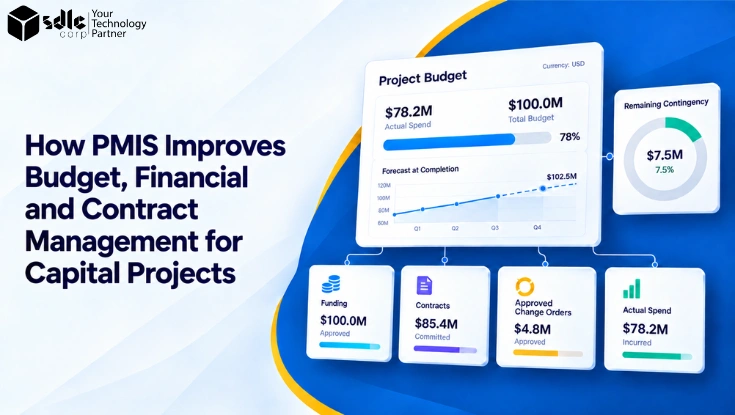
Most capital programs keep four separate records of the same project: the budget in a spreadsheet, the contracts in a shared drive, the change orders in an inbox, and actual spend in the accounting system.
Each is accurate alone. Together they cannot answer what the program will cost at completion, or how much contingency is still uncommitted.
PMIS budget and contract management closes that gap by holding money, commitments, contract records and time in one system that reconciles them against each other.
This guide walks the financial chain from fund source to close-out, the controls at each step, the change order where budget and contract meet, the ERP boundary, and the reporting that makes it usable.
- The ten-step financial chain a PMIS enforces, and the demo test that proves a platform actually enforces it.
- Contingency and change order controls that stop budget being committed before it is approved.
- A clear PMIS and ERP ownership split, plus a four-phase rollout with definitions of done.
What Budget And Contract Management Look Like Without A PMIS
The core problem is the reconciliation interval, meaning the lag between something happening on a project and the financial record catching up with it.
In a spreadsheet-run program that lag is measured in weeks or months, and every decision made inside it rests on stale numbers.
The four records most owners keep separately
| Record | Where it usually lives | Who trusts it | What it misses |
|---|---|---|---|
| Approved budget | Spreadsheet built at approval | Finance | Revisions made after approval |
| Commitments | Procurement log, or nowhere | Procurement | Pending and disputed changes |
| Contract record | Shared drive of signed PDFs | Legal | Cost consequence of its own clauses |
| Actual spend | Accounting system | Accounts | Work performed but not yet invoiced |
Scroll the table sideways to see all columns.
The symptoms are recognisable long before anyone calls it a systems problem.
- Month-end becomes a rekeying exercise rather than a review.
- Two people quote two different contingency figures in the same meeting and both can defend theirs.
- Change orders reach contractors before approved budget exists to cover them.
- Nobody can state uncommitted budget without building a spreadsheet first.
A project management information system does not make people more careful. It removes the interval, so every downstream number moves the moment a commitment is made.
Where Capital Project Money Actually Leaks
Capital projects rarely lose money in one visible event. They lose it through repeated record-keeping failures that only add up at close-out.
That is why McKinsey research on large capital projects keeps reporting cost growth well above the original budget.
| Leak | Cause | Consequence |
|---|---|---|
| Undocumented change orders | Work instructed verbally, priced later | Owner negotiates after the cost is already sunk |
| Silent contingency absorption | Scope creep charged without a record | Contingency gone with no audit trail behind it |
| Missed escalation and entitlement clauses | Evidence not gathered at the time of the event | Recoverable cost becomes unrecoverable |
| Lapsed bonds, insurance and retention | Expiry dates tracked manually | Risk transfers back to the owner unnoticed |
| Invoices unreconciled to contracts | Approval is a signature, not a balance check | Overpayment against the commitment |
Scroll the table sideways to see all columns.
What the table cannot show is timing. Every one of these leaks starts early in the lifecycle and only becomes visible much later, which is the reason they are expensive rather than merely annoying.
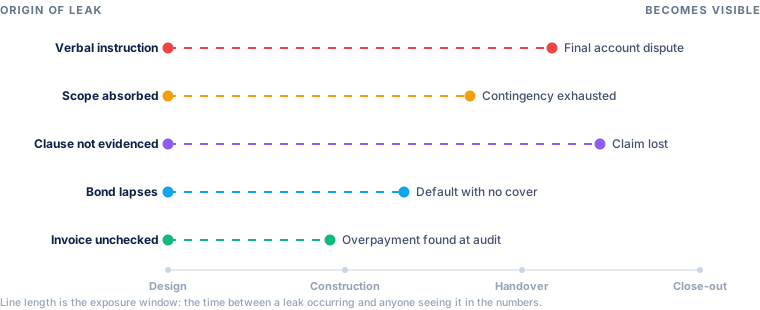
The root cause is identical in every row. The commercial event and the financial record sit in different systems, so nothing is checked at the moment when checking would still change the outcome.
The Financial Chain A PMIS Enforces
The value of a PMIS in financial terms is not the module list. It is that money moves along one chain, and every link updates the ones after it.
| Step | What it is | What it controls |
|---|---|---|
| Fund source | The pot the money comes from | Statutory, grant and fiscal-year restrictions |
| Approved budget | Allocation against a cost breakdown structure | The fixed benchmark, never edited |
| Budget revision | Additions, omissions and transfers | Traceability back to the original approval |
| Contract award | Intention becomes legal obligation | Tied to a budget line before signature |
| Commitment | Contract value reserved against budget | Reduces the uncommitted balance |
| Change order | Cost and time variation to the contract | Checked against budget before it is issued |
| Revised commitment | Contract value after approved changes | The base every forecast is built from |
| Pay application | Contractor claim for work performed | Assessed against the revised commitment |
| Invoice and actual | Certified amount, paid and posted | Feeds real cost back into the forecast |
| Forecast at completion | Expected final cost | Built from actuals and commitments, not optimism |
Scroll the table sideways to see all columns.
Raise a change order during the demonstration, then ask to see the effect on remaining budget, uncommitted contingency, forecast at completion and the audit trail, without anyone rekeying.
A platform that shows all four is a PMIS. One that cannot is a document repository with a login.
Most owners already run software that holds parts of this chain. What they usually lack is the reconciliation between the parts, and that reconciliation is the product.
Budget Management: Baselines, Revisions And Contingency
Capital project budget management fails on governance more often than on tooling. The system enforces the rules, but somebody in the organisation still has to set them.
Original budget versus revised budget
The original approved budget is a fixed record and should never be edited. The revised budget is the original plus every approved addition, omission and transfer since.
Keeping both visible answers a better question than whether the project is within budget: how far it has drifted from what leadership signed.
Budget transfers across the cost breakdown structure
Every transfer needs an approval, a reason and a date, and it has to move within a cost breakdown structure stable enough for the comparison to mean anything.
Where funding is restricted, grant funds, bond proceeds and fiscal-year appropriations often cannot be reallocated at all.
Fund source accounting has to work at transaction level rather than project level, or staff will commit money the funding rules do not permit.
Contingency drawdown rules and authority levels
Contingency is the least governed number in most capital programs and the first one leadership asks about. Three questions have to be answered before any system can help.
| Question | Why it matters |
|---|---|
| Who authorises a drawdown, and at what value does authority escalate | Without thresholds, requests route to nobody in particular |
| What evidence must accompany a request | Determines whether the drawdown survives an audit |
| Is contingency held at project level, program level or both | Decides whether one project can drain the whole program |
Scroll the table sideways to see all columns.
Once those rules exist, the reporting changes the conversation. Leadership sees what was allocated, what has been drawn, what it was drawn for, and what remains uncommitted against the work still to come.
Uncommitted contingency is the most useful figure a capital program can publish, and it is almost never accurate in a spreadsheet-run program.
Contract Management Across The Capital Project Lifecycle
Construction contract management software is usually sold as a document problem. For a capital project owner it is a financial problem.
The contract is the instrument that converts budget into obligation, and every clause inside it carries a cost consequence.
Award, commitment and the contract as a financial object
Awarded inside a PMIS, a contract is tied to a budget line, its value becomes a commitment against that line, and the uncommitted balance drops accordingly.
From that point it is a live financial object rather than a stored document. Its value changes with approved variations and reduces with each certified payment.
| Dimension | Contractor field tool | Owner PMIS |
|---|---|---|
| Scope | One contract, one defined scope | Many contracts across many projects |
| Funding | Single source | Multiple restricted sources and fiscal years |
| Priority | Field execution and production | Financial governance and audit defensibility |
| Reporting | Project progress | Portfolio rollup with drill-through to transaction |
Scroll the table sideways to see all columns.
Compliance evidence: insurance, bonds, lien waivers and retention
Contract obligations expire, and manual tracking works only until the portfolio outgrows what one person can hold in mind.
A PMIS attaches each obligation to the contract with a date, flags or blocks payment when evidence is missing, and alerts before expiry rather than after.
- Insurance certificates with renewal dates and coverage limits.
- Performance and payment bonds with their terms recorded.
- Lien waivers collected before payment rather than chased afterwards.
- Retention with release tied to practical completion and defect periods.
The real gain is that compliance state becomes reportable across the whole portfolio, which turns an audit from an exercise in retrieval into an exercise in printing.
Claims defence and the document record
Document control on a capital project is usually justified as efficiency. Its actual purpose is claims defence.
When a claim arrives two years later, the owner's position rests on what was recorded at the time: the instruction, the date, the site conditions, the approval or the refusal.
A PMIS keeps that record immutable, timestamped and linked to the contract and the cost it relates to.
Where Budget And Contract Meet: The Change Order
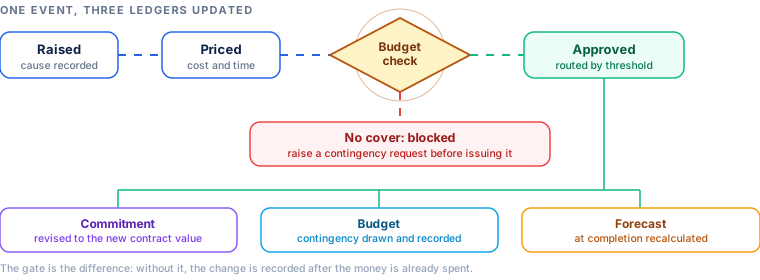
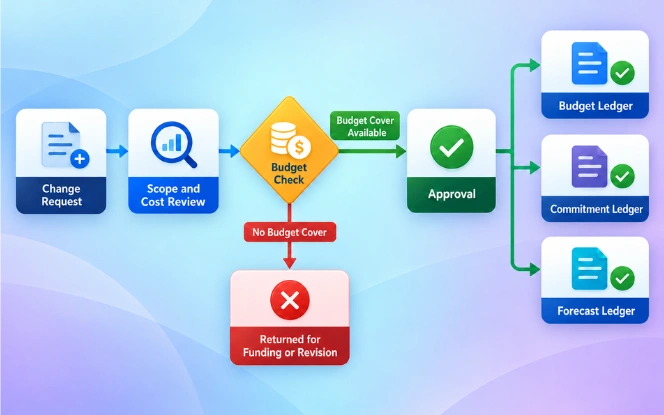
The change order is the moment the budget ledger and the contract ledger have to agree, and it is where most capital programs lose control.
| Stage | What happens | Control applied |
|---|---|---|
| Raise | Event and its cause are recorded | Nothing verbal survives unrecorded |
| Price | Cost and time impact assessed separately | A zero-cost variation can still add weeks |
| Budget check | Uncommitted balance or contingency drawdown confirmed | The gate that matters most |
| Route | Escalated automatically by value threshold | Authority matches financial exposure |
| Decide | Approved, rejected or held in dispute, visibly | Status leaves one person's inbox |
| Post | Commitment, budget and forecast all update | No rekeying, complete audit trail |
Scroll the table sideways to see all columns.
The rule underneath all of it is simple and frequently broken. No change order should be issued to a contractor without approved budget already behind it.
A PMIS makes that check a required step rather than a courtesy, which is the single largest reason owners adopt one.
Change order cycle time, meaning the average number of days from raise to decision, is worth tracking from the first month. It predicts claims exposure more reliably than almost any other metric, because unresolved changes accumulate into disputes.
Pay Applications, Invoices And The ERP Boundary
A PMIS does not replace the finance system, and any implementation that assumes it will meets the accounting team within the first quarter.
| Function | Owned by PMIS | Owned by ERP |
|---|---|---|
| Budget against cost breakdown structure | Yes | No |
| Commitments and change orders | Yes | No |
| Pay application assessment and certification | Yes | No |
| Chart of accounts and vendor master | No | Yes |
| Tax treatment and payment runs | No | Yes |
| Statutory and financial reporting | No | Yes |
Scroll the table sideways to see all columns.
What belongs where, and why the boundary sits at certification
The PMIS certifies an amount as payable with the supporting evidence attached. The ERP pays it and posts it. Actual costs then flow back so project forecasts rest on paid reality rather than certified intent.
Integration patterns that survive an audit
- Every field has exactly one owning system and the other reads it. When both claim a field, the reconciliation you removed comes straight back.
- Prefer a narrow bidirectional interface over a broad one. Commitments and certifications out, actuals and vendor data in is usually enough.
- Broad synchronisation looks impressive at go-live and is the first thing to break when either system is upgraded.
Get this boundary wrong and the program ends up with two versions of project cost that finance and delivery each defend. Get it right and the monthly reporting cycle shortens from weeks to days.
If you are scoping this alongside an existing finance platform, our guide on how to integrate PMIS with Dynamics 365 and SharePoint covers the integration side in more detail.
The Financial KPIs A PMIS Should Report
Construction project financial reporting for owners fails when it produces volume instead of decisions. A small set of defined metrics reported consistently beats a dashboard with forty tiles.
| Metric | What it answers | Why it matters |
|---|---|---|
| Cost variance | Are we above or below the revised budget today | The baseline health check, insufficient on its own |
| Uncommitted contingency | How much cover remains for work not yet done | The number leadership asks for and rarely gets accurately |
| Committed versus uncommitted budget | How much is already legally obligated | Shows real flexibility rather than notional headroom |
| Change order cycle time | How quickly variations are being resolved | Leading indicator of claims exposure |
| Forecast accuracy | How much the forecast moves between periods | Measures whether the reporting can be trusted at all |
| Compliance currency | Which contracts have lapsed insurance or bonds | Uncontrolled risk transfer back to the owner |
Scroll the table sideways to see all columns.
At portfolio level the same data answers a different set of questions: which projects are drawing contingency fastest, where forecasts are least stable, and what the ageing profile of certified but unpaid invoices looks like.
Forecast accuracy deserves particular attention because it measures the reporting itself. A program whose forecast jumps ten percent every quarter does not yet have a cost problem. It has an information problem, and the cost problem is arriving.
What A PMIS Will Not Fix
A PMIS does not eliminate cost overruns. It makes them visible earlier, which gives an owner more options in how to respond.
That is a real benefit, and a different claim from the one usually made in vendor material.
| Limitation | What it means in practice |
|---|---|
| No governance to enforce | Undefined thresholds route requests to nobody in particular |
| No agreed cost breakdown structure | Reporting becomes consistent and meaningless at the same time |
| No named data owner | Records decay at the same rate they did in the spreadsheets |
| Bad data migrated cleanly | Still bad data, now carrying the appearance of authority |
| Weak adoption | Staff route around anything that costs them a week to save a month |
Scroll the table sideways to see all columns.
Loading a validated minimum viable dataset almost always beats loading everything that exists, and the programs that succeed tend to be the ones whose first phase delivered a report the team was previously assembling by hand.
Implementing Financial Control In Phases
Each phase earns the credibility that funds the next. Attempting the full scope at once produces a long implementation with no visible benefit until the end, which is how most stalled programs begin.
| Phase | Scope | Done means | Typical duration |
|---|---|---|---|
| 1. Budget and fund structure | Cost breakdown structure agreed, fund sources loaded with restrictions, budgets migrated | Every active project has a budget finance agrees with | 6 to 10 weeks |
| 2. Contracts and commitments | Active contracts loaded with values, retention, insurance and bond dates | Uncommitted budget is accurate without a spreadsheet | 6 to 8 weeks |
| 3. Change control and pay applications | Thresholds configured, change workflow live, certification moved into the system | No change order is issued without a budget check | 8 to 12 weeks |
| 4. Reporting and integration | ERP interface at the certification boundary, dashboards published, KPIs baselined | The monthly cycle runs without manual assembly | 8 to 12 weeks |
Scroll the table sideways to see all columns.
Phase three delivers most of the financial benefit, which is exactly why it should not be attempted first.
Public owners face additional funding and transparency requirements at each phase, covered in PMIS for Public Infrastructure and Capital Improvement Programs.
If you are deciding whether an existing platform can be extended rather than replaced, our guide to PMIS Fit-Gap Analysis sets out how to assess that.
Frequently Asked Questions
A PMIS controls budgets by linking commitments, change orders, invoices and forecasts to the same budget record.
When a contract is awarded or a variation approved, the uncommitted balance updates immediately, so decisions are made against current figures rather than a spreadsheet that was accurate last month.
A PMIS owns the project view: budgets, commitments, change orders, pay application assessment and supporting evidence. An ERP owns the corporate ledger: chart of accounts, vendor master, payment runs and statutory reporting.
The boundary sits at certification, where the PMIS certifies an amount and the ERP pays and posts it.
Each change order is raised with its cause recorded, priced for cost and time impact, checked against available budget or contingency, and routed by value threshold for approval.
On approval the contract commitment is revised and the budget and forecast update automatically, with the full history retained for claims defence.
Yes, provided fund source accounting works at transaction level rather than project level.
That allows a single project drawing on grant funds, bond proceeds and general appropriations to report spend correctly against each source, and prevents staff committing money the funding rules do not permit.
No. A PMIS manages project cost control, commitments and certification, then passes certified amounts to the accounting system for payment and posting.
Actual costs flow back so forecasts are built on paid reality. Running statutory accounting inside a PMIS creates duplication rather than removing it.
At minimum: cost variance against the revised budget, committed versus uncommitted budget, uncommitted contingency, forecast at completion tracked over time, change order cycle time and contract compliance currency.
At portfolio level these should roll up with drill-through to the underlying transaction.