

Artificial intelligence (AI) can help anchorage teams estimate arrivals, anticipate congestion, review anomalies and compare planning options. Each use needs a defined decision, suitable inputs and a result that shows its uncertainty.
The practical starting point is one task where a prediction or recommendation can be compared with the current method. Approval rights, mandatory constraints and the fallback when data is missing must remain clear throughout that evaluation.
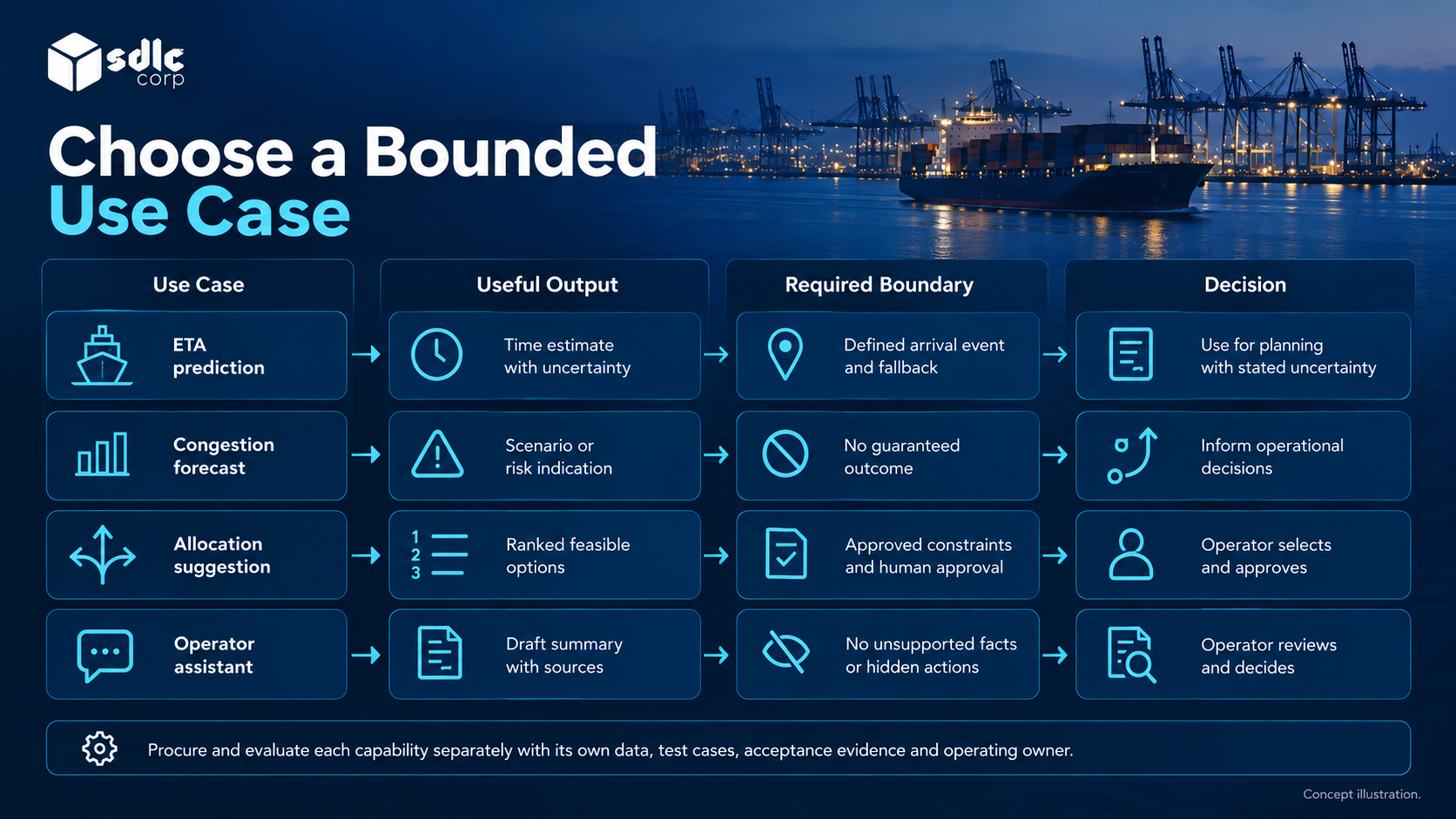
Choose The Decision Before Choosing The AI Method
Predict An Outcome
Arrival and congestion forecasts estimate a defined future event or condition. Compare them with the current planning method at the same decision horizon. Evaluating vessel arrival predictions and congestion forecasting for operational decisions cover their separate evaluation requirements.
Rank Feasible Options
Allocation recommendations compare choices that already satisfy mandatory constraints. A preference score expresses the ranking rule; it is not a probability of correctness or permission to approve.
Detect Anomalies For Review
Unusual observations or possible duplicate records can be flagged for investigation. Define the condition, evidence and reviewer, including the consequence of false alarms. A flag is not authority to merge or delete records.
Assist With Permitted Information
An assistant can retrieve material and draft a supported explanation within the user's access rights. Assess source fidelity and unauthorized actions separately from forecast error. A fluent answer does not demonstrate a reliable prediction model.
Choose one of these decisions for the first pilot. State the user, input, output, allowed action and fallback before selecting a method. Scores, forecast intervals and identity confidence require separate definitions and must not be placed on a common scale.
Keep Eligibility And Approval Rules Outside The AI Model
Keep mandatory operating constraints explicit and independently testable. A model can help compare options, but it should not silently redefine eligibility, permissions, or approval authority. If no feasible option exists, the application should say so and show the reason rather than produce a confident looking recommendation.
Record the input data, model or rule version, output, and operator response. This allows the team to distinguish a data problem from a model problem or a workflow issue. A recommendation accepted after a human review is different from one applied automatically; the audit trail should preserve that distinction.
Establish the core anchorage workflow before testing an optional model. The ordinary request and approval path must remain usable when a prediction is unavailable.
Use deterministic rules when the answer is an explicit permission, eligibility condition or authoritative status. An AI model adds little value to a decision already settled by an approved rule, and must not replace the record that establishes who may act.
A proposed option still has to pass the allocation rules and approval checks before it can become an operational decision.
Follow One Arrival Estimate Into A Planning Decision
Illustrative example
A planner needs to decide whether to seek confirmation of a service slot. At 12:00, the model uses information available at that time to predict arrival at the waiting area. The declared estimate is the comparison baseline. Later corrections to the arrival record are outcomes for evaluation, not inputs the model could have known earlier.
| Step | Record Or Action |
|---|---|
| Input | Call C-182; current progress and earlier call history available at prediction-time |
| Baseline | Declared arrival estimate 14:00, retained as it stood at 12:00 |
| Output | Estimated arrival 14:20 with an 80% prediction interval from 13:50 to 15:00 |
| Observed outcome | Arrival recorded at 14:35; model absolute error 15 minutes, baseline absolute error 35 minutes |
| Human response | Check whether the service plan remains usable across the interval and request confirmation where needed |
| Missing input | Show the supported baseline or prediction unavailable, with the reason |
| Boundary | The estimate does not authorize a vessel movement |
Evaluate The Interval Separately From Availability
An 80% prediction interval expresses a coverage target to test on held-out outcomes. It is not an 80% probability that a particular vessel identity is correct, nor an allocation preference score.
| Evaluation Population | Calculation | Meaning |
|---|---|---|
| 100 forecasts that produced intervals | Actual arrival inside 78 intervals: 78% observed coverage | Compare coverage and interval width with the baseline |
| Separate 100 eligible calls | Forecast produced for 60: 60% availability | Report the missing 40 as unavailable, not correct forecasts |
Inspect large errors and the width of the intervals before deciding whether the output helps the planner. Continue monitoring the same decision horizon after deployment.
Check Labels, Historical Coverage And Prediction-Time Inputs
Inspect the history for missing periods, inconsistent event definitions, manual corrections, and changes in operating conditions. Determine whether the target outcome was actually observed or inferred later. A model evaluated on information that was unavailable at prediction-time can appear better than it will be in use.
Train on earlier records and evaluate on later periods, including difficult operating conditions. Compare the result with a simple baseline, such as the current planning rule. Check errors by vessel call type and by how far ahead the prediction is made. Agree what operators should do when the estimate is uncertain.
Make Human Review Effective
Give The Operator Enough Evidence To Disagree
Show why the recommendation is being presented, which inputs are current, and what remains uncertain. Let the user inspect supporting records and decline the suggestion without obstructing the normal workflow. A confirmation button alone is not effective oversight if the operator cannot understand the basis of the output.
The National Institute of Standards and Technology (NIST) AI Risk Management Framework resources offer voluntary guidance for managing AI risk. Apply the relevant practices to the actual use case and authority model. Security due diligence for the proposed platform should include model access, data handling, and third-party dependencies where AI is included.
For anomaly detection, define the unusual condition to flag. Test missed events and decide who reviews false alarms.
For a language model assistant, restrict available actions and access to each call. Show sources, but do not allow instructions inside retrieved documents to override the assistant’s rules. Test misleading answers and malicious document instructions before supervised use.
Deploy In Stages And Monitor The Result
Start with offline evaluation, then shadow operation in which outputs are recorded without changing decisions. Move to a supervised pilot only after the team agrees on performance and failure behavior. Preserve the existing workflow as a fallback. Assign someone to review errors, changes in input data, and unexpected operator behavior.
| Release gate | Evidence needed |
|---|---|
| Offline evaluation | Defined target, baseline and test results |
| Shadow operation | Live input quality and error review |
| Supervised pilot | Usable explanations and fallback evidence |
| Continued use | Monitoring, ownership and change control |
Avoid introducing several models at once if their effects cannot be separated. A measurable business case should connect the capability to a workflow outcome, not assume that adding AI produces savings by itself.
Choose one pilot decision, one baseline and an explicit fallback. Progress only when the team can explain both successful outputs and the errors that matter operationally.
Conclusion
Select one AI use case and agree how its output will change a real planning decision. Compare it with the current method on representative calls, including disrupted operations and missing inputs.
Proceed when the result demonstrates useful performance at that decision point and operators can recognize its limits. Keep the existing workflow available when the model cannot provide a supported answer.
Evaluate An AI Use Case With SDLC Corp
Discuss one bounded AI use case with SDLC Corp in the context of the anchorage operations platform and its ai development services. Bring the decision, baseline, permitted data and fallback process. Request an evaluation plan covering prediction-time inputs, uncertainty, missing outputs and operator review, with no assumption that a model result confers approval authority or establishes a measured operational benefit.
Frequently Asked Questions
Which AI Use Case Should We Evaluate First?
Choose a decision with usable historical inputs, a measurable outcome and a practical response to the prediction. Arrival estimation or anomaly triage may be candidates, but the available evidence and operating need should determine the choice.
Is High Average Accuracy Enough?
No. Examine large errors, unavailable predictions, uncertainty and performance under difficult conditions. A result can improve the average while becoming less useful at the planning horizon or situation that matters most.
Must AI Be Included In The First Release?
Only if the accepted scope depends on it. Requests, approvals, allocation and audit records can form a useful release independently. Add predictive capability when its evaluation, oversight and fallback arrangements are ready.