An anchorage management system organizes the work between a vessel's request for space and the release of its allocation. It connects requests, approvals, occupancy information and changes to a shared record, so operators can see what is authorized and what still needs a decision.
The starting point is the port's operating workflow. A map or vessel feed provides useful context, but the application also needs clear ownership, exception handling and a reliable way to resume work after a disruption. Predictive features based on artificial intelligence (AI) can be evaluated separately.
What Does An Anchorage Management System Do?
| Operator Task | What The Application Shows | What Remains A Decision |
|---|---|---|
| Handle a request | Vessel call, missing information and requested area | Whether the request is eligible under local rules |
| Review an allocation | Proposed place, restrictions and current records | Approval by the authorized role |
| Follow an exception | Source age, changed restriction and assigned task | Whether a permitted fallback or revised allocation is appropriate |
| Close a call | Release state and linked history | Confirmation through the approved operating process |
An application becomes valuable when the same vessel call no longer needs conflicting records across a map, a spreadsheet, and an operator's queue. Start by documenting those discrepancies. Establish a baseline for reconciliation effort and unresolved exceptions; do not assume software alone will change vessel waiting time.
Define The End-To-End Workflow
Follow The Request Through Approval And Release
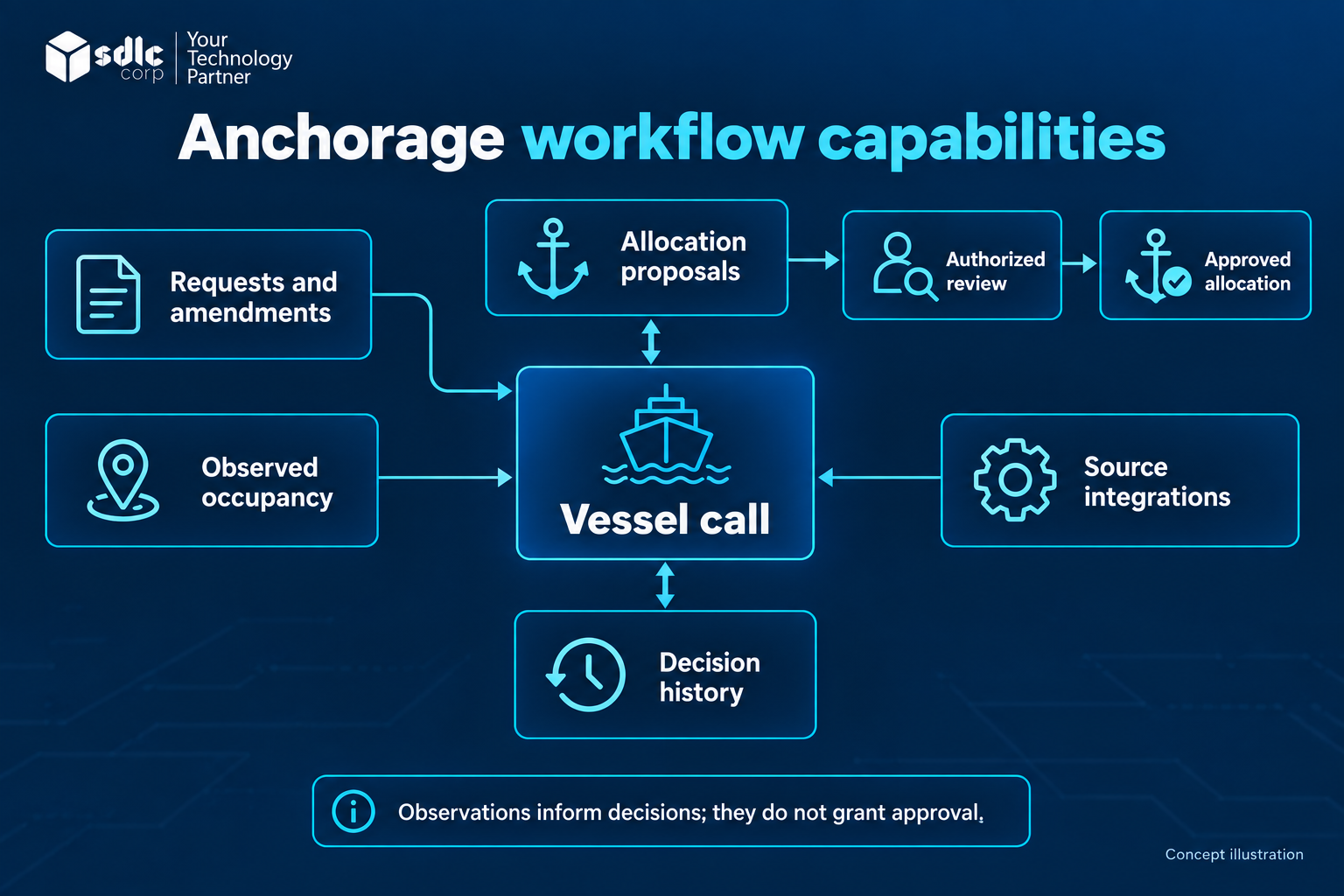
Map a vessel call from the first request through review, allocation, arrival confirmation, any reallocation, and release. Keep the requested position, approved allocation, and observed position as different facts. A tracking update can inform an operator without becoming an instruction to move a vessel.
For each transition, record who may initiate it, what evidence is required, what system owns the result, and how the transition can be corrected. An amendment should retain the earlier decision and its reason. A cancellation should release a reservation without erasing the history needed for a later review.
Evaluate anchorage allocation rules and approval workflows early. If the team cannot explain how a reservation becomes confirmed occupancy, a sophisticated map will only display inconsistent information more attractively.
One Vessel Call From Request To Release
Illustrative example
In this workflow, call C-182 belongs to vessel A. Times are on the same day. The application records approvals; it does not issue navigational instructions.
| Time | Event | Application State | Responsible Person |
|---|---|---|---|
| 08:00 | Agent requests Zone A | Request R-41 submitted; no reservation | Agent |
| 08:08 | Operator verifies required information | R-41 eligible for allocation | Operator |
| 08:12 | Approver accepts Zone A | Allocation AL-7 approved, version 1 | Allocation approver |
| 08:25 | Position evidence places the vessel in Zone A | Occupancy recorded separately from approval | Operator under local procedure |
| 09:10 | Zone restriction changes | AL-7 remains in history; exception EX-3 opens | Duty supervisor |
| 09:18 | Authorized alternative is accepted | AL-7 superseded by AL-8 in Zone B | Allocation approver |
| 11:00 | Departure is confirmed through the approved process | AL-8 released; capacity becomes available | Authorized operator |
The 09:10 event opens work for a person. It does not silently move the vessel or rewrite the 08:12 decision. A later investigation can reconstruct both the original allocation and the reason for replacement.
What The Operator Sees During The Exception
| Record | Value At 09:11 | Next Action |
|---|---|---|
| Approved allocation | AL-7, Zone A, version 1 | Retain until an authorized change |
| Observation | Vessel A last observed in Zone A at 09:10 | Show source and age |
| Exception | EX-3: zone restriction affects AL-7 | Supervisor assigns a review |
| Proposed alternative | Zone B, awaiting approval | Approver accepts or rejects |
A system that shows only “vessel in Zone A” loses the distinction between the physical observation and the pending decision. The minimum useful screen shows both, with the exception owner and the next permitted action.
Specify Capabilities Around Operator Decisions
The initial release should give operators a shared vessel call record, request queue, approved zone map, allocation workspace, exception list, and searchable history. Add clear freshness indicators so an old position is not mistaken for a current observation. Permissions should distinguish viewing, proposing, approving, configuring, and investigating actions.
Operational dashboards need more than totals. A supervisor should be able to open an unresolved request, see its owner, understand why it is blocked, and inspect the supporting data. Reports should use the same state definitions as the operational screens. Agree whether a metric counts requests, vessel calls, allocations, or physical arrivals before using it in a business case.
Turn A Feature List Into A Shift Workflow
For a practical evaluation, follow one request across the people who handle it. The submitter needs to understand missing information; the reviewer needs the applicable constraints; the approver needs a current decision record. The next shift needs to see what remains unresolved without reconstructing the previous shift from messages.
Ask evaluators to record where they leave the application, re enter information or seek an explanation from another person. These observations identify a workflow gap more precisely than a general request for a better dashboard. They also give the pilot a baseline for assessing whether the new process helps.
Anchorage System Architecture: Workflow, Sources And Audit
A practical reference design separates source adapters, validation and identity matching, the operational state store, decision rules, operator applications, and monitoring. Ask suppliers to demonstrate how their proposed components handle each responsibility.
The division between Vessel Traffic Services (VTS), Vessel Traffic Management and Information System (VTMIS) and anchorage applications helps identify which responsibilities belong in the new scope. Vessel traffic services have a broader navigational role; the anchorage application should not silently replace the authority's procedures or the responsibilities of vessel masters.
The International Maritime Organization (IMO) overview of vessel traffic services provides context for that boundary. Use it alongside the port's own operating procedures when agreeing application responsibilities.
How The Main Components Work Together
A practical reference design separates five responsibilities. First, adapters receive permitted traffic, call and stakeholder data. Second, validation checks the source and matches the data to the correct vessel call. Third, a workflow service handles requests, rule checks and authorized decisions. Fourth, storage and audit records retain current and previous states.
Fifth, screens show each user the work and evidence relevant to their role. These responsibilities can be modules in one application; they do not require five separately deployed services.
For example, a revised arrival estimate passes through an adapter and updates the call's planning information. The workflow checks whether an existing reservation needs review and opens an exception if necessary. It does not convert the estimate into an approval. The operator sees the revised estimate, affected reservation and next permitted action together.
Ask the supplier to trace the revised estimate through the proposed components during a working demonstration.
Inventory Integrations Before Selecting A Platform
Automatic Identification System (AIS) data, a VTMIS, berth planning, and environmental information may all contribute different facts. A Port Community System (PCS) may exchange stakeholder information, while a Maritime Single Window (MSW) handles a distinct authority reporting workflow. Their local interfaces and ownership must be verified individually.
For each connection, ask for sample messages and definitions of its fields. Confirm permitted uses, expected availability and a named owner. Arrange test credentials through the approved access process.
An interface described as available may still need commercial access, network changes, or work by another supplier. The VTMIS integration design checklist explains how to translate those dependencies into a testable contract.
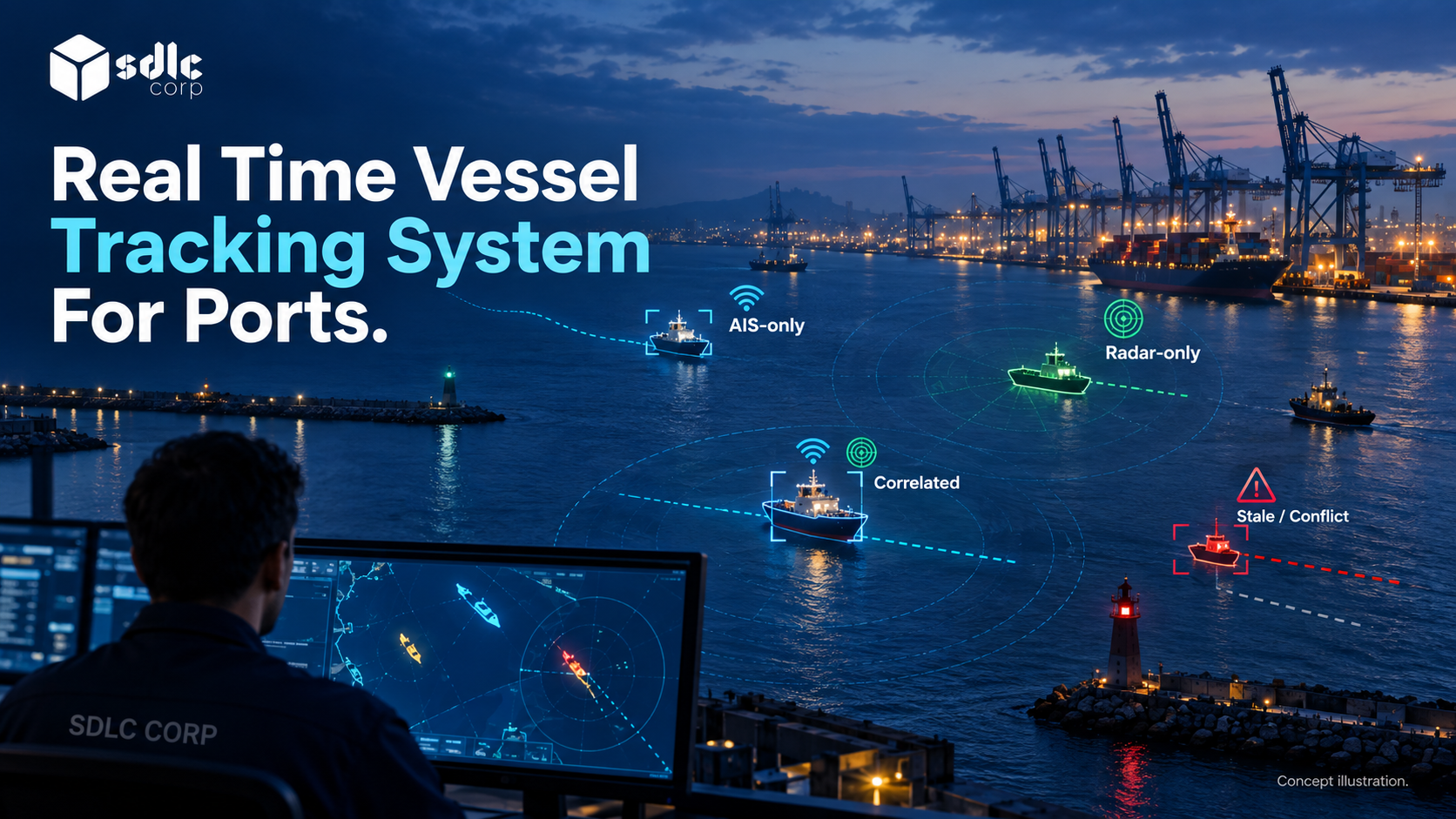
Where independent tracking is required, ask whether the application consumes radar tracks or a fused traffic picture. Radar can detect suitable targets without AIS transmissions, but identity still needs corroboration. Include radar only, conflicting source and recovery states in the proposed scope.
The AIS and VTMIS data-flow guide explains how source observations reach the call record without becoming allocation approvals.
Keep Safety Rules And Human Authority Explicit
Port-approved operating constraints should be represented separately from preferences such as minimizing reassignment. The system should explain a rejected allocation and identify missing or stale inputs. If predictive models are proposed, evaluate uncertainty, fallback behavior, and operator approval rather than accepting an unqualified accuracy claim.
Require a deliberate response when a feed stops, two operators approve conflicting requests, or a zone becomes unavailable. The interface should show what is known, what is uncertain, and who is responsible for the next decision. Automated recommendations must remain within the authority's approved control model.
A planned workflow during AIS loss makes clear which records remain available, which decisions need other evidence and how recovery is reconciled.
Plan Deployment And Acceptance Together
Compare cloud, on premises, and hybrid options against connectivity, integration proximity, recovery requirements, support capacity, and data governance. A hosting label does not establish availability. Ask how operators work during an outage and how records are reconciled afterward.
An implementation can progress through discovery, a read-only integration stage, a supervised pilot, and controlled operational adoption. Assign an acceptance owner to each stage. Test failures before cutover, train each shift, and retain a documented rollback decision. Convert these obligations into testable port authority requirements and then into the anchorage procurement request for proposal (RFP) structure.
Choose A First Release That Can Be Accepted Independently
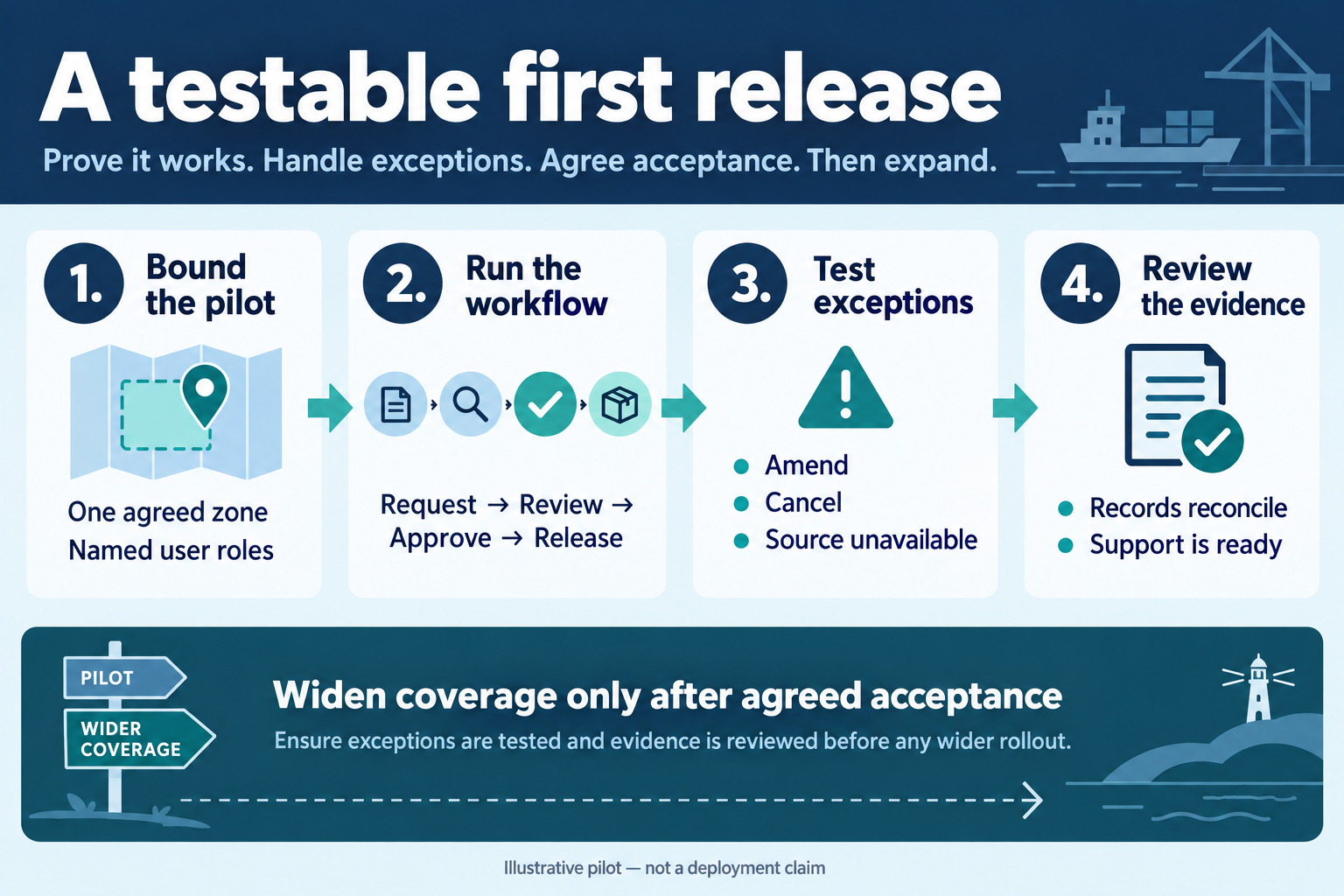
A bounded first release could cover one request to release workflow, its essential source connections and the roles needed to operate it. Include amendments, cancellations and an unavailable source in the acceptance scenario. Keep optional forecasting separate unless that workflow depends on it.
For illustration, a port might pilot one agreed zone and a limited user group before widening coverage. That boundary is useful only if the pilot exercises the necessary approvals and recovery paths. A successful demonstration with clean sample records is an earlier milestone; it does not establish that live access, shift handover and support arrangements are ready.
When reviewing implementation evidence, examine the anchorage modernization case study for its stated project stage, delivered scope and acceptance evidence. Compare those details with your proposed first release before treating it as a relevant reference.
Product, Custom Or Hybrid: What Changes The Cost?
Separate reusable product capability, configuration, custom development, and third-party work in each proposal. The same feature may be priced differently depending on the starting product, the quality of existing data, and the accessibility of interfaces. Compare the costs of operating and changing the system as well as building it.
Use anchorage system pricing and ownership costs to normalize bids. Ask what happens when a feed changes, a new anchorage zone is introduced, or the port needs its records exported. A low initial price is difficult to interpret without those assumptions.
Before shortlisting platforms, agree one workflow, name the interface owners and prepare a demonstration scenario that includes a changed allocation.
Use the software selection process to compare demonstrated workflow fit, interface access and long-term ownership before committing to an implementation.
Conclusion
Choose the system around a complete vessel call, including an amended request, a changed allocation and a source outage. A convincing demonstration should show the responsible person, current approval and decision history at each step.
Use that demonstrated workflow to define the first release. Add wider coverage or prediction only after the essential interfaces, permissions and recovery arrangements have been accepted.
Explore Anchorage Software With SDLC Corp
Explore whether the anchorage management software fits your port's request, approval and release workflows. SDLC Corp can be consulted about the product boundary and any custom software development services needed for local requirements. Bring the current operating process and interface inventory, and request a scoped response that identifies supported capabilities, missing evidence, delivery dependencies and acceptance conditions before making a commitment.
Frequently Asked Questions
What Does An Anchorage Management System Manage?
It manages requests for anchorage space, allocation decisions, amendments, occupancy records and release. Vessel observations can inform those workflows, but an observation and an authorized allocation remain separate records.
Does Anchorage Software Replace VTS?
Not by itself. Vessel traffic service responsibilities and movement authority remain with the approved operating arrangements. Define which administrative tasks the new application will support and which decisions stay in the existing service.
Can The First Release Work Without Live AIS Or AI?
Screens and workflow rules can be tested with representative data. Operational acceptance still requires any live sources needed for the chosen scope. Predictive features can be deferred when the request, approval and audit workflow does not depend on them.