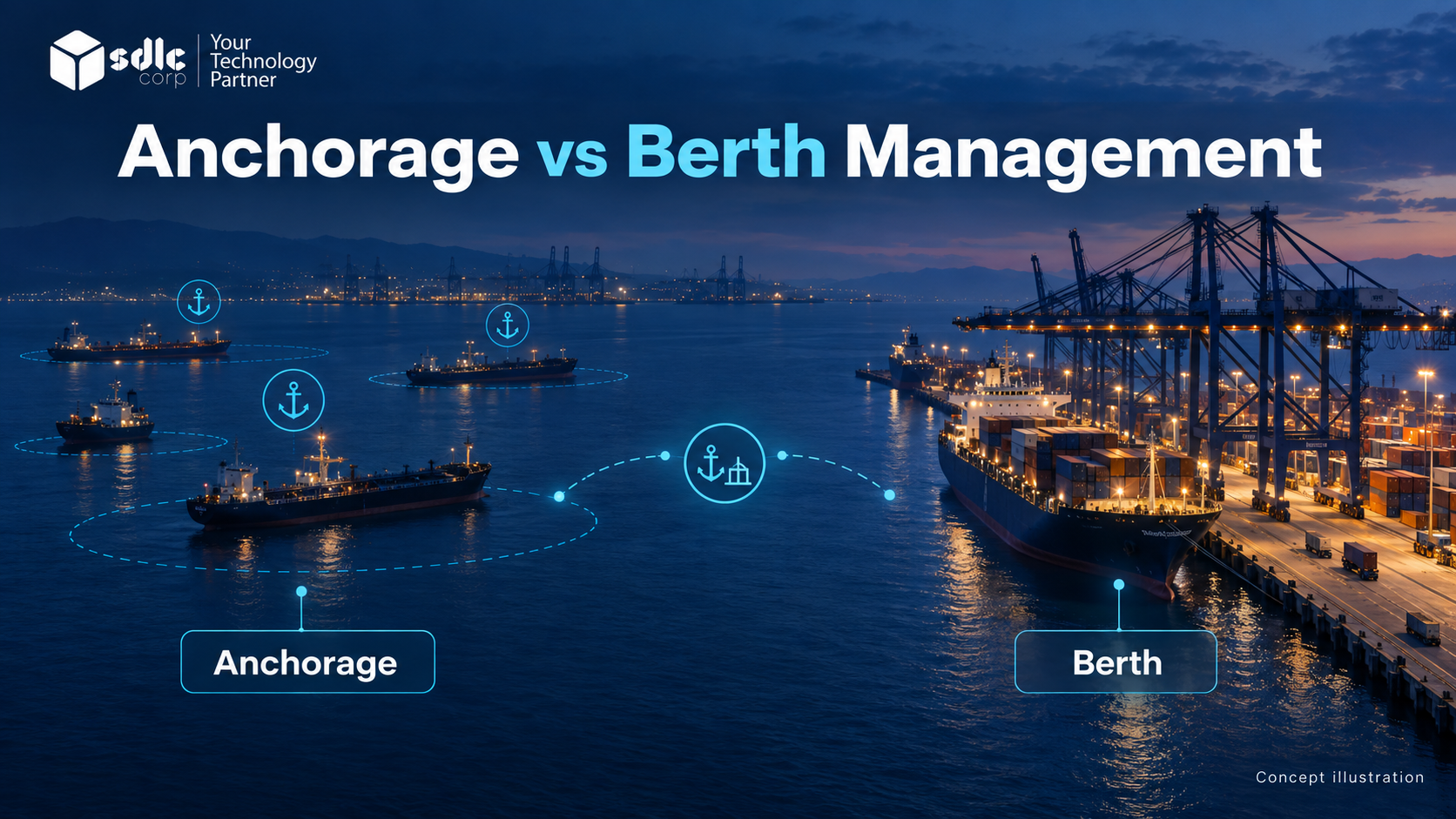
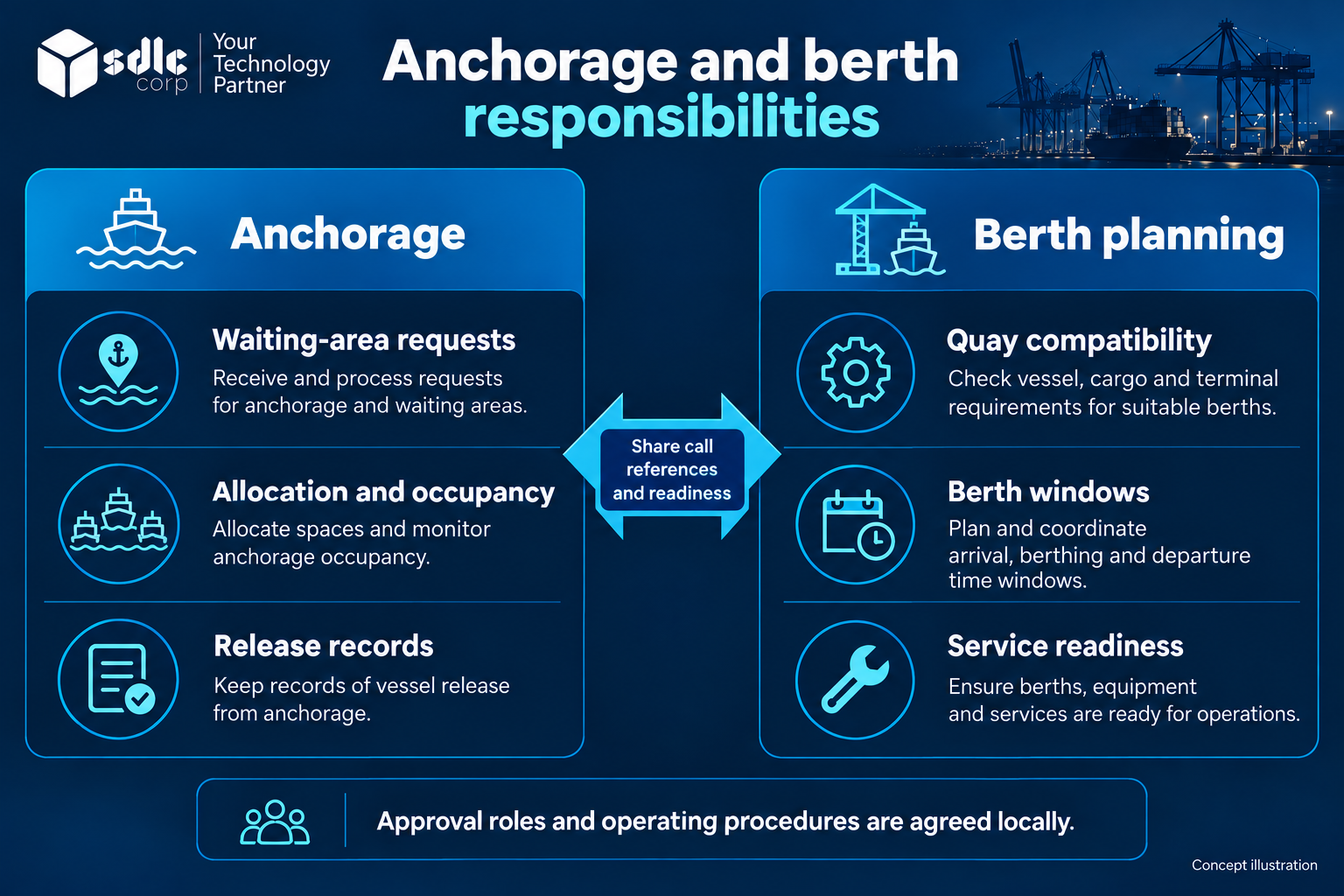
Anchorage software manages requests and allocations in waiting areas; berth management software plans the use of terminal berths. A port may need either or both, depending on where coordination breaks down and which team owns the affected decisions.
When the systems work together, a vessel call must retain a consistent identity through changes in arrival and readiness. A berth update can trigger an anchorage review without automatically authorizing a movement.
Anchorage Vs Berth Software: Responsibilities Compared
| Operating question | Anchorage responsibility | Berth responsibility |
|---|---|---|
| Where can the vessel wait? | Approved zone, reservation and occupancy | Expected berth availability |
| What prevents the next step? | Unresolved request or allocation constraint | Berth, terminal or service readiness |
| Who approves a change? | Authorized anchorage workflow owner | Authorized berth planning owner |
| What is released? | Anchorage reservation or occupied allocation | Berth slot or alongside resource |
Separate these responsibilities before comparing feature lists. A shared map may show both areas, but visual proximity does not make their approval rules interchangeable. A berth estimate is also different from a confirmed instruction to depart an anchorage. The application must preserve that distinction when it receives an updated schedule.
The International Maritime Organization (IMO) introduction to its Just In Time Arrival Guide connects arrival planning with assured berth, fairway and nautical service availability. Agree which application owns each readiness milestone and approval under the port’s operating procedures.
These are capability boundaries, not fixed product categories. A port-management suite may combine anchorage and berth functions, or separate applications may share a call record. Evaluate the actual workflow, field ownership and approval boundary before deciding how many systems are needed.
When To Buy Anchorage Software, Berth Planning Or Both
For a port with stable berth plans but inconsistent waiting area records, anchorage workflow may be the first useful investment. Start with request intake, allocation approval, occupancy confirmation, and audit history. Keep berth integration narrow until those states are reliable.
For a terminal led operation where berth clashes dominate, begin with berth planning and expose the relevant readiness milestones to anchorage teams. Do not buy an anchorage module merely because the vendor's suite includes it.
For a multi terminal port with frequent last minute changes, a shared event model and explicit system ownership may matter more than whether the applications come from one supplier.
The wider anchorage platform decision should remain separate from this scope comparison. Once the boundary is agreed, use a must have capability shortlist to identify which modules belong in the first release.
Where One Vessel Journey Changes Hands
Illustrative example
This call C-182 is waiting for terminal berth B4. Berth readiness informs the anchorage team but does not itself authorize departure.
| Time | Anchorage Responsibility | Berth Planning Responsibility |
|---|---|---|
| 08:00 | Approve a waiting area allocation | Publish B4 estimate: 12:00 |
| 09:30 | Retain current allocation | Revise B4 estimate to 13:00 |
| 09:31 | Acknowledge the revised estimate; review affected work | Identify the revised milestone as version 2 |
| 12:45 | Await the port’s required movement approval | Confirm terminal readiness for 13:00 |
| 13:00 | Record release only after authorized confirmation | Record the berth side arrival under terminal procedure |
The interface handoff occurs when the berth team publishes readiness and the anchorage team acknowledges it. Operational responsibility does not transfer simply because the message arrived.
A Handoff That Does Not Lose A Revision
| Field | Sample Value | Owner |
|---|---|---|
| Call | C-182 | Shared call identity agreement |
| Berth readiness | 13:00, confirmed, revision 2 | Terminal |
| Anchorage allocation | AL-7, approved | Anchorage approver |
| Readiness acknowledgement | Revision 2 processed at 09:31 | Anchorage application |
| Movement approval | Pending | Port designated authority |
If readiness is withdrawn at 12:50, the receiving screen flags the changed milestone and affected release task. It retains the existing allocation until the approved workflow changes it. An acknowledgement proves processing of revision 2; it is not permission to move.
How Berth Readiness Changes An Anchorage Plan
Keep Berth Readiness, Release Approval And Observed Occupancy Separate
Use a shared vessel call identifier or an explicit, maintained mapping between local call identifiers across the integration. Keep the requested berth time, estimated availability, confirmed readiness, approved anchorage allocation, and observed occupancy as separate fields.
Every field needs an owner, an update time, and a clear meaning. A late terminal update should change the readiness view without silently erasing an anchorage operator's decision.
An effective handoff includes an acknowledgement and an exception route. For example, if berth readiness is withdrawn after an operator has prepared a release, the workflow should notify the responsible team and make the conflict visible.
It should not manufacture a replacement allocation or issue movement instructions without the approved process. Coordinating berth readiness and nautical services provides the integration detail behind this boundary.
Separate the shared-information benefit from physical constraints when evaluating coordination-related port delays.
Test Changes That Cross The Boundary
Ask both suppliers to work through a delayed berth, a canceled call, a changed vessel attribute, and an update arriving twice. The receiving application should show whether it accepted, rejected, or deferred the change. Include a temporary communication outage and check how both plans converge afterward.
| Test | Evidence of an acceptable result |
|---|---|
| Berth estimate changes | Anchorage team sees the revision and its owner |
| Call is canceled | Reservations are reconciled without deleting history |
| Duplicate update arrives | No duplicate call or repeated workflow transition |
| Connection returns | Missed events are recovered and conflicts are visible |
Also test a human correction. Operators need to know whether an edit is local, will be shared, or must be requested from another team. A silent overwrite is a workflow defect even if the integration reports a successful response.
Compare Ownership Costs Across Both Systems
Request separate prices for application capability, integration adapters, data cleanup, testing, and ongoing interface support. An integrated suite can still charge for new message types or third-party access. Two applications can work well together when the data contract and support responsibilities are clear.
Include an exit test in the comparison: export calls, allocation history, berth milestones, and identifiers in documented formats. Determine who maintains the connector when either product changes. Carry these obligations into the platform selection process rather than scoring integration as a simple yes or no feature.
Choose the scope that resolves the handoff you have documented. Ask each bidder to demonstrate the same change across both plans before comparing prices.
Conclusion
Identify whether the unresolved task concerns waiting space, terminal scheduling or the handoff between them. Then evaluate the corresponding workflow with the team that owns it.
If both systems are needed, make the shared call identifier, readiness acknowledgement and amendment rules part of acceptance. Test a delayed berth and a revised allocation together before approving the connection.
Discuss Workflow Boundaries With SDLC Corp
Contact SDLC Corp to evaluate the anchorage operations platform alongside the berth-planning capabilities your port already uses. Bring the vessel journey, approval responsibilities and shared call records. Request a clear account of which functions the proposed platform would own, which remain elsewhere, and how changes, acknowledgements and recovery would be demonstrated before agreeing the scope.
Frequently Asked Questions
How Do We Decide Which System We Need?
Start with the task that is failing. Requests, waiting area allocations and release point toward anchorage workflows; terminal berth availability and scheduling point toward berth management. Delays between those teams may require integration rather than replacement.
Can One Platform Cover Both Workflows?
Yes, if it demonstrates the required behavior for each team. Test permissions, amendments, exceptions and recovery separately for anchorage and berth operations, even when they share a map or database.
How Should The Systems Identify The Same Visit?
Use a stable vessel call identifier as well as the vessel's identity. A vessel may visit repeatedly, so its identity alone cannot distinguish the requests, allocations and milestones belonging to a particular call.