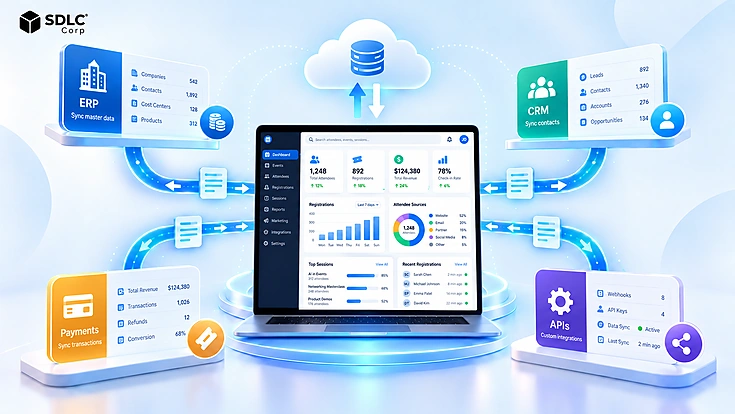

Every training team knows the last hour of an event. Sessions have ended and the feedback form is live.
Yet someone is still sitting with a spreadsheet of 480 attendee names, a design file and a mail merge that breaks on accented names.
Certificates are the final promise you made to your learners. They are also, almost always, the slowest part of the whole programme to deliver.
Certificate automation closes that gap. Instead of a person producing documents one by one, the attendance or completion record itself triggers the certificate. The file then reaches the learner while the event is still fresh in their memory.
- 12Minutes to build one certificate by hand
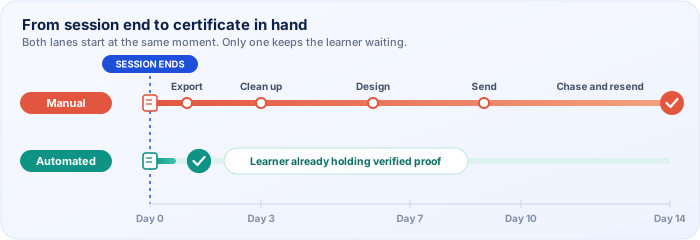
- 14Days before the last learner is served
- 100%Of issuance handled by rules once automated
This guide walks through how to automate certificates for training and educational events end to end. It covers the data you need, the workflow stages, template rules, the verification layer and the integrations that keep everything in sync.
It applies whether you run one 40-person workshop a quarter or a continuing education programme issuing thousands of credentials a year. The scale changes the tooling, but the sequence stays the same.

Why Manual Certificate Work Breaks Down
Manual certificate production rarely fails loudly. It fails quietly, as a two-week delay, a misspelled name on a credential meant for an employer, and a support inbox full of reissue requests.
Training coordinators absorb that work because it has always been theirs to absorb. The real cost only becomes visible when the task is broken into its parts.
| Task | Time cost | Measured per |
|---|---|---|
| Cleaning the attendee list and matching it against attendance logs | 60 to 120 minutes | Event batch |
| Producing and proofing certificates one at a time in a design tool | 8 to 12 minutes | Certificate |
| Sending, tracking bounces and resending to failed addresses | Half a working day | Event batch |
| Handling reissue requests for typos, name changes and lost files | Weeks of trailing effort | Open-ended |
At 10 minutes per certificate, a 200-person cohort alone consumes more than 30 hours of coordinator time. Three structural problems sit underneath that number.
First, the data is scattered. Registration lives in the event platform, attendance sits in the webinar tool and scores sit in the LMS.
Second, eligibility is decided by judgement rather than a written rule, so two coordinators applying one policy reach different outcomes. Third, nothing is verifiable afterwards, so an employer checking a credential has to email you and wait.
What Certificate Automation Actually Means
Certificate automation is often mistaken for bulk generation, which is only one stage of it. A genuinely automated system is triggered by an event in another system and decides for itself who qualifies.
It then renders a personalised document, delivers it, and keeps a verifiable record of what was issued and to whom.
A certificate is automated when no human has to open a design file, retype a name, or press send for the credential to reach the right person.
Everything short of that is a faster manual process. It is still worth having, but it will not scale past a few hundred learners.
The Four Capabilities That Separate The Two
Read from the source
Completion data comes straight from the system that recorded it, never from an exported copy.
Stored eligibility rules
Who qualifies is written into the platform, so the policy is applied the same way every cohort.
Data-driven templates
One design serves every event, with fields merged in rather than typed by hand.
Independent verification
Every credential carries an ID a third party can check without contacting your team.
The Certificate Automation Workflow, Step By Step
Most training platforms converge on the workflow below, whether it is assembled from off-the-shelf tools or built as custom software. Work through it in order, because each stage depends on the quality of the one before it.
Capture Clean Attendance Data
Decide early which system holds the truth: the check-in record for a live workshop, the minutes-attended log for a webinar, or the LMS completion flag for a course.
Capture names once at registration, validate them there, and never retype them. A certificate is only as accurate as the field it was merged from.
Write Eligibility Rules First
Eligibility should read like policy, not like code buried in a script. Typical rules cover minimum attendance, a passing score, a mandatory module and settled payment.
Put each rule in writing, get the programme owner to sign off, then encode it. Stored rules make every cohort comparable and audits straightforward.
Build A Data-Driven Template
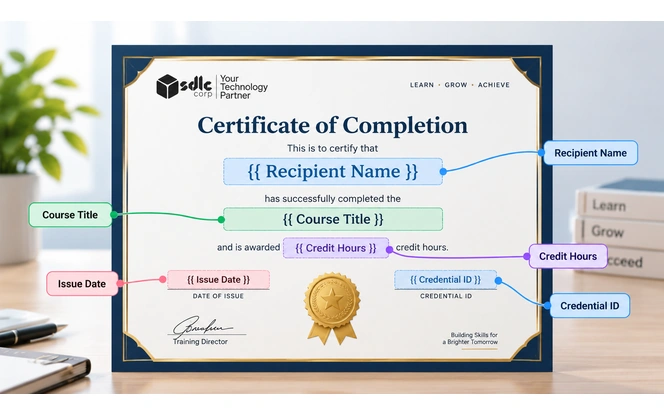
The template holds fixed brand elements plus named placeholders for recipient name, course title, credit hours, dates, signatory and credential ID.
HTML and CSS templates render to PDF reliably and can be version controlled. Keep one master template per credential type, not one file per event.
Generate The Files In Bulk
Eligible rows are merged and rendered through a queue, so a run of 5,000 certificates does not block the platform. Failed rows are retried and reported rather than silently dropped.
Produce both PDF and image outputs, since learners share the image and file the PDF with an employer.
Deliver Through Email And A Portal
Link the certificate instead of attaching a heavy file, and log every delivery status.
Give learners a permanent page where they can download the credential again months later. That single decision removes most of the reissue requests that reach training teams.
Publish A Verification Record
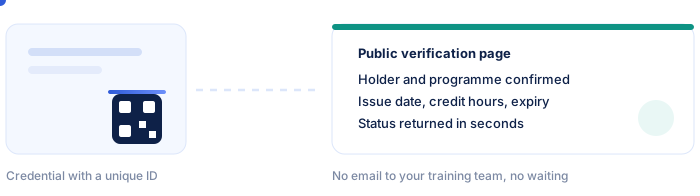
Issue each certificate with a unique ID and a QR code that resolves to a public verification page confirming holder, programme, date and status.
Employers and licensing bodies can then check a credential in seconds, and your team is removed from the loop entirely.
Once these six stages exist, the certificate stops being a task on someone's list and becomes an outcome of the learning record itself.
That shift is exactly what our teams design as part of EdTech app development services, where certificates, assessments and reporting are treated as one connected flow.
Turn Your Completion Data Into Issued Credentials
Share your current event stack and we will map the fastest path from attendance record to verified certificate.
Choosing The Right Certificate Automation Approach
There are three realistic paths. The right one depends on volume, compliance pressure, and how closely your credential design is tied to your brand. Many teams start on the first path and move along as the programme grows.
| Approach | Best fit | Setup effort | Strengths | Limitations |
|---|---|---|---|---|
| No-code tools and form triggers | Workshops, webinars and community events | Live within a day | Low cost, no engineering time to start | Quota limits, script timeouts, thin verification and branding |
| LMS certificate modules | Organisations already running structured courses | Days, inside the LMS | Tied straight to completion data, no extra integration | Rigid layouts that are hard to brand, weak on blended programmes |
| Custom automation platformFor scale | High-volume, regulated and accredited training | 4 to 10 week build | Rule engine, API access, branded portal, verification and audit built in | Needs a build phase and a named owner |
A useful test: if a wrong certificate would create a compliance problem rather than an embarrassment, the custom path is usually justified.
Continuing education, safety training, financial services and healthcare programmes fall on that side, because the credential becomes evidence in an audit.
Builds of this kind are scoped like any enterprise software development company engagement, starting with data mapping and rule definition rather than design.
Designing Certificate Templates That Scale
Template design is where most automation projects quietly lose time. A layout that looks right with "Ana Roy" often breaks with "Krishnamurthy Venkataraghavan" or an eleven-word course title.
Design for the worst-case string, not the demo one.
Six Template Rules Worth Enforcing
Variable fields defined once
Name, programme title, credits, dates, signatory and credential ID, each mapped to a single source field.
Text that reflows
Long names and titles shrink or wrap inside a fixed block instead of overflowing the border.
Unicode and script support
Fonts must render accented characters and non-Latin scripts, or some learners receive broken names.
Print and screen parity
Set the canvas at print resolution so one file works in print and online.
A fixed place for the verification mark
Keep the QR code and credential ID in the same position on every template.
Version control on the template
Store each revision with a date so you can reproduce what was issued in a past year.
Before launch, run a rendering test against a deliberately awkward sample set. Include the longest name in your database, a name with diacritics, a hyphenated surname and a title in every supported language.
Problems found in that test cost minutes. The same problems found after 3,000 certificates have been emailed cost a week.
Verification, Security And Compliance
A certificate that cannot be checked is decoration. Once credentials carry professional weight, the verification layer matters more than the artwork.
It is also the part learners and employers notice most in the years after the event.
Give Every Credential A Public Verification Route
Issue a unique, non-sequential credential ID and expose it through a QR code and a short verification URL. The page should show holder name, programme, issue date, any expiry and current status.
Non-sequential IDs matter. Predictable numbering lets anyone guess a valid credential and infer how many you have issued.
Answer The Accreditation Question With IACET In Mind
For continuing education, the harder question is not whether a certificate is genuine. It is what evidence the certificate represents, and IACET is the benchmark most providers are measured against.
Under the IACET definition of the CEU, one continuing education unit equals ten contact hours of participation in an organised learning experience with qualified instruction.
Only IACET Accredited Providers may award IACET CEUs, so automation can document credit but cannot confer accreditation. The eligibility rule must count instructional contact time, not attendance percentage, and credit only completed programmes.
IACET also expects a record for every learner awarded CEUs, with a transcript available on request. Your certificate engine should store that record, not just the PDF.
Contact time is easiest to prove when it is tracked per session. Our guide to managing multi-session events, workshops and breakouts explains how session-level attendance feeds CEU and CPD evidence.
Consider Open Standards For Portable Credentials
Where credentials must travel between institutions, open standards are worth the extra setup. The Open Badges specification packages achievement metadata inside the badge itself.
The W3C Verifiable Credentials data model defines a tamper-evident format a recipient can present anywhere. Academic bodies, professional associations and government-adjacent programmes increasingly expect one of the two.
Handle Learner Data With The Same Care As The Credential
Certificate systems hold names, email addresses, employer details and assessment outcomes, which puts them inside data protection obligations.
Restrict who can issue and revoke, and log every action with a timestamp and an actor. Encrypt files at rest and in transit, and set a retention period instead of keeping records forever.
Revocation is often forgotten. You need a way to mark a credential void and have the verification page reflect it immediately.
Issuing rights are often granted broadly during a busy season and never withdrawn, leaving many people able to mint valid credentials.
The discipline behind approval routing in workflow automation services applies here: roles, approvals and audit trails belong in the system from day one.
Add A Verification Layer Your Auditors Will Accept
We build credential IDs, QR verification pages, revocation controls and audit logs into certificate platforms from the first sprint.
Integrating Certificate Automation With Your Existing Stack
Certificates sit at the end of a chain, so integration quality decides whether the automation holds up. The connections below cover most training and education environments.
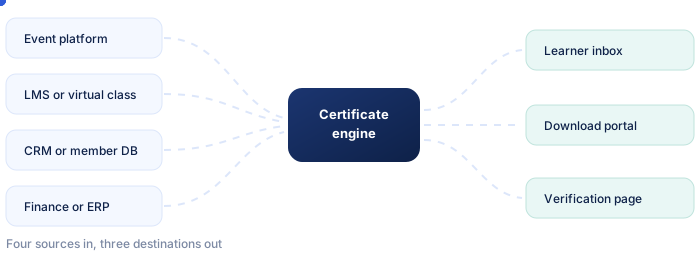
Where The Connections Run
Event and webinar platforms
Attendance duration is the field that matters. Pull it through a webhook the moment a session ends, while the platform still holds full session data.
For in-person events, our guide to event check-in, badge printing and attendance tracking covers how that record is captured.
Learning management systems
Completion status, module progress and assessment scores are read through the LMS API or a completion webhook.
If your LMS already issues basic certificates, keep it as the data source and let the engine handle rendering, verification and delivery.
CRM, membership and ERP systems
Credentials are written back so the learner record shows what was issued and when, which powers renewal reminders and credit hour tracking.
Where the record of truth lives in an ERP, teams connect it through Odoo integration services.
Storage, email and documents
Files belong in object storage with signed, expiring links. Transactional email should report bounces and opens, since delivery status is the only proof a credential arrived.
Uploaded evidence such as signed attendance sheets can be read with AI intelligent document processing instead of manual data entry.
Common Certificate Automation Mistakes To Avoid
These failures show up repeatedly in post-launch reviews. Each one is cheap to prevent and expensive to correct after issuance.
Automating Before The Data Is Clean
Automation multiplies whatever it is given. Inconsistent registration names now produce 900 inconsistent certificates instead of nine.
FixClean and validate the source fields before the first automated run.
Leaving Eligibility To Human Judgement
When rules are not written down, exceptions get made informally and the programme cannot defend its decisions later.
FixEncode the policy, then allow a documented override path with a named approver.
Skipping The Revocation Path
Certificates get issued in error, and credentials expire. Without a revoke function, the only remedy is asking a learner to delete a file they already hold.
FixBuild revocation into the first release and link it to the verification page.
Treating Delivery As The Finish Line
A sent email is not a received certificate. Bounces, spam filtering and stale addresses are normal.
FixShip a self-service portal and a delivery report alongside the first release.
Testing Only With Short, Simple Names
Demo data hides layout failures that real learner names expose.
FixTest with the extremes present in your real learner base before going live.
Measuring Whether Certificate Automation Worked
Automation deserves the same measurement rigour as any other operational change. Four numbers tell you almost everything within the first two cohorts, and each needs a target set before launch.
Time To Issue
Hours between session close and the last certificate delivered. Manual programmes typically take up to 14 days.
TargetUnder 24 hoursError And Reissue Rate
Certificates corrected or reissued, as a share of the batch. Every reissue is a data or template defect worth tracing.
TargetBelow 1% of the batchDelivery Success Rate
Credentials opened or downloaded, not merely sent. Measure it 14 days after issue so late openers are counted.
Target95% or higherStaff Hours Returned
Record what certificate production used to consume per event, then compare after two cycles. This figure usually justifies the investment internally.
Target80% fewer hours or more
Treat these as starting targets and tighten them once two cohorts give you a baseline of your own.
A Realistic Rollout Sequence
- Pick one recurring programme rather than the whole catalogue, and automate it end to end.
- Run the automated batch and the manual process side by side for one cohort, then compare the output line by line.
- Switch the programme over, keep the manual fallback documented, and watch delivery reports for the first two runs.
- Roll the same templates and rules out to the remaining programmes once the first has been stable for two cycles.

Automate Certificates For Your Next Training Programme
From attendance capture to verified delivery, our engineers build the pipeline around the systems you already run.
Bringing It Together
Automating certificates is less a design project than a data project. Trustworthy attendance records, eligibility written as policy and verifiable identifiers make issuing the easiest part of the programme.
Learners receive proof while the training still matters to them, and your coordinators get their post-event week back.
Start with one programme, prove the pipeline against a manual run, and extend from there. If credentials must stand up to an auditor, build verification and revocation into the first release.
Teams that need help scoping that work can bring their existing stack to a software development company and start from the data map.
Frequently Asked Questions
How Long Does It Take To Set Up Certificate Automation?
A no-code setup for a single workshop can be running within a day.
A connected pipeline across an LMS, an event platform and a verification portal normally takes four to ten weeks, mostly spent on data mapping and eligibility rules.
Can Certificates Be Issued Automatically For Live In-Person Events?
Yes. Check-in scans or badge reads supply the attendance record, the eligibility rule is applied against session minutes, and certificates are generated the same evening. Only the data source differs from virtual events.
What Data Is Needed On An Automated Certificate?
At minimum: the recipient's registered full name, the programme title, the completion date, the issuing organisation and a unique credential ID.
Credit hours, expiry date, signatory and a QR verification link are added where the credential carries professional or regulatory weight.
Can Automated Certificates Award IACET CEUs?
Only if the issuing organisation is an IACET Accredited Provider. Automation records and documents the credit, but it cannot grant accreditation.
One IACET CEU equals ten contact hours, so the eligibility rule should count instructional contact time and keep a learner record that can produce a transcript on request.
How Do Employers Verify An Automated Certificate?
They scan the QR code or open the short verification URL printed on the credential. A public page confirms the holder, programme, issue date and current validity without anyone contacting your training team.
Do We Need Blockchain For Certificate Verification?
Not usually. A hosted verification page with unique IDs, tamper-evident records and an audit log satisfies most training and education programmes.
Blockchain anchoring is worth evaluating when credentials must stay verifiable even if your organisation no longer exists.
What Happens When A Certificate Is Issued By Mistake?
The credential is revoked, the verification page shows it as void, and a corrected certificate is reissued under a new ID. The original stays in the audit log rather than being deleted, which keeps the trail defensible.
Can Automated Certificates Be Personalised Per Cohort Or Language?
Yes. One master template supports variants for language, region, signatory and credential type.
The same rule engine that decides eligibility selects the right variant, so you avoid maintaining a separate design file for every event.