
Government departments, schools, colleges and universities run conferences, training programmes, faculty meetings, student workshops and public consultations. Each produces information that has to be controlled: registrations, attendee details, payments, attendance records and administrative activity.
Most security guidance for this category stops at a feature list, and a feature list does not help you make a decision.
- Classify the event and its data before you choose a single control.
- Match identity, authorisation, monitoring and recovery to that classification, not to a generic checklist.
- Test every control in your own deployment rather than trusting vendor documentation.
- Keep a standing evidence pack, because procurement judges the documentation more than the product.
The Decision Path That Security Feature Lists Miss
Use multi-factor authentication, encrypt your data, apply role-based access control, run a penetration test. All correct, and none of it answers the question a security reviewer or procurement officer actually asks.
Not "does the platform have MFA?" but "which risk does this control address, where is it enforced, how did you test it, and what evidence proves it worked?"
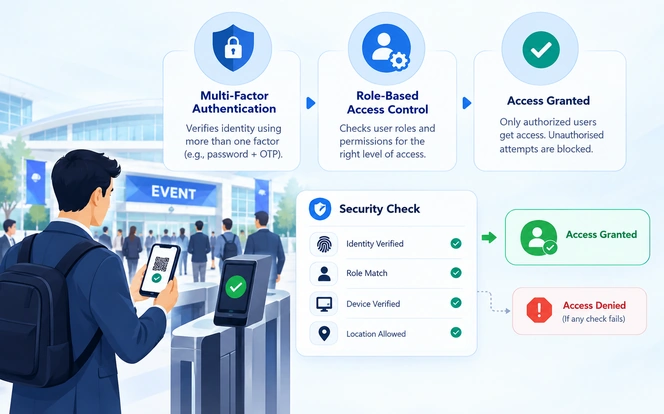
Two conditions make this sector different. The first is the volume of temporary identities: one conference can generate hundreds of speakers, volunteers and contractors who need access for days and should lose it immediately afterwards.
The second is that the buyer is not the user. Procurement teams, security officers and legal counsel judge the platform on documentation, not on daily use.
Programmes fail at test and evidence far more often than at control. Most organisations can list their controls. Fewer can show each one was tested. Fewer still can produce evidence on request.
Setting The Foundation: Risk Classification And Architecture
Two decisions shape every control that follows. The first is what the event actually handles. The second is how the platform is divided into trust zones, so a failure in one area cannot spread into another.
Step One: Classify Event Risk Before You Classify Controls
A registration page looks trivial from the outside. Behind it, the platform may handle personal information, payment records, student records, attendance history and privileged administrative actions.
For an institution, that can mean student, faculty or staff records, which in the United States brings FERPA into scope depending on the data and the deployment.
Seven Questions To Answer Before Choosing Controls
Start with seven questions before any control decision is made.
- What does the platform collect?
- Who can view, modify, export or delete it?
- Which actions affect money, attendance or official records?
- Which external systems exchange data with it?
- What happens if an account or integration is compromised?
- What evidence must be retained?
- What availability is needed during peak registration?
As you move from public events through institutional events to restricted ones, identity, authorisation, monitoring, auditability and recovery requirements all tighten.
| Risk area | Public event | Institutional event | Restricted event |
|---|---|---|---|
| Attendee data | Basic contact details | Personal or institutional records | Sensitive or restricted |
| Authentication | Standard | SSO and MFA where appropriate | Strong authentication throughout |
| Authorisation | Basic roles | Department and event roles | Strict least privilege |
| Integration controls | Standard | Scoped access | Strictly scoped access |
| Monitoring | Standard | Enhanced | Enhanced and continuous |
| Recovery | Defined | Tested | Tested against critical objectives |
Treat this as a planning indicator for discovery, not a universal compliance checklist. What any organisation needs depends on its jurisdiction, contracts, deployment model and the data it processes.
Step Two: Trust Boundaries In The Architecture
Separate identity, event operations, payments, storage and integrations into defined trust boundaries, with external systems reached from the service layer rather than from the client.
Not every module needs to be its own service. A modular application with well-defined internal APIs usually beats premature decomposition.

What matters more than topology is being explicit about which services may communicate. The payment module should not reach student records. Check-in should not modify financial data.
Where an organisation is moving toward zero trust, NIST SP 800-207 is the reference model for making those boundaries explicit, and the NIST Cybersecurity Framework 2.0 is the right structure for the governance around them.
Identity And The Temporary Account Problem
Administrative accounts here can modify registrations, export full attendee lists, change access rules and manage payments. They warrant stronger authentication than attendee accounts, chosen deliberately rather than applied uniformly.
NIST SP 800-63B defines authenticator assurance levels and gives you defensible language for the difference.
Single sign-on suits any institution already running a central identity provider, over SAML or OpenID Connect. Beyond convenience, it moves account lifecycle into a system that already handles joiners, movers and leavers.
Temporary identities are the problem most event platforms handle badly. Volunteers, speakers and contractors are created under time pressure, given more access than they need because nobody wants to block a live event, and then forgotten.
Handle them as a defined lifecycle instead.
- Invite through a controlled processNo ad hoc account creation during the event week.
- Verify the person against the invitationConfirm identity before any role is attached.
- Assign a scoped rolePermissions limited to the specific event and function.
- Grant access for the event period onlyStart and end dates set at creation, not later.
- Expire automaticallyRemoves the dependency on human follow-up during the busiest part of the cycle.
- Review and revoke residual accessConfirm the account is inactive after the event closes.
Automatic expiry is the highest-value control in this whole section. Every other step depends on someone remembering to act; expiry does not.
Data: Minimisation, Protection And Location
Do not collect information you do not need. Every additional field increases what must be protected and what could be exposed.
Registration is the most exposed surface because public users interact with it directly. Validate on the server rather than relying on browser-side checks, and protect registration APIs against automated abuse, malicious input and duplicate submissions.
For what you keep, define who can access it, where it is stored, how long it is retained, when it is deleted and how it is protected in transit and at rest.
Apply the same controls to backups, since a poorly protected backup is another route to the same data.
Buyers here also need to know where their data physically lives, and this is often decided late, when it is expensive to change.
- Hosting: where production data and backups are physically hosted.
- Support access: whether support staff can reach data from another jurisdiction.
- Subprocessors: how they are disclosed and kept current.
- Deletion: whether it can be verified rather than merely asserted.
Some subprocessors now supply AI features such as chatbots, attendee matching or automated scheduling. Put each one through an AI vendor risk assessment before it can touch attendee data.
Transactions, Payments And Exports
Treat fees, refunds, cancellations, attendance records and exports as controlled transactions rather than interface operations. Each needs a defined initiator, approver, permitted changes, recorded evidence and a reversal path.
Route card collection through a payment provider, limit the platform to payment status, transaction identifier, amount and registration reference, and avoid storing raw card data.
This section covers the security controls around these flows. For how the flows themselves should work, see our guide to event registration and payment processing features.
One point is frequently overstated. Tokenisation can reduce the payment data the platform handles and may reduce PCI DSS assessment scope, but it does not by itself make an implementation compliant or eliminate PCI DSS responsibilities.
Scope depends on the actual architecture and payment flow, and should be confirmed against current PCI Security Standards Council guidance.
Export Is Its Own Design Problem
A platform can be well secured internally and still lose data the moment someone downloads an attendee list.
- Separate permission: give export its own right, distinct from view.
- Mask by default: sensitive fields hidden unless explicitly required.
- Cap or approve bulk: require approval above a defined threshold.
- Log every download: actor, scope and timestamp on each extraction.
- Alert on volume: abnormal export activity raises a signal.
The key decision is separating the right to see a record from the right to extract it in bulk. Many roles need the former. Very few need the latter.
Integrations, APIs And Check-In
Every integration creates a new security boundary, and the list here is long: ERP, CRM, HR, student information systems, accounting, email, SMS, payment gateways and identity providers.
Each connection needs strong authentication, scoped tokens or keys, secure credential storage, rotation and its own activity logging.
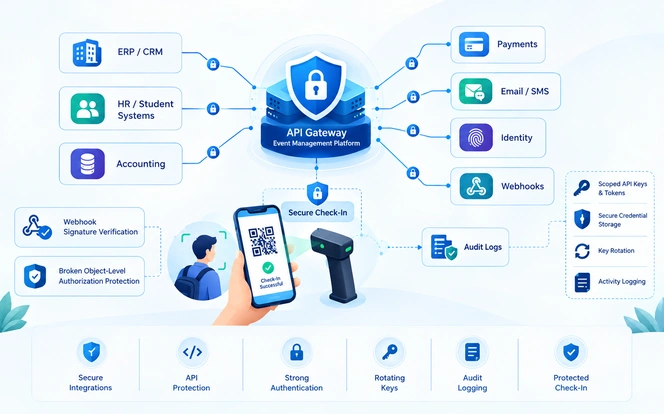
The failure mode to avoid is platform-wide access for an integration that needs one dataset. Webhooks need signature verification rather than source IP alone.
The most common API weakness in platforms of this type is broken object-level authorisation, where an endpoint checks that a user is logged in but not that the record belongs to them.
It is the top entry in the OWASP API Security Top 10 and should be tested explicitly.
For check-in, do not put personal information inside a QR code. Use an opaque identifier the platform validates on arrival, confirming the registration belongs to the correct event, is valid and has not already been used.
The operational side of this workflow, from scanning at the door to printed badges and attendance records, is covered in our guide to event check-in, badge printing and attendance tracking.
Where one platform serves several departments or campuses, tenant-aware authorisation must be enforced at both the application and database boundaries. Test it by attempting cross-tenant access and confirming refusal. Reading the code is not sufficient.
Evidence: From Logging To A Defensible Audit Trail
A log records that something happened. Evidence proves it to a third party during an investigation, an access review or a procurement assessment.
Build the chain deliberately: event, actor, action, timestamp, object, result, artifact, retention period. Apply it to account changes, permission updates, registration modifications, approvals, refunds, exports and administrative activity.
Two properties make the difference. Audit records must be shielded from ordinary users and resistant to modification, ideally written to storage the application itself cannot rewrite.
They must also be retrievable. If it takes three days and a developer to answer who changed a registration and when, the evidence exists but is not usable.
Retention And Review Cadence
Evidence needs defined time limits, or nobody can say whether it will still exist when a reviewer asks. The figures below are a defensible baseline drawn from PCI DSS and NIST SP 800-63B.
| Control area | Figure | Basis |
|---|---|---|
| Audit log retention | At least 12 months, with the most recent 3 months immediately retrievable | PCI DSS v4.0.1, Requirement 10.5.1 |
| Privileged session timeout | Reauthenticate after 15 minutes of inactivity | PCI DSS v4.0.1, Requirement 8.2.8; NIST SP 800-63B at AAL3 |
| Standard staff session | Reauthenticate after 30 minutes of inactivity and at least every 12 hours | NIST SP 800-63B at AAL2 |
| Access review interval | At least every 6 months, and on every role change or departure | PCI DSS v4.0.1, Requirement 7.2.4 |
| Temporary event accounts | Expire the day after the event, with removal confirmed within 7 days of close | Our recommended practice |
Treat these as minimums. Contracts, records schedules or local law may require longer retention or shorter timeouts, and the stricter figure should win.
Record whichever figures you adopt in the evidence pack, so a reviewer can check the platform against a stated policy.
Accessibility Is Part Of The Security Surface
In an event platform, accessibility overlaps directly with the security flows. The overlap is clearest in authentication, where WCAG 2.2 added success criteria that specifically address cognitive function tests in login flows.
A control that cannot be completed by a user with a cognitive or motor disability is not a working control for that user, and in this sector it can also be a legal exposure.
Error recovery matters most, because a failed login or a declined payment is exactly when an inaccessible interface strands a user.
Validation And The Procurement Evidence Pack
Validation belongs throughout development, not in the final sprint. Start with code and dependency checks, then API, access-control, role and tenant-isolation testing, then penetration testing.
Load testing matters more here than in most categories, because registration spikes are sharp and a platform that is unavailable during the registration window has failed regardless of how well it is secured.
| Threat | Control | Validation |
|---|---|---|
| Account takeover | MFA on privileged accounts | Authentication testing |
| Excessive permissions | Role-based access control | Role testing |
| API authorisation failure | Object-level authorisation | API testing |
| Forged QR credential | Server-side validation | Check-in testing |
| Cross-campus access | Tenant isolation | Cross-tenant testing |
| Unauthorised export | Export permissions and logging | Data-access testing |
| Payment manipulation | Gateway verification and reconciliation | Transaction testing |
Know Which Kind Of Obligation You Are Mapping To
If the platform uses AI to screen registrations, answer attendee queries or generate reports, those features also fall under your government AI governance framework. Map them there alongside the obligations above.
The Standing Evidence Pack
Assemble it in advance rather than producing one under deadline.
- Architecture and data-flow diagrams.
- The authentication and authorisation model.
- Encryption approach, in transit and at rest.
- Penetration-test results with remediation status.
- Incident-response process and recovery-test evidence.
- Sample audit logs and the retention policy.
- Subprocessor inventory and hosting location.
- A security responsibility matrix.
The responsibility matrix resolves more procurement disputes than anything else, because most disagreements come from both parties assuming the other handles a given control.
An incomplete answer rarely causes rejection. It causes delay, and for a platform tied to a fixed event date, delay and failure are the same outcome.
A Worked Example: A University Research Conference
A university hosts a three-day conference with 400 attendees. Two sessions are restricted to named participants under an industry funding agreement. The event charges fees and uses volunteer check-in staff.
Risk To Readiness In Five Moves
Risk
- Restricted sessions rank highest, because unauthorised attendance breaches the funding agreement.
- Thirty volunteer accounts created in the week before the event.
- The delegate list, which is commercially sensitive to the sponsor.
Control
- Session-level authorisation distinct from event registration, so a valid conference registration does not by itself grant entry to a restricted session.
- Volunteer accounts scoped to check-in only, expiring the day after the event.
- Export permission separated from view and held by two named staff.
Test
- Attempt to check into a restricted session with a general attendee credential and confirm refusal.
- Confirm a volunteer account cannot view payments or export a delegate list.
- Confirm volunteer accounts are inactive after expiry.
Evidence
- Access-decision logs showing every admission and refusal with actor and timestamp.
- The volunteer roster with creation and expiry dates.
- Export logs showing who extracted what and when.
Readiness. The conference can proceed if restricted-session decisions are logged and refusals verified.
It should not proceed if volunteer expiry is unverified, because thirty accounts with check-in access and no expiry date outlive the event. The path produced a go and no-go position, not a list of features.
Measuring Readiness Before You Launch
After deployment, alert on privileged-login failures, permission changes, abnormal exports and unexpected payment events. One failed login is noise, several hundred against an administrator account is a signal.
Backups should be encrypted, access-controlled and restore-tested before a major event creates the pressure.
A weighted scorecard helps identify weak areas before production. The weights below are our own, not an external standard, and should be adjusted to the deployment.
| Security area | Suggested weight |
|---|---|
| Identity | 15 |
| Authorisation | 15 |
| Data protection | 15 |
| Resilience and recovery | 15 |
| Integrations | 10 |
| Payments | 10 |
| Audit and evidence | 10 |
| Monitoring | 10 |
The overall number is the least useful part of the exercise, because strong monitoring does not compensate for an untested authorisation boundary.
Do not launch at all if privileged accounts lack MFA, cross-tenant access is untested, critical vulnerabilities are unresolved, payment flows cannot be reconciled, audit logs cannot capture privileged actions, temporary account expiry is unverified, or recovery has not been tested.
Conclusion
Classify the event and its data first. Choose controls proportionate to that classification. Test each one in your own deployment.
Retain the evidence in a form you can produce on request. Then decide, against a threshold set in advance, whether the platform is ready.
That sequence is what turns a security feature list into a defensible launch decision.
If you are comparing event management software for a department or campus, run every shortlisted option through the same path before you commit.
For the wider evaluation criteria beyond security, work through our event management platform buyer's guide alongside this path.
Frequently Asked Questions
They combine public-facing registration with privileged internal data, large numbers of temporary accounts, and a procurement process that evaluates documentation rather than the product. The controls overlap with commercial platforms. The evidence requirements and the temporary-identity load do not.
Stronger authentication than attendee accounts, because administrators can modify registrations, export attendee data, change access rules and manage payments. NIST SP 800-63B provides assurance levels for choosing this deliberately rather than applying one standard everywhere.
No. It can reduce the payment data the platform handles and may reduce assessment scope, but scope and obligation are determined by the actual architecture and payment flow. Confirm against current PCI Security Standards Council guidance.
Through a defined lifecycle: controlled invitation, verification, a role scoped to the specific event, access limited to the event period, automatic expiry, post-event review and revocation. Automatic expiry is the highest-value control, because it removes reliance on manual follow-up.
Architecture and data-flow diagrams, the authentication and authorisation model, encryption approach, penetration-test results with remediation status, incident-response process, recovery-test evidence, sample audit logs, retention policy, subprocessor inventory, hosting location and a security responsibility matrix.