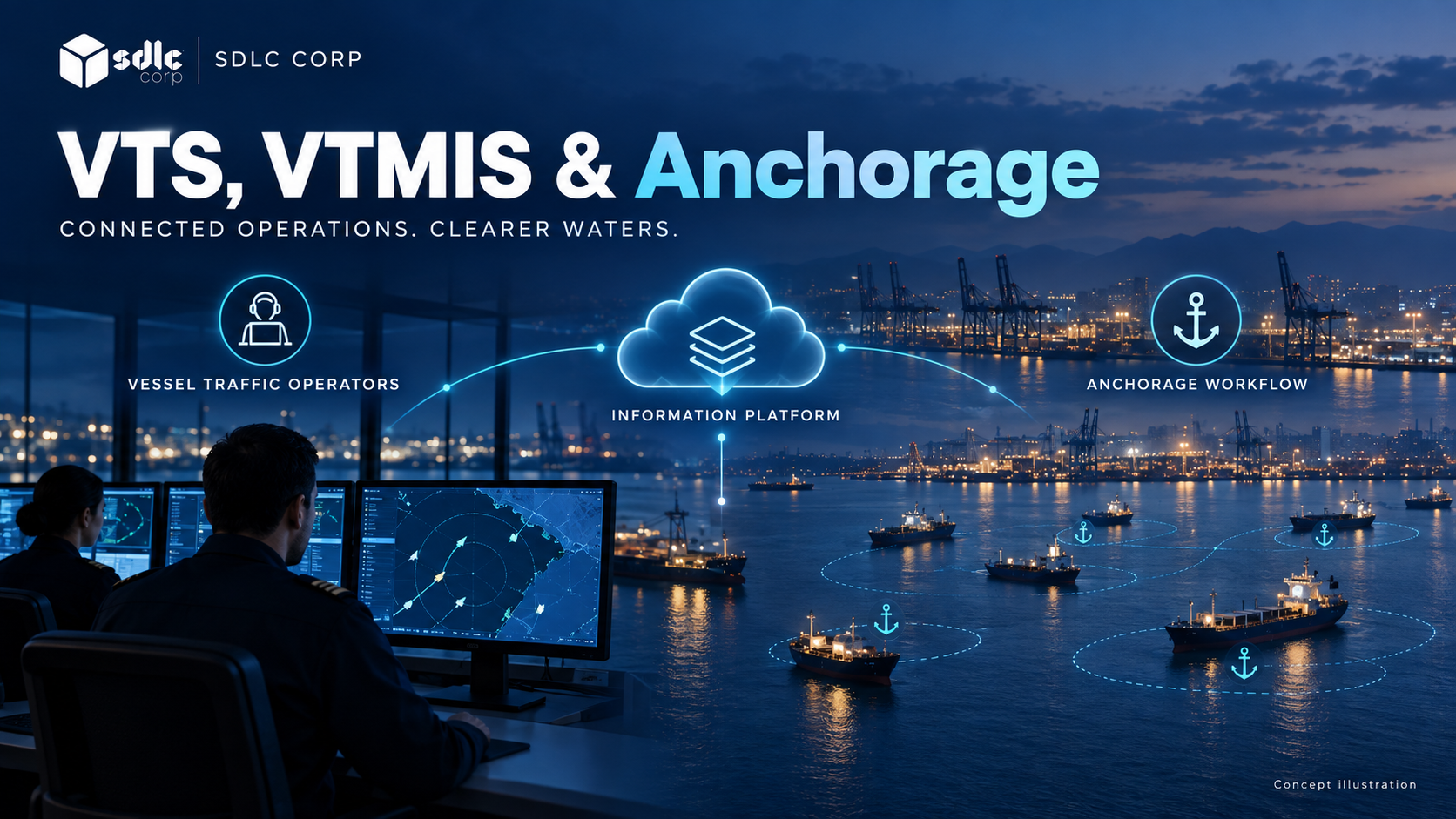
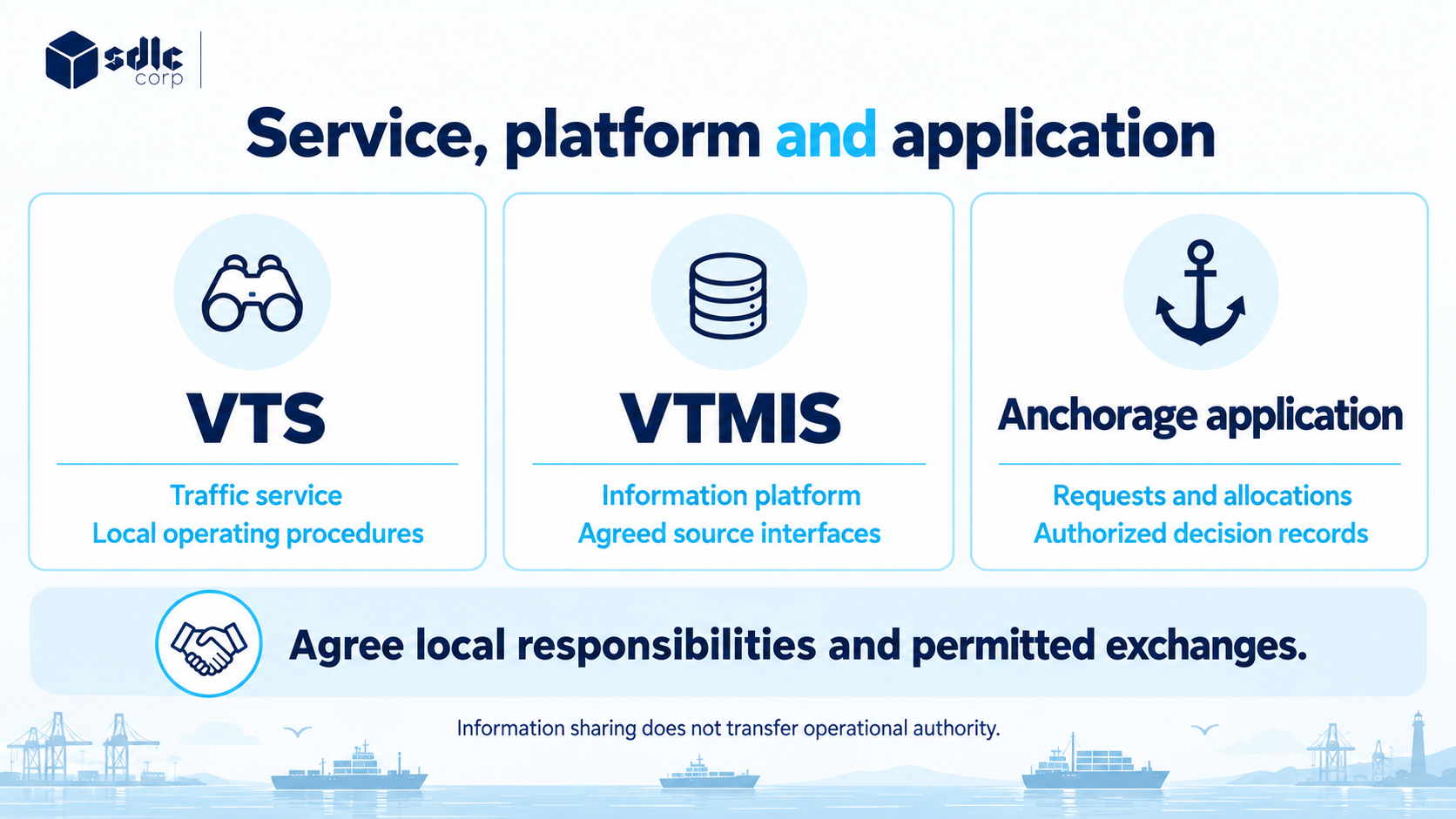
Vessel Traffic Services (VTS) are an operational service; a Vessel Traffic Management and Information System (VTMIS) is supporting technology whose functions depend on the installation. Anchorage software manages the requests, approvals and allocation records assigned to it by the port.
Separate service authority, technical capability and workflow ownership before comparing suppliers. Sharing a screen or supplier does not make those responsibilities interchangeable.
Service Responsibility, Supporting Technology And Anchorage Workflows
Vessel Traffic Services (VTS) are an operational service with responsibilities established by the competent authority. A Vessel Traffic Management and Information System (VTMIS) is technology that may support traffic monitoring, information management and related functions according to its installation. An anchorage application manages the requests, approvals and allocation records assigned to it by local procedures.
These are different kinds of responsibility, not three interchangeable software categories. The International Maritime Organization (IMO) description of vessel traffic services sets VTS in its operational context. Buying software does not establish the staffing, authority or procedures of that service.
Ask the incumbent owner which sensors, tracks, records and interfaces its VTMIS actually supplies. Separate that capability inventory from the anchorage platform capability overview and from the authority to make each decision.
| Responsibility | What To Establish | Evidence |
|---|---|---|
| VTS service | Who provides the service and under what procedures? | Authority, service scope and operating responsibilities |
| VTMIS technology | What does this installation support and expose? | Installed functions, supported interfaces and permissions |
| Anchorage workflow | Who can request, approve, amend and release? | Operating procedure, application states and audit records |
Build A Responsibility Matrix For Real Events
Name The Owner Of A Zone Restriction And Its Application Consequences
Take one vessel call and document who owns each fact. Position observations, expected arrival, an anchorage request, an approved allocation, and actual occupancy can come from different people or systems. Their relationship should be defined without forcing them into one status field.
For example, a tracking source can indicate a vessel's position while the anchorage application retains an approved reservation. If the two disagree, the system should surface an exception. It should not automatically erase the reservation or assume that a position observation proves an authorized allocation.
For each record, name who owns it, who may edit it and who uses it. State how an error is corrected. Retain record identifiers and timestamps so the integration team can investigate a disputed update. This matrix becomes the starting point for connecting traffic information to anchorage workflows.
Who Does What For A Single Arrival?
Illustrative example
This responsibility matrix uses “accountable” for the decision owner and “responsible” for the team performing the work. Actual authority must follow the port’s procedures; a software platform is not a decision-making authority.
| Activity | Accountable | Responsible | Consulted Or Informed |
|---|---|---|---|
| Submit arrival information | Designated reporting lead under local rules | Authorized submitting agent | Port reporting team |
| Maintain traffic information | Traffic service duty manager | Traffic service operators using their platform | Anchorage team receives permitted observations |
| Submit anchorage request | Requesting organization | Authorized agent | Anchorage operator |
| Approve allocation | Port designated allocation approver | Anchorage review team | Traffic service informed where required |
| Authorize or coordinate movement | Authority designated by local procedure | Authorized traffic/movement personnel | Anchorage and terminal teams |
One Event, Three Different Records
At 08:00, agent A submits request R-41 for call C-182. At 08:03, the traffic platform supplies position observation O-55. At 08:07, the anchorage approver creates allocation AL-7.
| Record | What It Establishes | What It Does Not Establish |
|---|---|---|
| R-41 | A waiting area request exists | The request has been accepted |
| O-55 | A source observed a position at 08:03 | An allocation or movement was authorized |
| AL-7 | The named approver accepted an allocation | The vessel is already occupying it |
When O-55 falls outside AL-7, the application opens an exception for review. It does not change allocation ownership to the traffic platform. That separation is the practical difference between sharing information and duplicating operational authority.
Map The Service, Technology And Application Without Confusing Them
| Fact Or Action | VTS Service Responsibility | VTMIS Technology To Verify | Anchorage Application Role | Local Owner To Name |
|---|---|---|---|---|
| Traffic observation | Uses information within the defined service | Supported sensors, processing and display | Consumes permitted evidence | Traffic service and source owner |
| Vessel identity evidence | Applies the relevant identification procedure | Source association and uncertainty fields | Retains provenance and unresolved matches | Designated identity reviewer |
| Anchorage request | Receives information where procedure requires | May relay data if supported | Records the request and its state | Requesting and receiving organizations |
| Allocation approval | Participates only as locally assigned | May expose a supported workflow or exchange | Records the designated approval process | Port allocation authority |
| Movement instruction | Follows the competent authority’s service arrangements | Supports its authorized personnel | Does not infer authority from an allocation | Designated movement authority |
| Audit record | Retains service evidence under its obligations | Provides available history and access controls | Records application decisions and changes | Each record’s accountable owner |
These responsibilities may share a platform. Verify the local service remit and implementation instead of treating the columns as mandatory separate systems.
Identify Inputs, Outputs And Handoffs
The anchorage team may need vessel identity, location observations, a call reference, arrival estimates, zone availability, restrictions, and request details. These are requirements to validate, not a promise that the incumbent VTMIS publishes them all. Some may come from agents, port systems, or authorized manual entry.
Document the outputs with equal care. A confirmed allocation, cancellation, or operational exception may need to reach another application, but the receiving system must agree on its meaning. Avoid treating a notification, an acknowledgment, and an operational approval as interchangeable responses.
Each handoff needs a successful path and a failed path. If the receiving system is unavailable, specify where the pending action appears, who follows it up, and how completion is reconciled. Operators should be able to distinguish a decision awaiting transmission from one already received elsewhere.
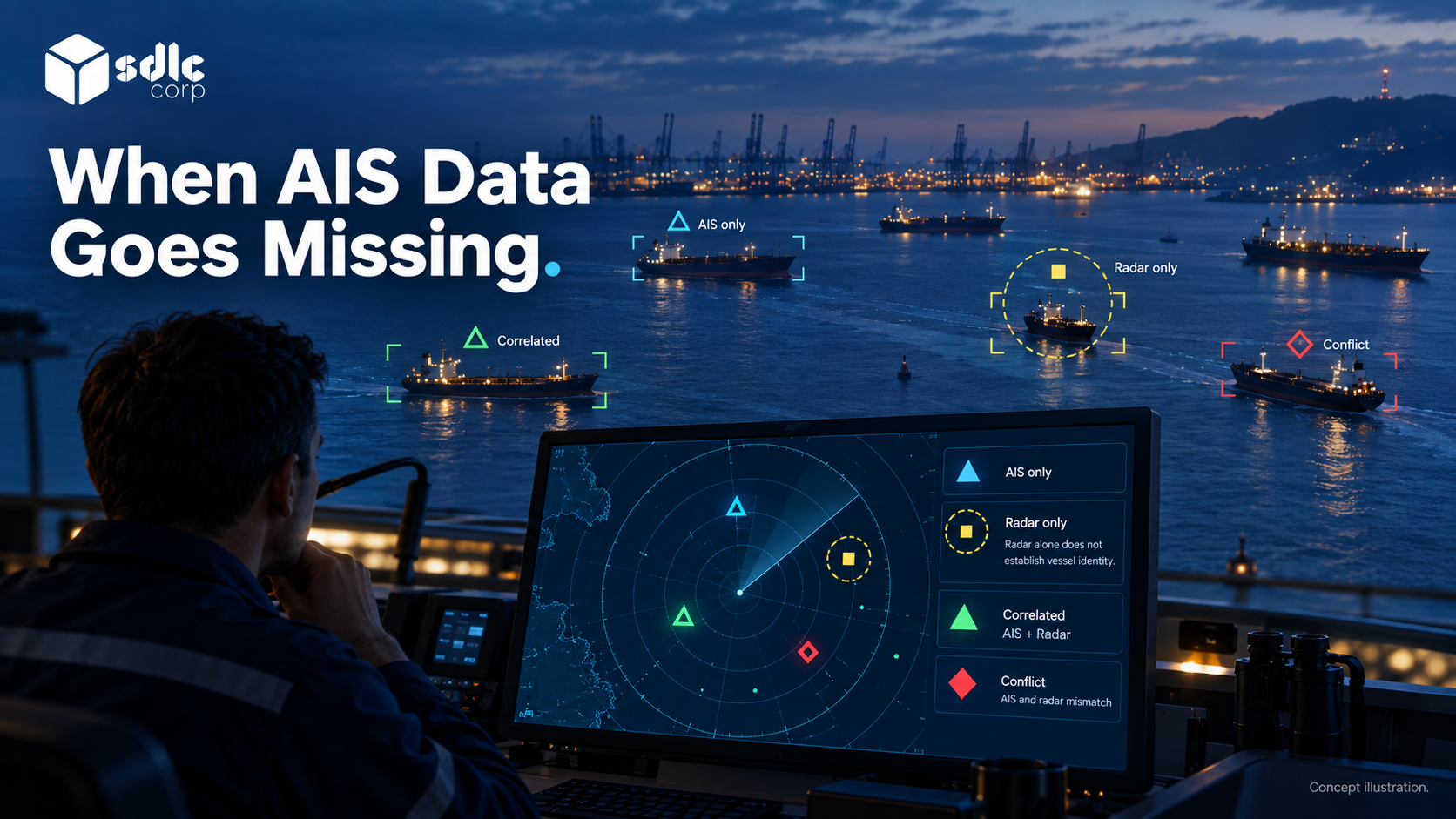
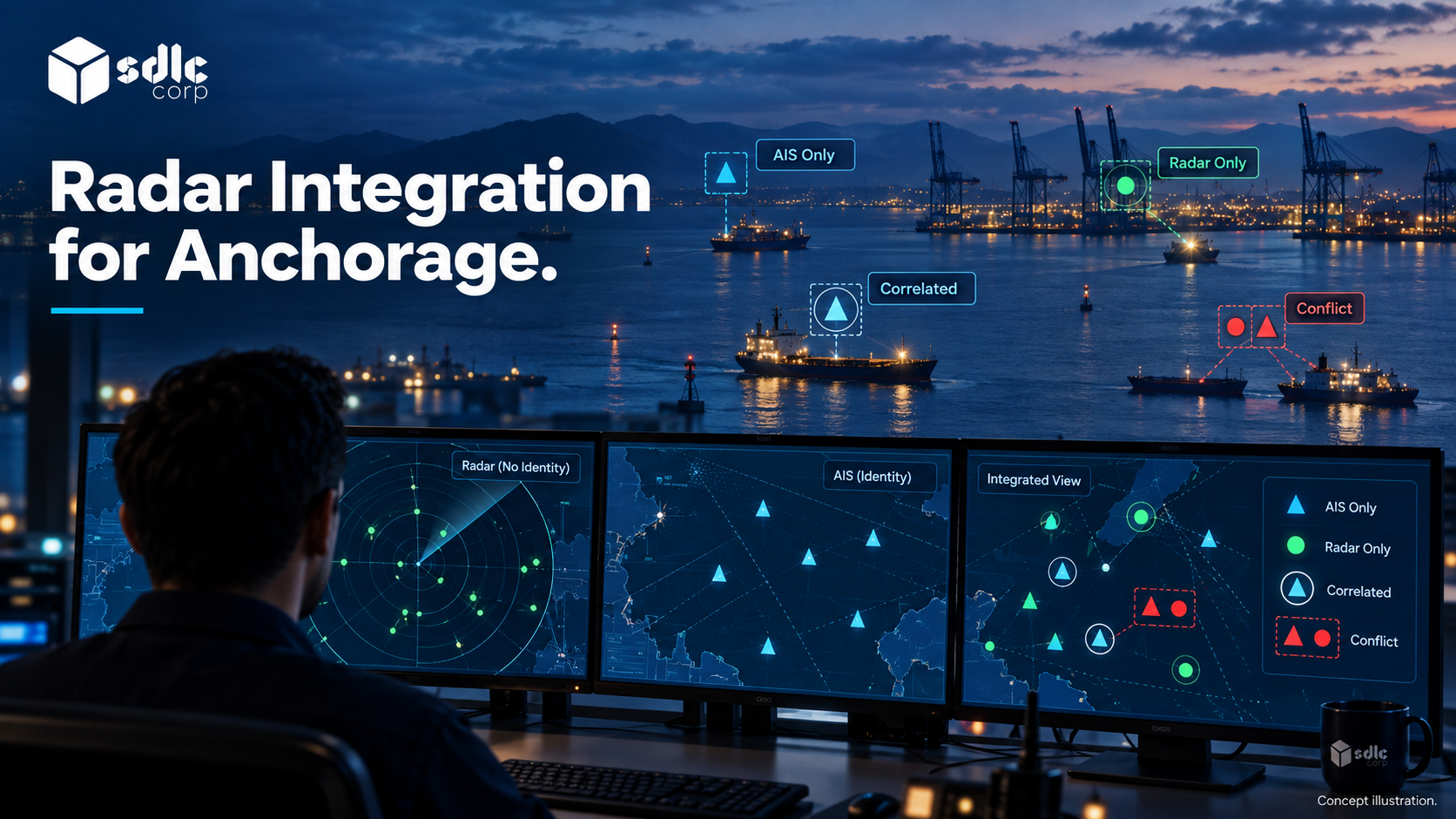
Trace the Automatic Identification System (AIS) and VTMIS data exchange before assigning an incoming field the authority to change an application record.
Choose The Integration Pattern By The Decision
Read-only sharing may be enough when operators only need to see information. To exchange workflow updates, assess authenticated application programming interfaces (APIs), event notifications or a supported combination. Scheduled file exchange may suit a batch task if the delay is acceptable for the decision it supports.
Do not request event-driven architecture simply because the dashboard is described as real-time. Identify which transitions need prompt notifications and which can use scheduled reconciliation. Ask for the source event time, receipt time, current freshness, and recovery behavior instead of a vague claim of instant updates.
An initial architecture workshop should also settle whether the new application can write into incumbent systems. Read and write permissions have different consequences. Start with the smallest authorized surface and prove reconciliation before expanding it.
Where Duplicate Maps And Approval Workflows Create Gaps
Ask suppliers to show where request handling, vessel records, maps, operator permissions, and reports already exist. Reusing an incumbent function may be preferable to creating a second maintenance obligation. Conversely, a map that displays vessels may still lack request ownership or an allocation approval history.
Use a buying committee's system selection framework to compare those tradeoffs across suppliers. Require them to identify which capabilities are standard, configurable, custom, dependent on another party, or excluded. That classification makes apparent product overlap easier to assess.
Resolve disputed ownership with a named port representative before signing integration work. Developers can implement the agreed rule for conflicting records. The port must decide which operating team has authority.
The reporting, community and traffic-platform transaction boundaries help place reporting and community exchanges in the wider system landscape.
Turn The Boundary Map Into Procurement Evidence
Attach the responsibility matrix to the request for proposal (RFP) scope and evaluation criteria. Ask each bidder to mark the interfaces it will deliver, the evidence it needs from incumbent suppliers, and the exclusions that could prevent acceptance. Identify who will coordinate cross-supplier defects during the pilot.
The demonstration should include a stale position, a conflicting request, an unavailable interface, and a corrected allocation. Judge whether operators can understand and recover the situation. A clean demonstration using only the normal path provides limited evidence about ownership at system boundaries.
The useful output is an event by event responsibility matrix with one accountable decision owner, the required exchanges and a test for each disputed boundary.
Conclusion
Agree the responsibility matrix before comparing product names. Each request, observation, reporting obligation and approval needs an accountable owner, even if one supplier provides several components.
Use a representative vessel call to test the boundaries. Any handoff that leaves two teams assuming the other has approved an action needs to be resolved in the operating model and interface contract.
How SDLC Corp Can Help
Consider SDLC Corp's software consulting services when reviewing how the anchorage management system would fit around the existing traffic service and installed platform. Supply the local responsibility matrix and permitted interfaces. A useful assessment should identify overlapping workflows, unsupported assumptions and the records each party owns, with open questions assigned for resolution before an integration is priced or approved.
Frequently Asked Questions
Is VTS A Software Product?
VTS refers to an operational service, not simply an application. Software and information systems can support that service, but purchasing a platform does not establish its staffing, authority or operating procedures.
Can One Vendor Supply VTMIS And Anchorage Software?
A vendor may supply both, but each component still needs a defined scope and acceptance evidence. Keep the authority's responsibilities and the ownership of shared records explicit rather than relying on a common supplier name.
Does Anchorage Software Need Its Own Map?
Only where a map supports a defined task. Compare a shared view, a linked view and a separate map using operator effort, freshness and maintenance needs. Avoid adding a second display that creates conflicting versions of the same information.