Choose a port integration by identifying the transaction and its accountable party, then confirming the designated local system and interface. Maritime single window (MSW), port community system (PCS) and vessel traffic management and information system (VTMIS) labels do not establish that architecture on their own.
Reporting, community processes and traffic information may share a platform or cross several systems. Preserve the meaning and authority of each response regardless of how the local products are arranged.
Identify The Transaction And Accountable Party First
Start with the required exchange, the party accountable for it and the designated local route. A product label is a clue to investigate, not an instruction to connect every transaction to a fixed system category.
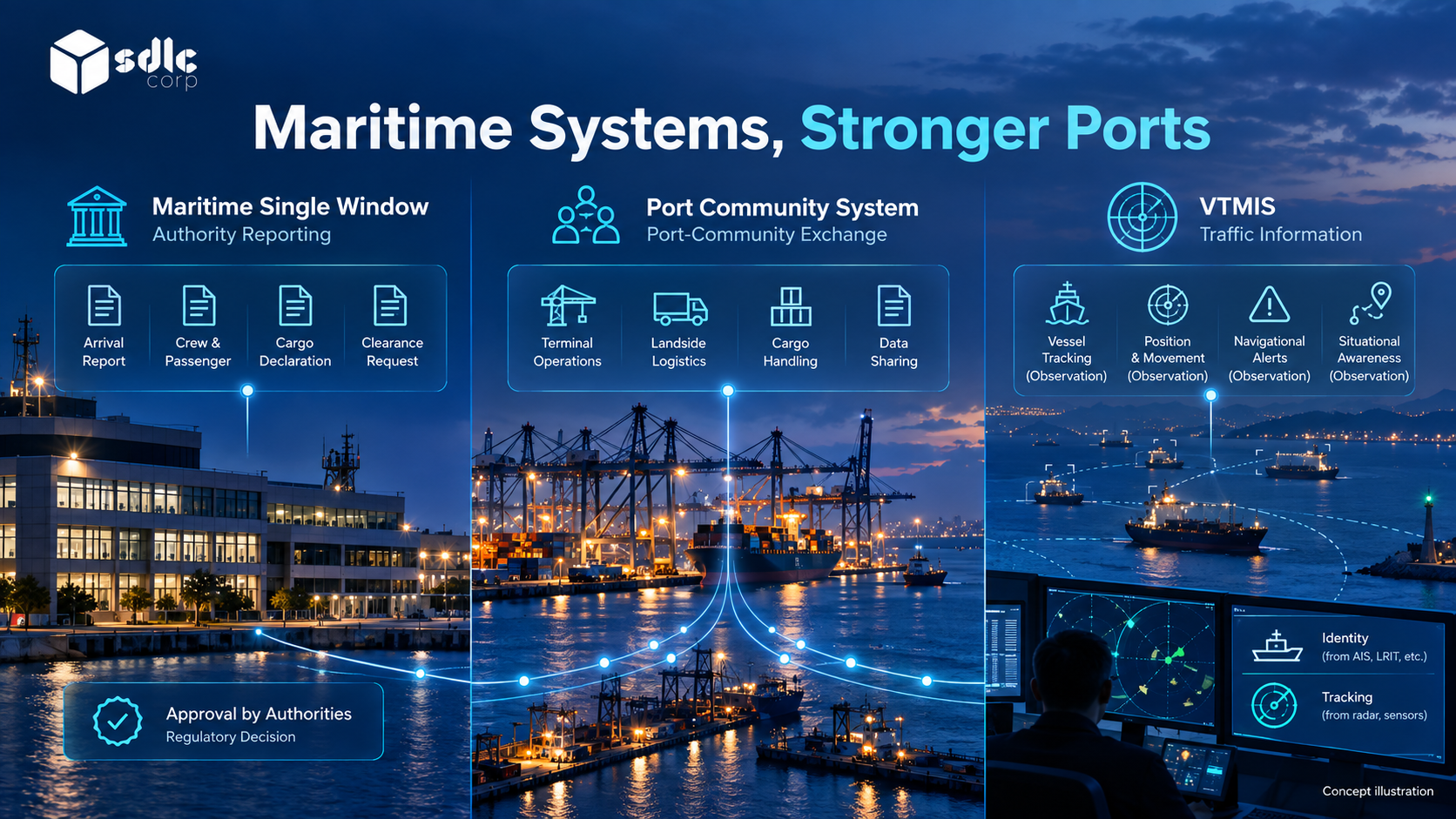
A maritime single window (MSW) supports electronic information exchange between ships and public authorities for port calls. A port community system (PCS) can connect public and private stakeholders across wider port and logistics processes. A vessel traffic management and information system (VTMIS) may expose traffic information or other functions according to its installation.
The IPCSA definition of a Port Community System includes secure exchange and port/logistics process automation. A PCS is therefore broader than a readiness-message channel. Local platforms may combine functions while retaining distinct authorization and acceptance responsibilities.
| Required Transaction | Accountable Party To Identify | Local Route To Confirm |
|---|---|---|
| Authority declaration | Designated reporting authority and permitted submitter | Approved submission interface, including any supported relay |
| Service readiness | Owner of the service commitment | Agreed community or direct exchange |
| Traffic observation | Source-system owner and authorized consumer | Installed feed, fields and usage permission |
| Allocation approval | Port-designated decision owner | Authorized workflow and decision record |
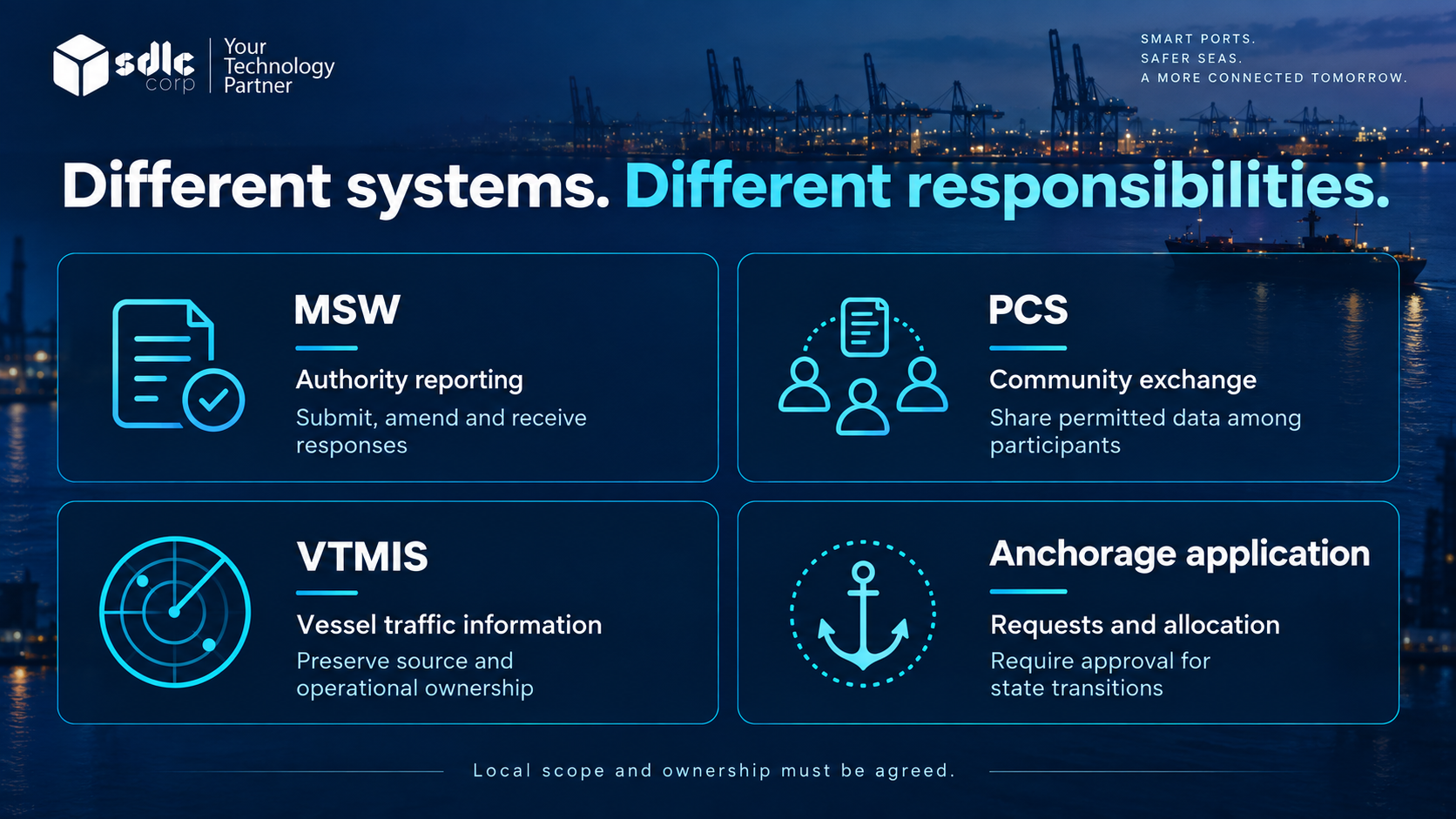
Choose The Connection From Three Practical Scenarios
You Need To Submit Authority Reports
Start with the designated reporting service and its supported submission contract. List the declarations, permitted submitters, required fields and response states. An MSW connection may be the relevant route, but the local authority determines the accepted arrangement. A PCS relay can help only where that route is supported; it does not grant reporting authority by itself.
Agents And Providers Need To Exchange Readiness
Identify the parties, the minimum information each may receive and who can correct it. A PCS may support these community exchanges. Confirm its actual message coverage and participant permissions before adding an anchorage connector. The application may need a readiness summary without receiving the confidential material behind it.
Operators Need Traffic Information Beside An Anchorage Request
Investigate the installed VTMIS interface and the permission to consume it. Request source timestamps, target identity states and failure behavior. The anchorage application can present that information beside its own requests and approvals. It should not infer that a track observation grants permission to allocate or move a vessel.
These scenarios can coexist. The decision is which exchanges are required, not which acronym wins the comparison. A single product may provide several modules while retaining different owners, access rules and acceptance tests.
The VTMIS interface guide separates installed read capabilities, authorized writes and recovery obligations for the traffic connection.
Match The Transaction To The Connection
Illustrative example
Confirm the supported route with the accountable authority or operator.
| Requirement | Accountable Receiver And Route To Confirm | Required Response |
|---|---|---|
| Submit arrival declaration D-41 | Reporting authority through its designated single window or approved relay | Accepted, rejected or correction required |
| Share service readiness for call C-182 | Service owner and authorized recipients through their supported community or direct exchange | Revision received by permitted participants |
| Display permitted track T-9 | Installed traffic source and permitted consumer through its supported interface | Position, source time and track status |
| Approve allocation AL-7 | Port-designated approver in the locally assigned workflow | Attributed decision and version |
Distinct States Even When A Platform Combines Functions
At 08:00, declaration D-41 is submitted. At 08:02, the reporting authority rejects a missing field. At 08:05, a provider confirms a service slot through the community exchange. At 08:06, the traffic platform updates T-9.
| Fact At 08:06 | State | Correct Next Step |
|---|---|---|
| Reporting | D-41 rejected | Authorized submitter corrects it |
| Service readiness | Confirmed revision 1 | Coordinator uses it in planning |
| Observed position | T-9 updated | Operator sees current source evidence |
| Allocation | Still awaiting approval | Approver follows the local workflow |
A service confirmation cannot repair a rejected declaration. A position update cannot approve an allocation. Even if one supplier hosts all three interfaces, the application must preserve these distinct states and owners.
Keep Reporting Separate From Operational Permission
Distinguish A Received Declaration From An Approved Action
Sending a declaration does not prove clearance. Receiving a message does not authorize a movement. Show the actual response: pending, accepted, rejected or awaiting correction. Keep the authority's response separate from the anchorage approval state.
The International Maritime Organization (IMO) Maritime Single Window overview describes the electronic reporting framework. Use the applicable authority's implementation rules to determine the fields, transactions, and access conditions required for a specific port. Connecting authority reporting workflows turns those local requirements into an integration scope.
Reuse Vessel Call Data Across Reporting And Operations
Several teams may need the same call details. Before sharing a field, record where it comes from, who may receive it and how corrections reach them. Keep the source and update time with the copied value. Agree how long each party may retain it.
Do not give every participant unrestricted access to a complete call record simply because it is convenient. Use the minimum dataset needed for the transaction. PCS integration and participant permissions examines the stakeholder boundary in more detail. An anchorage workflow may need readiness information without needing the full underlying declaration.
Design Interfaces Around Acknowledged Exchanges
Give each exchange a request identifier, version, time, sender, recipient and call reference. Agree what an acceptance or rejection response means. Sending the same request again should not create a second submission. A real amendment needs to remain distinct from a retry.
| Interface behavior | Acceptance evidence |
|---|---|
| Repeated delivery | The same business transaction is processed once |
| Rejected data | The sender receives a useful correction reason |
| Amendment | Earlier and current versions remain traceable |
| Lost connection | Pending exchanges resume or reconcile visibly |
The application programming interface (API) requirements for port systems should capture these obligations. Avoid assuming that two systems integrate simply because both expose an application programming interface.
Compare Combined And Separate Platforms
A combined platform may simplify some user journeys, but it can also concentrate dependencies. Ask how authority access, community access, and operational access remain separated. Examine release coordination, outage impact, and the ability to export records. A vendor's module list does not answer those questions.
Separate platforms need a named integration owner and agreed meanings for each event. Test one vessel call across them. Create it, amend it, reject a transaction, recover a missed response and close the visit. The anchorage application's place in the port environment helps keep allocation and occupancy responsibilities distinct during that exercise.
The traffic-service and platform responsibility comparison helps distinguish the operational service from the technology used to support it.
Scope The Connections Before Replacing Systems
Start by listing the transactions that fail today and the parties involved. Some problems need an adapter or a better acknowledgement workflow; others require changes to the underlying application. A replacement decision should follow that analysis rather than precede it.
Record the transaction, its recipient and the meaning of each acknowledgment. Use that map to decide which connections are needed before considering system replacement.
Record access approvals, source owners and test environments in the integration readiness checklist. A connection belongs in the plan only when its dependencies are visible.
Use a small decision record for each proposed exchange:
| Decision | Evidence Needed Before Commitment |
|---|---|
| Why connect? | A user task that requires information or a response from another party |
| Which route? | The designated service or supported source interface |
| What may cross? | Field definitions, recipients and permitted use |
| What remains local? | Approval ownership and records the receiver must not overwrite |
| What proves completion? | A normal exchange, rejection, correction and recovery test |
If two modules claim the same role, demonstrate one revised vessel call through both. Find where users would submit twice, see conflicting statuses or lose an exception. Select the supported route that resolves the task and leaves a clear correction path. Keep an unresolved interface visibly conditional rather than replacing an entire platform to solve an untested assumption.
Conclusion
Build a transaction inventory before deciding which systems to connect. For each exchange, identify the source, recipient, call identifier and meaning of the response.
Test the reporting, community and allocation states independently. A submission received by one service must not appear as an approval by another, and a retry must not create a second vessel call.
Discuss Your Integration Scope With SDLC Corp
Evaluate the anchorage operations platform with SDLC Corp after identifying the transaction, accountable party and designated local receiver. Where connections are needed, discuss software integration services against the supported contracts. Request a clear distinction between reporting, community exchange, traffic observations and allocation authority, with permission, acknowledgement and recovery dependencies identified before any implementation commitment is made.
Frequently Asked Questions
Do We Need Connections To All Three Systems?
Only when the chosen workflows require them and supported access is available. Map each required transaction to its responsible system instead of adding connections simply because the products are present at the port.
Can A PCS Perform The Role Of A Maritime Single Window?
Functional overlap alone does not establish that role. Confirm the designated reporting arrangement and supported submission path with its owner before treating a community exchange as authority reporting.
How Can Duplicate Vessel Calls Be Prevented?
Agree the call identity, amendment rules and retry behavior across the connections. Repeated delivery of the same transaction should update or acknowledge its existing record rather than create an unrelated call.