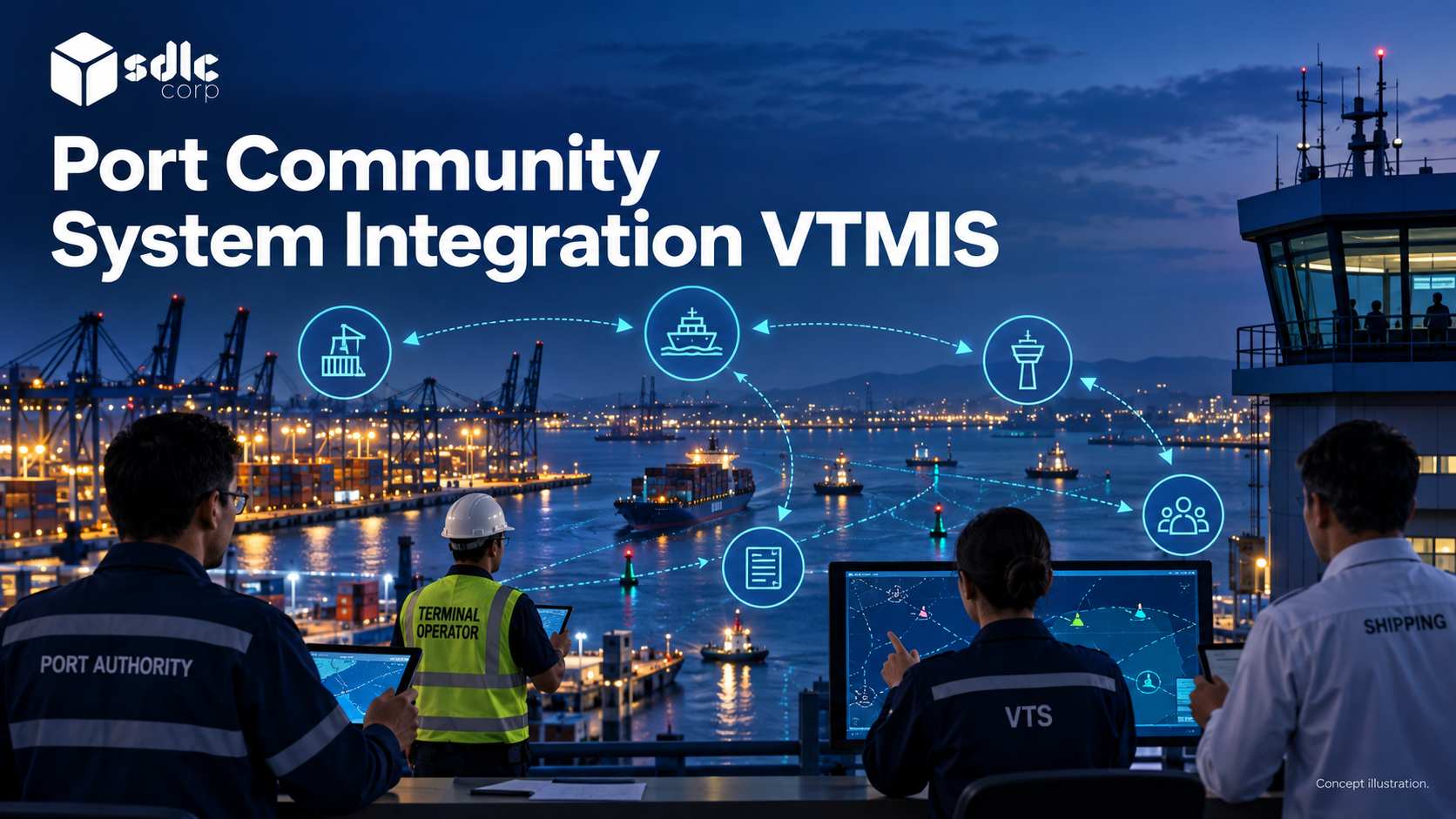
A port community system (PCS) connects public and private stakeholders across approved port and logistics workflows. For anchorage integration, identify the transaction that must cross that boundary and which organizations may receive or change its information.
Readiness messages are one possible exchange, not the full scope of a PCS. The integration contract must combine the supported local message with record visibility, ownership and correction rules.
Which PCS Messages Must Agents And Port Teams Exchange?
The International Port Community Systems Association definition describes a neutral platform for public and private participants to exchange information. Agree message formats and access permissions with the community operator before building the connection.
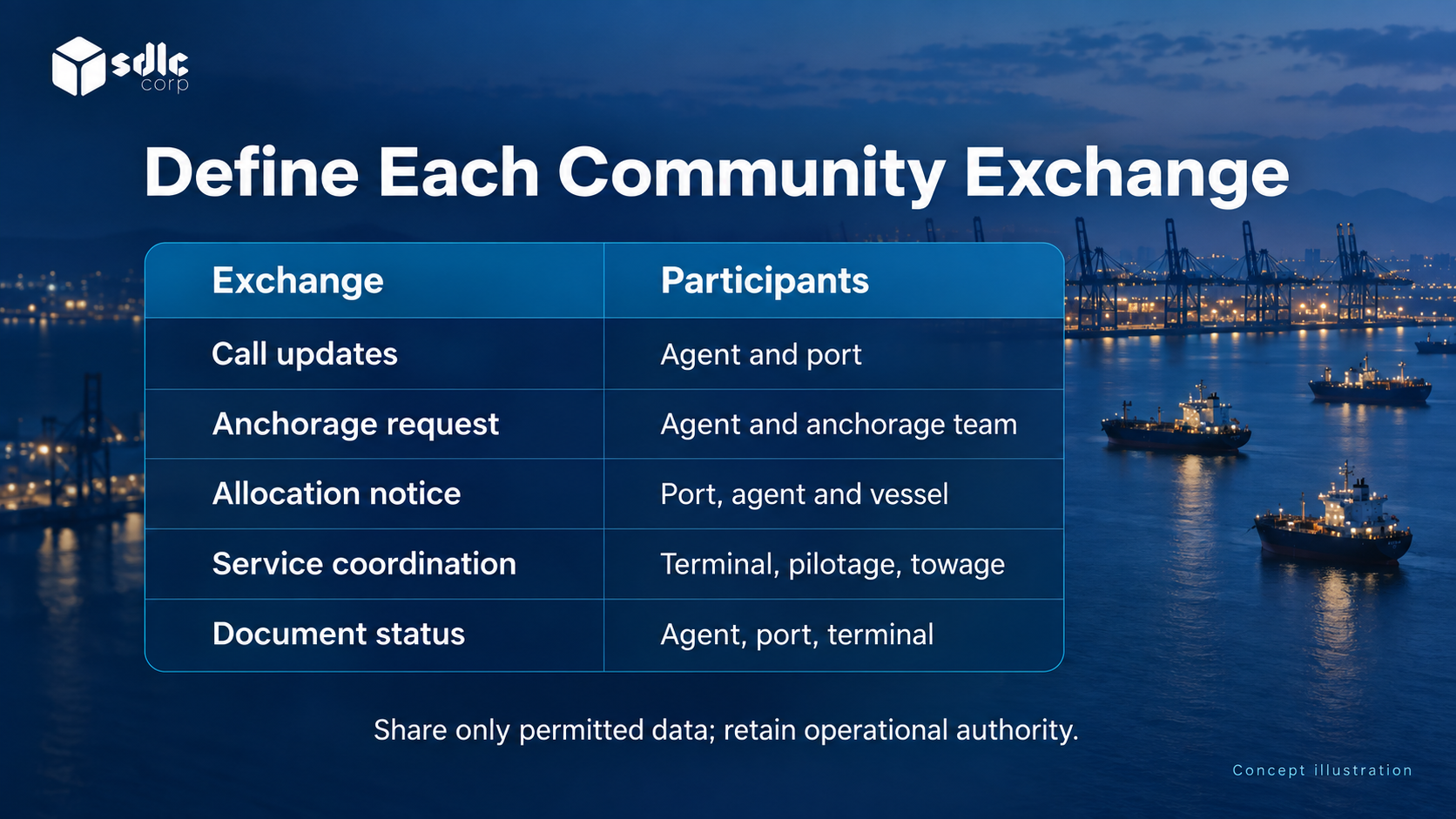
Name the exchanges you intend to support and the party on each side. If a proposed flow has no external counterparty, it probably belongs inside the port's own systems instead.
| Exchange | Parties | Why it belongs in the community system |
|---|---|---|
| Call announcement and updates | Agent, port | Many recipients, one source |
| Anchorage request submission | Agent, port anchorage function | External party initiating an internal workflow |
| Allocation notification | Port, agent and vessel | Outcome that external parties must act on |
| Service coordination | Terminal, pilotage, towage | Multi party, time critical |
| Documentation status | Agent, port, terminal | Shared reference, not operational control |
The distinction between community systems, single windows and traffic systems is worth settling with stakeholders before any interface work, because scope disputes here are organizational rather than technical. Where authority reporting is also in scope, keep it separate: maritime single window integration follows a different obligation and a different data set.
Ask the integration supplier questions against each proposed exchange. Record which messages are already supported and which need work by other participants.
Assign Owners For Calls, Bookings, Requests And Allocations
Name the owner of vessel records, calls, agents, bookings and allocations. Then check any shared fields one by one. The anchorage application may own approvals while receiving voyage details from elsewhere. Record exceptions so two systems do not both claim the right to change the same fact.
Where both sides hold a version of the same fact, define precedence and staleness rather than synchronising blindly. Source of truth and reconciliation design covers the rules and the reconciliation job that keeps them honest.
One Message, Different Organization Views
Illustrative example
The exchange publishes a service confirmation for call C-182. Confirm the field mapping with the community operator before implementing it.
{
  "message_id": "M-77",
  "call_id": "C-182",
  "event": "service_ready",
  "service_owner": "provider-P",
  "ready_at": "2026-09-18T13:00:00Z",
  "revision": 3,
  "audience": [
    "agent-A",
    "port-coordinator",
    "terminal-T"
  ]
}
Visibility And Action Matrix
| Role | May See C-182 Readiness? | May Change This Fact? | Restricted Data |
|---|---|---|---|
| Organization A representing C-182 | Yes | No; can request a correction | Other agents’ calls hidden |
| Organization B representing another call | No | No | C-182 denied at record-level |
| Organization C, the service provider | Yes | Yes, its own service commitment | Cannot change allocation approval |
| Port coordinator | Yes | Can acknowledge, not impersonate P | Commercial price excluded |
| Terminal T | Yes where agreed | Only its own terminal milestones | Provider credentials never shared |
At 10:00 the port processes revision 3 and acknowledges M-77. At 10:01 a duplicate arrives: processing records remain one logical application of that revision.
At 10:02 Agent B requests C-182 directly; the service denies it even if B guesses the identifier. If provider P withdraws readiness in revision 4, the shared view changes while the historical commitment remains available for authorized review.
Check the server response, export and notification payload for every recipient, not just the screen. Organization B receives no record for the unrelated call. Organization A receives the agreed readiness fields but not provider credentials or unrelated commercial details. Organization C can revise its own service commitment without gaining approval rights over the allocation.
Choose Message Patterns That Match The Workflow
Different exchanges need different patterns, and using one pattern for everything creates avoidable coupling.
- Request and response for lookups and submissions where the caller needs an immediate answer
- Publish and subscribe for state changes many parties must react to
- Scheduled reconciliation for reference data and low volatility records
- File based exchange where the supported contract and required update interval make it appropriate
Define what happens when a message arrives twice, arrives late or cannot be processed. Idempotency means a retry does not repeat the business action. A dead letter queue holds failed messages for review. Set retry limits and a review owner in the port application programming interface (API) contract requirements, using patterns the community system actually supports.
A shared port-call milestone contract makes the owner, revision and acknowledgement explicit for each permitted participant.
Restrict PCS Record Visibility By Organization And Role
Match Shared Information To Each Participant Role
A community system carries commercially sensitive information between competitors. Visibility rules are a functional requirement, not an administrative afterthought.
For each call, decide which fields an agent, terminal or service provider may see. Recheck access when that role changes. Keep evidence of sensitive reads as well as changes. Security, roles and audit requirements applies the same checks inside the anchorage application.
Design Notifications And Exception Handling
Notifications are the part stakeholders judge the integration by. Too many and they are filtered; too few and the coordination fails silently.
- Trigger on decisions and material changes, not on every field update
- Address the notification to a role, with the organization's own routing behind it
- Include permitted context and a secure route to inspect sensitive details
- Provide a status the sender can check rather than resending
- Define the exception path when a counterparty does not respond
Agree exception ownership across the participating organizations. Name a port-side contact for affected operations and the external party responsible for investigation or resolution; an unacknowledged message needs an escalation route.
Govern The Integration After Go-Live
Multi party integrations decay without governance. Agree in advance who approves a change to a shared message, how much notice counterparties receive, and how versions are supported in parallel.
- A named change authority with representation from major stakeholders
- Version support window, published and honoured
- Onboarding process for a new participant
- Shared monitoring so a failure is visible to both sides
- Periodic review of message volumes and rejection rates
The integration checklist should record the community system operator as an owner with dated commitments, because their availability governs the schedule.
Pilot one exchange with named participants. Try a duplicate request, a rejection, a lost reply and a recovery. Check that one party cannot read another's restricted records. Test how a new participant joins and how support escalates a fault. Keep authority submissions under their own approved contract.
The integration scope should end with an ownership map, permitted exchanges and an exception route that each participating organization can use.
Conclusion
Test each exchange using accounts from different participating organizations. Confirm both the information they should receive and the records or fields they must not retrieve, including through direct requests.
Assign responsibility for permission changes, interface versions and departing participants before launch. Shared data remains dependable only while the message contract and access rules are maintained together.
Explore PCS Integration With SDLC Corp
SDLC Corp can be consulted about connecting the anchorage management system through the relevant software integration services to your community platform. Bring the permitted transaction, participant roles and field-visibility rules. Ask for explicit data-sharing boundaries, correction ownership and denied-access tests, together with confirmation of the community operator's supported interface before scope, cost or delivery commitments are made.
Frequently Asked Questions
Does Receiving A Call Update Give Access To The Whole Call?
No. Apply the agreed organization, role and record permissions to the exchanged fields and any later query. A notification should not become a route to unrelated confidential information.
Should We Bypass The PCS With A Direct Connection?
Compare the specific transaction, supported access, delivery needs and support ownership. A direct exchange can be appropriate, but it introduces its own contract and maintenance duties rather than automatically simplifying the overall workflow.
What Happens When A Participant Leaves?
Revoke its users and integration credentials through the agreed process, then test access to formerly visible records. Keep required history under the retention rules without preserving an unintended route to current information.