
Planning to launch a sportsbook business in 2026 requires more than choosing software. Operators need to confirm the business model, licensing path, technology stack, compliance workflows, payment setup, risk controls, and go-live sequence before accepting real-money wagers.
Already know your target market and license path? Use the operator questionnaire to get a personalised launch recommendation, or jump to the go-live checklist .
What Makes a Sportsbook Business Successful?
A sportsbook is a licensed operation that accepts wagers on sporting events. Beyond the betting interface, it includes an odds and risk layer, regulated payment processing, KYC and AML compliance, an admin and reporting system, and a player management tool. Each component must be operational and compliant before the operation accepts real-money bets.
A licensed digital betting operation serving users through a regulated web and mobile product backed by a compliant payment and verification stack.
A physical betting location or terminal network operating under a jurisdiction-specific retail license with cash management and in-person compliance workflows.
A combined online and retail operation sharing back-office infrastructure, player wallet, compliance reporting, and risk management systems.
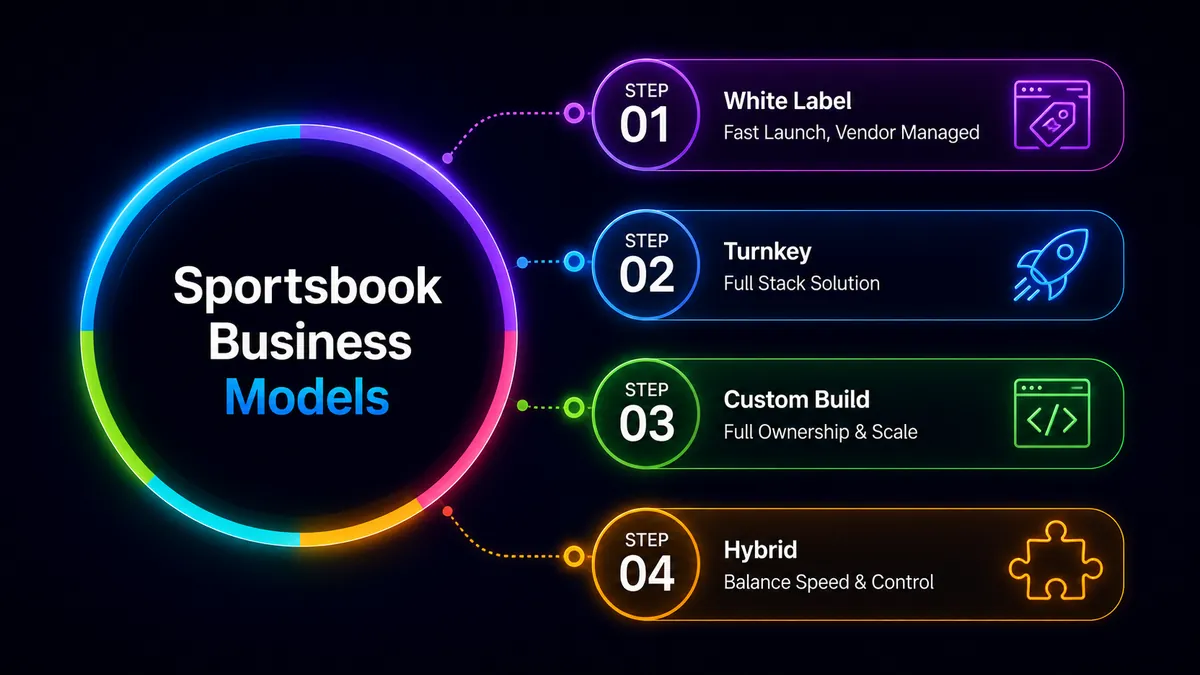
Sportsbook Business Models for Online Betting Platforms
Before selecting technology, operators define a commercial and product model. Each carries different trade-offs in speed, cost, product control, and vendor dependency. The right choice follows your launch stage and growth targets, not default assumptions about what is cheapest or fastest.
| Model | Best For | Strengths | Trade-offs |
|---|---|---|---|
| White Label | Operators validating a new market | Quick go-live, vendor-managed infrastructure, lower initial complexity | Limited product differentiation, vendor dependency |
| Turnkey | Operators needing a complete stack with operational support | Faster than a bespoke build, full-stack, configurable | Less flexibility than in-house, lock-in risk |
| Custom Build | Funded operators building for scale | Full IP ownership, maximum product control, long-term scalability | Higher cost, longer delivery timeline |
| Hybrid | Scaling brands adding differentiation | Balances speed and control, modular expansion | Requires careful scope and vendor alignment |
Operators comparing vendor-managed options can review available sportsbook software.
Sportsbook Business Licensing and Legal Planning
The jurisdiction you target determines the license category, which compliance systems are required, and how much time and capital the licensing process will consume ahead of market entry. Confirm the jurisdiction before committing to any technology spend.
- Identify the target jurisdiction and intended player demographic
- Confirm local gambling laws, tax obligations, and operator license category
- Assess operator license versus platform provider license requirements
- Plan AML and KYC compliance frameworks before technology selection
- Document responsible gambling obligations relevant to your jurisdiction
- Engage qualified gambling legal counsel before accepting real-money wagers
Licensing rules vary significantly by jurisdiction. Consult qualified legal counsel before making jurisdiction or entity structure decisions.
Certification note: Regulated sportsbook launches may require independent testing, security review, or product certification depending on the jurisdiction. Operators can review guidance from Gaming Laboratories International and eCOGRA when planning compliance and go-live readiness.
Jurisdiction Guides
Find Your Sportsbook Business Launch Path
Answer three questions to receive a launch path recommendation matched to your operator profile, target timeline, and budget.
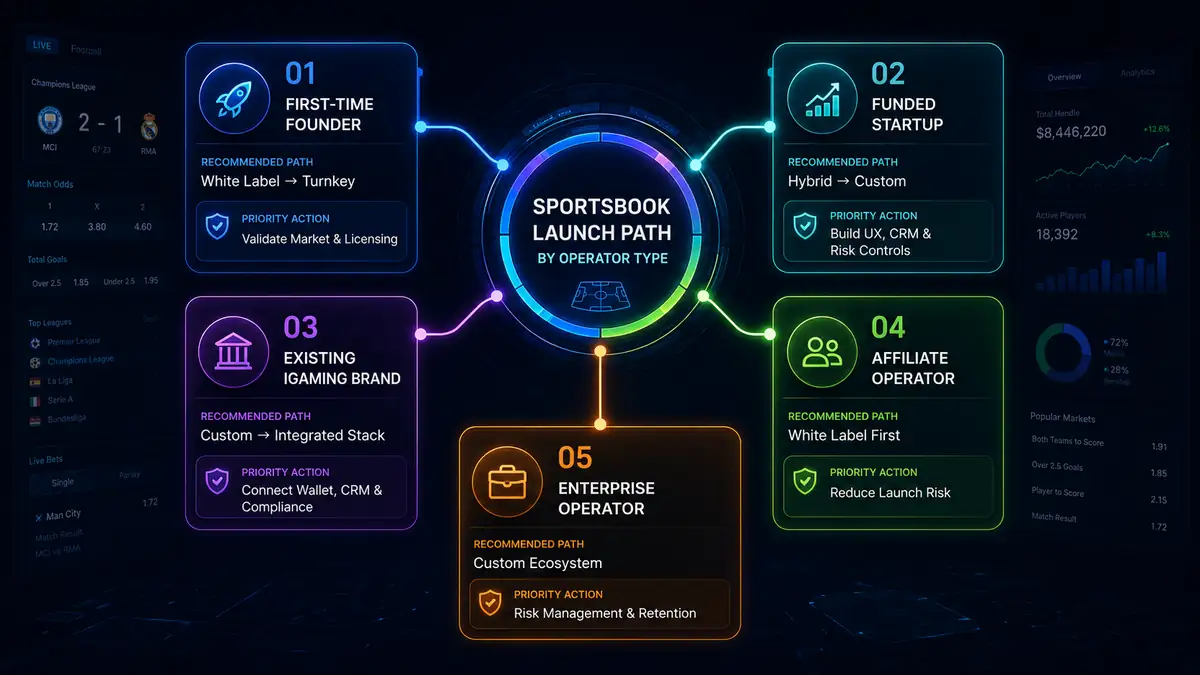
Sportsbook Business Launch Path by Operator Type
Match your operator type to the recommended launch path below. Validate any recommendation against your specific jurisdiction, licensing timeline, and compliance requirements before proceeding.
| Operator Profile | Recommended Path | Priority Action |
|---|---|---|
| First-time founder | White Label or Turnkey | Validate the market and license before committing to a bespoke build |
| Funded startup | Hybrid or Custom | Build differentiated UX, CRM, and risk controls from day one |
| Existing iGaming brand | Custom or Integrated Stack | Connect the sportsbook with your existing wallet, CRM, and compliance layer |
| Affiliate to operator | White Label first | Start lean; avoid heavy licensing and technology risk at entry |
| Enterprise operator | Custom Ecosystem | Invest in risk management, multi-market reporting, and player retention |
Choosing the Right Technology Stack for a Sportsbook Business
Technology selection should be driven by functional requirements and operational readiness, not upfront cost alone. The infrastructure must support the full operating stack, not only a front-end betting interface. Evaluate each requirement before shortlisting vendors.
- Web and mobile compatibility with responsive design
- Admin dashboard with bet management and settlement controls
- Odds feed integration for pre-match and live markets
- Payment gateway and multi-currency wallet support
- KYC and AML verification workflow with document review
- Risk management, trader controls, and exposure monitoring
- Reporting, analytics, and player activity dashboards
- API-first architecture with third-party integration support
- Multi-language, multi-currency, and geo-targeting support
- Uptime SLA, load handling, and disaster recovery documentation
Operators considering a bespoke build can review custom sports betting development for scope and delivery detail.
White Label vs Custom Sportsbook Business: Key Differences
A white label setup suits operators who value speed, lower initial complexity, and vendor-managed infrastructure. A bespoke build suits operators who require full product control, IP ownership, and long-term scalability. Neither is universally correct-the right choice reflects the business model, not the technology cost alone.
| Factor | White Label | Custom Build |
|---|---|---|
| Time to Market | Weeks to months | Several months or more |
| Upfront Cost | Lower | Higher |
| Product Control | Within vendor scope | Full ownership |
| IP Ownership | Limited | Full |
| Compliance Support | Often vendor-managed | Operator responsibility |
| Scalability | Constrained by vendor | Designed for scale |
| Best For | New or validating operators | Funded operators with confirmed market |
Odds Feed and Risk Setup for a Sportsbook Business
Every sportsbook needs a pre-match and live odds feed, settlement logic, and risk controls in place before accepting its first bet. These define margin, exposure, and liability. Incorrect configuration during setup creates compounding financial and compliance risk after go-live.
- Odds feed provider and pre-match market coverage
- Live in-play odds with latency requirements
- Bet settlement and voiding rules
- Margin and overround configuration by sport
- Exposure limits and liability monitoring
- Trader admin and manual override controls
- Auto-suspend and event-lock triggers
- Custom risk rules per market and sport
For technical guidance on integrating live data, see live odds integration in a sports betting product.
KYC, Payments, and Player Verification for a Sportsbook Business
Player verification and payment infrastructure must be fully operational before a sportsbook accepts deposits. Gaps in either system expose the operator to fraud, regulatory penalties, and chargeback liability. Both require testing under realistic load conditions during pre-launch.
- Identity verification at registration
- AML and sanctions screening
- Age verification and geo-restriction rules
- Responsible gambling flags and self-exclusion
- Document upload and review workflow
- Payment gateway selection and integration
- Deposit and withdrawal routing
- Fraud detection rule configuration
- Chargeback management and limits
- Payout SLA and currency handling
For onboarding flow optimisation and verification conversion, see reducing KYC drop-off in betting products.
CRM and Player Retention for a Sportsbook Business
Acquiring players is one part of the operation. CRM manages lifecycle engagement, bonus logic, VIP tiers, and churn reduction – all of which directly affect margin and player lifetime value. Retention planning should begin during setup, not after go-live.
- Player segmentation by value, sport preference, and activity level
- Bonus campaign management with wagering requirement controls
- Reactivation flows for dormant and lapsed accounts
- VIP and high-value player management with manual review
- Push notification, email, and SMS execution with A/B testing
- Responsible gambling monitoring, self-exclusion, and deposit limits
- Churn detection and early intervention workflows
For a full CRM capability overview, see iGaming CRM software.
Sportsbook Business Launch Cost Ranges
Launch cost depends on jurisdiction, operating model, odds provider, payment integrations, and compliance scope. The figures below cover technology and build costs only; licensing fees, legal counsel, and market localisation are additional variables.
| Launch Model | Estimated Range |
|---|---|
| Basic White Label | $25,000 – $75,000+ |
| Turnkey Sportsbook | $75,000 – $200,000+ |
| Custom Build | $150,000 – $500,000+ |
| Enterprise Ecosystem | $500,000+ |
For an itemised breakdown covering all cost variables, see betting product development cost breakdown.
Sportsbook Business Go-Live Checklist
Work through this checklist across four pre-launch phases. Each item should be completed before accepting live wagers. Mark items as your team progresses.
Common Sportsbook Business Mistakes to Avoid
Most sportsbook launch problems are operational rather than technical. The following appear consistently in post-launch reviews and are preventable with thorough pre-launch planning.
- Committing to technology spend before the licensing path is confirmed
- Selecting a vendor based on price rather than functional requirements
- Underestimating payment gateway complexity and withdrawal processing timelines
- Treating CRM as a post-launch task rather than a go-live requirement
- Skipping load testing on live odds feeds and settlement flows
- Underestimating the ongoing cost of AML monitoring and compliance reporting
- Scaling marketing spend before risk controls are validated under real conditions
- Copying competitor UX without understanding target player behaviour
For UX decisions that affect player acquisition and engagement, see sportsbook UX design.
Final Thoughts on Starting a Sportsbook Business
A sportsbook launch in 2026 is a regulated business decision as much as a technology decision. Operators that define their jurisdiction, operating model, and technical requirements early are better positioned to reduce delays, avoid vendor mismatch, and control compliance-related rework.
The lower-risk approach is to validate the business case first-jurisdiction, model, and minimum viable compliance scope-then select the technology that fits the budget and growth plan. Changes made during planning cost significantly less than changes made after go-live.